Serving Mammon, The Duggar Way

by

JC Schildbach, LMHC

Last week, it came out that Josh Duggar, of the “19 Kids and Counting” Duggars, sexually assaulted four of his younger sisters as well as a young girl from another family. From what we know, this all happened back around 2003, when Josh was 14 or 15 years old.

Josh Duggar does not deny that he committed these crimes, although he refers to them as “sins” and “terrible things” and “mistakes” rather than crimes.

Josh Duggar never faced any legal consequences for his crimes.

The Duggar family claims that they addressed the sexual assaults by getting “closer to God,” by pursuing counseling for both Josh and the victims, and by going to the police.

But let’s be clear about this–the Duggar family NEVER GOT COUNSELING FOR JOSH OR THE VICTIMS OF HIS CRIMES, and THE FAMILY NEVER WENT TO THE POLICE.

How can I possibly know this? Well…

Let me first address the police situation, even if that is a bit backwards. Jim Bob Duggar (father to all of the Duggars—victims and victimizer), following Josh’s “counseling” took him to a law enforcement officer who was a family friend, for a “confession” that resulted in a “stern talk.” According to Josh’s parents, the law enforcement officer told them that since Josh had already gone through counseling, there was nothing more that could be done. So either 1) Josh’s parents are completely lying about what the police officer advised, or 2) The police officer was completely derelict in his duty, as far as what he was supposed to do when given information about sexual abuse involving children.

Also, the cop (again, a family friend) that the Duggars took Josh to meet with is currently SERVING MORE THAN 50 YEARS IN PRISON FOR POSSESSION OF CHILD PORNOGRAPHY. I’m sure he quite enjoyed his meeting with the young Josh Duggar.

Now, as to the counseling…

If any of the victims, or the perpetrator, had gone to any kind of legitimate counselor who deals with sexual offense behaviors, or with sexual victimization, or with any form of recognized counseling that requires a person to be credentialed at all, a report would have been made to Child Protective Services, and an investigation would have occurred much earlier than it did—early enough that Josh would likely have faced some legitimate legal consequences before the three-year statute of limitations on his crimes ran out, and early enough that his family would not have been able to completely manipulate the situation, and keep it out of the legal system, and out of the public eye—well, out of the public eye until now.

Simply put, counselors are mandated reporters. They cannot keep things like this on the down-low—not without losing their licenses.

Such a lovely wedding.  You'd never guess...

Such a lovely wedding. You’d never guess…

As it is, if it weren’t for an anonymous “tipster” contacting the authorities in Arkansas and the production staff of the Oprah Winfrey Show (who also contacted the Arkansas authorities) back in 2006, there never would have been an investigation at all. Josh would have victimized four of his sisters, and another young girl, and had to face the “punishment” and “counseling” he got by spending four months away from home, reading the Bible and helping a family friend do some remodeling work—not exactly an evidence-based means of addressing sexually predatory behaviors.

And, again, that’s exactly what happened: No punishment. No real counseling.

The victimized girls also did not receive anything that might be considered an evidence-based form of counseling for addressing sexual trauma and sexual victimization. We have a key to what kind of treatment the girls might have received, in Samantha Field’s blog post, where Duggar-family Guru Bob Gothard’s insanely creepy “Counseling Sexual Abuse” graphic is posted—a chart that, among other things, suggests that being sexually assaulted brings one favor with God, and special spiritual strengths.

In other words, the Duggar girls were almost certainly told that being sexually victimized was a good thing in the eyes of Jesus—in no small part because it helps them recognize how terrible they were as prepubescent temptresses, and because it makes them super-spiritual. In case there is any need for clarification, such “reframing” is not considered “best practices” for addressing sexual victimization.

In fact, if any of the children had gone to any legitimate form of counseling, the girls would have had control over whether they even had to listen to an apology from Josh, much less having him allowed back in the home after a few short months away.  And there would have been a much more involved discussion of how/whether to integrate Josh back into the home.

And just so you know where I’m coming from, I spent over two years working full-time with juvenile sex offenders, and then spent over six years working part-time with adult sex offenders.

I also read the entire (redacted) police report —something I have had to do in many other cases.

The story of Josh Duggar is not unique—in the sense that families are generally unsure of what course to take when such situations arise. Families do not want to invite shame on their children–victims or victimizers–or the family as a whole, and often delay any meaningful action or professional intervention until the problem has progressed to a state where it can no longer be viewed as a “phase” or as “innocent exploration”—or until one of the victims reports the abuse to a therapist, or a school counselor, or a camp counselor, or a teacher, or a friend who tells a parent, or a pastor, or anybody else who chooses to act in a responsible fashion.

I have had contact with families who earnestly sought help and support, and tried to do right by both their daughters and their sons—and any other victims. I have had contact with families where the abusers were clearly given the benefit of the doubt, and the victims shamed as if they had deliberately ruined the family–even to the point of sending the victims away so the abusers could come back to the home. And I have been in contact with families who tried to beat the bad behavior out of the victimizers, and who go on pretending they are being persecuted over some dumb crap that they are perfectly capable of handling.

Clearly, the situation with Josh Duggar progressed to a dangerous state. His was not a case of budding sexual curiosity leading to “playing doctor.” His was a case of repeatedly exerting sexual “authority” over girls who were smaller, weaker, and devalued in his family’s “culture.”

From a fan blog--a charming sign in the Duggar family home.

From a fan blog–a charming sign in the Duggar family home.

In fact, what many have viewed as the Duggar family’s “wholesomeness”—their constant harping on values of purity and modesty—could not be further from a healthy attitude toward relationships and sex.  It places girls and women on a “pedestal” that values their virginity first, their breeding abilities second, and their whole selves not at all.  It is a “culture” that infantilizes women, treating them as too stupid to be trusted with control of their own bodies. It is a “culture” that preaches submission of wives to their husbands to an extreme degree. Women are told to recognize their inferiority, and to be celebrate it, because that’s what God wants.

Consider what message is being sent to one’s daughters—and one’s sons—when the matriarch of a family asserts publicly that it is her job to submit sexually to her husband, even when she does not want to.

Consider the message being sent to one’s children when parents say they should keep having children, no matter what, simply because it is biologically possible.

Consider the message being sent to one’s children when it is deemed acceptable for a pre-teen male to “chaperone” his nearly-adult sister on a date, to make sure she and her boyfriend do nothing inappropriate.

Many conservative/Republican figureheads have come out in support of the Duggars, and in condemnation of people who are now criticizing the Duggar family for their handling of the sexual abuse situation—mostly in the vein of “quit picking on Christians” and “Christians aren’t perfect, just forgiven.” With few exceptions, those defenses involve labeling Josh’s actions as teenage frivolity, rather than what they are—deliberate, sexually predatory behavior that was covered up by his family.

Family friend, and Duggar-political-endorsement-recipient Mike Huckabee used the argument that a victim, or multiple victims, of Josh’s behavior, wanted privacy–both in defending the family and when he had a judge he appointed destroy the un-redacted police report about Josh’s offenses. He claims the Duggars sought out help, and went to the authorities. But, yet again, they didn’t—not in any real way.

Likewise, Matt Walsh, used the childish “Oh yeah?!? Well—liberals!!” argument (along with the ‘persecuted Christians’ argument) in a post where he also made the poignant observation that, “As a parent, you have to think whether your 14 year old son deserves to have his life ruined over his mistakes.”

Really, Matt? What about your 12-, or 10-, or 8-, or 6-year-old daughter, or the 5-year-old neighbor girl? (No, I don’t have actual information on the specific ages of the victims). They’ve already had their “lives ruined” by the “mistakes” of your son. So, devalue the daughters? They’ll get over it? What’s important is that you protect your sexually-predatory teenage son?

But it’s not just a “mistake” when a 15-year-old male repeatedly gropes the genitals and chests of multiple younger girls. It is sexual assault.

I will note that the recidivism rate for juvenile sex offenders (and for adult sex offenders) who are caught and go through some sort of legal proceeding is much lower than the public perceives it to be, and that said rate goes down even more with appropriate treatment. So, given that Josh was caught, but not actually subject to legal punishment or real treatment, I guess I can believe that he’s steered clear of further offenses—as Josh and the family assert–although there’s not a lot of data on people who got caught but essentially are allowed to skate.

But I do not believe Josh has really changed his attitude toward his behaviors—especially when he calls them “mistakes” for which he feels he has already paid a big enough price.

Also, for those who are claiming to support the Duggars, let’s be clear about what is being supported. In pursuit of both political power, and celebrity, (the truest of Christian values) the Duggar family decided to bury sexual offenses committed by their son, against their daughters and another girl. Their attempts to prevent Josh from getting in trouble were successful, inasmuch as the offenses did not come to light until after the law no longer allowed any punishment for son Josh.

So, if you’re supporting the Duggars, you’re arguing that families should dodge the law, allow their daughters to be sexually assaulted by their brothers or by family friends, and do what they can to keep their sons from getting in legal trouble, all while counseling the children that sex is bad, but that it’s okay that the sexual assault took place because boys and men can’t help themselves and girls and women are really only important as breeding stock–and provoke sexual assault in the first place.

Furthermore, you’re advocating that it’s acceptable for the son who committed the offenses to take a prominent job with a well-known organization that utilizes bogus research in an attempt to control women, and demonize the LGBTQ community in order to deny them the basic rights that heterosexual adults have—all while accusing the LGBTQ community of habitually engaging in the behaviors that Josh engaged in, and that his parents covered up.

That’s not wholesomeness or purity.

Those aren’t “mistakes.”

Those aren’t the kind of beliefs, or actions, anyone should be lauding.

A Reframe for Dick Whitman OR Don Draper Gets Just Enough ‘Therapy’ to Go On Being Don Draper

by

JC Schildbach, LMHC

(Spoiler Alert!)

Let’s imagine that Don Draper’s momentary breakdown—a realization of abandonment, followed by a phone call wherein he recounts his sins to Peggy, leading to an anxiety attack or some other form of emotional paralysis, which is essentially broken by a cathartic, sobbing hug with a stranger in a group “seminar”—is an honest therapeutic breakthrough.

don's anxiety

While many people have interpreted the final moments of the series as cynical—the smirk that rises on Don’s face as he sits in a meditation group, followed by the ring of a meditation bell fading into the opening of the Coke “Hilltop” commercial jingle—a better “reframe” for what happens with Don is that he recognizes how his own behavior has been impacting others, that he is able to identify his own feelings of emotional disconnection, and that he is able to gain some real acceptance of his situation and how to thrive in it.

Don's idea

In the terms of a therapeutic cliché, Don realized that when one cannot change one’s circumstances, one can change one’s response/attitude toward those circumstances.

Essentially, such a “reframe” relies on the acceptance of the idea that the “Hilltop” Coke commercial is Don’s concept (all apologies to Bill Backer)—an idea that hardly seems up for debate. Among other elements, in the final scenes of the final episode, Peggy’s plea to Don to “come home” involves the pointed appeal, “Don’t you want to work on Coke?” And the final words spoken, by one of the retreat leaders, before the Coke commercial closes out the series, are an invitation to greet the morning sunshine and bask in the possibilities of a “new day, new ideas, a new you.”

Don’s answer to Peggy’s question about working on the Coke account is, “I can’t. I can’t get out of here.” At that particular moment, it’s a statement of desperation. Don is panicked. He is stuck at a coastal retreat “somewhere in California” with no transportation.

But Don’s sense that he needs to be able to control where he is, and when he can leave, is about to melt away. After his moment of connection with fellow seminar-attendee, Leonard, Don realizes he can “work on Coke,” or any other account, so long as he abandons his need for control of the situation where he is working.

Don’s initial flight from McCann-Erickson is brought on by feeling he has lost control. He is called to a meeting for Miller Lite, only to realize he is one of many creative directors there—and not the creative director there. He quickly decides this is not for him, grabs up his catered box lunch, and hits the road.

Don’s need for control plays into his sobbing hug with Leonard—who details how he feels that his family doesn’t even look at him; that he doesn’t know how to give, receive, or even recognize love; and that “nobody cares I’m gone.”

don's hugg

In a moment of recognition and connection, Don realizes his family does not “care” that he’s gone, and that his idea of love is ill-defined at best. Of those family members he has tried to reach, daughter Sally and ex-wife Betty have told him to stay away, and that the lives of his sons are more stable in his absence. Stephanie, the niece of the (real deceased) Don Draper, both invites (the imposter) Don to the coastal retreat, and then leaves him stranded there, after telling him he is not part of her family (and after having her own desire for a therapeutic experience thwarted by what she feels are the judgmental and stereotypical attitudes about what she should value in life).

In the lead-up to Don’s hug with Leonard, it is only Peggy who urges Don to come home. And by “home” Peggy means back to work at McCann. It is Peggy alone who knows how to reach Don, and does so, rather than just accepting that Don does what Don does and leaving him to it. She appeals to the only thing that Don clearly loves—the pure joy of coming up with a winning ad campaign.

It’s possible to interpret Don’s brief breakdown as entirely self-serving—that he is distraught only because he has been abandoned instead of being the one to abandon, and because he lost the ability to just pick up and leave. He was even left without his usual means of numbing himself with alcohol and casual sex.

So when Leonard revealed his dream of being left alone in the dark on the refrigerator shelf, of course it struck a chord with Don. After all, Don’s whole career has been spent trying to get people to pick that particular item out of the refrigerator—the one that would make them whole. To do that, he needs to know how to connect with people like Leonard—people who have a sense of emptiness and who don’t know how to correct their emotional deficits. And now Don is trapped here with Leonard, in the dark and cold of that nightmare refrigerator where others are in charge of who gets in and out. That bit of recognition allows Don to plunge into his own feelings of sadness, if only for a moment, before he recognizes the value in what Peggy has told him, and the value of tuning into people like Leonard, at least until the end of the week.

It’s a fairly common misconception about therapy that such moments of insight and catharsis will lead to meaningful change, or that a therapist’s job is to provide a client with just the right piece of advice or insight to “fix” that client, and put the client on the right course for life. Part of that misconception can be attributed to “retreats” like the one where Don is stranded—certainly sold to the participants as a week of healing and life-affirming change. And, certainly, recognizing something lacking in yourself, and having a good cry can be helpful at times, but it doesn’t make you a different person. Real change takes will and work.

But if therapy is about meeting a person where s/he is, and helping that person to be the best version of who s/he can be at that time, and of using a ‘strengths-based’ approach that helps the person tune into their own abilities to address problems, then Don’s time away at the retreat is successful. Don not only has a moment of clarity and honest emotion; he gains acceptance about his own circumstances and how to change his response to them.

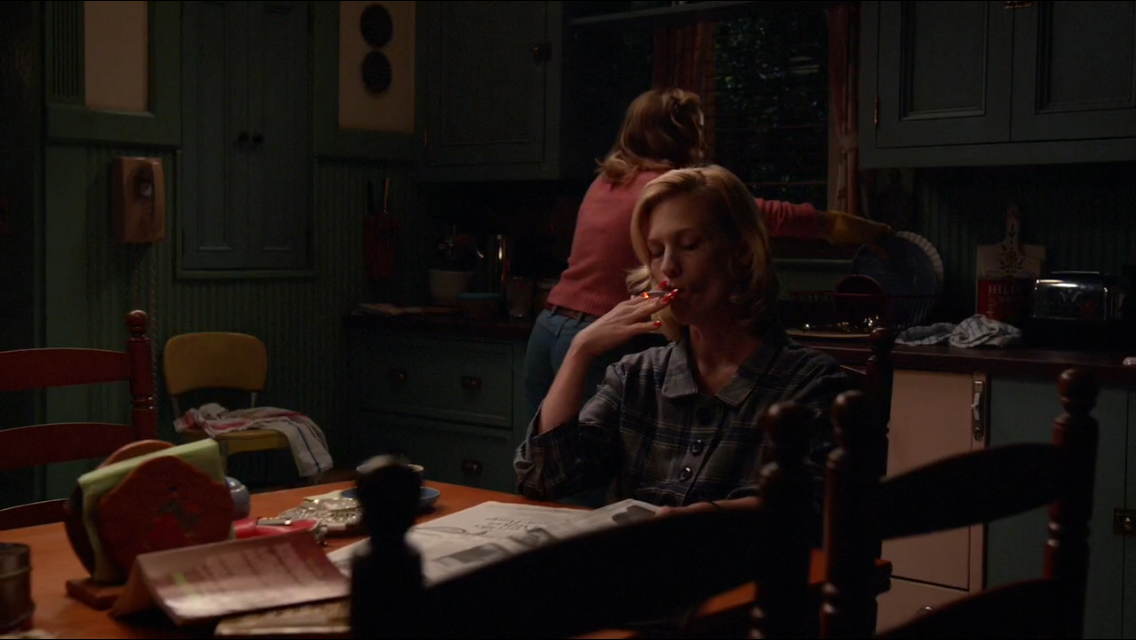
It is telling that in the final shot of Don’s family, we see them in a dimly-lit kitchen, Betty resignedly drawing on a cigarette, Sally, having assumed parental duties, washing dishes with her back turned to her mother and the camera. All this just before we see Don on a sunny cliff-top overlooking the Pacific Ocean and hear the opening words of the Coca-Cola jingle: “I’d like to buy the world a home, and furnish it with love.”

sally dishes, betty smokes

Don has spent a good portion of his adult life trying to fix problems with money and buying things, and exists in an industry where money and buying things is put forth as the answer to everything—even a broken home and the absence of love.

And Don has a significant history of childhood trauma and abandonment, and poor modeling from the adults in his life. A week of group seminars and meditation isn’t going to fix that.

But that week on the coast did give Don enough of a reframe to get him back to the work he loves, and to do that work successfully.

coke real thing

And that’s the real thing…or the realest thing we can expect from Don.

Really Lowes? and Sherwin Williams? and HGTV? Mocking Mental Illness as an Ad Strategy

by

JC Schildbach, LMHC

Lowes decided to announce its rollout of Sherwin Williams’ line of “HGTV Home” paint by crafting an ad that plays on popular ideas about some of the most well-known artists in history (and pop culture), each jealously challenging the notion of who is “the most legendary name in paint.”

Well, okay, “Mr. Happy Little Trees” Bob Ross doesn’t come across as jealous.

But Leonardo da Vinci, Andy Warhol, and Michelangelo all do.

Vincent van Gogh just comes across as…well, you can watch it here:  

Get it? It’s funny because you think he’s saying “what?” because he cut off his ear. But then you realize it’s actually funny because van Gogh is suffering from psychosis or whatever would make him talk to a pigeon.

Hilarious—right?

He talks to pigeons.  How clever.

He talks to pigeons. How clever.

Of course, nobody diagnosed van Gogh with a particular mental illness during his lifetime, particularly not from a current understanding of mental illness. Perhaps the most popular theory of van Gogh’s troubles is that they stemmed from Bipolar Disorder. Whatever the case, eventually van Gogh died of complications from a self-inflicted gunshot wound, following numerous other episodes of emotional difficulties and self-harm.

I want to be clear that I don’t have any particular axe to grind with any of the businesses in question (even if I should for one reason or another). I shop at Lowes regularly.  And even though Sherwin Williams has that terrible “Cover the Earth” logo, cover the earth all of the paint we’ve used in our home has come from our neighborhood Sherwin Williams store, except for the paint in the upstairs bathroom, and the stain on the deck, which we got at Lowes. And I watch HGTV (and the DIY Network) enough that M wishes I would just get off the damn couch and make our house more beautiful (or at least just quit talking about all those projects and do them).

Still, it’s disappointing to see that the big punchline for the combined Lowes-Sherwin Williams-HGTV commercial involves mocking, specifically, somebody who suffered from mental illness, and, more generally, the idea of psychosis, particularly given that the commercial was rolled out at the beginning of Mental Health Awareness Month:  NIMH’s “Mental Health Awareness by the Numbers”

I suppose I could also point out that all of the artists in the commercial are white males. But given how the myriad options for art “jokes” involving white male artists were handled, I don’t have a lot of faith that a woman artist, or a non-white artist, would have fared much better when reduced down to a humorous reference that might be commonly understood.

We Who Buy Bags of Dirt

by

JC Schildbach, LMHC

I spent an inordinate amount of time this morning attempting to purchase what I hope is the final bag of potting soil I need for this year’s “garden.” What I thought would be a quick and convenient stop in the midst of other chores, became, instead, a series of interactions with numerous store employees apparently necessary to the process of transporting a two-cubic-foot bag of ‘Black Gold’ from the no-public-access, chain-link parking lot pen where it is kept, to the actual checkout counter where I could pay for it. In past, would merely wheel a shopping cart to the garden center of the store, throw the dirt-bag in, and be on my way–well, after paying for it, of course.

Such has become the plight of the urban gardener. Okay, not really. That was the only time this year I’d experienced such an involved dirt-buying process, since that was the first time I’d stopped by that particular store for soil this year. And, I don’t know if I can really call myself an urban gardener. While I did buy that particular bag of soil in Seattle proper, I live in a rurally suburban (suburbanly rural?) area a few minutes north of the city.

Just to give you a sense of the rural flavor of the decades-old ‘development’ we moved into, the neighbor who owns rather large swaths of used-to-be-farmland to the south and west of our house still keeps ‘free range’ chickens—so free range that when we moved in, the chickens were very much in the habit of hopping the fence and making a mess of our yard. Our rather excitable part-Blue-Heeler mutt cured the chickens of that habit in short order.  In the meantime, we’ve grown accustomed to the ever-present sounds of clucking, which guests to our home often find rather amusing and hard to ignore.

Joy: Chicken chaser extraordinaire

Joy: Chicken chaser extraordinaire

That same chicken-owning neighbor also has a rather picturesque (read: abandoned and decaying) “canning shed” on the lot to our west, complete with rusted-out, ancient farm equipment, providing a lovely home to numerous small animals, of those varieties which are attracted to collapsing wooden structures.

The canning shed next door

The canning shed next door–do you see it?

We live within walking distance of many other neighbors who keep chickens, goats, horses, and cows, mostly in small numbers.

Still, I started my more-arguably-urban gardening adventures, of the vegetable-growing variety, back when we lived in the north end of Seattle. At the time, said ventures were mostly confined to attempts to grow pumpkins to be used for jack-o-lanterns, a fun project for myself and the then-elementary-school-aged kid.

But, each year, some new plight would befall the pumpkins…neighborhood cats thinking the cleared patch of dirt was an amazingly generous bathroom I had installed expressly for them…squirrels enjoying just enough of a taste of the young pumpkins to cause them to bleed out and die (the pumpkins, not the squirrels)…various forms of plant blight. We were lucky if, by the end of the growing season, we had a pumpkin or two large enough to accommodate the knife and a candle.

The first growing season we spent in our current digs, I had what I thought was a good thing going in terms of pumpkin patches. To the east of our house, I had cleared a patch. Several plants were going. Birds were kept away by rubber snakes (and the removal of the garish birdhouses the previous neighbor hung in the carport—birdhouses for which she left express care instructions–sorry, Vera, not your house anymore, not your birdhouses anymore, and not my intention to regularly clean a bunch of bird crap out of a carport and off of my car–and, yes, I just accused somebody of garrishness after stating that I deliberately place rubber snakes in my yard). Squirrels generally steered clear of the property because of the dogs. Few-to-no neighborhood cats were prowling about. No serious plant diseases.

And then…the sun shifted.   Well, actually, the earth tilted just a bit too far (although still within normal parameters) leading to that same chicken-raising, canning-shed-neglecting neighbor’s large stand of pine trees denying my pumpkins access to direct, glorious sunlight. The pumpkins didn’t die. They just had their growth viciously stunted.   I ended up with a small crop of apple-to-grapefruit-sized pumpkins. I drew jack-o-lantern style faces on them with a sharpie, and went off to the supermarket to buy carving pumpkins.

The following year, I attempted to address the problems of shifting light by doing some container planting, up on the back deck. Plant blight took the small number of pumpkin plants that year.

But something slightly revelatory (well, to me anyway) took place that year. On a whim, while shopping for pumpkin seeds and containers to grow them in, I picked up a few extra pots, and some tomato starts. Despite knowing nothing of how to grow tomatoes (I’m still not particularly knowledgeable—I just read and try different things) we got quite a few ‘Lemon Boys’ and ‘Early Girls’ that year. And, as those who grow their own tomatoes know, the difference in taste and texture between homegrown tomatoes, and store-bought, mass produced tomatoes is as vast as the gulf between the concept of trickle-down economics and reality.

The next year I added more varieties of tomatoes, learning an important lesson about “days to harvest.”

The year after that, I added more varieties of tomatoes, and a few varieties of peppers, and abandoned the idea of pumpkins altogether. Each year, I’ve expanded the container-garden to where we can count on a good crop of multiple varieties of tomatoes and peppers, a decent batch of cucumbers, some snow peas and green beans, and some hit-and-miss with different types of squash.

Each year, as spring arrives, I get into gardening mode, buying seeds and starts, adding new pots and new varieties of plants. M enjoys the results, so she endures the mess and my enthusiastically-delivered, but surely-boring explanations of various things going on with the plans.

A few years back, we added a greenhouse to the effort—one of those walk-in, metal-frame with netted-plastic, collapsible/moveable kind. I’m still trying to decide if that made a great deal of sense in terms of the actual amount of time it adds to the growing season (basically just a few weeks at the beginning and the end, when we could realistically just move the still-producing plants inside the house, although the light situation would be tricky).

This year, we purchased a rain barrel—which I am still waiting to install, as we also, in a case of bad timing, treated the roof for moss at about the same time. A recycled olive barrel full of diluted herbicides is not, I assume, a particularly good water source for growing vegetables and fruits.

Down on the farm

Down on the farm up on the deck

I’ve also gone back to attempting to grow pumpkins again this year. I mentioned this to the (now-adult, and learning wood-working) kid one night, explaining to her that I was contemplating building a simple, 8’ x 4’ frame for the front yard (hopefully out of reach of the neighbor’s pine shade). At the time, I had already gotten multiple varieties of pumpkin seeds into a seeding tray, and was trying to decide on a good strategy for where and how to transplant them.

The kid asked me to sketch out my idea for the frame, and asked me several questions about my insistence on certain aspects of the frame. A few days later, while I was at work, I got a series of text messages from her about varieties of wood and my willingness to front her a bit of cash. I arrived home to a completed, 8’ x 4’ cedar frame, complete with stakes, parked on the floor near the back sliding-glass door—something that would surely just be in the bought-some-wood-didn’t-get-around-to-the-actual-building phase if left up to me.

So, last weekend, I finally cleared the ground, set in the frame and soil, and got my pumpkin and squash starts in. I also have multiple kinds of squash, zucchini, cucumbers, green beans, and snow peas in movable containers, all started from seeds. Once again, I waited too late to grow my tomatoes and peppers from seeds, so bought starts, some of which are still waiting to get into their more permanent pots–hence, the dirt-buying trip this morning).

I suppose I could wax philosophic about the zen of gardening, or the joy of producing one’s own food, or maybe the health and mental health benefits of making space for a little bit of nature in one’s immediate surroundings…or maybe about how my and M’s grandfathers (well, actually M’s step-grandfather) were both committed to pretty significant gardening operations (not container-based). But, really, I engage in all the work of raising these plants because it leads to some very tasty food…well, maybe not the pumpkin patch…that’s just tied to my lifelong obsession with Halloween.

At any rate, it will be interesting (well, to me, at least) to see whether the pumpkin plants survive the shade, the rabbits, moles, squirrels, and birds, and produce anything that can be turned into a jack-o’-lantern.

But, whether we’ll be working on pumpkins grown in my front yard or purchased from Safeway, the carving party is already set for October 25.

Happy Halloween…I mean, happy gardening!

Pam Geller’s Free Speech Chum

by

JC Schildbach, LMHC

Two heavily armed, body-armor-clad, wannabe-jihadists shooting a security guard in the ankle and then getting picked off by a pistol-wielding traffic cop in a parking lot outside a cartoon contest in small-town Texas is not, as Pam Geller would have us believe, some kind of religious war in the United States. Rather, it was Geller’s own failed effort to start a larger fight.

Before I go any further, let me state up front that Geller, along with everybody else in America, has every right to say whatever paranoid, delusional things she wants to say about the inevitable imposition of Sharia Law and the ensuing mandatory ‘honor killings’ by our ‘secret Muslim’ President. She also has every right to hold a cartoon contest deliberately designed to insult a particular group of people over their religious views. Said group of people, or any of its members, has the right to fight back with words, logic, cartoons or delusional rants of their own—but not with bullets, bombs, or knives.

Let me also point out that some people have stated that there are prohibitions against engaging in speech that is designed to incite people to violence. But that doesn’t really apply in this case. If Geller held a rally where she encouraged the attendees to go out and physically attack somebody, then she would be inciting people to violence. Saying something to deliberately offend somebody is not inciting that person (or group) to do anything. Their reaction is entirely up to them.

That said, Geller sailed into Garland, Texas, along with Dutch politician Geert Wilders, to hold a cartoon contest intended to insult Muslims over their belief that the Prophet Muhammad should not be depicted in any physical form—much less in any deliberately offensive form. (Judaism and Christianity, among other religions, have similar prohibitions written into their holy books regarding depictions of holy figures, but plenty of Christians really like pictures and statues of Jesus—unless they’re offensive, in which case they call for bans on whoever made them, whatever paid for them, and whoever hung them on a wall).

Geller’s reason for holding the event at a community center in Garland was apparently related to a Muslim event held there earlier in the year, called “Stand with the Prophet in Honor and Respect,” an event which had been held in Chicago the previous year. In 2015, the “Stand with the Prophet” event had the unfortunate coincidence of having been scheduled to occur shortly after the Charlie Hebdo attack in Paris.

Geller has stated that her cartoon contest is intended as a response to the Charlie Hebdo attack. The Charlie Hebdo folks, though, were equal-opportunity offenders. That is, they didn’t seek only to piss off Muslims, they wanted to piss off everybody. And they’d been going at it for years. They didn’t just hire their own little paramilitary-force-for-a-day and set about trying to troll militant Muslims.

Geller, on the other hand, tried to chum the waters with her cartoon contest, thinking she’d draw a feeding frenzy of violent jihadists to her little event—perfect target practice for the $10,000 worth of security she hired. What she got instead was a pair of inexperienced, young pups, mouths full of aimlessly-chomping teeth, drunk on the blood and guts of Geller’s antagonism, who bit off way more than they could chew.

We're gonna need a dumber boat!

We’re gonna need a dumber boat!

Geller, when she isn’t directly attempting to insult all Muslims, claims that she is an opponent of Muslim extremists and extremism. However, she does not actually draw that line, or make any consistent effort to explain where that line actually is. To her, Muslims who actually do attack things and people like her cartoon contest and its attendees are seen as proof that she is right about the intent of Muslims to take over America and kill all non-Muslims. Unfortunately, to Geller, Muslims who do not attack are seen as evidence of a quiet, creeping plot—sleeper cells who are biding their time, before they make their move to take over America and kill all the non-Muslims.

Geller also claims she is a defender of free speech, religious freedom, and individual rights. But, again, her position on such freedoms is a bit muddled. For instance, if she is so supportive of religious freedom, it’s hard to understand why she pushed so hard to stop the “ground zero mosque” from being opened, or why she spends so much time antagonizing Muslims in general, accusing the religion as a whole, and all of its adherents, in whatever form, of heinous crimes (and future crimes).

Likewise, Dutch madman Wilders has attempted to ban the Quran in his home country, as well as trying to prevent mosques from being built there—all under the guise of protecting women and other ‘victims’ of Islam. These are not exactly the actions of someone who thinks that the ‘marketplace of ideas’ will lead to the best possible outcome.

In short, Geller and Wilders are in favor of freedoms for those who they agree with, but want to shut down those with whom they disagree, even if Geller’s and Wilder’s disagreements are with vague caricatures of their alleged enemies, or if those disagreements are assumed to apply to all people who fit under a vast umbrella of a label.

Yet, despite Geller’s and Wilders’ proclamations of war, Elton Simpson and Nadir Hamid Soofi do not represent all of Islam anymore than, say, Michelle Bachmann represents all of Christianity, or anymore than Geller and Geert actually represent the concerns of all people as relates to freedom of speech and freedom of religion.

Still, if we’re going to ban Geller from her weird little attention grabs, than might we also have to ban things like, say, The Book of Mormon (the play, not the book)?  As much as the authors of The Book of Mormon might have been making a more nuanced critique of religion and what it means to believe, they certainly weren’t out to avoid offense.

And if we’re going to justify Simpson’s and Soofi’s actions as some kind of expected or normal response to Geller’s provocation, then aren’t we moving dangerously in the direction of saying that perpetrators of violence are only acting in ways that the victims of the violence should have expected, and have to accept?

Make no mistake, there are consequences to Geller’s form of speech. The main form of those consequences is that stupid people will agree with her, and will buy into her ridiculous ideas that there is some vast Muslim conspiracy that is mere days away from taking away all of our freedoms as U.S. citizens in order to impose Sharia law. Said stupid people may even commit violent acts of their own, and will certainly engage in forms of speech that are as similarly unappealing as Geller’s. There is also the potential consequence that people of the Muslim faith around the world will view Americans as somehow aligned with Geller’s form of thinking (as opposed to tolerating it, because that’s what we do). Such people may view our tolerance of Geller as evidence of the ill intent of Americans toward the Muslim world, potentially perpetuating a long chain of conflict.

Although I’m not exactly demonstrating this by writing about them, perhaps the best response to people like Geller and Wilders is the response that all but two of the members of the Muslim community in the United States exercised: ignoring them/refusing to take the bait.

Evelyn Beatrice Hall, writing about Voltaire, expressed the core idea of freedom of speech as follows: “I disapprove of what you say, but I will defend to the death your right to say it.” I’m not sure I’m actually willing to take a bullet so that Geller can continue to peddle her special brand of targeted, incendiary bullshit. But I’m definitely not ready to make an argument that she must be shut down/shut up (like the arguments she has made about Muslims).

At the same time, I’ve also written numerous pieces suggesting that maybe certain forms of speech should be curbed in an attempt to reduce hostility toward people with mental illness, toward minorities, and toward people who generally don’t find themselves at the top of the power pyramid. Curbing such speech is, of course, a matter of personal choice, and a matter of seeking to be decent human beings. Under the banner of individual freedom, we get to say and do what we want, so long as we aren’t actually hurting anybody in some directly demonstrable way.

Of course, Geller isn’t on some quest to prove what a decent person she is, or what decent people Americans are in their acceptance of diverse traditions and differing viewpoints. She’s not on any kind of mission to promote free speech, despite her claims to the contrary.

And Elton Simpson and Nadir Hamid Soofi went down to Garland Texas with the intent to fight and die, much like Geller and Wilder went down to Garland Texas to try and provoke a fight.

They all got what they wanted—sort of.

8 Pieces of Relationship Advice I Just Pulled Out of My Ass

by

JC Schildbach, LMHC

A friend of mine recently turned me onto James Sama, a guy who, under the banner of “New Chivalry,” writes relationship advice, despite apparently having zero training in any relevant field and having nothing particularly original to say. Sama trades in stereotypes, and vague generalities, while somehow convincing people that his advice is just dandy and somehow forward-thinking.

Here’s one of his latest, which was featured on Huffington Post: 12 Stereotypes Labeled “Strong” to Hide the Blatant Sexism Involved

Sama has become a minor media figure and gotten over 30 million hits on his blog in about a year-and-a-half (his claim), which apparently qualifies him as a relationship expert. Have I mentioned that Sama has never been married and doesn’t get into a whole lot of discussion about how his amazing insight into relationships has personally made his own relationship(s) better?

Don’t get me wrong.  Sama’s not alone in the advice-peddling-with-no-credentials field.  Still, this all got me to thinking that maybe I could follow his business model—giving fortune-cookie-style relationship advice, presented in “list articles” about how this or that stereotypical thing is the key to a solid relationship. So, with the misplaced confidence and lack of thought that is often necessary to self-promotion, I present 8 pieces of relationship advice I just pulled out of my ass.

  1. I’m okay, you’re okay

Okay, okay—so I got this from somewhere else. I don’t really remember where. But until you can be okay, and know that everybody else is okay, you’re not going to have a good relationship. Or even an okay relationship. Okay?

  1. You need to love yourself first

We’ve all heard it a million times—you can’t love anybody else until you’ve learned to love yourself. This is true enough. But, seriously, none of us love ourselves all that much, unless we are lacking in basic self-awareness. I mean, you know everything you think and do! And a lot of that is just plain unforgivable. Just know that you don’t really love yourself, and so you’re probably incapable of loving anyone else fully. But the great thing is that your partner is in the same boat. You don’t really think anybody who loves her/himself would actually waste her/his time on someone like you; do you?

  1. If your partner is mad at you, it’s probably because he/she is really mad at her/himself

Relationship experts know that people in relationships are going to get mad at each other. It happens. Sometimes it happens a lot. When your partner gets mad at you, just recognize that it’s probably because your partner did something really dumb and is just taking it out on you. Knowing that it’s not your fault means you can accept responsibility for whatever the argument is about, while not really having to feel too bad about it. Everybody can move on a little quicker that way.

  1. Agreeing with your partner can help shorten arguments

Following from the previous advice point, we all know that the main goal in any relationship is to keep conflict to a minimum. When your partner is mad at you, if you can listen to their complaint just enough to agree with what they are saying, and prove you were at least sort of paying attention by making a semi-relevant apology for whatever that is, they’ll start to feel better and quit climbing up your ass. And remember, it’s not really your fault anyway. Your partner is just mad at her/himself.

Stock photos of happy and/or upset couples just aren't fun--but a rubber skeleton couple on vacation in an island paradise, possibly being swarmed by gulls...

Stock photos of happy and/or upset couples just aren’t fun–but a rubber skeleton couple on vacation in an island paradise, possibly being swarmed by gulls…

  1. Sometimes simply agreeing isn’t enough

Sometimes just agreeing and taking the blame isn’t going to fix an argument. Sometimes you have to promise to never again do whatever made your partner so upset in the first place. Again, since your partner is really just mad at her/himself, it’s really no skin off your teeth, or sweat off your brow, or whatever things come off of you when you’re stressed and having to put forth some effort.

  1. Try to keep track of your promises

Right now, I’m talking about your ‘negative promises’—you know, the promises that you won’t do something again. Positive promises—like, ‘I’ll pick up after myself’, or ‘I’m totally saving up so we can go to Hawaii’—are for another article entirely. Although, now that I think about it, I suppose those positive promises could be negatives, too—like ‘I’ll never leave my dirty clothes all over the bathroom/bedroom floor again’ or ‘I’ll never waste my money on video games again, so that we can maybe one day have enough money to actually take a nice vacation.’ Anyway, the point is, you can only promise never to do something again so many times before your partner catches on, and realizes you are doing that thing—again! Or perhaps–still!

  1. Relationships are hard work, but fun work

This is pretty much an obligatory point to make. Nobody’s relationship is perfect all the time. And when there are problems, nobody’s relationship just fixes itself. You have to put in some work. That work should ideally be fun—because arguing can really be a lot of fun if you know how to do it right. And it’s especially fun when you win.

  1. Winning isn’t the point

Another obligatory point. I know I just said it’s fun to win arguments. But, really, that’s not the point. I mean, if you were paying attention to the rest of the things I wrote here, you’d realize that I was telling you how to avoid arguments, or to just give up and let the other person win, so that the argument might just end and you can avoid doing any meaningful work toward understanding your partner, or improving your relationship.

If you can remember these points and try to stick with them, your relationship may just last another day or two. And if it lasts just another day or two, and then another day or two, and then another day or two…before long, you’ve spent a lifetime together.

Author’s note: Gee whiz, that was fun! I was afraid that having been trained as a counselor, and having been married for over two decades might have hindered me in advancing some pointless advice. But, since I’m not actually trained as a marriage and family therapist, and my marriage is—well, a marriage that exists in the real world—I was able to cobble some stuff together that sounds pretty good, actually. Plus, laying it out in short, numbered points meant that I didn’t have to actually put together a cogent argument.

Now if some of you can help out by sharing this around, or maybe getting it to the attention of “media outlets” I should be well on my way to 30-million blog hits, and solid status as a relationship guru.  Thanks!

Self-Infantilization or Supportive Compromise? On the Controversy over Safe Spaces

by

JC Schildbach, LMHC

In her March 21 piece for the New York Times, “In College and Hiding From Scary Ideas” Judith Shulevitz mocks, among other people and things, Brown University student Katherine Byron for setting up a “safe space” for students who might be “triggered” during a debate between Jessica Valenti and Wendy McElroy that was likely to include a discussion of rape culture.

Shulevitz reported that the safe space “room was equipped with cookies, coloring books, bubbles, Play-Doh, calming music, pillows, blankets and a video of frolicking puppies, as well as students and staff members trained to deal with trauma.” Nothing is said about why such items and personnel might have been present, or what the theory behind such a ‘safe room’ might be, other than Shulevitz’s own assumptions about how college students of today are over-parented and overly-sensitive.

Shulevitz goes on to say that, “Safe spaces are an expression of the conviction, increasingly prevalent among college students, that their schools should keep them from being ‘bombarded’ by discomfiting or distressing viewpoints.” Shulevitz does not provide anything other than anecdotal evidence about the alleged increasing prevalence of such a conviction.

On top of that, one major thing that gets lost in Shulevitz’s piece is that the debate between Valenti and McElroy went on. The ideas were not silenced. No speaker was banned.

Instead, Byron, and those who assisted her, offered a place where audience members could go if they became uncomfortable, not necessarily with the ideas being expressed, but with the content of the discussion, which presumably included descriptions of how rape is depicted in popular culture, as well as how rape and rape victims are treated in the news media, by law enforcement, and in other areas of their lives.  The safe room was established by the Sexual Assault Task Force, first and foremost, to afford a safe space for trauma victims–not a refuge from ideas.

All the comfort of the joys of childhood...

All the comfort of the joys of childhood…

Perhaps Shulevitz’ mocking of the “safe spaces” is particularly disappointing because she has written other pieces on trauma and its impacts, most notably, a November piece in The New Republic, called “The Science of Suffering” which explored research into how PTSD can potentially be transmitted from generation to generation.  In it, Shulevitz includes this succinct and powerful description of PTSD:

Provoke a person with PTSD, and her heart pounds faster, her startle reflex is exaggerated, she sweats, her mind races. The amygdala, which detects threats and releases the emotions associated with memories, whirs in overdrive. Meanwhile, hormones and neurotransmitters don’t always flow as they should, leaving the immune system underregulated. The result can be the kind of over-inflammation associated with chronic disease, including arthritis, diabetes, and cardiovascular disease. Moreover, agitated nervous systems release adrenaline and catecholamines, both involved in the fight or flight response, unleashing a cascade of events that reinforces the effects of traumatic memories on the brain.

Shulevitz’s New Republic article describes research into, among others, Cambodian refugees who suffered through brutal conditions of war. And maybe this is where Shulevitz’ disconnect arises: her inability to see how a sexual assault in the modern-day USA could lead to similar forms of psychological and physical response as living through a years-long period of war somewhere else in the world.

But PTSD just as powerful as that experienced by those who have been through war can arise out of a sexual assault or rape. PTSD is not measured and assigned on some scale where those who experienced the longest, and arguably worst, trauma have the ‘most’ or most severe PTSD.

Complaining of the “self-infantilization” (a term Shulevitz credits to Judith Shapiro) demonstrated by things like the Brown University safe room, Shulevitz also neglects to explore other potential psychological issues stemming from sexual assault, particularly for those who were assaulted repeatedly at a young age. To be clear, I am not assigning a specific causal relationship here (i.e., if this happens, then that is the result, and/or, because a person exhibits this behavior, this particular thing has happened to them) but issues such as Borderline Personality Disorder are often tied to a history of having been sexually traumatized.

Strangely enough, complications associated with Borderline Personality Disorder can include shortcomings in one’s ability to develop into an emotionally mature adult.  Along with the repeated hospitalizations, there are frequently tendencies toward anxiety and overreaction to stimuli, impulsivity, fear of abandonment, hostility and perceptions that one is being personally attacked, and difficulties in forming long-term, stable relationships—issues which might, along with PTSD symptoms, be addressed (at least in the immediate sense of a perceived threat) by the “safe room” tactics that Byron deployed.

Rather than exploring the potentially positive effects of the safe room, though, Shulevitz instead uses it, and other alleged examples of “hypersensitivity” at universities, as evidence that today’s college students aren’t tough enough to handle the real world, and that today’s parents are coddling their children too much. But ongoing PTSD, personality disorders, and other psychological manifestations of trauma are not the result of overly-attentive parenting—and are more likely to be exacerbated by the opposite—a lack of attentiveness and support by those who should be providing it.

Still, Shulevitz pats herself and her peer group on the back for being much “hardier souls” than today’s college students–which includes an explanation that, in her day, college students only censored speakers for the right reasons. She writes, “I’m old enough to remember a time when college students objected to providing a platform to certain speakers because they were deemed politically unacceptable.” Shulevitz isn’t particularly clear on how “politically unacceptable” is markedly different from ‘ideas that make some people uncomfortable.’

Perhaps this is a good time to reiterate that Byron and her Sexual Assault Task Force didn’t actually stop anybody from speaking at Brown, but set up a space, off to the side, out of concern for those who might be interested in hearing the debate, but weren’t too confident that they would respond well to it. If anything, it represents a form of compromise much more than a form of censorship.

So maybe the safe room isn’t the perfect answer. Maybe it seems funny and easy to mock as a form of “self-infantilization,” particularly to those who aren’t all that interested in finding out what it’s supposed to mean or accomplish—those people who, as Shulevitz puts it, haven’t learned “the discipline of seeing the world as other people see it.”

Then again, maybe today’s college students aren’t really that different from past generations of college students—and are just exploring different ways of addressing concerns that didn’t exist in the past—or, rather, were ignored in the past.

Because heaven knows, none of us from older generations ever did anything questionable while we were in college, or came up with ideas that older generations might mock, as we tried, in an atmosphere of rapidly evolving technology, culture, and scientific understanding, to navigate a complicated passage into adulthood.

Passing on Tradition: Easter Edition

by

JC Schildbach, LMHC

Being the son of a pastor, and having been raised religiously, you might think Easter would have a pronounced level of importance in my consciousness. But it doesn’t really register with me. Growing up, I was fascinated by the Good Friday church service—the overall tone of fear and denial, lapses of faith, betrayal, brutality, and sacrifice. Exiting the church in silence into a darkened spring night.

Easter service, in contrast, felt more like an obligation and an aggravation. Crowded with people who didn’t regularly attend church, those who showed up only to get ‘the good stuff’—just like at Christmas—it felt something like the story of the ‘Little Red Hen’ minus the justice of it all—which I suppose is the point of all that ‘grace’ business.

The idea of a resurrection was appealing to me, I suppose. But I like my resurrection stories with a bigger helping of horror and revenge.  (There’s that grace getting in the way again). And maybe the idea of an empty tomb as the big symbol of hope was just a little unnerving to me.

In my adult life, I don’t think I’ve been to a single Easter church service. I’ve occasionally made it to Christmas Eve (nighttime) services. Maybe if I thought ahead about Easter at all, I would take in a Good Friday service.

I do remember the fun of Easter weekends as a child—a quick (indoor) Easter egg hunt, getting a basket of candy. We, of course, dyed the eggs on Saturday, which I enjoyed. But perhaps being unable to eat eggs, the art project angle, followed by the hiding-and-seeking, was all I was ever going to get out of that. The church service was a sort of drawn-out block of time before a gathering of extended family members—with ham (or pink pig meat, as it came to be known in a family joke based on my younger brother’s objection to ham’s color reminding him of the actual animal we were eating).  And in another aside, my mother apparently makes amazing deviled eggs–something I’ll never experience unless allergy-defeating technology makes a huge leap forward.

All of this background is by way of observing my current lack of (meaningful) observation of the Easter holiday.

This morning, I treated my wife, M, to an indoor Easter egg hunt—a few plastic eggs stuffed with gifts. But that had more to do with a particular 7/$27 clearance sale that coincided with the holiday, than with anything else.

The aftermath of a half-assed Easter observation

The aftermath of a half-assed Easter observation

The kid is off with her boyfriend, not observing the holiday in their own way.

And despite efforts—mostly aimed at all that business about creating fun memories for one’s children—to engage with the Easter holiday, we (M, the kid, and I) never really got any solid tradition going.

There were years when we colored eggs, sometimes with other family friends and their children—which inevitably involved me running out to a store on Saturday afternoon to get eggs, vinegar, and dye, as I hadn’t given it any thought beforehand.

There was a stretch of years where Easter involved me hiding plastic eggs, each containing a numbered clue, pointing the kid toward a fabulous gift—a basketball hoop, a rubber raft…something related to spring and getting outside and having fun.

There were years—or maybe just one year—when the kid went off with family friends to their big, extended-family gathering, out somewhere where I could not go due to work or school, and to which M did not want to go without me.

There was a year where we tried doing the public, child-centered, not-really-religious observation. When I asked the kid about Easter memories, she described it as that “Easter event at some community space we went to where they trapped a bunch of kids in a room with a bunch of plastic eggs with prizes,” and where one of the children who’d gone along with us “was scared shitless of the guy in the Easter Bunny costume.” For whatever reason, I found it rather amusing that the kid took pains to spell out “the guy in the Easter Bunny costume” rather than just saying “the Easter Bunny.”

There was a year when we were invited to a family celebration, which consisted of us arriving to a very short period of pre-dinner conversation, the serving of the meal, then dessert, then everyone being asked to leave so that there would be no further disruption in the family routine. Sure, there’s something to be said for stability, but if a holiday isn’t an excuse for an extended routine-disruption, what is?  Okay, to be fair, there were added complications that I won’t get into right now.  But, still, it felt like the least celebratory celebration in the history of Easter.

I sometimes have regrets that M and I were not more consistent in our own routines where (some) holidays and traditions are concerned. The kid simply has no solid foundation for an Easter tradition—or even a solid conviction about not celebrating the holiday. Perhaps that’s not so unusual as I think it is—a thought that is based on my own upbringing, and my vague sense of what many other people do to mark the holiday each year.

On some level, I suppose my concern about how we’ve celebrated, or not celebrated, Easter over the years boils down to a question of what kind of memories I’ve provided for the kid, or perhaps, what kind of memories she has formed around the holiday, based on the cicumstances we provided. Most of that is probably concern based around the knowledge that my own mother established a remarkably stable environment for our family, despite some major challenges—a level of stability I’ve never come close to achieving through the various moves, shifts in careers, and tenuous connections with friends and family.

But in the end, I suppose the kid has a sense of humor about it all. My feelings of urgency or importance to the holiday—feelings that are definitely muted and muddled—came out of the sense of importance assigned to the holiday in my upbringing. My feelings that I should be doing more about Easter are, ultimately, tied to a sense that my family did more for me around the holiday (and about religion and tradition in general), and that I should pick that up and go with it.

Still, what I grew up with was “normal” to me, and I wasn’t able, or willing, to maintain it. What the kid grew up with is something she has to define for herself, and which she can decide to expand on, or abandon. As much as we may like to think that such celebrations are universal in action and understanding, obligation and satisfaction, we’re all bringing our own baggage, and taking away what we will.

Happy Easter.

Suicide at the Oscars, part two: ‘The Phone Call’

by

JC Schildbach, LMHC

It was a great year for crisis lines at the Oscars—or, rather, for films involving crisis lines. Not only did the documentary, Crisis Line: Veterans Press 1 take home a statue, but so did the short, live-action film The Phone Call. And, while Crisis Line: Veterans Press 1 tried (perhaps a little too enthusiastically) to convey a sense of the actual drama that can occur at a crisis line, The Phone Call comes across as a disturbingly simplistic endorsement of suicide-on-demand and irresponsible behavior by crisis line workers, all while portraying a dangerously inaccurate view of the function of crisis lines.

I will begin with the same bit of disclosure I placed at the beginning of my piece on Crisis Line: Veterans Press 1: Having spent more than five years working full-time for a crisis line, and continuing to work in a position sideways from, and occasionally overlapping with, such work, I can’t help but come to these films with something of a bias. And I will also offer up a spoiler alert for The Phone Call: if you haven’t seen it, and you don’t want to know exactly what happens, stop reading now.

The Phone Call seems to have generated most of its praise based on the acting of Sally Hawkins (as Heather) and Jim Broadbent (as Stanley/John)—which is undoubtedly solid, even given the ludicrous material. But most reactions seem to ignore any other critical angle—like the crass manipulations taking place in order to make The Phone Call happen at all.

To begin with, the call center where the story takes place seems to be lost in time. Despite the opening shot of the movie panning by a sign that reads “City WiFi Zone,” the crisis center apparently has no computers and no Internet hookup.

Now, I don’t know the current state of crisis line call centers in the UK, or really the state of any such call centers aside from the ones I’ve worked in, visited, or seen in documentaries—all in the United States. But I will say that if a call center in this day and age equips workers only with a pad of paper, a pen, a phone, and a lamp—they are verging on worker abuse. Absent the most dire of funding situations, failing to provide crisis line workers with computers and Internet access is simply unacceptable, given the relatively low cost of such amenities—and the necessity of such items in making it possible for workers to track down lifesaving information—or even to assist callers who are simply trying to access other services.

At one point in the movie, we see Sally Hawkins’ character, Heather, get up from her desk—thankfully she sat at the front of the room near the bookshelves—to try and look up the “mystery caller” in the notebooks where past call records are kept—handwritten on paper.

Add to that the script manipulation of having absolutely minimal staffing. Despite there being numerous desks in the call center, when Heather arrives, there is only one other worker there–Daniel.  At the only time Heather even considers enlisting Daniel’s help with Stanley/John, Daniel is talking with another caller, back turned to Heather, and flipping through a phone book, or some other reference material. She immediately (and completely irresponsibly) determines she can’t get Daniel’s attention—as if muting her phone and calling across the room would have been too much trouble to stop somebody from dying.

'Would you look at that?  Daniel's busy.  Guess you really are going to die today, Stanley.'

‘Would you look at that? Daniel’s busy. Guess you really are going to die today, Stanley.’

Stanley/John is also supposed to be a sympathetic character, the main reason being that his wife, Joan, died two years ago after a long struggle with cancer. As Heather questions Stanley/John about other family members he may have, we also find out that he and Joan tried to start a family, but had only one stillborn child, 25 years ago, and then were unable to have any children after that. Certainly, it’s a sad tale. Certainly, we can understand Stanley/John’s despair.

But just imagine being in the same situation as Heather—or really any crisis line worker—being treated the way Stanley/John is treating her. Stanley/John has decided he is going to die, and has decided that whatever random worker answers the phone is going to have to listen as it happens.

John/Stanley sobs, makes vague statements indicating he has taken actions to kill himself, and refuses to provide information under threat that he will hang up to prevent anyone from tracing the call and sending an ambulance. The audience has to accept that either the call center does not utilize caller id—further putting workers in a terrible situation—or that John/Stanley blocked his information, in order for the whole ‘hanging up’ thing to really work as a threat.

Stanley/John eventually reveals that he’s taken “Antidepressants” that he got “from the doctor.” But killing oneself with pills tends to be a lot trickier than most people realize—at least to do it in the calm, and apparently quick way that Stanley/John manages, all while allowing for a conversation and a quick death before the ambulance crew can arrive and try to revive him—and without his body doing its damnedest to try and expel the deadly pills he’s ingested. Then again, perhaps Heather waited a good long while before calling for the ambulance, as she was looking through notebook after notebook to find the right person named John who lived around the corner from the Boston.

The big moment of connection for Heather, where she (mostly) accepts Stanley/John’s decision to die, is when Stanley/John asks in a pressured tone, “Can you just stay there and talk to me? Are you allowed to do that? Can’t you just stay there and talk to me and hold my hand? Isn’t that alright?”

Heather’s answer: “Of course, I can. I’m not going anywhere.”

There are an infinite number of much better answers Heather could have given at that time. For instance: “No, that’s not allowed, Stanley/John. I’m not here to make you feel better about killing yourself. And, to be honest, if I was really doing my job, my co-worker, Daniel, here would know everything that was going on, and probably already have an ambulance heading your way.”

Instead, in the course of the short conversation, Heather passes up numerous chances to make more than just a conversational connection with Stanley/John. For instance, Heather and Stanley/John discuss jazz, including Stanley/John telling Heather he could teach her how to play tenor saxophone properly. Yet, rather than latch onto that, and suggest that Stanley/John maybe teach music, or otherwise get back into music, Heather doesn’t push on that point of Stanley/John’s ambivalence at all.

In fact, beyond asking about immediate family, Heather does nothing to find out if Stanley/John was involved in anything else in his entire life beyond his relationship with Joan. Work? Friends? Family? Hobbies? Pets?

Heather also does nothing to explore what Stanley/John has done to deal with his grief over the loss of his wife. All we know is that he got antidepressant pills from his doctor. Apparently, Heather takes this as evidence that Stanley/John really has made a valiant effort to deal with the kinds of normal struggles anybody feels at the loss of a long-time companion. ‘Oh? You got a prescription? Wow—that was very brave of you. I’m sorry you still ended up feeling something.’

And perhaps the most obvious thing Heather leaves out is asking how Stanley/John’s wife, Joan, might react to Stanley/John’s decision to kill himself. Or maybe we are meant to accept that Joan is the kind of person who would want her husband to die—that she’s something of a monster, and Stanley/John is really stressed out because he’s two years late on following through with their suicide pact.

Throughout the conversation, Heather lets Stanley/John bully her into not talking about the things she should be talking about, all with the threat that he’ll hang up, and the assertion of his ‘needs’—how he just can’t go on without Joan, but really needs someone to ‘hold his hand’ at the end.

We are supposed to find it comforting that once Stanley/John insists that it is, in fact, too late for a rescue, he compliments Heather, saying, “you’ve been wonderful. You’ve been a wonderful friend to me.”

But Heather is not Stanley/John’s friend, and isn’t supposed to be acting in that capacity. And really, if Heather was either doing her job right, or actually acting in a capacity as Stanley/John’s friend, she would have done more to try and help him.

And then we get the most maudlin endorsement of suicide ever committed to film—we see the ambulance arriving outside Stanley/John’s home. The camera switches to an interior shot of the home’s front door. We see someone arrive, and…it’s Joan! We never actually see Stanley/John, only hear him talking to Joan for a while.  She talks about how she’s “been looking for” him, and they both agree that they’ve missed each other. So, we get this reunited-in-death sap that makes this suicide seem cute, since it helped an old couple get back together.

'What, John?  You've gone and killed yourself?  You go to hell for that, don't you know?'

‘What, John? You’ve gone and killed yourself? You go to hell for that, don’t you know?’

It’s no surprise that director and co-writer Max Kirby comes out of the world of commercials and music videos. The Phone Call is practically a commercial for suicide, with all the depth of the average music video. It’s a concept piece that tries to press emotional buttons, while keeping the audience from engaging in too much thought.

As we watch The Phone Call, we are not meant to think about the value in going on with life, and finding meaning after loss. We don’t even get a serious look at suicide, depression, or mental illness, because we are given only the most surface reasons for Stanley/John to kill himself. We are supposed to take this all as somehow romantic—the sad, old man who just can’t go on without his wife. Isn’t it sweet that he’s killing himself?

And perhaps even more aggravating is the summation of the movie from its official website: “Heather works in a helpline call centre. When she receives a phone call from a mystery man, she has no idea that the encounter will change her life forever.”

I’m not sure exactly what we are supposed to take away from this tagline—that the big change in her life is that she is now carrying the burden of having sat through this man’s death, while being derelict about trying to help him? The big scene we are supposed to take as evidence of change is one in which we see Heather following through on part of the conversation she had with Stanley/John—to go back and visit a jazz club she used to frequent. We see her getting cozy with call center co-worker, Daniel, a potential relationship that was hinted at early in the movie. ‘Gee whiz, isn’t it nice that all it took was the suicide of an old man to make me get out and live a little? Isn’t this rosé delightful?’

To clarify, my reaction to the movie is not meant as some discussion about the right to die, but about the way crisis lines operate, and the absolutely awful way this is portrayed in the movie. It is simply not the job of crisis line workers—paid or volunteer—to just “hold a caller’s hand” while that caller dies by his/her own hand.

It is a hazard of working at a crisis line that one may end up on the phone with somebody as that person dies. But this is much different than such an occasion being the purpose of that work. A police officer has the potential hazard of being shot on the job—but it is not the police officer’s work to be shot on the job. A teacher may be subject to the hazard of being verbally abused or even hit by an angry child—but it is not the teacher’s job to be verbally abused or hit.

And what kind of horrible people would you be attracting to work at the crisis line if you told them that part of their job was just to listen as people die? What would be considered an appropriate level of intervention if just letting people die was considered an acceptable or even desired outcome?

Heather, like any crisis line worker, when confronted by questions of listening versus intervening, should make it clear that, as much as crisis line workers are there to offer support, they are required to intervene in order to prevent callers from completing suicide. And with experience and training, one will gain a better idea of just when that intervention needs to take place.

In the case of The Phone Call, there was an admission that a suicide attempt was already underway; and for all intents and purposes, Heather did nothing. We are supposed to see that as somehow touching, and even life-affirming.

Don’t just feel about that. Think about that.


And now for the obligatory ending: If you or someone you know is having thoughts of suicide, call the national (U.S.) suicide prevention hotline 1-800-273-TALK.


Suicide at the Oscars, part one: ‘Crisis Hotline: Veterans Press 1’

by

J.C. Schildbach, LMHC

The topic of suicide came up in at least three acceptance speeches at the latest edition of the Academy Awards on February 22, 2015. (Okay, yeah, I’m late to the party again). And perhaps even more astonishingly, two of those acceptance speeches were actually related to films about suicide prevention hotlines. First up is the documentary, Crisis Hotline: Veterans Press 1. (A post about the short film, The Phone Call will follow soon).

Having spent more than five years working full time for a crisis line, and continuing to work in a position sideways from, and occasionally overlapping with, such work, I can’t help but come to these films with something of a bias.

As a matter of fact, I first saw a portion of Crisis Hotline: Veterans Press 1 on a Sunday morning after coming home from an overnight shift at a call center where the crisis line calls represent only one of many mental health functions with which the staff is tasked. Having spent the bulk of my work week on understaffed shifts, I was perhaps a bit resentful at flipping on the TV to see a scene what Bob Hosk, one of the Veterans Crisis Line supervisors who features prominently in the documentary, described as “five hours here at the hotline” utilizing “about four personnel to help one guy.”

Now, don’t get me wrong. I think it’s great that the resources were available and the effort was made, with (spoiler alert) a positive outcome for an active duty service member in Hawaii.

In the time since I first saw that segment of the documentary, I’ve become more familiar with the workings of the military in addressing the epidemic of suicide among veterans and service members, and will say it is truly impressive to see the complete change that has taken place over roughly the last two decades—from an approach to suicide and mental health issues that could be described as ‘don’t ask don’t tell’ to one of increasing and highly-promoted access to counseling services, to working with suicide prevention specialists and investing in the crisis line depicted in the documentary, among many other avenues.

But, back on that summer morning, knowing that in similar situations (an unknown caller making a vaguely suicidal statement, then hanging up) rather than having a specific staff member on shift to call a special “law enforcement” phone number at cell phone company to get information on the caller’s location by pinging cell phone towers, and then being able to devote ‘five hours and four personnel’ to find the caller, whichever one of us took the call would typically end up trying to call back, and, failing any respone from that, doing a quick Internet search on the phone number (like they show in the documentary) and then making a call to 911 dispatch in whatever location the phone number (probably) originated, to report that somebody had called and threatened suicide—‘no, we don’t have a name; we don’t have an address; we don’t know how they might do it or if they tried anything yet; we don’t know if there are weapons involved; no, we don’t know much of anything about anything—we’re following our protocol, sorry to bother you.’ Then on to the next call—which could range from a hospital social worker inquiring about a client’s mental health history, to a client with chronic mental illness telling us about his dinner, to someone struggling to get help for a family member with a mental illness, to…

In the case of Crisis Hotline: Veterans Press 1, my sense is that the caller from Hawaii was truly coming from a place of desperation, and, perhaps, wasn’t aware of other options available to him, or just what sort of response might kick in as the result of the call he made. He may have thought that by hanging up, he could just drop the whole matter. He may have scared himself simply by voicing the thoughts he was having about ending his life, and so tried to walk away from that.

But beyond my initial reaction to the portion of the film I saw back on that sunny Sunday morning, and my somewhat-tempered-by-time-and-new-information response now, I have mixed reactions to the film.

I’ll say that, overall, I think it’s an excellent depiction of some of the most challenging types of work that happen at crisis lines, and at the Veteran’s Crisis Line Center in particular, which the film notes “is the only call center in the U.S. serving veterans in crisis.” (A more accurate description would be that it is the only call center in the U.S. specifically established to serve veterans, and specifically engaging the particular protocols of that call center in order to assist veterans. Any crisis line in the U.S. will take calls from veterans, and do what they can to help. Call centers affiliated with Lifeline routinely take calls from veterans and their families, in part because the callers don’t always ‘press 1’ when prompted to get transferred specifically to the Veterans Crisis Line Center. And, while Lifeline workers typically will explain to such callers that they have not reached the veteran’s line, they always offer to help.)

Semantics aside, not all calls to a crisis line are life and death—or even crises. Each time the phone rings, it’s not a given that the caller is a someone on the verge of taking her/his life, or a family member of such a person. But you wouldn’t know that from watching this film. You only get the slightest whiff of the lighter calls, when, early on, the camera moves through the call center, the sound of constantly ringing phones and poignant snippets of dialog, reaching the microphones at just the right time: “really proud of you…Where were you stationed?..So twice you tried to hang yourself before?…Do you want me to send someone there for you?…Did you get injured while you were out on active duty?…diagnosed with PTSD?…If there’s anything we can do for you…”

Okay, so those don’t come across as all that light. That particular scene is one of many subtle manipulations used by the filmmakers—layering audio to create a particular impression of an “always on” call center. For the sake of drama, the filmmakers leave out audio involving callers who are just seeking information or non-emergency services. They leave out the repeat callers who are really just touching base and giving a brief synopsis of their day. They leave out those calls having any of a number of angles that aren’t even remotely related to suicide.

The filmmakers also choose to escalate the drama in a completely unnecessary way. For instance, the music, most often quiet, involves drawn-out, high-pitched tones that add to the tension viewers are meant to feel—as if trying to talk a stranger out of suicide isn’t drama enough.

I love this woman: Maureen--Crisis Line Responder, Extraordinaire

I love this woman: Maureen–Crisis Line Responder, Extraordinaire

On top of that, the final segment of the film takes place on Christmas Eve. The scene opens with outside shots of the call center at night, American flag flying, trees wrapped in colorful, twinkling lights, as a soft jazz version of “Have Yourself a Merry Little Christmas” plays–the song adding a sting of dark humor with it’s ‘all our troubles will be miles away’ and ‘let your heart be light’ emotions. The timing of the scene was undoubtedly selected because of the heightened emotions many viewers are likely to have around the idea of a “Christmas miracle” or notions of family togetherness at the holidays. But it also serves to reinforce the popular, but ill-informed, notion that ‘the holidays’—Christmas in particular—are a time of heightened depression and increased suicide, an impression reinforced by a shot of the notepad where the crisis responder has written a quote from a suicidal veteran: “Holidays are depressing.”

There are other things that could be taken as manipulation, but which I think were not only clinically sound decisions, but also place the focus where the documentarians wanted it: on the people working at the crisis line. Not hearing the callers, for instance–while likely done just as much for clinical reasons, as for legal and artistic reasons–provides for greater control over how the information will be presented to the audience, and also removes any impressions viewers might have of the callers based on their voices, or the tones they are using.  While I obviously don’t know the specifics of how any of the callers in the documentary spoke or sounded, anybody who has spent time working on a crisis line knows that many of the callers can come across in a way that, shall we say, challenges empathy. Responders need to be aware of the potential biases they bring to calls, and need to develop skills for de-escalating and connecting with difficult callers. At any rate, difficult or not, hearing the callers’ voices would create a completely different film.

Still, one of the most valuable aspects of the film is in giving voice to the crisis line responders, not only in their moments of calm where they appear to be completely in control, but when they are giving voice to frustrations as well. During one call, Robert, a veteran himself, complains that the response time from police is “ridiculous.” In a separate interview segment, Robert expresses the anger that crisis line responders can feel toward callers: “How dare you take your own life?” But part of the reason Robert’s rawness comes across in a potentially endearing fashion is that the filmmakers also let him speak about his struggles with questions of his own abilities, whether or not he has made the right decisions, or whether he made them in time—questions born of situations where the interventions failed.

There are other responders in the film with whom I had a harder time connecting—feeling a sense of kinship, or understanding their particular reactions, or the ways they tried to connect with callers. I don’t want to dwell too much on my snotty, hypercritical reactions, though—or even mention them in any specificity. For one thing, I know only a very limited amount about what was happening in those particular situations. And I don’t know how those people move about in daily life, or in their routine work at the crisis line.

But why I will most back away from potentially harsh or nitpicky-sounding criticism of any of the responders is because I can’t imagine having to work a crisis call with the knowledge that cameras are on me, and that whatever I do could end up on HBO.

That said, there is one responder in particular, Maureen, who comes across as the undoubted ‘star’ of the film. Little is explained about Maureen or her background, except, perhaps, that she reveals that she has sons, as she is complimenting a caller on her handling of a difficult situation.

Beyond that, Maureen demonstrates the perfectly complicated balance of compassion and detachment that is rare in crisis line workers. She is able to connect to the callers, but does not get visibly drawn into the drama, despite mentioning calls that ‘stay with you.’ Early on, we hear her say, “It’s ultimately the veteran’s decision if they are going to live or die…and as a responder, you have to have a really good grasp of that.” Truer words have never been spoken.

Maureen is able to deliver lines of perfect connection to callers–lines that may seem odd to those unfamiliar with such situations. After asking a caller about how his friend (who died in combat) would react to news of the veteran’s suicidal intent, she listens for a bit, then says, “He’d kick your ass? So he’s a good friend.” Maureen is able to drably ‘contract for safety’ with callers, getting them to promise that they at least won’t kill themselves while they are on the line with her, and then works to expand on that promise.

Maureen is the responder featured in the final scene of the movie—the one that takes place on Christmas Eve. Against this backdrop of heightened emotion, she is tasked with drawing a soldier with a gun out of the desert, and back to his parents, despite much of his life unraveling. She is further challenged by limitations on her involvement—having to direct the veteran’s mother on how to bring him home, and then sitting silently, listening, and hoping it all works out.

In the end, Crisis Line: Veterans Press 1 leaves much to contemplate—whether from a clinical or technical perspective—or any of the other myriad perspectives that could be brought to the film. It is incredibly effective in that it is able to provoke a range of emotions, and could, potentially, be used as a tool for training crisis line workers and volunteers, service members and their families, or really anyone who wants a better understanding of how crisis lines work, how the mental health system can be accessed, or how the military is responding to concerns of suicide among its ranks.

It remains to be seen if the film will help draw more workers and volunteers to crisis services, or perhaps scare more of them off. And this is where I have the most difficulty with the film. How much is too much when trying to convey the intenstity of real-life situations? What level of manipulation and film-making technique serves to create understanding, and what level serves to drive only emotional response?

Granted, the vast majority of people who see Crisis Line: Veterans Press 1 will never work in a crisis line call center. But, there’s always a chance they might need one.

So (obligatory ending)…

If you are concerned that somebody you know may be struggling with thoughts of suicide, call (or get them to call) the National Suicide Prevention Lifeline at 1-800-273-8255—Veterans Press 1.