Three Frightening Movies that Aren’t Traditional Horror, or Suspense, or…

Well, Halloween is over, but who cares? You can still keep on scaring yourself, right? Only, rather than the usual gore and mayhem, how about some unsettling horror, the kind that makes you question the reality of the movie, it’s characters, and your own thought processes?

Don’t get me wrong, I’m a big fan of the traditional monsters-and-bogeymen (bogeypeople?) style of horror. But sometimes it’s good to be scared by things that aren’t quite so over-the-top. And speaking of over-the-top, you’re probably already irritated with all the ‘Early Black Friday’ specials and the ‘Holiday’ ads anyway.

The movies listed here also get at some small bit of what it is/might be to cope with various forms of mental illness, or to deal with others who are struggling with it. They spotlight what it is like to be unsure about what is happening, and to have a difficult time understanding what constitutes legitimate forms of support. These are movies that cause a tightness in your chest, and not the kind that is alleviated by the next hissing cat springing out of a cabinet, or garden tool splitting open some body part or other.  They carry with them the kind of dread that has a real impact.

And I’m going to say there’s probably a good chance that these movies should come with some trigger warnings, in case that’s not obvious from the descriptions.

Safe (1995): From Todd Haynes, writer/director of Velvet Goldmine, I’m Not There, and Far From Heaven, Safe sees Julianne Moore as Carol White, a woman who, after much confusion from a wide range of medical, mental health, and ‘other’ providers, is diagnosed with Environmental Illness, a disease that makes her hypersensitive to various chemical agents that are common in everyday life in modern America.

But is she really suffering from anything, or is the disease a physical manifestation of the sheltered nothingness her life has become? The only people who claim to understand her and her disease have clear motivations for convincing her she’s sick, while those who tell her she’s fine seem to lack any concern for her whatsoever.

As much an indictment of the “American Dream” of being completely carefree (there’s no such thing as “safe”), as it is of various forms of mental and physical healthcare, and the lack of clear, irrefutable knowledge to address all maladies (despite ‘professional’ claims to the contrary) Safe will have you clearing your throat, checking your temperature, wondering just what that smell is, and…wait, that’s probably not the best way to encourage anybody to watch a movie.

Safe is a bit difficult to track down. They don’t have it available on Netflix in any format, and Amazon only has it for sale as a DVD or Blu-Ray. Here’s a trailer (that kinda sucks)…

Affliction (1997): Written and directed by Paul Schrader (writer of Taxi Driver, and writer and/or director of numerous other impressive works), based on a novel by Russell Banks, Affliction sees Wade Whitehouse (Nick Nolte) descending into unreality, or perhaps hyper-reality, during what should be the routine investigation of a hunting accident. Having grown up in the shadow of an abusive father, played in frightening fashion by James Coburn, Wade never quite makes it out into the light that might help him establish some reliable sense of self.

An occasionally brutal meditation on familial abuse, PTSD, and other forms of trauma, this one is a slow crawl over gravel, peppered with the occasional hot coal. It’s available right now streaming or by disc on Netflix, as well as on Amazon Prime.

Here’s a trailer (that isn’t all that bad…)

Take Shelter (2011): From Jeff Nichols, also writer/director of Mud, Take Shelter stars Michael Shannon, aka General Zod and numerous other amazing roles, as Curtis, a man convinced that tornado season is bringing something much more sinister than twisters. Curtis jeopardizes his job, his financial security (including money saved for a cochlear implant for his daughter), his friendships, and his marriage to Samantha, played by Jessica Chastain, to build a storm shelter that can keep his family safe from not only storms, but perhaps the end of the world.

Nichols keeps the audience off balance by providing plenty of information that is clearly accurate, or at least witnessed by people other than Curtis, and also including a number of elements we can’t be so sure of. Is Curtis the only one alert to the signs of danger all around? Or is he suffering a breakdown of some kind?

Take Shelter is currently available via disc on Netflix, via Amazon or AmazonPrime in multiple formats, and on Starz—both on-demand and in the regular schedule.

Here’s a trailer (which is pretty darn good)…

https://www.youtube.com/watch?v=I5U4TtYpKIc

So, happy no-longer-Halloween season. And remember, Thanksgiving and Christmas are still a good, long way off…as well as being great times to share disturbing films with family and friends.

The Stigma of Mental Illness and the Noble Savage Myth

Okay, I’m kind of cheating here.  I haven’t posted anything for a while, so I’m popping this up.

This is an article I worked on with Dr. Jeffrey Guterman, based in part on a post I did for this blog (which was a great deal snarkier, and which I will re-post at a later date).

Enjoy… The Stigma of Mental Illness and the Noble Savage Myth

noble savage photo

Happy Birthday to Me II: Contemplate This on the Cake of Woe

by J.C. Schildbach, MA, LMHC, ASOTP, Fashion Icon

(for part one, click here https://respecttheblankie.com/2013/09/20/happy-birthday-to-me/ )

Check out this picture:

It's 1971--do you know where your emotions are?

It’s 1971–do you know where your emotions are?

Pretty amazing, right?

No, no, I don’t mean the fetching haircut accentuating the perfect, potato-esqe shape of my head. That haircut was a dad special a la 1971—the hairdo all of my brothers and I had by dad’s decree. I’m thinking a “1” setting on the clipper.   Quick and easy, nice and tidy.

And, no, I’m not talking about the fashion, although I am pretty damn suave in that dual-layer, v-neck with mock-turtleneck, combo. Or, more accurately, I guess that would be a mock-mock-turtleneck, given that it’s not even a real mock turtleneck, but just the neck and a little bit of the chest of a mock-turtleneck sewn into a shirt. The dead giveaway is that the striped part of the outfit is short-sleeved, and who ever heard of a short-sleeved mock-turtleneck? Right? The dove-gray slacks perfectly compliment the olive stripes sandwiched between the ocean blue stripes that match the mock-mock-turtleneck.*  Still, I’m thinking that this getup would definitely make it into a top ten list of my all-time most fashionable outfits, such is the limited ability I have to dress myself.

No, I’m not even talking about the gift, proudly displayed—that Fisher Price Little People airplane—the red winged version. Pure brilliance of design, down to the weird, yellow plastic string tied to the front so it could be pulled along the ground, the pilot, head flipping back and forth, ever vigilant. Of course, the pilot eventually wanted to break free from the tarmac, and I obliged. The plane today (still in a closet of my mother’s home, or perhaps in a box in the “workshop” of my house) is missing the door, and a chunk of one of it’s horizontal stabilizers, courtesy of a few attempts over the years to see if I could get the thing to fly properly. Perhaps such confusion over aerodynamics is tied to why I became a therapist, and my older brothers went into the “hard sciences.”

Anyway, any other guesses as to why the photo is so amazing? The cake? Well, I did reference it in the title of this piece, I suppose. And it is pretty impressive—home-baked, double-layer, chocolate frosting on devil’s food, set atop a shimmering, crystal cake stand, the candles, playfully askew. But, that’s not it, either.

Are you ready for it? The big reveal?

What’s so amazing about this picture is that it was taken, by my mother, one week after my father’s rather unexpected death. That the picture is so normal, that it fits in so perfectly with the small parade of yearly birthday pictures of all of my siblings and me (all featuring the birthday kid, with a cake and a gift, either posed alone or with that year’s cadre of siblings) is what is amazing to me.

My mother managed, seven days after what I assume was the absolute pinnacle of the sadness and distress in her entire life, with that sorrow still hanging heavily over her and the entire family, to make a cake, wrap a gift, and provide me and our family with some small bit of normalcy. I can imagine my mother just realizing that it was her duty to do so, that she signed up to have kids, and, well, that’s what you do when you have kids…you soldier on and keep things as stable as possible even if everything just collapsed right out from under you.

I have always wondered (and I suppose it wouldn’t take all that much to ask, but since mom will be reading this, I’m sure I’ll get an answer of some kind) if that plane was purchased before or after my father’s death…since it wasn’t until after my father’s death that what would be my first plane ride—out of Nebraska, and on to Oregon—would even be a thought. Was it a gift meant to help prepare me for that trip, or was it merely a coincidence? Was I fascinated with planes at the time? Was it just kind of a cool thing my parents thought I would like? Or was I manipulated by television commercials telling me I wanted that plane?

As a bit of an aside, here’s a Fisher Price commercial from 1972, including the plane, and narration by Dick Cavett. The gentle pitch to parents (although the images would definitely grab the attention of children) is rather quaint now, compared to todays ads telling kids that they MUST HAVE THESE TOYS NOW!!

At any rate, one thing I never noticed in this photo until I scanned it and really looked at it earlier this morning—is that the door behind me opens onto my parents’ bedroom—or what had recently become only my mother’s bedroom.   I can clearly see the same bed that my mother still sleeps in through that open door just behind me.

Not long ago, I told my mother that one of my earliest memories was of going into her bedroom (I believe after being told to leave her alone) and finding her lying on her perfectly-made bed, crying. I asked her why she was crying. I don’t recall that she said anything, only reached out to me and put her hand on my arm, which I had rested on top of the bed. Soon thereafter, somebody—a brother? Some other relative? A family friend?—stepped in and ushered me out of the room, closing the door behind us.

In my mind, the setting for this memory always defaults to our house in Oregon, because that is the only house my family lived in that I consciously remember. But seeing that, in this photo, the bed is covered in a white bedspread, just as it always was in our house in Oregon, it is easy to imagine that same scene playing out here, in the Nebraska house, although to ‘block out’ the scene would require flipping certain elements in different directions. I can definitely imagine that the dining room furniture in the photo here would have provided me with some measure of blockage between me and whoever (may have) told me to leave my mother alone, just as the short distance between our dining room and my mother’s bedroom in the Oregon house would have given me that tiny bit of time to do the same. Nebraska in September (probably more likely) or Oregon in November, it makes sense to me either way.

Getting back to the specific elements of the photo, certainly, other mothers have done the same as my mother did, in similar circumstances, just as other mother’s have fallen apart. Certainly, plenty of fathers have also had similar experiences following the loss of a spouse, and the effort to carry on and keep things stable for their children (or of falling apart). But it’s my birthday, and if I want to tell my mom she did an amazing thing—then I get to do that.

So, happy birthday to me, and thanks, mom!


*Color matches approximated using Ingrid Sundberg’s “Color Thesaurus” which can be found here: http://www.boredpanda.com/color-thesaurus-char-ingrid-sundberg/ .  If you have suggestions for better labels of the colors in the photo, feel free to submit them in the comments section below.

Dad’s Grave

by J.C. Schildbach, MA, LMHC, ASOTP, Preacher’s Kid

The Summer of 1977 is forever burned into my brain as a collection of hallowed moments experienced while on a cross-country, family car trip in a Pine-Green Chevy Impala Station Wagon: Seeing a lightning storm roll toward St. Louis from the top of the Gateway Arch, enjoying a traditional Chinese wedding banquet in San Francisco, swimming in Lake Michigan, watching “Star Wars” at a theater in Chicago when we were unable to procure tickets to the King Tut exhibit. (As a decades-long fan of the movie, it pains me to note that I nodded off sometime after the scene of R2-D2’s capture, later jarring awake to the battle cry of a Tusken Raider).

There were days-long visits to farms in communities we had lived in before I was old enough to remember, where I got to ride a horse for the first time, play in a rubber raft in a flooded cornfield, and experience the frightening speed of an angry mother pig as a newfound friend and I were made to race it to the fence of its pen after said friend pelted the sow with a dried-out corn cob. There was the morning I inadvertently released the inmates of a henhouse as I made a rather misguided effort to helpfully gather the eggs before breakfast, and the wonder of first experiencing the Beach Boys’ “Endless Summer” surf anthems from a landlocked farm community in the midwest.

Somewhat more mundane moments have stuck with me as well—attending a Saturday night church service in Sheboygan; staying up late to watch “Sssssss” on TV on a rainy night in Independence, Missouri; settling into the perfect stereo situation in the back seat of the Impala as my brothers played Blue Oyster Cult’s “Agents of Fortune” on the car’s cassette deck—“This ain’t the Garden of Eden,” indeed.

But there was one great disappointment in the whole epic adventure: the trip to my father’s grave in a small town in Nebraska. The victim of a stop-sign-running driver, and the shoddy engineering of the late-60s AMC vehicle he was driving, my father, the local Missouri Synod Lutheran minister, lost his life in the late summer of 1971. I am writing and posting this on the 43rd anniversary of that unhappy day—a day I was too young to remember or properly process—a day that gave birth to the attachment issues referenced in the subtitle of this blog.

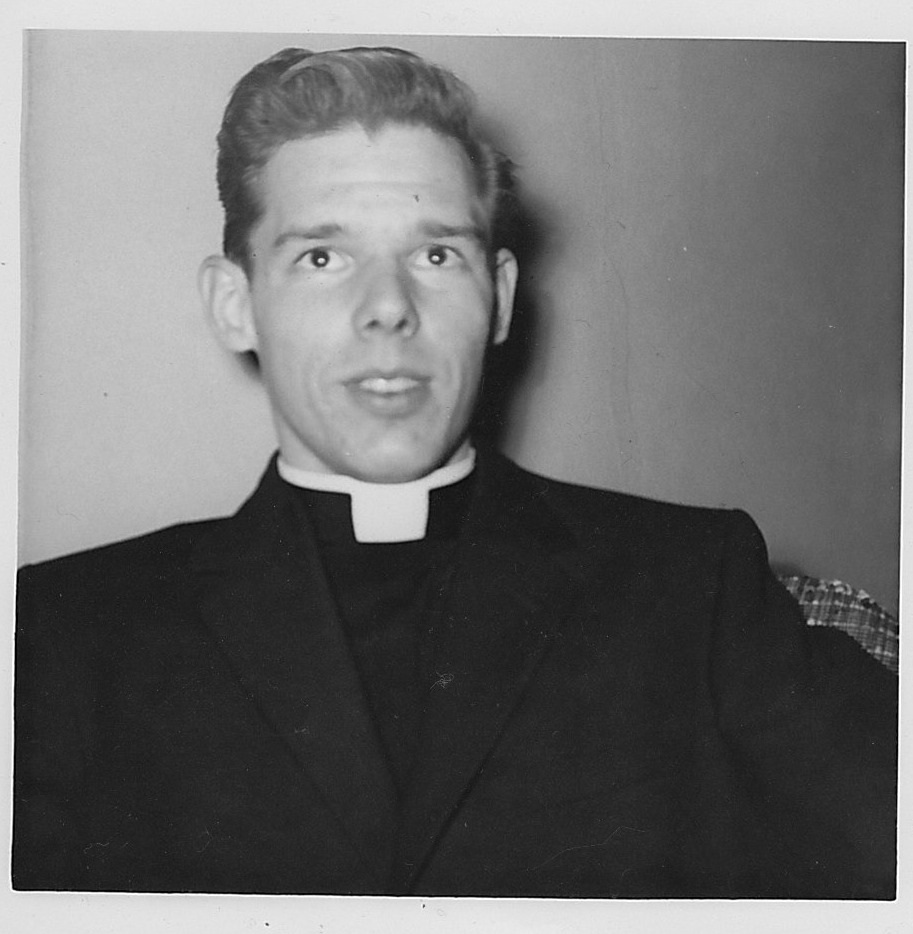
Pops at 21...on his way to change the world.

Pops at 21…on his way to change the world.

The occasion, for me, was already lacking the appropriate sense of solemnity, with the shouting from a baseball game just across the road filling the bright, evening air. Things seemed even further amiss as we headed in the direction of…well, what seemed to be nothing.

Where was the towering monument? The magnificent marble Pieta? Or at least a moderately ornate cross?

Being a big fan of horror movies, and fascinated with the ornamentation and mythology of the church, I had built up the idea in my mind that my father’s grave would be marked by something appropriate to his stature as an important religious leader. My ideas were perhaps weirdly informed by my recent reading of Scott Corbett’s “Here Lies the Body”—a story set in a graveyard, and involving a massive grave marker with a statue of a pointing, judgmental angel—not to mention occult symbols scrawled in blood, and a murder mystery. On top of that, to pass the time on the drive from state to state, I had also read and re-read a book of “real life monsters,” which included stories of Vlad Dracula, and Haitian zombification procedures.

So when I saw the flat, drab grave marker, I wouldn’t say my heart exactly sunk, but my 8-year-old mind certainly underwent some shifts in its understanding of the world–shifts I filed away for later examination.

A little over a decade later, when I bought a copy of Tom Waits’ “Blue Valentine” album, and heard the song “A Sweet Little Bullet from a Pretty Blue Gun” (about the 1977 suicide of a 15-year-old girl who jumped from the 17th story of a Hollywood hotel with her guitar) which contains the line, “Nebraska never lets you come back home,” that scene of my father’s grave came back to me, despite not having given it much thought at all in the interim.

The passage of time, and hopefully the acquisition of some tiny bit of maturity, led me to reassess the precise meaning of my father’s grave. I realized that that grave marker wasn’t about his importance in the world, or his stature in a small Nebraska town. It was just some sign, marking the place where the material–or perhaps more preciseley, the matter-bound–part of his existence was left. His influence, his importance, extends way beyond that little concrete or stone marker.

My father’s influence in the communities he served extends to this day, in part through the connections my family made in those communities.  His impact, which, combined with the hard work and diligence of my mother, who raised five sons and a daughter in the years after my father’s passing, extends out into the world in myriad ways, through the hard work and community involvement of all of my siblings and their children—all in their own ways striving to make the world a more humane place.

For my own part, struggling to understand my father’s path in life before it was cut short, and trying to find my connection to it, has been a lifelong endeavor. And while I may have, at times, viewed my father and his life in weirdly iconic terms—iconic in the sense of symbols, signs, and signals to the outside world—I now view it as iconic in the sense of legitimate meaning and influence, the ability to impact the world positively by being a decent person…the same sort of influence I can only hope to emulate.

Happy death day, pops!

Sons of Guns & Daughters of Rapists

by Jonathan C. Schildbach, MA, LMHC, ASOTP

The last several weeks have seen charges of molestation, “aggravated crimes against nature,” and rape of a child, among others, brought against Will Hayden of Red Jacket Firearms and the Discovery Channel’s “Sons of Guns” reality show. Hayden has protested that the alleged victim, his own 12-year-old daughter, made the accusations only after his angry ex-girlfriend put the child up to it. The police and many news sources are now walking back their identification of the victim as Hayden’s daughter under laws that protect the identity of minors…but since it’s already splashed all over the Internet, I’m not sure what good that’s supposed to do.

I’ll put forth the disclaimer that anyone accused of a crime in the U.S. is innocent until proven guilty. I’ll also say I’m all for keeping things like this out of the media—but that’s clearly not the world we’re living in, particularly when such charges involve a public figure. After all, Hayden’s show was abruptly cancelled, and his business partners openly distanced themselves from him as a form of damage control to keep their custom gun business afloat. In addition, in the time since the accusations from Hayden’s minor daughter first surfaced, multiple other alleged victims have come forward, including Hayden’s adult daughter Stephanie, who initially defended him against the charges, but is now reportedly slated to appear on the “Dr. Phil” show later this week to explain that she was molested and raped by Hayden when she was a child.

And to add to the various disclaimers and caveats, I must also say I don’t know enough about Hayden’s past, or his current behaviors, to suggest that I, in any way, know that he fits, or doesn’t fit, the general clinical conditions suggesting high-risk behaviors for pedophilia or sexual abuse of a minor.

Let me also put forward that as much as there is an assumption of innocence for the accused, if we really want to make any headway on addressing sexual abuse of children, the assumption needs to be that children who come forward to seek help for sexual abuse are not making things up. When children are lying, their stories do not hold up particularly well, although depending on how skilled or unskilled, careful or careless, someone is when interviewing children, plenty can go wrong with the information that is gathered. But if our first reaction to children who report sexual abuse is to shut them down, or leave them in the homes of the accused, they are potentially being put at further danger, and a likely increase in the level of that danger.

And speaking of making headway in addressing issues of sexual abuse, I’ve noticed, at least as indicated by Internet comments, that when it comes to stories like this, we can count on public opinion to fall into a small number of categories:

1) Kill ’em all: This just involves amped-up vitriol aimed at sex offenders, and those accused of having committed sex offenses. I understand the anger. But, seriously, if you think that killing more people, or addressing problems of abuse with violence is the way to move toward a better society, a more healthy understanding of human sexuality, or better protection for children, you’re taking an overly simplistic view of the way the world works. And if you think this approach has some merit, why weren’t you able to spot Hayden and bring him to justice earlier? Is that anger and all those demands for vengeance really accomplishing anything?

2) “He’s obviously a rapist because he does/likes/thinks X.” Whenever somebody is in trouble for being an (alleged or convicted) sex offender, people like to equate the offender’s other behaviors and beliefs (that don’t jibe with their own) with the offense behavior. In the case of Hayden, some have connected “gun culture” to sexual abuse of children. And while, as anybody who has read my other posts knows, I am no fan of guns, I just can’t see anything productive coming from conflating gun ownership or gun manufacture with child molestation. Of all the people I know, holding varying levels of support for gun ownership or gun control, none of them have ever expressed an endorsement of sexually abusing children. This lack of support for sexually abusing children is pretty universal, regardless of one’s political beliefs, religious beliefs or hobbies.

Furthermore, while I have worked with a few offenders who have had guns figure prominently or incidentally in their abuse behaviors, they have been the exception, not the rule. In terms of grooming behaviors, things like money, jewelry, candy, drugs/alcohol, video games, clothing, toys, and porn have been involved in many more of the offenses I’m aware of than have guns.  And I’m not going to advocate for the banning of any of those items based on the ability of abusers to involve them in abuse patterns. I’m more than happy to advocate for a ban on guns based on their use in—well, shootings—homicide and suicide and attempts at both, not to mention all manner of other crimes and accidental deaths, but as for their involvement in child molestation–not a huge concern, at least from what I’ve personally seen.

3) “How can somebody do this?” This is usually sideways of the “Kill ’em all” concept, and often involves plenty of name-calling. I get that it is very difficult to understand how somebody could rape their own daughter—or sexually abuse any child—but many of the factors involved are not beyond explanation. Most people just don’t want to hear the explanations…or deal with them…except in punitive, harsh ways once somebody has committed such acts.

Generally speaking, though, a person doesn’t sexually abuse a child because he or she is thinking clearly, or because he or she has just suddenly come up with such an idea after a long life of healthy relationships. If Hayden was engaging in sexual abuse of children, he wasn’t, one assumes, doing it out in the open, as such behaviors usually involve a great deal of secrecy and manipulation, like Hayden’s alleged warnings and threats to his daughter not to tell anyone, because, “I’m all you’ve got.”  In short, people who sexually abuse children are ill and engage in a number of behaviors to try and mask that illness, or keep others from learning of it.  I’m not sure how to properly emphasize this enough.  Sexual abusers of children are not just random guys who are bored and horny.  There are a lot of factors involved, including a huge number of elements (rationalizations, justifications, creating situations where one has access to children and is willing to take advantage of that access while plotting to keep anyone from finding out) that involve breaking down the normal barriers that prevent such sexual abuse.  In other words, “How does somebody do this?” is a question that involves a long and extended answer.

…And now for a clip of Hayden that seems weirdly re-contextualized, check this out–especially the last 20 seconds or so…y’know, where he talks about people becoming bad headlines and how he tends to his own conscience.

Anyway, let’s say that way back before Hayden had ever (assuming he did) touched his daughter or any other young girls in a sexually inappropriate manner, he realized he was having thoughts in that direction, and that he needed to do something to steer clear of that behavior. What would he do?

For those of you who know what kinds of resources are out there for dealing with someone who is having thoughts of sexually abusing a child, bravo. Please do what you can to make sure others know. I will say that over my years working on the crisis line, I have fielded a very small number of calls from people (both men and women) who were concerned about the nature of some of their sexual thoughts towards minors—either specific minors in specific situations, or more generalized sexual thoughts—and were seeking help.  In my years of dealing with offenders, I have seen numerous people who just might have sought help if they had any idea how to, and if they hadn’t felt like total garbage for acknowledging that they needed help.

But most people facing thoughts of sexual attraction to children do not have the wherewithal to seek help, much less have any idea where such help could be sought. It is a much more common reaction to deny that there is a problem, to try to push the thoughts away, or even to feed the thoughts (as in masturbating to inappropriate fantasies) while assuming that the actual offense behaviors can still be avoided.

Furthermore, treatment providers in the field of sexual abuse can have a difficult time promoting services. People tend to come to providers by referral from a lawyer or a community corrections officer (CCO) after they are already in trouble or have already served time, even though the same types of treatment could be just as effective before any offenses were committed. After all, just how welcome do you think a provider would be if they hung a sign out on their business that said “Sex Offender Treatment” or “Specializing in the Treatment of Sexual Deviancy,” or something similar? The stigma and shame that prevents people from seeking help for mental health issues as relatively common and accepted (and I mean relatively accepted) as depression, is increased a great deal for issues surrounding sexually inappropriate thoughts and behavior.

So, regardless of all that business about stigma and secrecy and providers protecting the privacy of their clients and confidentiality of their services…here’s a site that has a directory of providers throughout the U.S.  It’s basically set up for people who are already in trouble.  But it doesn’t have to be.  This is through “Stop It Now” which has referrals to the Association for the Treatment of Sexual Abusers (ATSA) and numerous other organizations.  Get help if you need it.  Get help for others if they need it.  That’s right, help, and try to discontinue the hurt.

http://www.stopitnow.org/faqs_treatment

Maybe if everybody calmed the f*ck down and decided they were more interested in actually protecting children than in getting angry at offenders, we might make some progress.  And maybe tend to that part of your conscience that’s problematic before you become a bad headline, or before you celebrate a bad headline.

Peace.

Why Would You Work in the Field of Sexual Abuse?

By J.C. Schildbach, MA, LMHC, ASOTP

There are few circumstances where one would relish the opportunity to talk about sexual assault with one’s niece. But given that my niece and I both work in fields related to sexual abuse, and don’t get to see each other very often, chances to “talk shop”—despite “shop” involving some rather heinous things—are pretty great.

You see, my niece, I’ll call her SC for short so I don’t have to keep calling her “my niece” and so I don’t have to use her actual name, spends a portion of her workweek as a Forensic Nurse Examiner (FNE). I spend a portion of my workweek as an (Affiliate) Sex Offender Treatment Provider, and have worked with offenders in one capacity or another for over seven years.

Among the topics we discussed was the rather personal issue of why anyone gets into a field related to so much trauma and other forms of ugliness.

One big similarity we found is that, on learning of our professional lives, most everyone says, “I couldn’t do what you do.” In fact, we said it to each other. I have zero desire to be involved in anything that involves touching patients or perpetrators in order to draw blood or gather other bodily fluids and materials. I cannot imagine dealing with people who have just been traumatized, when the wounds are so fresh and the pain is still so raw. SC has no interest in engaging with those who commit sexual crimes, in order to get them to accept responsibility for what they’ve done, and unravel the knots they’ve tied themselves into on their way to convincing themselves it was okay.

One huge difference SC and I found in relation to the subject of why we do the work we do is that almost everybody asks me how I got into the field, while almost nobody asks her the same. The split in questions about why anyone goes into any career built around sexual crimes may be based largely on gender, and stereotypical beliefs about how one’s gender informs one’s connection to sexual assault. Then again, the particulars of our jobs might connect to different expectations. She’s involved in the early stages of trauma intervention and evidence gathering. Generally speaking, I’m involved with people with impending court proceedings or who have already served time for their crimes.

At any rate, in her estimation, it’s likely that nobody asks SC about her entry into the field because there is an underlying assumption/fear that she chose her path because she was sexually victimized. There is an assumption that asking her will unleash some history of traumatic experiences that will lead to all manner of emotional unpleasantness and the conversation rapidly turning uncomfortable.

Anna Gillespie's "I Don't Want to Know"

Anna Gillespie’s “I Don’t Want to Know”

On the other hand, people ask me because they assume that, since I’m a guy, I’ll have some interesting tale that is much less likely to involve me having been sexually victimized. From a purely statistical standpoint, the gender-based assumptions make a fairly good bit of sense. Although, with SC working mostly with adult victims of violent crimes, and me working mostly with offenders who groomed and manipulated underage victims, and no fully accurate statistics existing for crimes in either realm, statistics only say so much.

On top of the statistical inadequacies, despite such gender-based assumptions, I’m really not sure what people might think would be my reason for getting involved in the field that wouldn’t involve at least some form of indirect (to me) trauma—such as someone I know and love having been victimized. Or perhaps there’s some stereotypical thought that men in this field are engaged in matters of clinical interest due to career-building, problem-solving pursuits, while women are involved with their choices for more personal reasons. Perhaps a bit of research on gender-based perceptions of the career choices made by other people is in in order.

Inevitably, when I attempt to explain my involvement in evaluating and treating sex offenders, and I mention a connection to a pastor at the church I attended growing up, I get a “say no more” response. That is, once a pastor is invoked, the person asking me makes a quick re-evaluation of their question, resulting in the immediate reaction of trying to cut me off before I say anything they’d rather not hear.

But the connection to the pastor has much more to do with struggles of faith, and just what it means to have a significant portion of one’s religious education delivered by a sexual abuser of children, than with having been victimized. It has to do with understanding how anybody, let alone a religious leader, could have developed such behavior. But I rarely have the chance to get all of that out once the question has been raised.

And now that I think of it, while talking with SC, I didn’t get through much of that either—through no fault of hers, but due to my own hesitation/difficulty at explaining myself in this matter—or perhaps because I’m so used to being cut off. I did get to the “I’m not doing this because I was molested by a pastor” part, but didn’t get into the more esoteric components of my attraction to the field.

I don’t fault people for their (perhaps prurient) interest in hearing disturbing tales of twice-removed personal trauma. Anybody in this field has at least a clinical interest in such stories and understanding what is behind them, or how those involved might be healed or rehabilitated to the extent possible. Still, it’s much easier for most people to deal with such tales when they involve an unknown or distant victim, or when a computer or TV screen or a printed page is safely containing that victim’s story, than it is to deal with somebody whose emotional scars may burst open right in front of you.

In my work, I am much less likely to deal with such potential emotional eruptions than SC is. I’m used to dealing with all manner of misdirected, sometimes explosive, anger and shame. Still, the focus of my work involves a significant amount of distance from the victims of sexual crimes, and the pain of those experiences. As much as those of us who are involved in the treatment of offenders may attempt to dig in deep and uproot the sources of objectification and emotional distortion that may lead to further offenses, we providers are spared that intense level of immediate pain that comes from sexual assault. Even when dealing with offenders who have a history of victimization themselves, providers are generally removed from such experiences by years. In other words, I’m afforded a high level of abstraction of the victims and their pain that SC is not allowed in her work.

It may ultimately be that the distance from, and abstraction of, pain and victimization involved in my work makes it easier for people to ask me why I do what I do. In fact, the people I deal with are, to the general public, abstractions themselves. “Sex offenders” and “pedophiles” are little more than skewed ideas to large portions of the population. People want to know what such offenders are like, and if they fit the pervasive stereotypes. In that context, asking me what I do is merely a precursor to getting to “the good stuff,” the hope for a glimpse at the back-stories of true crime tales, as well as the actual true crime tales.

In contrast, the immediacy of the hurt SC deals with as a routine part of her job, and the connection to so much pain, is perhaps too real for most people to want to delve into. It doesn’t involve that level of abstraction, where offenders stay as cartoon characters, and, where the bad guys have already been caught and made to pay.

Or, to put it another way…SC deals with “us.” I deal with “them.” We all know what “us” is about. But what’s up with “them”?

People understand how a person could be in the wrong place at the wrong time, how someone could be so unfortunate as to become a victim, and they want to keep that out of their mind as much as possible, because it suggests their own vulnerability. They really want to know how a person becomes the factor…the thing…that causes that shift in time and place that makes that time and place all wrong. What they don’t realize is they’re still touching on another form of vulnerability, but one that they can’t acknowledge in themselves. They want to remain “us”—potential victims but still ‘normal’—while looking at “them”—the offenders as something alien.

Perhaps it’s just that people want to know more about my work, or why I’m doing it, because it involves the more unfathomable end of the abuse equation, the place where they cannot imagine themselves being, while they don’t want to know about SC’s work, or her connections to it, because that speaks to a form of vulnerability they more immediately understand…how they could be assaulted. Failing to imagine how anything could ever happen to lead them to become a victimizer (although, statistically speaking, a huge number more people victimize than are ever held to account for such behavior—whether with adult or child victims) people are much more comfortable asking me, “Why did you get into this field?”

THE Mental Health System Fix to Curb Gun Violence

The National Rifle Association (NRA), having confused “the mental health system” with the Pre-cog arm of the FBI’s Future Crimes Division, has endorsed the idea that mass shootings, as well as shootings of the non-mass-variety, are the responsibility of said mental health system. It is with the NRA’s assigning of responsibility for gun-related violence, and the attendant assignation of authority to resolve the problem, that I present the following mental health assessment tool: the Gun Violence Prediction and Prevention Mental Health Assessment Protocol, version 1 (GVPPMHAP-I)

The following assessment tool is to be administered any time a person wishes to purchase a firearm of any kind, regardless of how many firearms those people may already own. In addition, all current firearm owners are required to submit to the assessment by, oh, say next week. Scoring and outcomes of scores are presented at the end of the assessment.

Overcompensation?  What overcompensation?

Overcompensation? What overcompensation?

THE GUN VIOLENCE PREDICTION AND PREVENTION MENTAL HEALTH ASSESSMENT PROTOCOL, VERSION 1 (GVPPMHAP-I)

Instructions: Complete each of the following statements with the response that most closely resembles your own thoughts.

1. When you hear the phrase “assault weapon,” you think of…
a) a culturally accepted and understood term for certain kinds of weapons.
b) how you are so angry at peoples’ ignorance of gun specifics that you want to shoot somebody.
c) a pepper spray, a cumin pistol, a thyme bomb, a rosemary clooney, a mickey rooney.

2. Entering a fast food restaurant carrying an assault rifle…
a) causes other people to instantly perceive you as a threat, as it is a very irrational thing to do.
b) is my God-given right—you got a problem with that?
c) is a good idea given that a dimensional rift could open up at any time, leading to enormous, human-eating insects storming into our plane of existence, and it would really suck if you didn’t have your assault rifle with you when that happened.

3. The greatest American president of the 20th century is…
a) FDR, because the only thing we have to fear is fear itself.
b) Ronald Reagan, who in one fell swoop proved he could take a bullet, and that mentally ill people are the real problem…not guns
c) Thomas Whitmore because he gave those aliens what-for.

4. Despite all evidence showing that women are much more likely to be the victims of gun violence when they have guns in their homes or on their persons than when they don’t…
a) women should be allowed to buy guns under the law just like men, much the same way women should be treated equally under the law in all ways.
b) the real problem is that women just don’t have ENOUGH guns.
c) women are the last, best hope for defeating the impending robot insurrection, so need to keep guns at all times, whatever the cost.

5. Guns don’t…
a) have any purpose being brandished at peaceful political rallies other than to intimidate people who disagree with those showing off their guns in public.
b) kill people; people with mental illness kill people!
c) get to tell me what to do. I tell them what to do.

6. Of the roughly 19,000 suicides in the United States each year, half of them are completed with firearms, suggesting that…
a) guns allow for impulsive, violent suicide attempts that are far more likely to be lethal than any other method.
b) See, I told you the problem is with the mental health system.
c) if I’m really serious about killing myself, I should probably get a gun.

7. We don’t need new gun laws, we just need…
a) to reinstate the old ones that were made unenforceable through the lobbying efforts of the NRA.
b) to get rid of all gun laws.
c) more mystery-flavor Doritos so that we may learn to thrive on the toxins in our environment and become one with cancer.

8. School shootings could best be stopped…
a) with a combination of measures, including reasonable gun control policies; working to get school staff, parents, and students engaged in the school community; and educating parents about the potential dangers of keeping weapons in the home when children/teens might access those weapons.
b) by displaying the Ten Commandments in the classroom.
c) by attractive teens who are able to resolve society’s ills through the power of dance.

9. Smart gun technology…
a) is a reasonable way to limit who can and can’t use a particular weapon.
b) is just another tool of the fascist government to prevent me from shooting any gun I can get my hands on.
c) is a bad step in the direction of weapons gaining full consciousness and realizing the threat posed by their human masters.

10. Each year in the U.S. there are roughly as many deaths by automobile as there are by guns, leading to the conclusion that…
a) guns should be regulated at least as heavily as automobiles and subject to similar controls, such as training in appropriate usage and safety prior to licensing, gun registration, and requirements for gun owners to purchase insurance to pay for any damages resulting from the use of said weapons.
b) automobiles are just as deadly as guns (false equivalencies and misunderstandings of statistics be damned).
c) Pixar should make a “Guns” movie, similar to their “Cars” movie, which tells the tale of waning small-town America through the eyes of a cocky AR-15, Blasty McRatatat, who becomes stranded in a sleepy, little community on the way to a gun show. Through their obvious goodheartedness, the quirky, adorable townsweapons teach the AR-15 to slow down and appreciate life one short burst at a time.

11. Banding together with other assault-rifle owners in order to intimidate government employees who are attempting to enforce a penalty against a racist rancher who has been stealing from the commons for decades…
a) makes you one of those outlaws with a gun, who needs to be stopped by law-abiding citizens with guns.
b) makes you a patriot who believes in the true values of America.
c) Cows are pretty cool. I could hang out with cows all day. It’s only good manners to always say, “Hi, cow!” every time you see a cow, although most of them would prefer if you called them by their proper names. I once knew a cow named Sister Maria Theresa Fortenzia. Isn’t that a funny name for a cow?

12. People who live in fear that the government is coming to take all their guns away…
a) are paranoid and creepy and should probably have their guns taken away.
b) are the only real Americans who are truly awake to the reality of the one-world-government dystopian hell soon to be visited on us all.
c) should know that the loss of their guns is the last thing they should be worrying about in the face of the one-world-government dystopian hell soon to be visited on us all.

13. The only thing that stops a bad guy with a gun is…
a) another bad guy with a gun, a cop, a good guy with pepper spray, a good guy who knows how to tackle a bad guy with a gun, reasonable gun control measures making it much more difficult for bad guys to get guns, enabling law enforcement to track suspicious purchases of guns and ammo, a good guy with a crossbow, a good guy with a knife, a good guy with an apple…sorry, that was several things that potentially have the power to stop a bad guy with a gun…but, y’know, if people are gonna kill somebody or stop somebody, they’re going to find a way to do it, and guns aren’t really necessary, right?
b) Wayne LaPierre’s fiery delivery of nonsensical rhetoric.
c) a well-aimed garbage truck.

14. This assessment involves a fourteenth question because…
a) paranoid conspiracy theorists would probably view an assessment with thirteen questions as being somehow satanic or otherwise involving the occult.
b) because it was probably crafted by liberal pussies who want to make sure it doesn’t reference anything patriotic or pro-America like the original thirteen colonies.
c) test subjects engaging in speculation about the number of questions on an assessment is a sure-fire way to identify people who have an unnatural obsession with the arbitrary connections they make, which seem irrational to anyone not sharing in their delusions.

Scoring is as Follows:
For every “a” answer, score one point.
For every “b” answer, score two points.
For every “c” answer…what the hell, two points seems reasonable.

Once the score is added up, engage the following procedures:

For anyone scoring a 14 or above:
• Prior to any gun purchase, a license for gun ownership must be obtained, which will include training in, and demonstrated proficiency in, use of the weapon, safe storage of the weapon, and proper maintenance of the weapon.
• Prior to licensing, the person desiring to purchase a firearm must pass a comprehensive background check.
• Prior to licensing, the person desiring to purchase a firearm must undergo a three-month waiting period.
• Prior to licensing, the person desiring to purchase a firearm must pass a rudimentary course in statistics/risk assessment so that they understand that they are much more likely to experience the death of a family member by gunshot wound due to having a gun in the home, than by not having a gun in the home, and that cars really are not more dangerous than guns unless a lot more people deliberately start using cars to kill people.
• Purchases of assault weapons, assault rifles, automatic weapons, and semi-automatic weapons will be disallowed.
• Any guns owned must be registered in a national database accessible by local government/police agencies for the basic purpose of making sure any law enforcement officers responding to a situation at a particular residence will have some idea of the level of danger they are facing there.
• At time of acquisition of any gun, owners must purchase firearm insurance at whatever going rates insurance companies deem reasonable for covering expenses related to use of firearms, including, but not limited to, costs for destruction of property, medical care, mental health care, and loss of life stemming from use of firearms.

In an ongoing effort to ensure the public safety, the “mental health system” reserves the right to impose further restrictions/sanctions on the ownership of guns.  Currently under consideration: a proposal by one Dr. Rock to increase the cost of bullets to $5,000 apiece.

The “mental health system” would like to thank the NRA and the American people for their trust and support in the design and implementation of the GVPPMHAP-I and its attendant requirements.
Suicide Notes from the Cosmic Web of Coincidence

Back around Christmas, I posted a piece about how, contrary to popular belief, the ‘holiday season’ is not the most suicidal time of the year. I’m gonna let you in on a little secret…spring is.

I wasn’t giving the idea of springtime suicide all that much thought, until the news of a note from Kurt Cobain’s wallet—mock wedding vows that turned out to have been penned by Courtney Love—bounced into the news for a day or two, and I realized I’d been hearing about a lot of recent suicides–well-known and mostly-unknown.

Hearing the specifics of Cobain’s wallet note, on a local radio show as I drove home from work, knocked down a self-imposed wall that had prevented me from engaging with the stories of recently-released information and evidence from Cobain’s death, leading me to think back on my memories from that time.

Back then, my wife and I were making a living designing and printing T-shirts out of our apartment, selling them at the Fremont market, and through ads in a local paper, The Stranger, and in national publications Spin, Vibe, and Rolling Stone, as well as doing custom jobs for businesses, bands, and other organizations. News of Cobain’s death had managed to elude us until I saw it in a Seattle Times headline, there on display by the sales counter at a gas station/convenience store across the road from our apartment, where I had gone on a late-afternoon beer run.

As with most deaths, my reaction was one of stunned silence–an unvoiced, “Wow, that’s weird.”  Back home, I hemmed and hawed and didn’t quite manage to relay the information, instead turning on the TV news and waiting for the story to come on.

We had only recently confirmed my wife’s first and only pregnancy; and it hadn’t been long enough for us to share the news with friends and family. I couldn’t stop thinking of that photo of Kurt, Courtney, and baby Frances from the cover of Spin. Cobain, not even a year-and-a-half older than me, had achieved what we were all supposed to want—right? Money, fame, a family—all while getting to tout his artistic integrity and give a big middle finger to…well, whoever he wanted, I guess. He was just getting started. He could continue on being a vital artist, or get old and boring, or become a recluse, or whatever he wanted. He had the resources now, and…

Kurt and courtney and frances

Well, if I steer clear of the conspiracy theories, he killed himself. How was that even possible?

Looking back through a lens of pop culture references, I think of Tyler Durden confirming that we weren’t all going to become millionaires, and movie stars, and rock gods. But Cobain had become that…or at least two out of three.

Also, prior to Cobain’s death, I’d read interviews with Eddie Vedder where he talked about being depressed and drinking too much wine, and I was worried Vedder was going to kill himself…intentionally, passively, or accidentally. Cobain said plenty of dark things, sure, but he was just kidding…right?  And, yeah, I had all the Nirvana albums, and all the tracks that turned up on compilations, credited and uncredited…No Alternative, Hard to Believe, The Beavis and Butthead Experience

In my earliest thoughts about this post, I had some germ of an idea about making a connection between Cobain’s death and my current work…like Cobain’s death had some impact on the trajectory of my life, and…oh well, whatever, nevermind. I think we all try to fit various life events into narratives that make everything add up into some kind of “everything happens for a reason” bumper sticker idea…as if the suicide of a celebrity I had never even met was meant to guide me to my purpose.

It was a good 12+ years from the time of Cobain’s death until I bounced back into school with the intention of becoming a therapist, and then a few more before I had gotten involved in suicide prevention, almost more by happenstance than by a powerful drive to do so. I found out I was good at it–able to handle the stress of trying to redirect people in crisis—trying to suss out what it was they were after, and find a way to address that (which often just comes down to listening and validating the underlying emotions of their distress).

Cobain may have been one tiny thread among numerous others leading up to where I landed, just like the other people I knew (mostly peripherally) who had taken their own lives—or tried to—the bulk of them in spring. But Cobain was never some overtly motivating factor. In fact, I think if I cited him as a big reason for my work, it would be kind of ridiculous… “Man, Cobain’s suicide really changed me, and I decided I wanted to help people.” But to be clear, I have no harsh judgment for whatever factors direct people to engage in ‘the helping professions.’

A supervisor of mine, who was instrumental in providing me with the fundamentals for dealing with people struggling with suicidal thoughts, theorized that the increase in suicides in spring might have something to do with the dashing of expectations…that slogging through a cold, dark winter is one thing when everybody has to put up with the cold and the darkness. But when spring starts peeling open, turning itself toward the sun, grasping those opportunities to grow…and you’re still stuck in that winter mindset…cold, despondent, unable to see the sun or feel its warmth, or to even care about dragging yourself out into it…well, that’s when you lose hope.

In thinking about springtime suicide, I’ve had this other little germ of a thought…that when we are constantly exposed to the idea that everything happens for a reason, it can have the inadvertent effect of making people seek out connections for why they feel shitty. And when they can’t find particular reasons…or perhaps the reasons they find are viewed as trite or easily resolved by the people around them…or maybe the reasons they find all land in the arena of self-doubt, shame, or a sense that they are apparently deserving of the bad things that have happened to them and the lack of happiness they feel…well, it can hurt that much more.

Instead, why not embrace the idea that plenty of things in life happen for no reason at all, except, perhaps, for the culmination of random factors and arbitrary decisions…the cosmic web of coincidence…which can end up dropping anyone down a deep dark hole? (Arguably, this is a ‘shit happens’ bumper sticker argument, but I like to think of it as much more involved).  And why not embrace the idea that darkness is an essential part of being human? As much as happiness may be the goal, as much as we may all want to be millionaires and rock stars and movie gods, even the millionaires and rock stars and movie gods among us can’t completely avoid disappointments, disasters, trauma, and loss—hell, a lot of them are born of that negativity (although I don’t want to promote any ‘tortured artist’ stereotypes).

None of us get to insulate ourselves against negative feelings. Those negative feelings–even feelings of suicide–are actually much more common than people think. But when we’re so fixated on happy, and so fixated on the idea that we can ARRIVE at happiness once and for all, with just the right combination of attitude and effort, we set people up to wonder just what is wrong with them when happiness seems so elusive.

So, check in with your friends and family this spring and every spring (and every other season for that matter). That celebration-free, often contact-free, stretch from New Years Day until the world starts warming up in spring can be long and dark as hell…and when spring rolls around, and people are left feeling like they are still disconnected and down in a hole, despite all the blossoms and rays, that darkness can become something much more overwhelming.


Why Asking “Are You Off Your Meds?” Isn’t Funny

If somebody were to quit using their insulin, or stop taking their heart medication, would a company use that situation as a humorous way to try and sell soft drinks, power tools, or airline tickets?

In recent months, I’ve repeatedly heard a radio commercial involving a married couple discussing a particular service, which is supposed to be so great, at such an unbelievable price, that on hearing about it, the wife asks the husband, “Are you off your meds?”

Sadly, “off your (his/her/my/their) meds” is one of those expressions that is used so casually and so often that it is treated as a perfectly acceptable phrase to describe someone who is viewed as irrational, or who is behaving in any way that is deemed unacceptable by the person using the expression.  If the saying weren’t so accepted, it wouldn’t be used as a joke in a radio ad, in a way that the advertisers assume will cause no offense to anyone, and will actually draw people to the company that paid for the ad.

At base, when people use the phrase “off your meds” to take a dig at someone, they are indicating that they believe the target of that phrase is delusional, or foolish in some way that is indicative of mental illness.  Stripping that phrase down to its core, using “off your meds” as a joke is essentially saying that mental illness is something to be laughed at, and people who use medications to manage mental illness are appropriate targets of ridicule.  In such a context, the symptoms of mental illness that might lead to a diagnosis or to a prescription for psychiatric medications are symptoms that make a person entertaining, or perhaps annoying, in such a way that it is perfectly acceptable to mock them.

Hey, you know what would be really funny?  Debilitating psychiatric symptoms!!

Hey, you know what would be really funny? Debilitating psychiatric symptoms!!

For people working in the mental health field, and for a number of connected disciplines, such as medical practice or law enforcement, it is common to end up in situations where questions about a person’s psychiatric medications must be asked: “Are you prescribed any medications?,”  “Have you been taking your medications?,”  “Is your prescriber aware?,” and so on.  Such questions are not jokes to be taken lightly, but queries to get a read on potentially serious problems.

Mental illness that is being treated with medication is much like any physical condition being treated with medication, in that it is ideally guided by a skilled practitioner with a well-informed client, and with the client’s best interests in mind.  If medication is not being used properly, as directed by the prescriber, it becomes nearly impossible to know if medication is effective for a client, or if adjustments need to be made, or if new strategies altogether need to be employed.

So, what exactly does it mean to be “off one’s meds”?  The answer to that question depends on the nature of a particular mental illness, the severity of the illness, and a huge variety of factors in the life of the person taking the medications, much the same as it is for any physical illness being treated with medications.  Some mental illnesses may require use of medications over extended periods—years, or even decades—just to ensure a client’s ability to engage in daily functions.  Other mental illnesses may be subject to cycles where medications can be used over much shorter periods, when symptoms intensify, rather than as a long-term, critical part of everyday routines.

For some, being “off their meds” is the difference between stabilization and falling into debilitating psychiatric symptoms which are likely to lead to an inability to manage even simple tasks.  Intentional, or unintentional self-harm leading to hospitalization may be consequences of people being “off their meds.”  For people falling into this most severe category, maintaining a medication regimen without both professional and personal supports can be extremely difficult.

People with chronic, severe mental illness are also most likely to repeatedly go off their medications without warning, and without informing their friends, families, or professional supports of their decisions.  They are likely to do this with the thought that they are capable of handling their symptoms regardless of signs to the contrary.  Many who fall into the category of chronically mentally ill are also at risk of pursuing self-medication via alcohol, street drugs, or by tampering with the dosages of prescribed medications.

For people who need medications to manage psychotic symptoms, going “off their meds” can make a return to those medications extremely difficult.  Imagine, for example, trying to convince a client suffering from paranoid delusions that they need to take medications when that client views everyone urging the use of such medications as conspirators in a plot to poison and/or control that client.  In such cases, the unfortunate outcome may be that mental health conditions need to deteriorate to the point where the clients can be involuntarily hospitalized before they can get the help they need.

At the same time, for a number of people struggling with mental illness, being “off their meds” is a perfectly reasonable goal, one which they may achieve after a brief period of using medications, or one which they may find they need to pursue multiple times throughout their lives.  Such people may reach a point where they feel they have learned enough coping skills and health strategies to ease off their medications, as they try to maintain a healthy balance of the various elements in their lives, with the support of family, friends, and professionals.  Such attempts to live medication-free can lead to careful, deliberate lifestyle choices that allow for long-term, medication-free, satisfying relationships and careers.  But such attempts can also lead to disappointments, for example, when stressors become overwhelming, and people find that they need the support of medications to achieve periods of stabilization when things are at their worst.

For the purposes of full disclosure, I will say that I feel that the use of psychiatric medications without the support of counseling is almost always a mistake.  Medications without other professional mental health supports can keep clients from “checking in,” both with themselves, and with professionals who can help clients establish and/or strengthen coping skills.  Since it is becoming less and less common for prescribers to have the time for more than brief check-ins with clients, having mental health supports beyond just medication is crucial.

Let me also say that I know that people who call attention to such language issues are frequently accused of lacking a sense of humor, or of being overly sensitive.  Those who make such accusations are also quite fond of demeaning people for taking offense at something that is “just a joke.”  And, no doubt, there are also those people who fall into the potentially-offended group (people on psychiatric medications) who will say that phrases like “off your meds” do not offend them, because they have a sense of humor.

To such people, I say, go ahead and say what you want to say.  I can’t stop you, and I agree it is your right to do so.  But just know that you have a choice to say, or to not say, things that are potentially offensive.  If you feel that it is more important to make jokes about people being “off their meds” than it is to maybe find a different way of expressing yourself, then just don’t demand that others not get offended by your words.  You don’t have any more a right to expect a particular reaction to your words (especially after the potential offense has been pointed out) than anybody has a right to tell you that you can’t say something.

In the United States, we have a convoluted relationship with psychiatric medications, counseling, and mental illness in general.  We rail against people wanting to take pills to solve their problems, then turn around and rail against people who don’t take medications they need.  We say people need counseling to work out their issues, but then condemn counseling as something for people who are too weak to manage their own problems.  And we simultaneously blame untreated mental illness for heinous events, while laughing at people with untreated mental illness.

So how about if we agree that psychiatric medications, when used appropriately, can have a great many benefits, rather than shaming people who use them?  How about if we agree that counseling, entered into in good faith between practitioners and clients, is something that can be of great help?  And how about if we agree that you don’t get to blame untreated mental illness for gun violence (which is a ridiculous argument) and then turn around and laugh about how funny untreated mental illness is (which is an asinine thing to do)?


People Up: Toward ‘Gender Neutral’ Suicide Prevention

Phone-based crisis intervention and suicide prevention frequently involves guiding a caller toward an (often tenuous) agreement that there’s a reason to get through the next day, or maybe just the next hour.

Toward the end of a recent call, the man I’d been talking to for over 40 minutes summed up the call by saying, “Yeah, I get it…man up.”  He went on to mildly berate me, suggesting that he could have had the same stupid conversation with his dad if his dad hadn’t died.  But I’ll take that as a victory.  He agreed he would stay alive to see his kids on the weekend.

He would not agree to turn his gun over to a friend or family member, which would have helped lessen the likelihood of impulsive, violent suicide.  But, for the time being, he had put it away.  And at least he was calling.

Still, the “man up” comment stuck with me.  I suppose on a greatly reductive level, “man up,” was a component of what I had been saying—especially from the perspective of someone who, based on his interpretation of the world around him, had been getting that message for quite some time–that he needed to just take care of his problems and quit complaining.  But it is not the kind of phrase I would ever use with someone, or the kind of message I would try to convey.

My conversation with him had woven in and out of a number of concerns, with the crux of the conversation coming down to the caller’s children, and his responsibility (like that of all parents) to do whatever possible to ensure their well-being.  It is a conversation I’ve had hundreds of times.

The majority of such calls, involving people who have children but are contemplating suicide, involve the caller expressing that his/her children will be better off without them.  There are a small number of variations on the ‘logic’ behind such a thought—usually involving the children not having to suffer through the heartache of the bad parenting they will certainly continue to experience, the hassles the kids will face by bouncing back and forth between divorced parents, and the notion that the children will “get over it” in time.  If the children are young, callers express that it won’t make that big of an impression.  If the children are older, the parents think the children ‘don’t need me anymore’ or are mature enough to process what happened and move on with their lives.

Never mind the mental twists and turns it takes to imagine that children will have coping skills enough to deal with the suicide of a parent, when that parent doesn’t have the coping skills to deal with loss much less permanent than death—loss of a job, loss of a home, loss of a marriage—or any of numerous variations and combinations of things and people that have gotten away.  Statistical studies show that children of people who commit suicide are at greatly increased risk for attempting/committing suicide themselves.  In an overly-simplistic explanation, the increased risk can relate to genetic factors involved in mental health issues, but it also involves behavior modeling.  Our parents are usually the most significant modelers of behavior in our lives.  And we are all doomed to become our parents.

At any rate, I found myself having the same basic conversation with a woman less than two hours later.  “What messages are you sending your kids if you kill yourself?”  I challenged the cognitive distortions in her justifications for suicide, and explained the threat of her children committing suicide and otherwise potentially being saddled with mental health issues from the suicide of a parent.  Ultimately, we got to a similar end result—the caller agreeing she would put up her pills, and live another day.

But in the conversation with the woman, there was no idea of needing to “woman up”–no need to do what was stereotypically feminine in order to go on living, even though the idea of someone ‘sacrificing’ (in this case, the twist being that sacrificing meant staying alive) for one’s children is something that stereotypically falls more heavily on women.

With the ‘man up’ comment replaying itself in my thoughts repeatedly over the next few days, I realized I was (internally) protesting too much.  The notion that I had a nearly identical conversation with a woman that same night seemed like a defensive position more than a straightforward assessment.

I ran through other ideas, examining the way I deal with men versus the way I deal with women.  For example, any form of counseling involves meeting the client where the client is.  Such meeting includes the client’s perceptions of self in relation to gender.

Still, the client’s perceptions are not the same as my way of interacting with the client.  The client’s perceptions dictate a number of things about how I will approach the client, what thoughts might be challenged and how, for example.  But at base, how I deal with people of different genders is on me.  And I need to be aware of whether those dealings are clinically appropriate or not, whether they are tinged with personal biases about what constitutes being appropriately manly or womanly, or fitting into any other gender identity.

I have no problem acknowledging that I speak to people of different genders differently, and that things such as age, economic status, religious beliefs, education, ethnicity, and a whole host of other concerns can color the interactions I have with them.  An awareness of how clients differ in background falls under a heading of “cultural competence.”  Conducting all sessions or interventions in the exact same fashion would be negligent.

Cultural competence includes the need to avoid approaching clients from any viewpoint of prejudice.  In U.S. culture, with its heavy bias toward the idea of women being nurturing and emotional, and men being stoic and strong, it is easy to fall into a trap of diminishing men who seek support, while being much more accepting of women seeking support.  The underlying concepts of weakness and strength, as relates to seeking support, diminish everyone.  Accepting girls and women who seek support while being less accepting of men and boys who do the same indicates an underlying belief in the weakness of women–the need of women to have support, while believing men don’t–or shouldn’t.

In a context where men are expected to “man up” and take care of their problems, rather than to seek help in processing what is going on with them, it makes sense that many men reaching out for help are, if not hostile, at least pensive and anxious—feeling there is something inherently wrong with seeking help, so taking a position challenging those who might help them.

As a culture, we in the U.S. encourage defensiveness and entrenchment in men—refusal to change—with the exception of encouraging men to become ever harder, ever more willing to engage in aggressive fortifying of their position, with that position often being one of isolation.  The processing men do frequently gets externalized to the point where it is not processing at all.  They, for example, focus on fixing the world, usually by berating the weak, or advocating the destruction of people seen as enemies, rather than addressing the personal in their lives and what such isolation and fortification does to them.

I posit that the gender-stereotyped notion that men need to take action is in large part what leads men to commit suicide most often in a rather violent and impulsive fashion.  When the problem is your whole life, and you’ve been taught that the appropriate response to problems is action, frequently violent action, then ending one’s life can seem like an appropriate reaction when that life has gone off the rails.  Mix in alcohol, drugs and weapons, and suicide can seem a reasonable course of action, and be carried out quickly—a decisive form of action, a manly form of action.

This is not to say that I think men in the U.S. are “victims” of the mental health system or of some pro-suicide/anti-male conspiracy.  Men, whether willingly or unwittingly, participate in, and perpetuate, the stereotypes that trap them…the stereotypes that say seeking help is synonymous with weakness.  And so, long as angry men rail against the “wussification” of the nation, they are advocating for a culture of death before mental health, and ensuring that men will not seek help for mental health issues, or if they do, that it will come with a heaping helping of defensiveness and hostility, potentially putting clinicians in a position of enduring abuse, or having to break down numerous walls, before being able to engage productively with male clients.

So, instead of urging anyone to “man up,” perhaps perhaps there could be a kind of unstated encouragement to “people up”–and not in the reductive way that “man up” is used, but in a way that is expansive.  To “people up” could mean to recognize our responsibilities to one another as human beings, whether that be as parents, clinicians, friends, family members, or citizens.  We need to recognize the harm in gender stereotypes, particularly if seeking help and support is connected to stereotypes of weakness.