My wife, M–, or Ms. M– to her students, is a Montessori-certified preschool teacher, and darn good at it. Each year in the lead-up to MLK Day, she teaches a (age appropriate) unit on Martin Luther King, Jr. that is largely built around discussions of treating people fairly, and all that good, old Golden Rule stuff. I absolutely love this exercise and the stories that come out of it.
The lessons typically start off with a “circle” (full-class lesson time) involving the ‘snack experiment.’ In this exercise, the class is divided in half, or roughly in half. Usually, the division runs along gender lines, as that’s the easiest split to make, and one that the children will easily grasp. It also speaks to other forms of false divisions in our society, but I don’t think they get into all of that.
Anyway, depending on the age and temperaments of the children, there may or may not be an advanced warning that circle time involves an exercise in fairness and feelings. Each year, M– switches whether the boys or the girls get the snack at the outset of the experiment. For 2015, the girls got the snack first.
The group with the snack is encouraged to go ahead and eat the snack, while nothing is said to the group without the snack about whether or not they’re getting anything.
Inevitably, the group without a snack starts into fidgeting, and then a bit of grumbling, about why they aren’t getting the snack. Or they start asking if they’re going to get a snack at all.
Most often, there is also some hesitation on the part of those who have received something to eat, or at least from some of them, about whether or not they should be eating before everybody has been provided with a treat.
M— sits silent for a while, then starts the discussion. She asks, essentially, how everyone is feeling right at that moment.
The hands start to go up—usually from the slighted group. This year, the big word among the boys was “disappointed,” since the first respondent used that word, and it apparently sounded pretty good.
“I feel disappointed.”
“I feel mad…and disappointed.”
“I’m angry…and disappointed.”
“I’m disappointed…and sad…and mad.”
The side that got the snack sometimes has to be encouraged to give some input, which usually starts with some hesitant, and sheepish remarks.
“I feel good.”
“I liked the snack.”
It can take a little goading to get some other responses. But this year, the big breakthrough came from one of the older girls who raised her hand and said, “I don’t like it. I’m not happy. Because ( ) is my friend, and { } is my friend. And if they’re not happy, I’m not happy.”
Before long, other girls were joining in, offering up their thoughts on why it’s better when everybody gets a snack, and how it’s more fun when everybody gets to join in, why it’s hard to be happy when others are deliberately deprived of that same happiness.
When those empathetic thoughts start to come out, there is the beginning of a transformation throughout the class. Even without a treat, the snackless start to feel happier, realizing that others care about them, and are sticking up for them.
Of course, balance is inevitably restored. The snackless become…the snacked? Okay, let’s just go with ‘the hungry are fed.’
The discussion continues on, the children offering up sentiments that are occasionally amusing, occasionally profound, and sometimes both.
And, this year, the discussion was closed out when the youngest boy among them, after being prompted several times to raise his hand if he wanted to share his thoughts, finally did so. Then, talking through full cheeks, said, “I want more crackers.”
I’d venture a guess that many who enter the mental health field, as with any potentially dramatic profession all the way from police to executives, do so with visions informed by Hollywood. One of the main Hollywood portrayals of the mental health worker is is that of the therapist/psychiatrist as a well-compensated genius, ensconced in a plush office, treating the worried well or other “eccentric” or “neurotic” types, while constantly being admired by clients for one’s observational skill and ability to call forth ‘breakthrough’ moments. The other end of the spectrum is the heroic social worker who, through sheer tenacity, overcomes all the problems an impoverished neighborhood can throw at her, overcoming multi-generational patterns, and very recent traumas, to really, really make a difference in the lives of an entire community.
Many in the field are drawn to books by Yalom, or Rogers, or perhaps even some acolytes of Oprah, who tell us that just by listening and accepting our clients, or by throwing the right bit of tough-love advice a client’s way, true transformation will take place, and clients will make huge leaps forward, forever changing their lives for the better.
Susan Sheehan’s “Is There No Place on Earth for Me?” is perhaps the perfect antidote to the pie-in-the-sky visions of one’s brilliance and dedication making all the clinical difference in the world. It balances out the ideas about the wondrous gift of therapy with the reality of chronic and severe mental illness, and its resistance to ‘ah-ha moments’ and dramatic progress. It pushes past that “we don’t need no medications” mantra, which can, in fairness, apply to a lot of mental health issues.
“Is There No Place on Earth for Me?” was first published as a four part series in The New Yorker in 1981, then published as a book in 1982. For it, Sheehan won the Pulitzer Prize for General Non-Fiction in 1983. A new edition of the book was released roughly a year ago, including a new afterword by Sheehan. On reading about the re-issue in the online version of the New York Times in January of 2014, and having never read it before, I put it on my ‘to read’ list, and eventually checked out an old edition from the library.
The book, written from the perspective of a journalist, and not of a therapist trying to convince the readers of the efficacy of particular approaches to treatment, is involved in ways that few case studies can be. Sheehan spent over two years with Sylvia Frumkin (not her real name), a woman diagnosed with schizophrenia. Sheehan had a great deal of access not only to the information on Frumkin’s treatment and behavior during the period when Sheehan shadowed Frumkin, but also to family members and others, getting a great deal of background on Frumkin’s life prior to her diagnosis, and the progress and setbacks that took place before Sheehan had ever met her.
Having had numerous contacts with clients diagnosed with schizophrenia, or suffering from other forms of psychosis, most often from a distance, it took me a while to get through the book. That is, the kinds of delusions, rants, and flights from treatment that plague Frumkin and those trying to help her, and which Sheehan documents in detail, were familiar to me—of course, with Frumkin’s behaviors being particular to her own case. Still, it was like trying to read about many of the most frustrating aspects of work during one’s down time.
For the uninitiated, I imagine the book is much more compelling, rather than overly familiar, and thus, somewhat draining. In discussing “Is There No Place on Earth for Me?” with colleagues, I’ve most often likened it to Kafka’s “The Trial”—a book that is deliberately tedious in its depiction of a bureaucracy more intent on sustaining itself than serving any clear purpose—although, that comparison probably has much more to do with what I bring to the reading of Sheehan’s book than to what she has documented in such depth of detail. Also, I don’t think the mental health system—either now or at the time—is deliberately set up to be frustrating…it just frequently is, particularly for those most in need of help.
In addition to capturing the daily details of the behavior of a (this) client with schizophrenia, Sheehan also does a masterful job of explaining, simply and concisely, some fairly complicated legal, medical, and treatment-related concepts. For instance, Sheehan outlines the concept of “least restrictive” forms of treatment, both the bane and the beauty of our mental health system, which has been around since well before the current lack of options made it so completely mandatory. In doing so, she answers that most familiar of questions about why we can’t “just lock up” people suffering from chronic forms of mental illness who can become rather taxing to a variety of public and private resources.
The most fascinating elements of Frumkin’s story to me, though, were the ‘side treatments’—pointless, and sometimes dangerous, programs that Sylvia was subjected to. Without going into a great deal of detail, the treatments ranged from moving in with a relative and his family who believed that all Frumkin needed was a good dose of Jesus and discipline to overcome her laziness and wicked ways, to a doctor who felt that manipulating the insulin levels of patients to extreme degrees could cure them of schizophrenia.
Ultimately, what works for Frumkin (or worked back around 1980) is what still works for clients today: a small number of medications that prove effective in treating schizophrenia, as well as (to greatly simplify things) a structured environment and supportive professionals. Unfortunately, said medications can lose their effectiveness over time, or the side effects can become increasingly detrimental to the clients. It is also quite common for clients to simply quit taking their medications, feeling them unnecessary or viewing them as the root cause of various forms of discomfort or other troubles in their lives. In addition, the structured environments can only be maintained for as long as clients are compliant with treatment, and as long as the treatment remains effective, and as long as funding and various programs allow. On top of that, anything from the restructuring of institutions, to changes in law and other policy, to the career changes of providers, to differences of opinion between providers and family members, can lead to new doctors and other providers making changes, sometimes rather arbitrarily, to a client’s medication regimen or support systems. In Frumkin’s case, alterations to her treatment and medications were made numerous times, in the most haphazard of fashions, often by doctors and other providers who seemed ignorant of her case history, or of how the medications work.
One might also note that this book was written back before the U.S., under President Ronald Reagan, decided that people with chronic mental illness enjoy the freedom that homelessness brings. So, Frumkin’s movements within the system are relatively easy in terms of her various forays into decompensation leading to fairly quick, and relatively long-term inpatient placements, with step-downs to semi-independent housing, and other supports that are much rarer today (and for most of the last three decades).
Ideally, Sheehan’s book would be taught in graduate schools, or maybe at earlier levels, by instructors who are familiar with the clinical aspects of schizophrenia; the current and historical treatments for it; and the current and historical state of affairs with regard to mental health facilities, available inpatient beds for clients with mental health issues, and legal and systemic complications to accessing those beds or other program options.
To be clear, it is necessary, as therapists, or in other capacities in the mental health field, to come equipped with a belief that we can make a difference. Without a bit of the dreamer in us, we would never head down this path to begin with.
But it is also necessary for providers at all levels to understand just what they are up against, particularly given that almost all providers in the mental health field will end up doing at least a round or two in the public mental health system–from practicums/internships to early jobs to entire careers–where the most challenging of clients often end up by default—frequently after being abandoned by families and other support systems, including insurance companies.
Frumkin’s family, as dysfunctional as they are, and as frequently detrimental to her treatment as they can be, at least hang in there to the extent that they can—which I imagine was at least somewhat less difficult when hospital beds and supported living options weren’t at such a premium as they are today. In the end, though, this isn’t a story of a family hanging together and triumphing over a terrible disease. It’s the story of a debilitating mental illness, and the toll it takes on the client, as well as those around her, and the wildly inconsistent efforts by a variety of people and systems to help her cope.
Christmas morning, I found myself cleaning the remains of a chicken and stuffing out of the Crock Pot, to make way for the roast I was going to crock—which I suppose made it a crock rather than a roast.
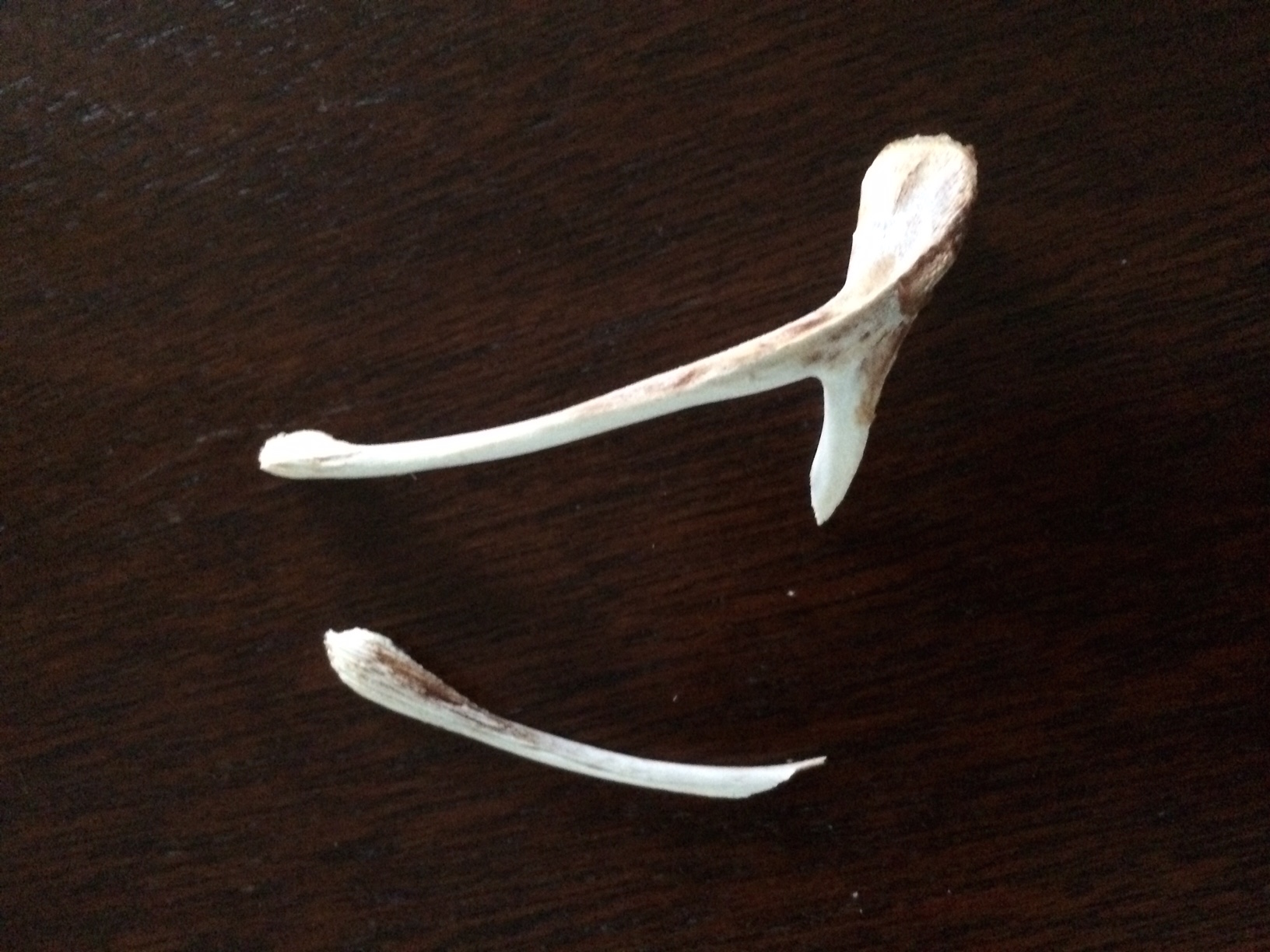
As I scooped stuffing from the pot, and rent that flightless bird’s flesh from its bones, I came across a fully intact wishbone. I paused in my work, rinsed the wishbone, and set it on the kitchen windowsill.
Not quite a partridge in a pear tree, but you take what you can get.
Continuing on with the operation, packing the chicken and stuffing away, neat and tidy in Pyrex containers, then prepping the roast…er, crock…the tradition of wishbones rolled around in my head. I’m not talking about the origins of the whole wishbone thing—where it came from, who was first to practice it, but rather, the more personal memories around it.
I can’t say as I have a whole lot of specific personal memories around wishbones. I know if mom was cooking a chicken, then there would be at least a minor squabble around who would get the wishbone—or, perhaps more accurately, when somebody found the wishbone, there would be a minor dispute around who would get to break it with the lucky discoverer. If one of my older brothers came across it, there would be inevitable teasing, just to see if they could get a rise out of one or more of us.
And then there was that time I won the wishbone-breaking contest and was rewarded almost instantly with the new bike I had wished for, and then felt bad because I could’ve wished that my cousin Brad’s hypochondria would be cured instead.
Okay, that never happened. I don’t even have a cousin Brad.
I thought on how I had witnessed my kid and her best friend, when they were probably about seven years old, engage in the wishbone-breaking contest immediately on finding one during dinner, despite my having never taught/explained it to my kid. There is, perhaps, some lesson in there about kids picking up all kinds of things beyond the specifics of what their parents teach them, but I’m not really sure what to make of that, or its importance. Weird things permeate the culture? I failed in this particular instance of ensuring that I was the one to pass a bizarre superstition on to my offspring?
I briefly entertained the question of whether two people could conspire to wish the same thing, thereby increasing the chances of the wish coming true. After all, so long as they didn’t speak of it afterward, they couldn’t truly know what the other had wished. A wishbone technicality would still invoke the magic—right?
At any rate, as soon as my wife got up from her mid-morning nap, and got herself a cup of coffee, I presented her with the wishbone. She immediately grabbed hold. I warned her she needed to think on her wish. She closed her eyes briefly, then gave me the nod.
It was on.
After a few seconds, she remarked on how the wishbone was too wet (from its days packed in chicken-fat-soaked stuffing at the bottom of a crock pot) and not likely to break. She relaxed her effort. There was a brief pause where I hadn’t quite processed what she said or did, and continued on with the match. Then, just as I followed her lead, conceding that the wishbone was, perhaps, too saturated to complete the fight, she resumed the pull, and…snap. She won. Was it a brilliant strategy, or dumb luck? I didn’t ask, just conceded. Victory was hers.
Victory is hers!
I like to believe she wished for something like I wished for…you know, that silly garbage about another year of relative happiness, good health, and enough stuff.
Still, I daren’t ask. Because maybe she did wish for that same silly garbage. Or maybe she wished for world peace. Or maybe she wished for a new bike. Or maybe something much better…or much worse.
With all apologies to the wonderful people among my family and friends who have prepared some amazing holiday meals over the years…
Thanksgiving is one of those holidays that I’ve had to learn to love…or like a lot…or maybe just kind of like. As a kid, Thanksgiving didn’t have the obvious benefits of other holidays—like Halloween (monsters and candy), Christmas (presents and flashing lights), New Years Eve/Day (getting to stay up late and listen to the top-whatever countdown of the year’s/decade’s/history of rock’s top hits), July 4th (explosions, fire, and kickass food prepared with fire). I could go on, but I don’t know if even adding fire could really make Thanksgiving all that interesting.
Way back when, the only really good thing about Thanksgiving was getting a four-day weekend, which was pretty weird, anyway. I mean, really, why put the holiday on a Thursday? If it was a celebration of Thor, that would be cool. Hey, maybe that’s the key to making Thanksgiving interesting—Thor. Well, probably not. But so far the best thing anybody has come up with is to add in a bunch of football games, which, as far as plans for making things interesting goes, is shaky at best.
And, sure, I liked turkey-based art projects. And I liked watching the parade with the giant balloon cartoon characters, but then there was that whole thing of having to sit through multiple marching bands and other weirdness and commercials in between the giant, inflatable cartoon characters. How much patience did these people expect 8-year-olds to have? And let’s face it, not even Ethyl Merman loves a parade, no matter how enthusiastically she belts out that musical lie.
Overall, Thanksgiving just felt like an excuse for adults to make kids put on clothes they should never have to wear outside of a church, forcing them to be itchy and bored for hours on end, while waiting for a meal of foods nobody really wanted to eat anyway. I blame Thanksgiving for tilting me toward a mild obsession with mashed potatoes. Peppermint Patty hollering, “Where’s the mashed potatoes?” is something I relate to entirely too well. My anxiety over the thought of attending a Thanksgiving dinner that has all the usual stuff, but no mashed potatoes…unreal.
As far as the rest of the Thanksgiving fare goes…Turkey—sure, that’s fine, I guess. Cranberries—I like them well enough now, but as a kid, I just couldn’t help but think they tasted all wrong. They were berries, but they weren’t really sweet. They just should have been different somehow. And speaking of sweet-and-should’ve-been-different, there are those damn sweet potatoes. Who wants to eat that? It’s brown sugar and something that’s kind of like a potato, but kind of like a carrot, and squishy, and…uggh, I don’t even wanna think about it.
And then there’s green bean casserole. Actually, I quite like green bean casserole. But nobody in my family ever made the stuff.
All the appeal and excitement of a traditional Thanksgiving meal, straight out of the box.
On top of the conspicuous absence of green been casserole, there was always some heinous cornbread dressing—chock full of eggs. Did I mention that I’m allergic to eggs? So, yeah, it’s great to have a meal that involves plenty of unappealing food, including at least one awful food with plenty of deadly toxins—toxins aimed only at me!! Haven’t you people heard of Stove Top? It’s much easier to make, and much less deadly. While we’re, on the egg tip…there were always weird, unappealing things like Waldorf salads, slathered in eggy mayonnaise. There were pumpkin pies and pecan pies–eggs, eggs, eggs!!
And, well, just forget the rest of that food, okay? I’m already in danger of going fetal here.
Since I’m an adult now, more or less, and I get to make at least part of the decision about what’s going to happen on holidays, we eat out on Thanksgiving—every Thanksgiving since 2010. This started out as a matter of practicality. I had been doing shift work for a few years already at that point—jobs that involved round-the-clock coverage, with holiday time off at a premium.
So, doing the whole, make-a-big-meal-and-then-take-off-for-work, or work-all-day-and-then-come-home-for-a-meal thing wasn’t exactly conducive to Thanksgiving harmony, especially when my wife had to take the lead on the meal with little support (hey, I took care of the shopping), and I would either be at work or asleep prior to going to work. Accepting invitations to other friends’ Thanksgiving meals was also complicated by my work schedule—so the wife and kid might go to a friend’s holiday meal without me (which was fine with me, but my wife felt bad about it).
To be sure, my wife is an amazing cook. But traditional American cuisine, and traditional American holiday cuisine, is not her forte’. She made some wonderful holiday meals (that whole incident with the Reynolds roast-in turkey bag not withstanding), but wasn’t always able to tell if things had turned out successfully, since the things she was making were a bit foreign to her. And given her highly-self-critical nature, no amount of reassurance was going to make her happy. So, forget it—let somebody else stress about the meals.
Most years, Thanksgiving out involves just my wife, my daughter, and me—although last year we had the pleasure of booking a party big enough to get us a private room at Preservation Kitchen—which is a pretty amazing place—and which was my favorite Thanksgiving meal since we’ve been doing the restaurant thing. I spent the bulk of the meal sampling beers (after a dirty gin martini opener) and conversing with a second grader. And since he and I have a similar sense of humor, it worked out pretty darn well.
I’m guessing most U.S. citizens feel obligated to be involved in some family-oriented, meal-centric Thanksgiving hassle, because that’s what you’re made to do growing up. But I’ll be damned if I’m going to let some weird sense of obligation ruin a perfectly good (if boring) holiday, that should be about things we’re thankful for. I’ll just say, I’m extremely thankful to be able to blow a few hundred bucks on a nice meal out, rather than blowing a few hundred bucks on a bunch of stuff that we now have to prepare ourselves amidst a bunch of other logistical complications.
Today, we’re hitting Palomino in downtown Seattle. Haven’t ever eaten there. Maybe I’ll post an update so you’ll know if it was at all satisfying. Maybe I won’t. I refuse to feel overly obligated by all this.
So, Happy Thanksgiving, everyone! If you’re eating at somebody’s home, be nice to the hosts and steer clear of conversations about religion, politics, and the Great Pumpkin. If you’re eating out, tip well—really, really well.
Not quite a month ago, The Learning Channel (TLC) announced plans to drop production of its ‘reality’ show, Here Comes Honey Boo Boo, as well as shelving an entire season that has been completed, but not aired. The reason? “Mama June” Shannon was photographed out and about with her former beau, convicted sex offender Mark McDaniel. Even worse, a few days after the original story broke, a photo surfaced showing June, Mark, and Alana “Honey Boo Boo” Thompson together.
McDaniel was convicted of “aggravated child molestation” for sexual contact with Anna Marie Cardwell, who is June’s daughter, and Alana’s half-sister. McDaniel served a ten-year sentence for the molestation, having been released from prison in March.
Now, I’m not a big fan of Here Comes Honey Boo Boo. I’ve seen occasional clips on other shows, and watched most of one episode when I came across it while flipping channels. But in that episode, I saw that the family was accepting of Alana’s uncle, who is gay, without making a big deal about it. And, despite my unease at the general weirdness of the child pageant circuit, the family members seemed to enjoy each other’s company. And then the show concluded with Honey Boo Boo climbing up on a chair and sticking her butt in the air to fart loudly, which, strangely enough, served as the lead-in to a very somber, ‘feed the children’ infomercial.
At any rate, speaking of the weirdness of the child pageant circuit, having seen a few episodes of Toddlers in Tiaras, the TLC show that spawned Honey Boo Boo’s spinoff, I am disturbed by what can only be described as the sexualization of little girls on that show. The contestants are small children who are essentially treated identically to adult beauty pageant contestants—made to wear too much makeup, with piled-up hairdos, wearing a variety of—I guess you’d call them revealing, although that sounds weird when talking about children—dresses and bathing suits, while performing routines involving dance moves that I pray the girls don’t understand the origins/meaning of.
I’ve had offender clients specifically mention Toddlers in Tiaras as a kind of ‘gateway’ form of visual stimulation leading to seeking out even more exploitative material. And, while such ‘gateway’ comments are often spoken with the intent to limit the personal responsibility of those clients—the whole ‘society is sexualizing young girls, what am I to do?’ complaint—it is somewhat difficult to view the show without thinking, ‘Wow—pedophiles must really enjoy this.’
So, while I could start shaming Mama June for putting her daughter in the beauty pageant circuit, or for taking up with a man who molested one of her daughters; instead it seems a better course in all of this would be for TLC to invest some more effort and money in the show, and maybe take it in some completely different directions—maybe even directions that would involve some actual learning.
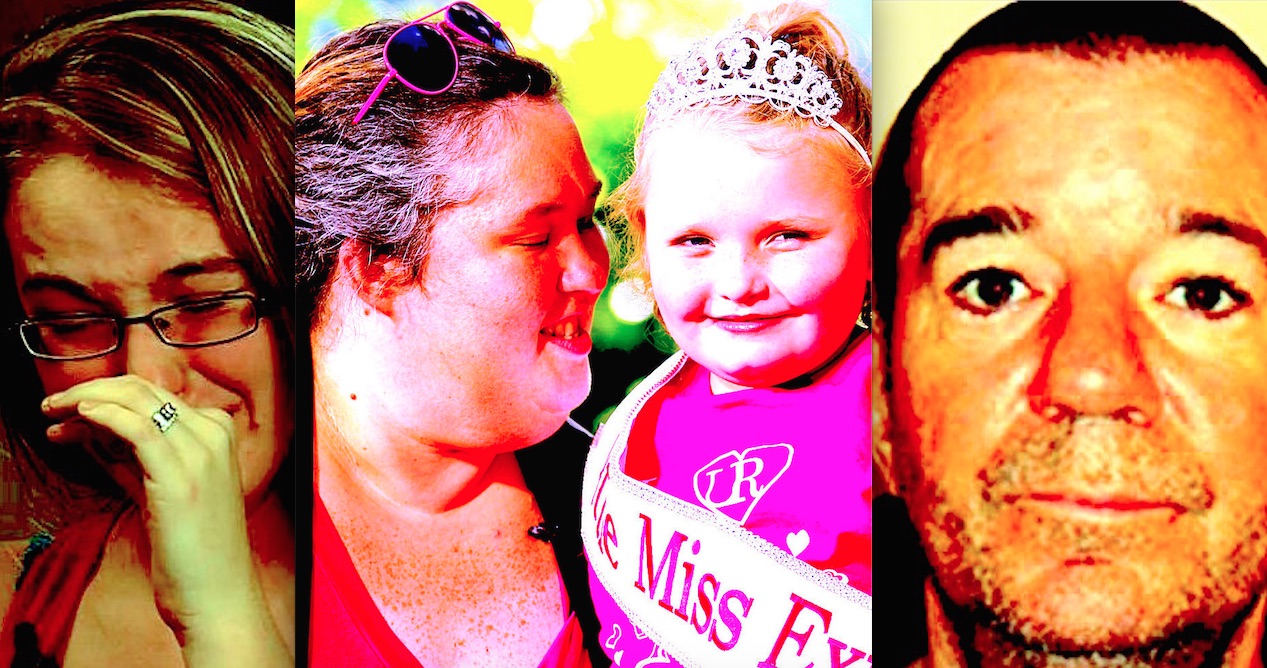
Broken portrait of an exploited family unit–Anna Marie, Mama June, Honey Boo Boo, and Mark McDaniel.
That is to say, it’s very odd to have a show built on the highjinks of a family that is portrayed as a bunch of unsophisticated rubes chasing a weird dream, and then to turn around and cancel the show when the matriarch of the family does something that shows she really doesn’t understand what’s at stake in a particular situation. According to Anna Marie’s own statements to the media, June minimized McDaniel’s behavior, telling Anna Marie that McDaniel wasn’t all that dangerous because Anna Marie was McDaniel’s only victim.
Such a statement is a big red flag that Mama June just might be buying a whole lot of lies from McDaniels—the kind of lies that offenders tell all too frequently. ‘It was just the one time;’ ‘I was drunk;’ ‘It was a mistake;’ ‘The victim did X first;’ ‘I paid the price/did my time;’ ‘I won’t ever do that again;’ etc, etc.
I don’t know what kind of treatment McDaniel may or may not have received in prison. But unless McDaniel has developed some understanding of his own behaviors, and unless Mama June has been educated on exactly what McDaniel did, how he did it, how he justified it to himself, what kinds of things Mama June needs to look out for in McDaniel’s behavior (preferably coming from McDaniel’s own confession); and unless she’s been given instruction in what McDaniel’s behavior means for the safety of her other children, and how to reduce risk (risk can never fully be eliminated), then it’s a little hypocritical of TLC executives to cut her off, claiming that it is in the best interest of the safety of the children involved.
And just for context, here’s the statement issued by the network at the time of the show’s cancellation: “TLC has cancelled the series HERE COMES HONEY BOO BOO and ended all activities around the series, effective immediately. Supporting the health and welfare of these remarkable children is our only priority. TLC is faithfully committed to the children’s ongoing comfort and well-being.”
Great, TLC, but where’s the support? I’ve seen many mothers of victims continue on in relationship with the men who molested those women’s children. And a supportive and appropriate relationship with an adult partner can actually reduce risk for re-offense. However, that risk isn’t (generally speaking) reduced when the offender is allowed back around likely victims, particularly without the partner being fully informed as to the nature of the offender’s behavior, and how to provide adequate support for the offender and for other family members. But maybe TLC executives are just looking at this as another example of the stereotypes they’re comfortable promoting–of poor, Southern folk accepting child molestation as a routine part of life.
It is potentially extremely damaging for victims of molestation, like Anna Marie, to see their mothers return to relationship with the offender, or to, in any way, be given the impression that they are being treated as secondary to the perpetrator of sexual violence. It definitely sends some disturbing messages about who is being given priority, and where the concern of the mother lies. It is possible to mitigate that damage, but only with some very involved, professionally-guided therapy.
I don’t want to over-simplify things here, but a major reason for women to continue on in relationship with offenders is economic. I don’t have any idea if McDaniel has any real way of providing for June’s family, but since TLC just cut off the family’s current main source of income, they are increasing Mama June’s likely reliance on someone who can provide support—and at a time when the person June is in relationship with is an offender who is very much putting Honey Boo Boo—that “remarkable child”—at risk.
So, again, why not take the show in a new direction? A learning direction? I don’t mean to advocate for making an offender a reality TV star, but TLC could at least build in scenes to Honey Boo Boo’s show, or maybe a spinoff, that follow McDaniel through treatment, and through all of the difficulties he now faces as a convicted offender trying to rebuild a life outside of prison, in conjunction with Mama June’s exposure to McDaniel’s treatment process. The audience could see scenes of June attending sessions with McDaniel—scenes of McDaniel explaining his ‘offense cycle’ to June, of McDaniel explaining his actual offense to June, of June going through a chaperone class where she learns just what limits need to be placed on McDaniel and his contact with June’s children.
And what about making sure Anna Marie’s okay? How about, instead of channeling any income to McDaniel, any money involved in a standard TLC reality-star fee, over and above the cost of his evaluation and treatment—funded by TLC—goes to Anna Marie to make sure she can get some ongoing treatment herself? Perhaps let Anna Marie gain some economic benefit from the exploitation she’s already suffered? She’s had various media outlets contacting her to ask how she feels about the man who molested her being released from prison. How about making sure Anna Marie’s not being re-traumatized by all of this? After all, how many victims of molestation really want the molestation being made public, and then want to have to address it, with complete strangers, for the purposes of having it blasted out all over the airwaves and the Internet?
Of course, TLC doesn’t have to do anything in this case. Perhaps TLC executives were grateful that a scandal of this sort came around when Here Comes Honey Boo Boo was pulling ratings of less than half of its peak performance, just so they had a good excuse to cut their losses. Then again, TLC could really do some good in this case. TLC could truly support the “health and welfare” of their child stars. TLC could really help advance public discourse on offenders, offender treatment, and victim advocacy.
Or TLC could just leave Mama June, Honey Boo Boo, and the rest of the clan dangling—dangling over a cliff where falling means families torn apart and potential acts of child sexual abuse—and move on to whatever other ‘reality’ show goofballs America wants to laugh at, until ‘reality’ creeps in and undoes them as well—leaving TLC to cut its losses, abandon its ‘stars,’ and run.
Well, Halloween is over, but who cares? You can still keep on scaring yourself, right? Only, rather than the usual gore and mayhem, how about some unsettling horror, the kind that makes you question the reality of the movie, it’s characters, and your own thought processes?
Don’t get me wrong, I’m a big fan of the traditional monsters-and-bogeymen (bogeypeople?) style of horror. But sometimes it’s good to be scared by things that aren’t quite so over-the-top. And speaking of over-the-top, you’re probably already irritated with all the ‘Early Black Friday’ specials and the ‘Holiday’ ads anyway.
The movies listed here also get at some small bit of what it is/might be to cope with various forms of mental illness, or to deal with others who are struggling with it. They spotlight what it is like to be unsure about what is happening, and to have a difficult time understanding what constitutes legitimate forms of support. These are movies that cause a tightness in your chest, and not the kind that is alleviated by the next hissing cat springing out of a cabinet, or garden tool splitting open some body part or other. They carry with them the kind of dread that has a real impact.
And I’m going to say there’s probably a good chance that these movies should come with some trigger warnings, in case that’s not obvious from the descriptions.
Safe (1995): From Todd Haynes, writer/director of Velvet Goldmine, I’m Not There, and Far From Heaven, Safe sees Julianne Moore as Carol White, a woman who, after much confusion from a wide range of medical, mental health, and ‘other’ providers, is diagnosed with Environmental Illness, a disease that makes her hypersensitive to various chemical agents that are common in everyday life in modern America.
But is she really suffering from anything, or is the disease a physical manifestation of the sheltered nothingness her life has become? The only people who claim to understand her and her disease have clear motivations for convincing her she’s sick, while those who tell her she’s fine seem to lack any concern for her whatsoever.
As much an indictment of the “American Dream” of being completely carefree (there’s no such thing as “safe”), as it is of various forms of mental and physical healthcare, and the lack of clear, irrefutable knowledge to address all maladies (despite ‘professional’ claims to the contrary) Safe will have you clearing your throat, checking your temperature, wondering just what that smell is, and…wait, that’s probably not the best way to encourage anybody to watch a movie.
Safe is a bit difficult to track down. They don’t have it available on Netflix in any format, and Amazon only has it for sale as a DVD or Blu-Ray. Here’s a trailer (that kinda sucks)…
Affliction (1997): Written and directed by Paul Schrader (writer of Taxi Driver, and writer and/or director of numerous other impressive works), based on a novel by Russell Banks, Affliction sees Wade Whitehouse (Nick Nolte) descending into unreality, or perhaps hyper-reality, during what should be the routine investigation of a hunting accident. Having grown up in the shadow of an abusive father, played in frightening fashion by James Coburn, Wade never quite makes it out into the light that might help him establish some reliable sense of self.
An occasionally brutal meditation on familial abuse, PTSD, and other forms of trauma, this one is a slow crawl over gravel, peppered with the occasional hot coal. It’s available right now streaming or by disc on Netflix, as well as on Amazon Prime.
Here’s a trailer (that isn’t all that bad…)
Take Shelter (2011): From Jeff Nichols, also writer/director of Mud, Take Shelter stars Michael Shannon, aka General Zod and numerous other amazing roles, as Curtis, a man convinced that tornado season is bringing something much more sinister than twisters. Curtis jeopardizes his job, his financial security (including money saved for a cochlear implant for his daughter), his friendships, and his marriage to Samantha, played by Jessica Chastain, to build a storm shelter that can keep his family safe from not only storms, but perhaps the end of the world.
Nichols keeps the audience off balance by providing plenty of information that is clearly accurate, or at least witnessed by people other than Curtis, and also including a number of elements we can’t be so sure of. Is Curtis the only one alert to the signs of danger all around? Or is he suffering a breakdown of some kind?
Take Shelter is currently available via disc on Netflix, via Amazon or AmazonPrime in multiple formats, and on Starz—both on-demand and in the regular schedule.
Here’s a trailer (which is pretty darn good)…
So, happy no-longer-Halloween season. And remember, Thanksgiving and Christmas are still a good, long way off…as well as being great times to share disturbing films with family and friends.
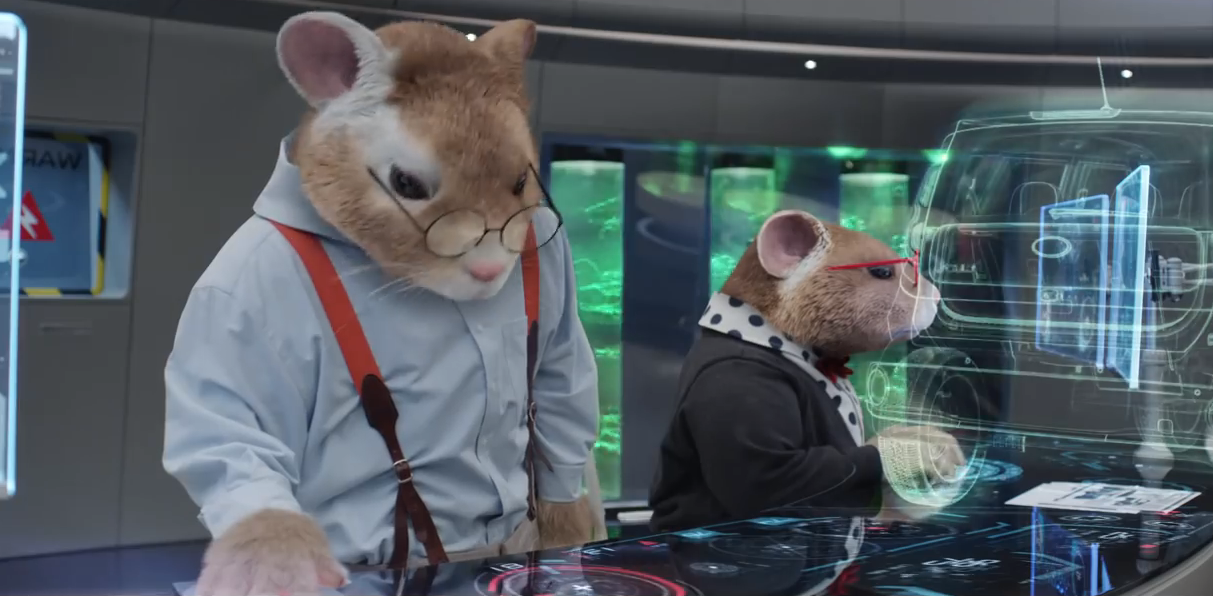
In the commercial for the Kia Soul EV (Electric Vehicle), these hamsters…
…have just created some kind of electric-beam-shooting machine that transforms cars with combustion engines into electric cars, but which also inadvertently transforms this hamster…
…into this hamster…
…which leads the scientists to run out and get these hamsters…
…in order to turn them into these hamsters:
You can watch the whole commercial here:
Now, I don’t know much about the normal behavior of the average anthropomorphic male hamster scientist, but the ones in this commercial are impulsive and reckless, and just plain engaging in bad scientific practices. It’s bad enough that they leave the newly-created anthropomorphic female porn-hamster alone in the lab, apparently irritating her, and leaving her to do God-knows-what with billions of dollars worth of barely-tested, super-high-tech equipment.
But they also, with complete disregard for their own safety, jump into an untested vehicle and race out of the lab with the intention of creating more female porn-hamsters. They don’t do any kind of systems check on the car, or even wait 30 seconds to, for instance, see if the porn-hamster they just created might have significant problems. Perhaps it suffers from severe physical or mental abnormalities. It could be hyper-aggressive or violent. One of its first actions, after all, was to blow a kiss across the room at one of the scientists, which actually had the electrified power to knock him to the floor. Guys, I don’t think you should be taking this so lightly.
Thankfully, the male hamster scientists make it to the pet store and back, nobody gets hurt, and the porn-hamsters only want to have a dance party.
Still, one has to wonder why these male hamster scientists are so enthralled by what they’ve created. I’ve not paid enough attention to the whole series of hamster commercials to know if the other female hamsters (are there other female hamsters?) in this Kia-commercial world have similar physical attributes to the male hamsters, as in looking like ‘real’ hamsters wearing clothing, or if all the female hamsters have the bodies of (human) Playboy playmates.
It bears asking, would the male hamsters really be attracted to some hideous abomination with the head of a hamster and the body of a human? After all, the female porn-hamsters seem to be attracted to the hamster-bodied males—or else they’re just tolerating them until they can escape. They would have to escape, right? The hamster scientists wouldn’t be so irresponsible as to just unleash these monstrosities on the world without knowing what they might do, right?
In any sci-fi/horror scenario, everything always seems great up front, and then rapidly goes to hell. First it’s a dance party, and then the killin’ starts. Just what can we expect from the porn-hamsters’ Frankenstein/Brundlefly/Jurassic Park moment? Or perhaps the better parallel is with Vincenzo Natali’s “Splice”—wherein genetic experiments lead to the creation of a hybrid human/insect thing that has sex with Adrien Brody and then kills him, and several others.
But, hey, for the Kia Soul EV, it’s still a dance party. We don’t have to worry about sex and murder. They even carefully edited the Maroon Five song that plays throughout the commercial to eliminate the lines “we get along when I’m inside you…I get so high when I’m inside you,” despite leaving in the lines about ‘hunting you down’ and ‘eating you alive.’ So, really, what happens if the porn-hamsters have some sort of melt-down, or revert back to their pre-porn-hamster selves?
Maybe I’m just taking this in the wrong direction. I mean, really, the ad is just a wacky homage to “Weird Science”—right? It’s light and fluffy, and titillating in a bestiality-inspiring way. And having a commercial that’s based on a film where two teens create a woman to satisfy their creepy urges, then turn Bill Paxton into a talking pile of turd, and accidentally end up with a nuclear weapon in their living room in the middle of a house party with uninvited bikers is all just in good fun. No harm done.
Yet, underlying the whole Kia Soul EV commercial is a bunch of disturbing assumptions about gender stereotypes, the ideal woman, and sex in general.
If you break it down we have 1) scientists who are all male; 2) a female who is, at first, kept as a pet locked up in a plastic ball, and then turned into a an anthropomorphic human-Playboy-playmate-bodied porn-hamster; 3) the all-male scientist group racing out to buy more pets that they can turn into a whole roomful of porn-hamsters; and 4) the female porn-hamsters instantly falling in love with the anthropomorphic, male, hamster-bodied hamster scientists.
So, the “men” in this commercial have jobs and are intelligent and seeking to advance science (I mean, holy shit!!–they invented a big ray-gun that can transform the power system of a car, when they could have just worked on engineering a better battery). The “women” in this commercial are initially tiny pets who are kept locked up, and can be sold at any time. Eventually, the pet-women are transformed into sex objects who instantly fall in love with the men, despite nothing happening to inspire love aside from being shot with some mysterious ray-gun that also turns gas-powered cars into electric cars.
And, again, maybe I’m just looking at this the wrong way. Personally, though, I was really creeped out the first time I saw it, and that had nothing to do with the use of a Maroon Five song. I just couldn’t help but think that the underlying story of buying pets to turn them into potential sex partners was just wrong and disturbing.
If you don’t see that, then let me ask you what would be the equivalent if this commercial involved humans instead of hamsters? Would the “pets” be chimps? Monkeys of some sort? Human babies? Tiny little humans that are sold in pet stores? If they weren’t human to begin with, would they retain their monkey/ape faces? If they were human… Well, whatever the angle, it’s pretty damn creepy.
And maybe you don’t see the supercharged sexism because they’re just hamsters, after all, and it’s basically just a cartoon. But cartoons still carry messages, and plenty of them carry messages involving and reinforcing gender stereotypes—most commonly that boys/men are action-oriented and assertive, while girls/women are passive and interested in socializing and being cute.
At base, this Kia Soul EV ‘cartoon’ relays the message that men act on the world, even as they are controlled by their sexual urges, while women (and pets?) exist to be the focus of men’s sexual urges.
Take it into your lab, dissect it, throw it under a microscope, zap it with whatever you want—if you take the time to study it, even a little, it’s far from a cute little ad with fun intentions. Rather, it’s an ugly, dangerous Frankenstein’s monster of a message to send.
No, no, I don’t mean the fetching haircut accentuating the perfect, potato-esqe shape of my head. That haircut was a dad special a la 1971—the hairdo all of my brothers and I had by dad’s decree. I’m thinking a “1” setting on the clipper. Quick and easy, nice and tidy.
And, no, I’m not talking about the fashion, although I am pretty damn suave in that dual-layer, v-neck with mock-turtleneck, combo. Or, more accurately, I guess that would be a mock-mock-turtleneck, given that it’s not even a real mock turtleneck, but just the neck and a little bit of the chest of a mock-turtleneck sewn into a shirt. The dead giveaway is that the striped part of the outfit is short-sleeved, and who ever heard of a short-sleeved mock-turtleneck? Right? The dove-gray slacks perfectly compliment the olive stripes sandwiched between the ocean blue stripes that match the mock-mock-turtleneck.* Still, I’m thinking that this getup would definitely make it into a top ten list of my all-time most fashionable outfits, such is the limited ability I have to dress myself.
No, I’m not even talking about the gift, proudly displayed—that Fisher Price Little People airplane—the red winged version. Pure brilliance of design, down to the weird, yellow plastic string tied to the front so it could be pulled along the ground, the pilot, head flipping back and forth, ever vigilant. Of course, the pilot eventually wanted to break free from the tarmac, and I obliged. The plane today (still in a closet of my mother’s home, or perhaps in a box in the “workshop” of my house) is missing the door, and a chunk of one of it’s horizontal stabilizers, courtesy of a few attempts over the years to see if I could get the thing to fly properly. Perhaps such confusion over aerodynamics is tied to why I became a therapist, and my older brothers went into the “hard sciences.”
Anyway, any other guesses as to why the photo is so amazing? The cake? Well, I did reference it in the title of this piece, I suppose. And it is pretty impressive—home-baked, double-layer, chocolate frosting on devil’s food, set atop a shimmering, crystal cake stand, the candles, playfully askew. But, that’s not it, either.
Are you ready for it? The big reveal?
What’s so amazing about this picture is that it was taken, by my mother, one week after my father’s rather unexpected death. That the picture is so normal, that it fits in so perfectly with the small parade of yearly birthday pictures of all of my siblings and me (all featuring the birthday kid, with a cake and a gift, either posed alone or with that year’s cadre of siblings) is what is amazing to me.
My mother managed, seven days after what I assume was the absolute pinnacle of the sadness and distress in her entire life, with that sorrow still hanging heavily over her and the entire family, to make a cake, wrap a gift, and provide me and our family with some small bit of normalcy. I can imagine my mother just realizing that it was her duty to do so, that she signed up to have kids, and, well, that’s what you do when you have kids…you soldier on and keep things as stable as possible even if everything just collapsed right out from under you.
I have always wondered (and I suppose it wouldn’t take all that much to ask, but since mom will be reading this, I’m sure I’ll get an answer of some kind) if that plane was purchased before or after my father’s death…since it wasn’t until after my father’s death that what would be my first plane ride—out of Nebraska, and on to Oregon—would even be a thought. Was it a gift meant to help prepare me for that trip, or was it merely a coincidence? Was I fascinated with planes at the time? Was it just kind of a cool thing my parents thought I would like? Or was I manipulated by television commercials telling me I wanted that plane?
As a bit of an aside, here’s a Fisher Price commercial from 1972, including the plane, and narration by Dick Cavett. The gentle pitch to parents (although the images would definitely grab the attention of children) is rather quaint now, compared to todays ads telling kids that they MUST HAVE THESE TOYS NOW!!
At any rate, one thing I never noticed in this photo until I scanned it and really looked at it earlier this morning—is that the door behind me opens onto my parents’ bedroom—or what had recently become only my mother’s bedroom. I can clearly see the same bed that my mother still sleeps in through that open door just behind me.
Not long ago, I told my mother that one of my earliest memories was of going into her bedroom (I believe after being told to leave her alone) and finding her lying on her perfectly-made bed, crying. I asked her why she was crying. I don’t recall that she said anything, only reached out to me and put her hand on my arm, which I had rested on top of the bed. Soon thereafter, somebody—a brother? Some other relative? A family friend?—stepped in and ushered me out of the room, closing the door behind us.
In my mind, the setting for this memory always defaults to our house in Oregon, because that is the only house my family lived in that I consciously remember. But seeing that, in this photo, the bed is covered in a white bedspread, just as it always was in our house in Oregon, it is easy to imagine that same scene playing out here, in the Nebraska house, although to ‘block out’ the scene would require flipping certain elements in different directions. I can definitely imagine that the dining room furniture in the photo here would have provided me with some measure of blockage between me and whoever (may have) told me to leave my mother alone, just as the short distance between our dining room and my mother’s bedroom in the Oregon house would have given me that tiny bit of time to do the same. Nebraska in September (probably more likely) or Oregon in November, it makes sense to me either way.
Getting back to the specific elements of the photo, certainly, other mothers have done the same as my mother did, in similar circumstances, just as other mother’s have fallen apart. Certainly, plenty of fathers have also had similar experiences following the loss of a spouse, and the effort to carry on and keep things stable for their children (or of falling apart). But it’s my birthday, and if I want to tell my mom she did an amazing thing—then I get to do that.
So, happy birthday to me, and thanks, mom!
*Color matches approximated using Ingrid Sundberg’s “Color Thesaurus” which can be found here: http://www.boredpanda.com/color-thesaurus-char-ingrid-sundberg/ . If you have suggestions for better labels of the colors in the photo, feel free to submit them in the comments section below.
by J.C. Schildbach, MA, LMHC, ASOTP, Preacher’s Kid
The Summer of 1977 is forever burned into my brain as a collection of hallowed moments experienced while on a cross-country, family car trip in a Pine-Green Chevy Impala Station Wagon: Seeing a lightning storm roll toward St. Louis from the top of the Gateway Arch, enjoying a traditional Chinese wedding banquet in San Francisco, swimming in Lake Michigan, watching “Star Wars” at a theater in Chicago when we were unable to procure tickets to the King Tut exhibit. (As a decades-long fan of the movie, it pains me to note that I nodded off sometime after the scene of R2-D2’s capture, later jarring awake to the battle cry of a Tusken Raider).
There were days-long visits to farms in communities we had lived in before I was old enough to remember, where I got to ride a horse for the first time, play in a rubber raft in a flooded cornfield, and experience the frightening speed of an angry mother pig as a newfound friend and I were made to race it to the fence of its pen after said friend pelted the sow with a dried-out corn cob. There was the morning I inadvertently released the inmates of a henhouse as I made a rather misguided effort to helpfully gather the eggs before breakfast, and the wonder of first experiencing the Beach Boys’ “Endless Summer” surf anthems from a landlocked farm community in the midwest.
Somewhat more mundane moments have stuck with me as well—attending a Saturday night church service in Sheboygan; staying up late to watch “Sssssss” on TV on a rainy night in Independence, Missouri; settling into the perfect stereo situation in the back seat of the Impala as my brothers played Blue Oyster Cult’s “Agents of Fortune” on the car’s cassette deck—“This ain’t the Garden of Eden,” indeed.
But there was one great disappointment in the whole epic adventure: the trip to my father’s grave in a small town in Nebraska. The victim of a stop-sign-running driver, and the shoddy engineering of the late-60s AMC vehicle he was driving, my father, the local Missouri Synod Lutheran minister, lost his life in the late summer of 1971. I am writing and posting this on the 43rd anniversary of that unhappy day—a day I was too young to remember or properly process—a day that gave birth to the attachment issues referenced in the subtitle of this blog.
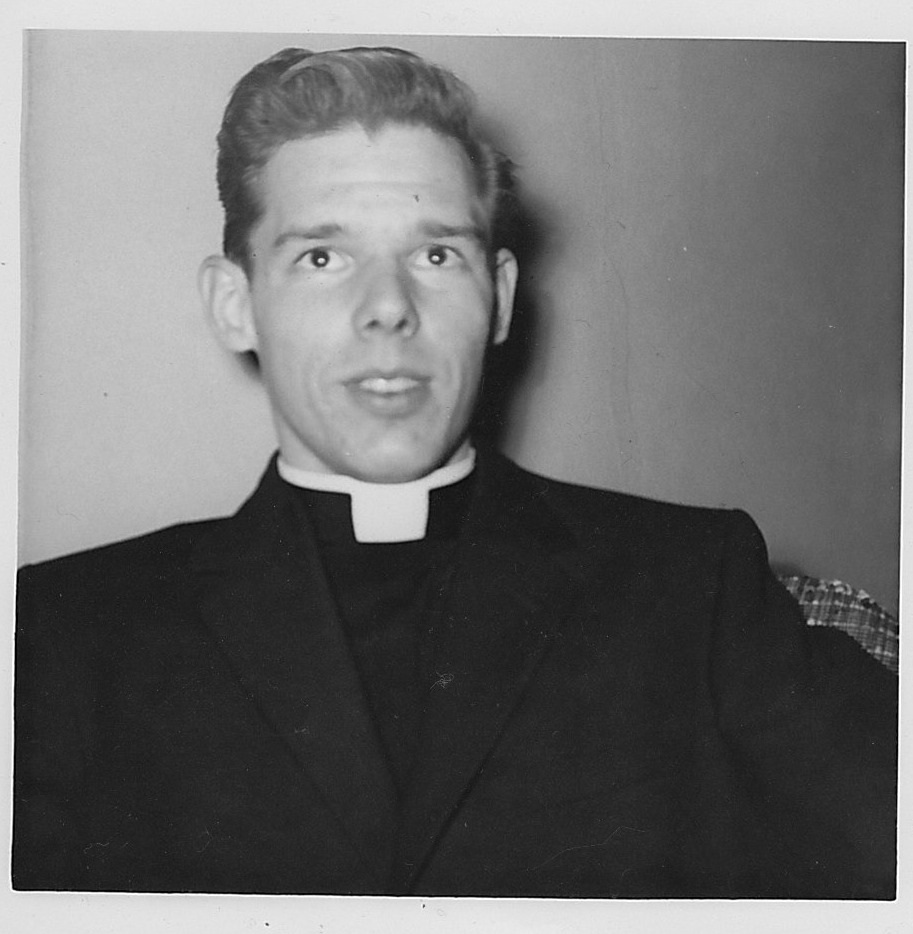
Pops at 21…on his way to change the world.
The occasion, for me, was already lacking the appropriate sense of solemnity, with the shouting from a baseball game just across the road filling the bright, evening air. Things seemed even further amiss as we headed in the direction of…well, what seemed to be nothing.
Where was the towering monument? The magnificent marble Pieta? Or at least a moderately ornate cross?
Being a big fan of horror movies, and fascinated with the ornamentation and mythology of the church, I had built up the idea in my mind that my father’s grave would be marked by something appropriate to his stature as an important religious leader. My ideas were perhaps weirdly informed by my recent reading of Scott Corbett’s “Here Lies the Body”—a story set in a graveyard, and involving a massive grave marker with a statue of a pointing, judgmental angel—not to mention occult symbols scrawled in blood, and a murder mystery. On top of that, to pass the time on the drive from state to state, I had also read and re-read a book of “real life monsters,” which included stories of Vlad Dracula, and Haitian zombification procedures.
So when I saw the flat, drab grave marker, I wouldn’t say my heart exactly sunk, but my 8-year-old mind certainly underwent some shifts in its understanding of the world–shifts I filed away for later examination.
A little over a decade later, when I bought a copy of Tom Waits’ “Blue Valentine” album, and heard the song “A Sweet Little Bullet from a Pretty Blue Gun” (about the 1977 suicide of a 15-year-old girl who jumped from the 17th story of a Hollywood hotel with her guitar) which contains the line, “Nebraska never lets you come back home,” that scene of my father’s grave came back to me, despite not having given it much thought at all in the interim.
The passage of time, and hopefully the acquisition of some tiny bit of maturity, led me to reassess the precise meaning of my father’s grave. I realized that that grave marker wasn’t about his importance in the world, or his stature in a small Nebraska town. It was just some sign, marking the place where the material–or perhaps more preciseley, the matter-bound–part of his existence was left. His influence, his importance, extends way beyond that little concrete or stone marker.
My father’s influence in the communities he served extends to this day, in part through the connections my family made in those communities. His impact, which, combined with the hard work and diligence of my mother, who raised five sons and a daughter in the years after my father’s passing, extends out into the world in myriad ways, through the hard work and community involvement of all of my siblings and their children—all in their own ways striving to make the world a more humane place.
For my own part, struggling to understand my father’s path in life before it was cut short, and trying to find my connection to it, has been a lifelong endeavor. And while I may have, at times, viewed my father and his life in weirdly iconic terms—iconic in the sense of symbols, signs, and signals to the outside world—I now view it as iconic in the sense of legitimate meaning and influence, the ability to impact the world positively by being a decent person…the same sort of influence I can only hope to emulate.
The last several weeks have seen charges of molestation, “aggravated crimes against nature,” and rape of a child, among others, brought against Will Hayden of Red Jacket Firearms and the Discovery Channel’s “Sons of Guns” reality show. Hayden has protested that the alleged victim, his own 12-year-old daughter, made the accusations only after his angry ex-girlfriend put the child up to it. The police and many news sources are now walking back their identification of the victim as Hayden’s daughter under laws that protect the identity of minors…but since it’s already splashed all over the Internet, I’m not sure what good that’s supposed to do.
I’ll put forth the disclaimer that anyone accused of a crime in the U.S. is innocent until proven guilty. I’ll also say I’m all for keeping things like this out of the media—but that’s clearly not the world we’re living in, particularly when such charges involve a public figure. After all, Hayden’s show was abruptly cancelled, and his business partners openly distanced themselves from him as a form of damage control to keep their custom gun business afloat. In addition, in the time since the accusations from Hayden’s minor daughter first surfaced, multiple other alleged victims have come forward, including Hayden’s adult daughter Stephanie, who initially defended him against the charges, but is now reportedly slated to appear on the “Dr. Phil” show later this week to explain that she was molested and raped by Hayden when she was a child.
And to add to the various disclaimers and caveats, I must also say I don’t know enough about Hayden’s past, or his current behaviors, to suggest that I, in any way, know that he fits, or doesn’t fit, the general clinical conditions suggesting high-risk behaviors for pedophilia or sexual abuse of a minor.
Let me also put forward that as much as there is an assumption of innocence for the accused, if we really want to make any headway on addressing sexual abuse of children, the assumption needs to be that children who come forward to seek help for sexual abuse are not making things up. When children are lying, their stories do not hold up particularly well, although depending on how skilled or unskilled, careful or careless, someone is when interviewing children, plenty can go wrong with the information that is gathered. But if our first reaction to children who report sexual abuse is to shut them down, or leave them in the homes of the accused, they are potentially being put at further danger, and a likely increase in the level of that danger.
And speaking of making headway in addressing issues of sexual abuse, I’ve noticed, at least as indicated by Internet comments, that when it comes to stories like this, we can count on public opinion to fall into a small number of categories:
1) Kill ’em all: This just involves amped-up vitriol aimed at sex offenders, and those accused of having committed sex offenses. I understand the anger. But, seriously, if you think that killing more people, or addressing problems of abuse with violence is the way to move toward a better society, a more healthy understanding of human sexuality, or better protection for children, you’re taking an overly simplistic view of the way the world works. And if you think this approach has some merit, why weren’t you able to spot Hayden and bring him to justice earlier? Is that anger and all those demands for vengeance really accomplishing anything?
2) “He’s obviously a rapist because he does/likes/thinks X.” Whenever somebody is in trouble for being an (alleged or convicted) sex offender, people like to equate the offender’s other behaviors and beliefs (that don’t jibe with their own) with the offense behavior. In the case of Hayden, some have connected “gun culture” to sexual abuse of children. And while, as anybody who has read my other posts knows, I am no fan of guns, I just can’t see anything productive coming from conflating gun ownership or gun manufacture with child molestation. Of all the people I know, holding varying levels of support for gun ownership or gun control, none of them have ever expressed an endorsement of sexually abusing children. This lack of support for sexually abusing children is pretty universal, regardless of one’s political beliefs, religious beliefs or hobbies.
Furthermore, while I have worked with a few offenders who have had guns figure prominently or incidentally in their abuse behaviors, they have been the exception, not the rule. In terms of grooming behaviors, things like money, jewelry, candy, drugs/alcohol, video games, clothing, toys, and porn have been involved in many more of the offenses I’m aware of than have guns. And I’m not going to advocate for the banning of any of those items based on the ability of abusers to involve them in abuse patterns. I’m more than happy to advocate for a ban on guns based on their use in—well, shootings—homicide and suicide and attempts at both, not to mention all manner of other crimes and accidental deaths, but as for their involvement in child molestation–not a huge concern, at least from what I’ve personally seen.
3) “How can somebody do this?” This is usually sideways of the “Kill ’em all” concept, and often involves plenty of name-calling. I get that it is very difficult to understand how somebody could rape their own daughter—or sexually abuse any child—but many of the factors involved are not beyond explanation. Most people just don’t want to hear the explanations…or deal with them…except in punitive, harsh ways once somebody has committed such acts.
Generally speaking, though, a person doesn’t sexually abuse a child because he or she is thinking clearly, or because he or she has just suddenly come up with such an idea after a long life of healthy relationships. If Hayden was engaging in sexual abuse of children, he wasn’t, one assumes, doing it out in the open, as such behaviors usually involve a great deal of secrecy and manipulation, like Hayden’s alleged warnings and threats to his daughter not to tell anyone, because, “I’m all you’ve got.” In short, people who sexually abuse children are ill and engage in a number of behaviors to try and mask that illness, or keep others from learning of it. I’m not sure how to properly emphasize this enough. Sexual abusers of children are not just random guys who are bored and horny. There are a lot of factors involved, including a huge number of elements (rationalizations, justifications, creating situations where one has access to children and is willing to take advantage of that access while plotting to keep anyone from finding out) that involve breaking down the normal barriers that prevent such sexual abuse. In other words, “How does somebody do this?” is a question that involves a long and extended answer.
…And now for a clip of Hayden that seems weirdly re-contextualized, check this out–especially the last 20 seconds or so…y’know, where he talks about people becoming bad headlines and how he tends to his own conscience.
Anyway, let’s say that way back before Hayden had ever (assuming he did) touched his daughter or any other young girls in a sexually inappropriate manner, he realized he was having thoughts in that direction, and that he needed to do something to steer clear of that behavior. What would he do?
For those of you who know what kinds of resources are out there for dealing with someone who is having thoughts of sexually abusing a child, bravo. Please do what you can to make sure others know. I will say that over my years working on the crisis line, I have fielded a very small number of calls from people (both men and women) who were concerned about the nature of some of their sexual thoughts towards minors—either specific minors in specific situations, or more generalized sexual thoughts—and were seeking help. In my years of dealing with offenders, I have seen numerous people who just might have sought help if they had any idea how to, and if they hadn’t felt like total garbage for acknowledging that they needed help.
But most people facing thoughts of sexual attraction to children do not have the wherewithal to seek help, much less have any idea where such help could be sought. It is a much more common reaction to deny that there is a problem, to try to push the thoughts away, or even to feed the thoughts (as in masturbating to inappropriate fantasies) while assuming that the actual offense behaviors can still be avoided.
Furthermore, treatment providers in the field of sexual abuse can have a difficult time promoting services. People tend to come to providers by referral from a lawyer or a community corrections officer (CCO) after they are already in trouble or have already served time, even though the same types of treatment could be just as effective before any offenses were committed. After all, just how welcome do you think a provider would be if they hung a sign out on their business that said “Sex Offender Treatment” or “Specializing in the Treatment of Sexual Deviancy,” or something similar? The stigma and shame that prevents people from seeking help for mental health issues as relatively common and accepted (and I mean relatively accepted) as depression, is increased a great deal for issues surrounding sexually inappropriate thoughts and behavior.
So, regardless of all that business about stigma and secrecy and providers protecting the privacy of their clients and confidentiality of their services…here’s a site that has a directory of providers throughout the U.S. It’s basically set up for people who are already in trouble. But it doesn’t have to be. This is through “Stop It Now” which has referrals to the Association for the Treatment of Sexual Abusers (ATSA) and numerous other organizations. Get help if you need it. Get help for others if they need it. That’s right, help, and try to discontinue the hurt.
Maybe if everybody calmed the f*ck down and decided they were more interested in actually protecting children than in getting angry at offenders, we might make some progress. And maybe tend to that part of your conscience that’s problematic before you become a bad headline, or before you celebrate a bad headline.






 Respect the Blankie