2014 in review

The WordPress.com stats helper monkeys prepared a 2014 annual report for this blog.

Here’s an excerpt:

The concert hall at the Sydney Opera House holds 2,700 people. This blog was viewed about 14,000 times in 2014. If it were a concert at Sydney Opera House, it would take about 5 sold-out performances for that many people to see it.

Click here to see the complete report.

The Old Normal

by JC Schildbach, LMHC

Just how the hell does anybody on a regular Monday-to-Friday workweek ever get anything done?  I mean, aside from work work?

For the entire month of November, and the first few weeks of December, I was on a Monday-to-Friday, 8-to-5 schedule. This was only the second time in over 20 years that I had been on such a schedule—the previous time being the training period for a new job, just like the most recent episode of “normalcy” was.

I was commuting at the same time as everybody else (read: taking almost three times as long to get to and from work as the trip should actually take). I was having lunch at the same time as everybody else (god help anyone who only has a half-hour at noon to try and get out to procure some nourishment—thankfully, I only had to do this a few times, and had a full hour for lunch).

I was doing my grocery and other shopping when everyone else was—either on my way home after work, or on the weekends—when the stores are at their peak crowdedness.  Navigating a single aisle at the grocery store, waiting for people to make their decisions and get out of the way, or waiting for them just to notice they were blocking the entire aisle by hanging onto a corner of their angled grocery cart while staring at a wall of spaghetti sauce, was trying.  And forget all of those little errands—running to the post office, for example—the extra-long lunch-hour or Saturday morning lines—uggh!

Everything seemed to take much longer than it should have. Everywhere seemed so much more crowded than it needed to be.

I felt crushed by this tyranny of scheduling normalcy, this chronometrically-imposed and enforced bottlenecking. Just how do people do this, day in and day out? How do they ever get anything done beyond the extra-slow commutes, and the added imposition of everybody else doing the same damn thing at the same damn time—or at least trying to?

Aaaaagh!  I feel like a stretched-out, messed-up face pinned down by a floppy clock!

Aaaaagh! I feel like a stretched-out, messed-up face pinned down by a floppy clock!  Or is that a decapitated, vomiting swan, wearing a fake beard pinned down by a floppy clock?

I forced myself through the daily tasks I absolutely had to complete, and blew off the rest for the weekend, and then blew them off again, as if maybe this next week I wouldn’t feel so tired after spending most of my waking hours devoted to work and the process of getting there and back.

Weekends felt short. By the time I felt rested and started in on that to-do list, the to-do list was necessarily pared down a great deal, with Sunday evening and Monday morning hanging over my head–sending me into to-do list despair.

I suddenly understood the asshole-ish behaviors of driving a bit too fast and recklessly to get that parking spot, the feigned ‘oh-I-didn’t-see-you-and-that’s-why-I-let-that-door-swing-shut-in-your-face-rather-than-chancing-you-getting-ahead-of-me-in-that-long-f***ing-line,’ the impossibly tight closing of the gap between one’s own car and the one just ahead to prevent anyone from merging and making the commute take even nine seconds longer. I suddenly understood these behaviors. I did not engage in these behaviors. It seems it would take years of this ‘regular workday’ harshness before one would be pushed to such extremes.  But I was just a tourist here in normal-land. I knew I would be leaving before long. I didn’t have to act that way.

The particulars of the situation helped me appreciate what I had experienced for so long, in terms of scheduling and work. When my kid was little, I was self-employed, working out of the home. All that time, getting her to and from school was a pleasant walk or a short drive—a little break in the work day.  I could attend to tasks at my own pace, except in the few ‘busy seasons’ when all hell broke loose and I had to hunker down for a few weeks or a month, working every waking minute, except for those quick trips to the school and back.

Later on, when I angled toward jobs in the mental health field that required shift work, it was so much easier to work all night, or in the evenings, and take care of all those other daily tasks when very few others were. There were several periods when I was allowed to knock out 40-hour workweeks in three days, leaving the rest of the week free—or for much of that time, free to go to grad school or work a second job. At any rate, I wasn’t tied to the same schedule as the bulk of the rest of the working world.

I’m now back to a bit of the old normal—a work schedule that helps keep me from needing to move about too much in the peak hours of the work-imposed world. I’m thankfully off of graves—not that I hated that—but it takes a toll, especially when you’re trying to spend some normal day hours with family and friends, and working occasionally at a second job that takes place during the day.  I’m back to having a few weekdays and a weekend day off, a schedule of four tens–and with no second job sapping hours from my days off.

I’m trying to get back to where I can spend my days off getting some stuff done—like writing on a sort-of-regular basis, or getting back to those projects around the house that are perpetually sidetracked or shelved. But I’m also having to undo a number of bad habits and weird practices that still linger after years of being up all night most nights, and sleeping during the day. Hell, I started writing the rough draft of this just before 2 a.m. since I fell asleep early and then couldn’t stay asleep through the night.

Still, the adjustment to the new schedule isn’t nearly as rough as the adjustment to the ‘normal’ world of the rest of the day-walkers. I’m settling in to something of the old normal—awake and working during the days—just not always when the rest of you humans are clogging everything up.

While I enjoyed the training I was doing, it wasn’t really all that fun visiting your overcrowded, poorly scheduled world, and I definitely wouldn’t want to live there.

Thanksgiving Greetings from an Ingrate

by JC Schildbach

With all apologies to the wonderful people among my family and friends who have prepared some amazing holiday meals over the years…

Thanksgiving is one of those holidays that I’ve had to learn to love…or like a lot…or maybe just kind of like. As a kid, Thanksgiving didn’t have the obvious benefits of other holidays—like Halloween (monsters and candy), Christmas (presents and flashing lights), New Years Eve/Day (getting to stay up late and listen to the top-whatever countdown of the year’s/decade’s/history of rock’s top hits), July 4th (explosions, fire, and kickass food prepared with fire). I could go on, but I don’t know if even adding fire could really make Thanksgiving all that interesting.

Way back when, the only really good thing about Thanksgiving was getting a four-day weekend, which was pretty weird, anyway. I mean, really, why put the holiday on a Thursday? If it was a celebration of Thor, that would be cool. Hey, maybe that’s the key to making Thanksgiving interesting—Thor. Well, probably not.  But so far the best thing anybody has come up with is to add in a bunch of football games, which, as far as plans for making things interesting goes, is shaky at best.

And, sure, I liked turkey-based art projects. And I liked watching the parade with the giant balloon cartoon characters, but then there was that whole thing of having to sit through multiple marching bands and other weirdness and commercials in between the giant, inflatable cartoon characters. How much patience did these people expect 8-year-olds to have? And let’s face it, not even Ethyl Merman loves a parade, no matter how enthusiastically she belts out that musical lie.

Overall, Thanksgiving just felt like an excuse for adults to make kids put on clothes they should never have to wear outside of a church, forcing them to be itchy and bored for hours on end, while waiting for a meal of foods nobody really wanted to eat anyway. I blame Thanksgiving for tilting me toward a mild obsession with mashed potatoes. Peppermint Patty hollering, “Where’s the mashed potatoes?” is something I relate to entirely too well.  My anxiety over the thought of attending a Thanksgiving dinner that has all the usual stuff, but no mashed potatoes…unreal.

As far as the rest of the Thanksgiving fare goes…Turkey—sure, that’s fine, I guess. Cranberries—I like them well enough now, but as a kid, I just couldn’t help but think they tasted all wrong. They were berries, but they weren’t really sweet. They just should have been different somehow. And speaking of sweet-and-should’ve-been-different, there are those damn sweet potatoes. Who wants to eat that? It’s brown sugar and something that’s kind of like a potato, but kind of like a carrot, and squishy, and…uggh, I don’t even wanna think about it.

And then there’s green bean casserole. Actually, I quite like green bean casserole. But nobody in my family ever made the stuff.

All the appeal and excitement of a traditional Thanksgiving meal, straight out of the box.

All the appeal and excitement of a traditional Thanksgiving meal, straight out of the box.

On top of the conspicuous absence of green been casserole, there was always some heinous cornbread dressing—chock full of eggs. Did I mention that I’m allergic to eggs? So, yeah, it’s great to have a meal that involves plenty of unappealing food, including at least one awful food with plenty of deadly toxins—toxins aimed only at me!! Haven’t you people heard of Stove Top? It’s much easier to make, and much less deadly.  While we’re, on the egg tip…there were always weird, unappealing things like Waldorf salads, slathered in eggy mayonnaise.  There were pumpkin pies and pecan pies–eggs, eggs, eggs!!

And, well, just forget the rest of that food, okay?  I’m already in danger of going fetal here.

Since I’m an adult now, more or less, and I get to make at least part of the decision about what’s going to happen on holidays, we eat out on Thanksgiving—every Thanksgiving since 2010. This started out as a matter of practicality. I had been doing shift work for a few years already at that point—jobs that involved round-the-clock coverage, with holiday time off at a premium.

So, doing the whole, make-a-big-meal-and-then-take-off-for-work, or work-all-day-and-then-come-home-for-a-meal thing wasn’t exactly conducive to Thanksgiving harmony, especially when my wife had to take the lead on the meal with little support (hey, I took care of the shopping), and I would either be at work or asleep prior to going to work. Accepting invitations to other friends’ Thanksgiving meals was also complicated by my work schedule—so the wife and kid might go to a friend’s holiday meal without me (which was fine with me, but my wife felt bad about it).

To be sure, my wife is an amazing cook. But traditional American cuisine, and traditional American holiday cuisine, is not her forte’. She made some wonderful holiday meals (that whole incident with the Reynolds roast-in turkey bag not withstanding), but wasn’t always able to tell if things had turned out successfully, since the things she was making were a bit foreign to her. And given her highly-self-critical nature, no amount of reassurance was going to make her happy. So, forget it—let somebody else stress about the meals.

Most years, Thanksgiving out involves just my wife, my daughter, and me—although last year we had the pleasure of booking a party big enough to get us a private room at Preservation Kitchen—which is a pretty amazing place—and which was my favorite Thanksgiving meal since we’ve been doing the restaurant thing. I spent the bulk of the meal sampling beers (after a dirty gin martini opener) and conversing with a second grader. And since he and I have a similar sense of humor, it worked out pretty darn well.

I’m guessing most U.S. citizens feel obligated to be involved in some family-oriented, meal-centric Thanksgiving hassle, because that’s what you’re made to do growing up. But I’ll be damned if I’m going to let some weird sense of obligation ruin a perfectly good (if boring) holiday, that should be about things we’re thankful for. I’ll just say, I’m extremely thankful to be able to blow a few hundred bucks on a nice meal out, rather than blowing a few hundred bucks on a bunch of stuff that we now have to prepare ourselves amidst a bunch of other logistical complications.

Today, we’re hitting Palomino in downtown Seattle. Haven’t ever eaten there. Maybe I’ll post an update so you’ll know if it was at all satisfying. Maybe I won’t. I refuse to feel overly obligated by all this.

So, Happy Thanksgiving, everyone! If you’re eating at somebody’s home, be nice to the hosts and steer clear of conversations about religion, politics, and the Great Pumpkin. If you’re eating out, tip well—really, really well.

Three Frightening Movies that Aren’t Traditional Horror, or Suspense, or…

Well, Halloween is over, but who cares? You can still keep on scaring yourself, right? Only, rather than the usual gore and mayhem, how about some unsettling horror, the kind that makes you question the reality of the movie, it’s characters, and your own thought processes?

Don’t get me wrong, I’m a big fan of the traditional monsters-and-bogeymen (bogeypeople?) style of horror. But sometimes it’s good to be scared by things that aren’t quite so over-the-top. And speaking of over-the-top, you’re probably already irritated with all the ‘Early Black Friday’ specials and the ‘Holiday’ ads anyway.

The movies listed here also get at some small bit of what it is/might be to cope with various forms of mental illness, or to deal with others who are struggling with it. They spotlight what it is like to be unsure about what is happening, and to have a difficult time understanding what constitutes legitimate forms of support. These are movies that cause a tightness in your chest, and not the kind that is alleviated by the next hissing cat springing out of a cabinet, or garden tool splitting open some body part or other.  They carry with them the kind of dread that has a real impact.

And I’m going to say there’s probably a good chance that these movies should come with some trigger warnings, in case that’s not obvious from the descriptions.

Safe (1995): From Todd Haynes, writer/director of Velvet Goldmine, I’m Not There, and Far From Heaven, Safe sees Julianne Moore as Carol White, a woman who, after much confusion from a wide range of medical, mental health, and ‘other’ providers, is diagnosed with Environmental Illness, a disease that makes her hypersensitive to various chemical agents that are common in everyday life in modern America.

But is she really suffering from anything, or is the disease a physical manifestation of the sheltered nothingness her life has become? The only people who claim to understand her and her disease have clear motivations for convincing her she’s sick, while those who tell her she’s fine seem to lack any concern for her whatsoever.

As much an indictment of the “American Dream” of being completely carefree (there’s no such thing as “safe”), as it is of various forms of mental and physical healthcare, and the lack of clear, irrefutable knowledge to address all maladies (despite ‘professional’ claims to the contrary) Safe will have you clearing your throat, checking your temperature, wondering just what that smell is, and…wait, that’s probably not the best way to encourage anybody to watch a movie.

Safe is a bit difficult to track down. They don’t have it available on Netflix in any format, and Amazon only has it for sale as a DVD or Blu-Ray. Here’s a trailer (that kinda sucks)…

Affliction (1997): Written and directed by Paul Schrader (writer of Taxi Driver, and writer and/or director of numerous other impressive works), based on a novel by Russell Banks, Affliction sees Wade Whitehouse (Nick Nolte) descending into unreality, or perhaps hyper-reality, during what should be the routine investigation of a hunting accident. Having grown up in the shadow of an abusive father, played in frightening fashion by James Coburn, Wade never quite makes it out into the light that might help him establish some reliable sense of self.

An occasionally brutal meditation on familial abuse, PTSD, and other forms of trauma, this one is a slow crawl over gravel, peppered with the occasional hot coal. It’s available right now streaming or by disc on Netflix, as well as on Amazon Prime.

Here’s a trailer (that isn’t all that bad…)

Take Shelter (2011): From Jeff Nichols, also writer/director of Mud, Take Shelter stars Michael Shannon, aka General Zod and numerous other amazing roles, as Curtis, a man convinced that tornado season is bringing something much more sinister than twisters. Curtis jeopardizes his job, his financial security (including money saved for a cochlear implant for his daughter), his friendships, and his marriage to Samantha, played by Jessica Chastain, to build a storm shelter that can keep his family safe from not only storms, but perhaps the end of the world.

Nichols keeps the audience off balance by providing plenty of information that is clearly accurate, or at least witnessed by people other than Curtis, and also including a number of elements we can’t be so sure of. Is Curtis the only one alert to the signs of danger all around? Or is he suffering a breakdown of some kind?

Take Shelter is currently available via disc on Netflix, via Amazon or AmazonPrime in multiple formats, and on Starz—both on-demand and in the regular schedule.

Here’s a trailer (which is pretty darn good)…

So, happy no-longer-Halloween season. And remember, Thanksgiving and Christmas are still a good, long way off…as well as being great times to share disturbing films with family and friends.

The Stigma of Mental Illness and the Noble Savage Myth

Okay, I’m kind of cheating here.  I haven’t posted anything for a while, so I’m popping this up.

This is an article I worked on with Dr. Jeffrey Guterman, based in part on a post I did for this blog (which was a great deal snarkier, and which I will re-post at a later date).

Enjoy… The Stigma of Mental Illness and the Noble Savage Myth

noble savage photo

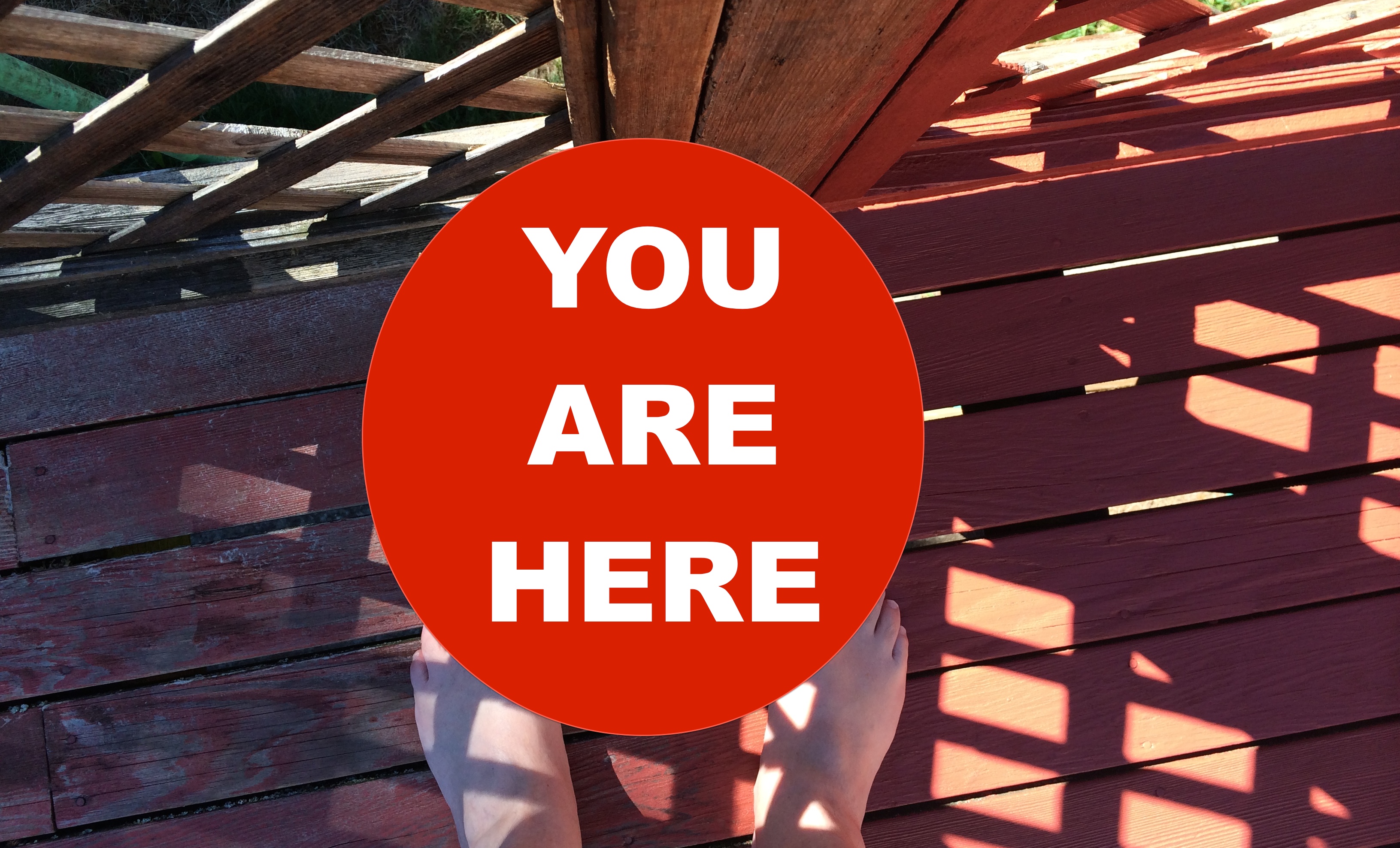
You Are Here

By J.C. Schildbach, MA, LMHC, ASOTP, Carbon-based being

If any of you pay all that much attention to this blog, then you may have noticed it’s been a little quiet over the last few weeks.

When I look at it objectively, the inactivity here makes plenty of sense. I caught a nasty summer cold at the same time I had a lot of extra work at my second job, along with the usual work at my full-time job, which has been predictably plagued by the summer vacations and seasonal staffing changes, leading to workload strains.

I was also trying to finish some of those summer projects—particularly the pressure-washing and re-coating of the deck. Even in summer, trying to get the weather to cooperate with my days off can be a challenge, not to mention my complete inability to accurately predict how long any project will take me. I’m working on a formula that is something like AT = h x 4 + 36d, where AT = actual time, h = the total number of hours I predict something is going to take, and d = days.

Whatever the equation or excuses, it’s not like I haven’t had plenty to write about. Hell, I’ve even cranked out a thousand-plus words on each of a few posts—a follow-up piece to one I wrote about a conversation I had with my niece; and one on Will Hayden of “Sons of Guns” getting arrested for allegedly raping his daughter repeatedly over the course of two+ years. (Just now, it occurred to me that the way to make those two posts work might be to combine them and dump at least half of what I wrote). When I couldn’t make these newer efforts work out, I tried re-tooling some things I had written earlier that I never liked enough to post. But all of it was turning into disjointed, bland, repetitive…stuff…stuff that I couldn’t quite untangle and reweave to the level I wanted. Trying to make any of it work at all started to feel too much like drudgery and burdensome obligation.

There were other things going on as well—upsetting situations with friends that, although, or perhaps because, I couldn’t do anything about them, were very draining. On top of that I was jumping through hoops to try to get adjustments made to the particulars of a contract, after spending over a month jumping through hoops to get to the point where any contract had been established at all. Expressing an intention to walk away rather than trying to fix anything more turned out to be just the thing to motivate a real resolution. Now why hadn’t I thought of that sooner?

A number of valued co-workers have also been moving on to what I hope are greener pastures for them, pastures that I hope will not become so lush and large that they put us out of contact. Among those who are moving on is a talented, funny, and inspirational artist.  Another who has made the big career shift is an ever-observant thinker who, with a few counselor-ly questions and observations—including pointing out the need to ‘mourn’ or otherwise acknowledge the little losses, such as co-workers moving on—has repeatedly helped me recognize whether I’m actually charting a course, or merely bobbing about in the tides.

Straddling the line of done and undone, looking for the passage to motivation.

Straddling the line of done and undone, looking for the passage to motivation.

I could turn this into a more deliberate post about self-care and minding one’s moods—about paying attention to those signs of situational depression—like pushing too hard and not having enough fun when trying to write one’s blog pieces. But really, getting this out was just about writing something that wasn’t a big struggle to be clever or original or even relevant. It was about scanning the map for that red dot or arrow that says, “You Are Here” so that maybe I could make my way to an exit and head back home.

In truth, none of the points I mentioned above are completely resolved. But at least I decided to go find that big, light-up plexiglass mall-map rather than wandering about looking at things I don’t want or need.  And now that I have some idea of where I’m at, it might be a little easier to get back to where I parked my car…after I hit a restroom.


Suicide?!? Shazbot!

By J.C. Schildbach, MA, LMHC, ASOTP

Before we get started, let me just mention that I spend the better part of my workweek involved in crisis intervention and suicide prevention. And let me note that anybody’s reaction to the death of another is going to be personal, and related to the kind of connection between them.

Now, let me tell you something horribly, selfishly, insensitively awful about me.

When I first heard of Robin Williams’ death by suicide, my thoughts were, more-or-less in this order…

1)  Damn!

2)  60-something-year-old man…history of mental health issues…history of substance abuse…makes sense.

3)  I wonder what else was going on with him.

4)  I am NOT going to write a blog post about this.

5)  Uggh! There’s gonna be a shitload of extra calls on the crisis line tonight!

Somewhere down the line was, “Shazbot!!” I totally f*cking wish “Shazbot!!” had been my first thought.

Anyway, before you climb all over me for my previously-mentioned insensitivity and selfishness, or whatever you might want to call it (I think I’ll call it “appropriate clinical detachment”), let me explain, in order of those thoughts.

1)  Yes, “damn!” It was shocking and unexpected to hear such a thing, essentially out of the blue. As for the context…I received a text message from my daughter about Williams’ death while running a plethysmography assessment (look it up). What this means is I was sitting in a small, dark, very stuffy and hot room running what I imagine would seem to most people to be a very disturbing clinical assessment to determine what kinds of really terrible things might lead to…ahem…responses for somebody with some admittedly inappropriate arousal patterns.

In such a situation, I didn’t have a lot of options for furthering a conversation or following whatever breaking news may have been happening. I had to shelve whatever thoughts or emotions I was having, and continue on with the assessment.

(You may ask why I wouldn’t have turned my phone completely off during a forensic assessment, but the reality of it is that the trace of the assessment is being recorded for later review, where it’s much easier to spot problem situations, and that turning my phone off only leads to things like my daughter destroying a sliding glass door because she locked herself out of the house on a cold day in early March—long story—well, not really, I think I just told it).

2) Which leads to…”60-something-year-old man…history of mental health issues…history of substance abuse…makes sense.”

Sitting in that dark, stuffy, hot room, staring at a double-lined forensic “trace” on a computer screen, with few responsible options available for furthering my knowledge/understanding of the situation, the defense mechanism of clinical detachment kicked in. Think about it, yelling “Oh my God!,” or sobbing openly, or exclaiming, “Shazbot!” all would have been pretty inappropriate.

At any rate, the quick run-through of Williams’ risk factors is the kind of clinically detached comment that I suppose is hard for a lot of people to take, especially when it has not been filtered at all. I can’t speak for everybody in the field of counseling/therapy, mental health, or even crisis intervention and suicide prevention, but there’s an odd dichotomy that exists in most people who get involved in such fields: we tend to be highly sensitive people; we learn to be very objective about that sensitivity.

If I wanted to get all sci-fi, I could say people in this field are empaths…empaths who have honed their skills away from making them one big, raw nerve, and toward using that sensitivity to discern a deeper sense of what is happening in others without being overwhelmed by it. Most of us have some pretty pronounced defense mechanisms. So, ideally, our training leads to an ability to pick out risk factors and make judgments about how those risk factors affect a situation, so that an appropriate course of action can be taken. Such risk factors are not predictive, but tend to be more actuarial.

Furthermore, the assessment of risk factors tends to weed out irrelevant elements. I’ve heard so many people go off about Williams’ fame and money as if that should have kept him from suicide, but those factors are irrelevant to a suicide assessment…except perhaps in the context of Williams’ available resources for obtaining help. But, and here’s a big generalization (as well as a big but), for somebody who is at the point of committing suicide, the concept of “help,” regardless of one’s resources, has become rather abstract and unreachable. From such a viewpoint, the available “help” appears to have been exhausted and shown to be inadequate. So, pushing past the money and fame, if one looks at Robin Williams from the standpoint of demographics and his personal history, he fits into a high risk category—or, rather, multiple high risk categories, even before other information about his health was revealed.

3)  “I wonder what else was going on with him” was merely a further part of the assessment of risk and what led Williams to his course of action. In suicide risk assessment, this is a huge factor. (Can I get a ‘duh’?). If the demographic factors alone played the deciding role in whether somebody was going to commit suicide, then we’d have near-universal suicide by people who fit into the same demographic categories as Williams.

Hence, one of the things that is always asked of people expressing suicidal thoughts is some variation on “Is there anything in particular that’s leading you to feel this way?”

The big idea behind such a question is to open up a conversation with someone who has, perhaps, not had such an opportunity to discuss what’s going on with them. A lot of people who attempt suicide, or are headed in that direction (here’s another big generalization) have been very closed off about their thoughts, and what they’re going through. Sometimes, broaching this conversation, being able to “normalize” suicidal thoughts (let people know they’re not as rare as they might think), and giving somebody a chance to talk through their immediate experiences, can lead to a person discovering that they have supports and strengths they weren’t considering when they were staying closed off and keeping it all to themselves.

4) The idea that “I am NOT going to write a blog post about this” came from a number of places. As someone who works in suicide prevention, and who writes a (mostly weekly) blog it seemed almost obligatory for me to at least note Mr. Williams’ passing. I shudder at “obligatory.”

Also, following any highly-publicized suicide, a whole slew of TV pieces, articles and blog posts (among other things) commenting on suicide and depression and the lives of those who complete or attempt suicide go flooding out into the world. It makes sense that people want to find out what happened, or understand how it could’ve happened, or share their personal feelings, or pay tribute, or say obnoxious, ignorant things…and there is often plenty of overlap in all of that.

And all of the posts and articles, and TV pieces close out with the phone number for Lifeline, the National Suicide Prevention Hotline, urging people to get help for themselves, or for anybody they know, who is considering suicide or having suicidal thoughts.

As I’ve noted in other posts, I don’t do death too well. And I don’t really like talking about a particular celebrity because they died, or talking about suicide because that’s how someone famous died. I don’t generally shy away from talking about suicide, but I’m not deep into worrying about what celebrities are doing in their private lives. At any rate, when such conversations happen, I find myself slipping too far into the clinical, or just keeping my mouth shut. As for Robin Williams…I’m pretty sure I saw the entire run of “Mork and Mindy” and the “Happy Days” episode that spawned Mork, although I couldn’t really tell you much of anything about any of those storylines…as apparently memorable as they were, what with the rainbow suspenders and flying eggs and all. I’ve seen several, but definitely not all, of Williams’ movies.

Williams, like almost any accomplished artist who is around long enough, and productive enough, is going to put out work that is great, and some that is less great. The last thing I saw him in was “World’s Greatest Dad”—strangely enough, a story about a man who becomes a sort of celebrity after he ghost-writes a suicide note to cover up the fact that his teenage son died from autoerotic asphyxiation. I really enjoyed this movie, like I’ve enjoyed all of Bobcat Goldthwait’s movies (the ones he writes and directs). They tend to involve a kind of dark humor and exploration of at least mildly taboo subjects that are right up my alley. And, as a special bonus, “World’s Greatest Dad” was partly filmed at a bookstore and “mall” about five minutes from my house.

Williams as the most talkative mime ever in "Shakes the Clown"...shattering expectations for better or worse.

Williams as the most talkative mime ever in “Shakes the Clown”…shattering expectations for better or worse.

But then again, I had also written some spotty notes about how “Good Will Hunting” is one of numerous movies that gets the therapeutic relationship all wrong. I could continue on about liking how “Alladin” made good use of Williams’ rapid-fire joking, as did “Good Morning, Vietnam” and how he did some good stuff around mental health issues, like “Awakenings” and even “Patch Adams.”

I could tell of how I once spent half of a 9th-grade biology class trying to stop laughing uncontrollably after attempting to relay part of a Williams comedy routine to my lab partner (who is still my closest friend, not counting my wife). To completely butcher the joke, it involved Williams doing an impersonation of E.T. saying “ouch” because he was standing on his testicles.

5) Which leaves only “Uggh! There’s gonna be a shitload of extra calls on the crisis line tonight!”

I’ll concede that this is a pretty damn selfish thought. But, to provide some context, the call volume on Lifeline, the National Suicide Prevention Hotline on Monday, the day of Williams’ death, was double the call volume of the day before. On Tuesday, August 12, Lifeline had its highest call volume ever in the history of the service.

It’s true that not all of those calls involved people with suicidal thoughts, or suicidal intentions. The calls were not all from people standing on a bridge, or sitting in their living room with a gun in their lap, or lying in bed with several containers of pills and a bottle of gin beside them. Many of the calls were people asking how to get help for people they know. Many were people upset and sad at Williams’ passing, and just trying to process their own thoughts. But many were from people struggling with suicidal thoughts and intentions, several of them consumed with the idea that if Williams, with all he had achieved, was going to kill himself, then why shouldn’t they?

And, of course, people being the way they are, whenever the Lifeline number gets widely published and shared around on social media, there were more than the usual number of prank calls. (Quick note, kids: DO NOT prank the Lifeline—we have to take suicidal threats seriously, which means you might get a visit from the police as the price of your little joke, and as the price to the people of your hometown, who now have police officers responding to a non-emergency situation because you thought it was funny to be the kind of asshole who mocks people suffering from depression).

On top of the massive increase in Lifeline calls, most of the Lifeline call centers also serve as local crisis lines, and there was a huge uptick in the calls to local crisis lines (I don’t have specific numbers on this one yet, but trust me). Several of the Lifeline call centers, including the one I work in, also serve multiple functions within the local mental health system. To say the least, things got a little overwhelming.

I could go on about a number of other factors involved here, like how, while some call centers may be able to call in additional volunteers to address the short-term spike, generally speaking, the staffing, as with any business, is aimed at addressing an ‘average’ workload.  And there isn’t any way to suddenly increase the number of telephone lines and work stations to deal with what is, ultimately, only going to be a short-term (even if massive) increase in call volume.

By Thursday night/Friday morning, things seemed to be calming down a bit, easing back down to normal…at least in terms of call volume.

But we’re all still left with the sadness and the loss of an entertainer who reached people worldwide, and the struggle to understand and accept whatever this means to us personally, or societally, or clinically.

And, oh yeah…

If you or anyone you know is struggling with suicidal thoughts, PLEASE PLEASE PLEASE call LIFELINE, the National Suicide Prevention Hotline, at 1-800-273-TALK.

How About We All Stop Using “Schizophrenic” as an Insult?

by J.C. Schildbach, LMHC, ASOTP

One night about two years ago, I challenged a friend for describing his behavior as “schizophrenic.” In an admittedly snide tone, I asked a quick barrage of questions referencing various types and symptoms of schizophrenia: Are you catatonic? Paranoid? Suffering from delusions? Auditory hallucinations? Visual hallucinations? And so on…

Somewhat unexpectedly, my friend responded with an apology for his use of the term, and didn’t engage in any kind of defensive posturing or attempts to justify his word choice. He clarified that he meant he had changed his mind back and forth several times in relation to a particular situation.

I was a little surprised that I had reacted in such a way to what was supposed to be a self-deprecating comment from a friend. But there were a number of things weighing on me at the time, not the least of which was that my friend was seeking advice on a matter that was best kept between him and his partner, and maybe a good couples counselor. As with most of the times he sought advice, he had already made up his mind about what he intended to do, and was looking to have his intentions validated, or to have them challenged with an argument so compelling that he would have no choice but to turn from that position.

Aside from my irritation with the immediate situation that evening, I had been in contact earlier in the week with a young man diagnosed with schizophrenia. He was in some pretty serious legal trouble, and did not appear to comprehend all that much about it except in the most concrete of terms. That is, he knew what law he had broken and why it was problematic. That information had been drilled into him during his time in court and a stay in jail. But his sense of what the crime meant, and how it was going to impact him, his connection to others, and the choices he was going to have to make, both short- and long-term, was murky at best. It struck me that he was so used to being marginalized that his current situation involved just one more bureaucratic system to interact with—as if this latest set of restrictions was little more than an additional cluster of tasks to occupy his time.

Working in crisis intervention, I also have fairly frequent (phone) contact with people coping with schizophrenia and other mental illnesses that involve psychotic symptoms of varying levels of severity, and which often fluctuate over time. There are few, if any, blanket statements that would accurately cover them all, or make a nice, tidy explanation of what they are dealing with. But, unlike the popular usage of the term “schizophrenic,” the way my friend had engaged it, the behavior, thoughts, and challenges of those dealing with schizophrenia are not simply a matter of being indecisive or changing their approach to an issue.

In the time since I first barked at that friend about his use of the word “schizophrenic,” I have seen it become more and more commonly used (or, perhaps, it was used a great deal before that, and I just hadn’t noticed). Currently, in addition to the way my friend used it, to describe his somewhat erratic decision-making behavior, it is used quite often in relation to politics, and often by writers and other figures I respect or at least tend to agree with. Such uses, though, are potentially offensive, and even insulting in a way that is beneath anyone attempting to make a serious point.

For example, in recent weeks it has been relatively easy to find articles, or to come across people on television news/opinion shows, complaining of politicians behaving in a “schizophrenic” fashion toward immigration policies. Generally, what the use of the term “schizophrenic” means in such a context is that the politicians are saying one thing and doing another, or that they have changed their position on an issue multiple times. It is basically used to mean that a politician or group of politicians have been inconsistent on an issue.

A quick Internet search can find all manner of uses of "schizophrenic" as a derogatory label--frequently in political discourse.

A quick Internet search can find all manner of uses of “schizophrenic” as a derogatory label–frequently in political discourse.

But the problem with using “schizophrenic” to describe contradictory political positions is that it suggests the politicians are suffering from a diagnosable mental illness that is beyond their immediate control, and which can interfere with their perceptions of reality, rather than that said politicians are making rational decisions based on what they think will get the most traction with their “base” or constituents. Politicians shifting their political positions is something that is done with the assistance of political strategists in an attempt to get a message out to voters in a way that might provoke support of a carefully crafted message, even if that message is inconsistent over time.

Schizophrenia, on the other hand, is not volitional. It is not deliberate. People who are living with schizophrenia are not choosing one day to deal with only minimal or well-managed psychotic symptoms, and the next day to pursue the exact opposite. People coping with schizophrenia do not, for example, determine that they will change the content and intensity of their auditory hallucinations based on political polling and messaging strategies. They are not thinking of the gains to be made by crafting an elaborate delusion wherein their friends and family are colluding with various government agencies to monitor and control them.

In short, saying that one’s political opponents are “schizophrenic” is just a different way of labeling one’s political opponents with the big, sloppy label of “crazy”—of indicating that their ideas do not merit any consideration because the people presenting those ideas are not grounded in reality. But, because “schizophrenic” is being used as an insult, as a way of accusing somebody of being worthy of ridicule and dismissal, by extension, it implies that people with schizophrenia are also worthy of ridicule and disrespect. Using “schizophrenic” as an insult encourages ongoing stigma towards those with mental illness. It encourages a lack of understanding of mental illness, and of how to address the needs of those struggling with it. It is dehumanizing in the way that all insults aimed at one’s “enemies” are intended to dehumanize.

And people with schizophrenia are not our enemies. They are people struggling with something that we only barely understand. They are people who, at the very least, do not deserve to be lumped in with politicians who are fine-tuning messages of anger and outrage to try and get votes.

Now, lest anyone think I’m engaging in “word policing,” let me say that I am. As much as language is a dynamic thing, there are still right and wrong ways to use words, or rather, more and less accurate ways of using them. We still make daily decisions about whether we are going to use words to clarify or to obscure, to increase understanding or to confuse. The word “schizophrenia,” unlike a number of other words used in mental health diagnoses (anxiety, narcissistic, etc.) was coined, by Eugen Bleuler around 1908, specifically to refer to the mental illness. It literally means “split mind.”

Arguably, the literal definition of schizophrenia could easily be applied to various other situations such as the one’s already described, and it would not be inaccurate. And, arguably, the mental illness or cluster of illnesses known as schizophrenia involves a broad enough range of symptoms and presentations that the diagnosis requires specifiers for clarification in individual cases. Still, rather than taking a word created to refer to a mental illness, one that will always have ties to that mental illness regardless of how one claims to be using it, and expanding the use of that word to include any behaviors one perceives as inconsistent or otherwise in opposition to one’s own beliefs about appropriate behavior, why not pursue more accurate understanding of the word, and a greater understanding of what the mental illness means, and does not mean?

It seems to me that, rather than calling politicians “schizophrenic,” it would be much more damning to say that one’s political opponents are completely inconsistent in their approach to an issue because they feel that they can achieve greater political gains by changing their position and their message, instead of sticking with real principles or working hard to find real solutions to complicated problems.

And instead of labeling our own actions, or the actions of others as “schizophrenic,” simply because they are inconsistent, appear contradictory, or we disagree with them, why not just acknowledge that most of us are not as steadfast and true as we like to imagine, and that we often don’t make decisions unless and until we have to? Why insult people with schizophrenia by suggesting our poor decision-making skills are the result of a serious mental illness, one that involves much deeper struggles than indecisiveness or occasional mild impulsivity?

How about we all stop using “schizophrenic” as an insult?

Requiem for a Snake

My daughter’s pet ball python, Smeagol, died over the weekend. We had no reason to think anything was wrong with him. The last time I observed him for any length of time—Friday, as I was yawning through the long pauses of eliminating a computer virus—he seemed just fine, climbing the ceramic branch/rock fixture in his cage. Sometime between then and Sunday, he vomited up his last meal—a partially-digested black mouse, eaten several days before—and shuffled off this mortal coil, while coiled on the floor of his cage.  I first took notice because he was lying there with his “nose” up under his body, which would have made it extremely difficult for him to breathe—had he still been breathing.

Smeagol was only about ten years old—not all that old for a ball python. And he wasn’t around long enough for me to resolve my mixed feelings about him. To put it mildly, I am not a big fan of snakes. To put it less mildly, they freak me the f*ck out. Constrictors, like Smeagol, don’t raise a panic in me as bad as smaller, squigglier snakes, or, of course, vipers and the like that can cause all manner of swelling, necrosis and more complete death with a single bite. But, still, he was a snake. And for me, that took a lot of getting used to—or not getting used to.

When my wife questioned my dislike of snakes, and more specifically, my queasiness toward our daughter’s pet, I told her that snakes are essentially tubes that crap out of one end, and bite with the other, and that being shat on and bit are not high on my list of favorite things. I didn’t explain to her how, when I saw a snake just out and about, say, in a field or a forest, I would completely lose my mind. She’s only come close to witnessing a subdued version of that once or twice. She still tried to convince me that Smeagol was cute—and he was as far as snakes go. He was pretty, even, with a funky black and brown pattern, a white underbelly, and a face that looked to be smiling.

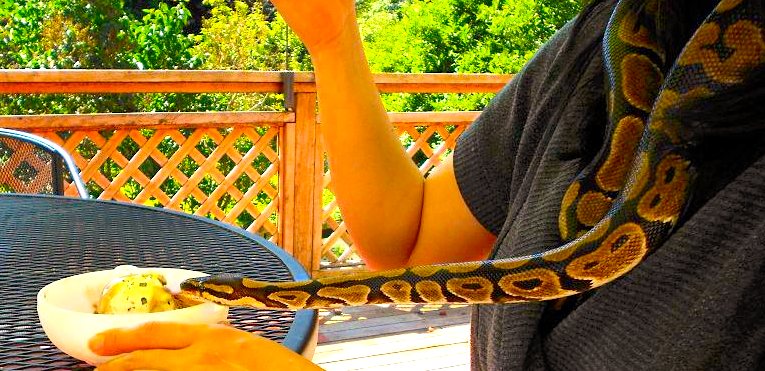
Smeagol investigates some ice cream.

Smeagol investigates some ice cream.

We had invited him into our home under the thought of good parents supporting our child’s interests. Back when she was in the fourth grade or so, our daughter got caught up in the idea of having a pet python. I told her if she could save up the money for a snake, I would buy the cage—a large, glass tank, with a screened, slide-out lid—for her birthday. Truth be told, I wasn’t sure she would meet the challenge. Ball pythons are not cheap; and I figured something else would capture her attention before she finished piecing together the money. But cash received as birthday gifts put her over the top of her fundraising goal, and she held me to my promise.

On the night we first brought him home, Smeagol bit my daughter, who admittedly was not exercising any caution whatsoever toward a small, confused animal who had just been stuffed into a box and transported through a cold, November night, to his new and unfamiliar home. I tried to tell her to just put the box in the cage and open it there, to let him come out in his own time. But instead, she set the box on a table, flipped it open, and reached in. Chomp!

Granted, when Smeagol bit anybody, it was more like a nip, designed as a quick warning. But he invariably drew blood with his little, hooked teeth when he did it. It was lightning fast, too, almost impossible to escape once he had a mind to do it. I know of two occasions, aside from his first few minutes in our home, when Smeagol bit my daughter. I also remember him taking a shot at one of our dog’s noses. The dog was just curious and unsure what to make of Smeagol. Smeagol took the dog’s face, with its looming mouth, to be a threat. Both dogs steered clear of him after that—she because she’d been bitten, he because I like to believe he shared my general belief in the benefits of snake avoidance.

Although it’s not good to speak ill of the dead, at times I wondered if Smeagol was perhaps something of a jerk among pythons. But then I figured he had, on average, only committed about one quick bite every two years—not bad considering everything he was put through, including visits to my daughters’ classrooms, and my wife’s classrooms, where he behaved around preschoolers and grade schoolers, even when one or two of them made lunging grabs at his face.

Personally, I never got bit by Smeagol, most likely because I kept my distance, even though, with my daughter spending less and less time at home, it fell to me to take care of most of his feedings and cage cleanings. My wife was the main one to spend time “playing” with Smeagol–letting him roam outside of his cage or drape himself over her shoulders. But, sometime in the last year, he bit my wife as she tried to retrieve him from behind a huge bulletin board that was leaning against a wall. Prior to the wife-biting incident, I had a theory that Smeagol’s likelihood of biting someone was, like with German Shepherds, tied to some sort of fear-sensing mechanism. With that one bite, my theory went out the window, as I knew my wife was the only one who had always approached Smeagol with a complete lack of fear, and a full sense of trust and love. This one bite sharply reduced my wife’s willingness to provide Smeagol with passes outside of his cage.

The need to take him out of his cage, or rather the need to keep him in a cage, or perhaps, the whole situation of pets in cages, had become increasingly troubling for me in the past few years. Part of my growing discomfort had to do with seeing Smeagol, essentially a wild animal who had grown to about four feet long, confined to a glass box, where he seemed to spend a good amount of his time searching for a way to get out. Snakes, as a rule, are pretty darn good at finding ways of getting in or out of wherever they want. So I imagine being trapped in such a way was maddening for him.

Part of my growing discomfort had to do with having dogs who have fairly free rein to go anywhere they want within the house and backyard—something I marvel at from time to time in the sense of, “Wow!  We have some fairly large animals just wandering around our house.”

When I was very young, we had a dog that was on the scene before I was, and who didn’t have much use for me, and vice versa. I never marvelled at her, and rarely even realized she was around.  Seriously, I can barely recall her existence, aside from some vague memories of my siblings’ reactions from around the time she was put down. I also didn’t give much thought to the idea of keeping animals confined to cages. In junior high and high school, well after the dog was gone, I acquired quite a few reptiles and amphibians (no snakes), and occasionally rodents, that were kept in a variety of fish tanks, mostly in my bedroom. Hell, once, with the help of my younger brother and a friend, I even transplanted a (slightly-larger-than-puddle-size) pond’s worth of native Oregon frogs (tiny little creatures) from their home in the suburban wild to a tank in our backyard—never thinking about just how difficult it would be to sustain that little ecosystem as the summer wore on and the heat became unbearable in that glass box. They were tadpoles when we caught them, and monitoring their transformation to frogs was pretty amazing. But we could have just visited the pond repeatedly and gotten the same basic show, all without wiping out the small frog community.

The vast majority of the reptiles and amphibians I collected met with premature deaths, often for reasons unknown, but more often through my own failings. There was a red-eared slider (turtle) who died shortly after I fed him bologna, unaware that turtles cannot physically process fat in their food.

There was the fire-bellied newt who escaped his cage (how a newt climbed out of a fish tank with only a few inches of water in the bottom, and a few flat rocks and a small branch poking out of the water is beyond me). I found the newt several days after his disappearance when I stepped on his dehydrated, crunchy little body, tangled in the shag carpet downstairs by the front window. I can only imagine the adventure he had making his way down the steps.

There was a procession of anoles (small lizards they sell in pet stores as chameleons), one to three at a time, who all caught the same wasting disease, despite thorough cleanings of the cage between inhabitants.

Various other turtles and lizards succumbed to death prematurely, with no real indication that anything was wrong until they woke up dead.

Later, well before my daughter acquired Smeagol, she had a pair of Russian dwarf hamsters—one of which completely consumed the other, except for its pelt. I kid you not.  There were no bones left or anything else aside from a well-preserved fur, in the style of a stripped and cleaned item you would find at an actual furriers. What was left of the devoured hamster would have made an excellent rug for, say, a beetle’s bachelor pad. I’m not sure if the consumed hamster died of natural causes before it was cannibalized, or if the carnivorous hamster just decided he’d had enough of corn and seeds, or maybe had had enough of her roommate’s bad habits.

But enough with the tales of animal woe. At this point, I’m going to make a little pledge in honor of our too-soon-taken Smeagol. I’m done with pets that have to be kept in cages. I don’t want to contribute anymore to the kind of recklessness that involves people boxing up animals in the first place. This is not to say that I think it is inherently wrong to have pets that are kept in cages. I suppose in some cases, it makes life more pleasant and less dodgy for the animals, and hopefully involves children learning some measure of responsibility, and hopefully a great deal of kindness and love. But in my personal weighing of the situation, I’ve made too many dumb mistakes. And I’ve failed to provide adequate levels of life outside the box. I’ve apparently failed to monitor properly for signs of illness, and to make sure I was avoiding harm.

Smeagol deserved a greater measure of freedom than he got. Of course, a ball python could do worse in life than to have a safe, warm home with regular feedings. But a snake native to the East coast of Africa probably could have done much better than to be kept in a glass box in the Northwest corner of the U.S., cared for by someone with a large measure of phobia aimed at him.

So, peace to you, Smeagol. May you pass through the fires of Mordor to the place of white shores and beyond—a far green country, under a swift sunrise.


Teddy in a Dress, Broadway Joe in the Toilet

By J.C. Schildbach, MA, LMHC, ASOTP

As with so many largely pointless childhood stories, the exact why and how of Mego Joe Namath ending up in the toilet are lost to time, blurred in a haze of retelling and embellishment, and perhaps a heavy dose of blame-shifting.

I’ve always carried a sense that whatever bad happens to me, I am somehow deserving of it, usually because I can trace a path through the exact actions I took that led to the consequences. When it comes to arguments with siblings, those paths are usually pretty clear.

With Mego Joe Namath, the clarity’s not there, perhaps due to my own desire to forget.

Mego was a company that once largely had the corner on the action-figure market, manufacturing all of the DC and Marvel superhero dolls, most of which were crafted with identical bodies—the hands, feet, and heads the only variable parts—with clingy, fabric, footy-pajama-like costumes to provide the rest of the customization. Anyone familiar with Cartoon Network’s “Robot Chicken” has seen plenty of Mego toys.

Mego Joe Namath, who had a decidedly different style of dress compared to the superheroes, was a birthday gift from my paternal grandmother. It was totally unexpected, given that she usually only sent cards with checks or cash for birthdays, and a Hickory Farms gift pack as a family gift at Christmas—something that, to this day, makes it mandatory for me to include summer sausage in my Christmas Eve festivities. Mego Joe Namath was also totally unexpected because I had zero interest in football—and may not have even known who Joe Namath was at the time.

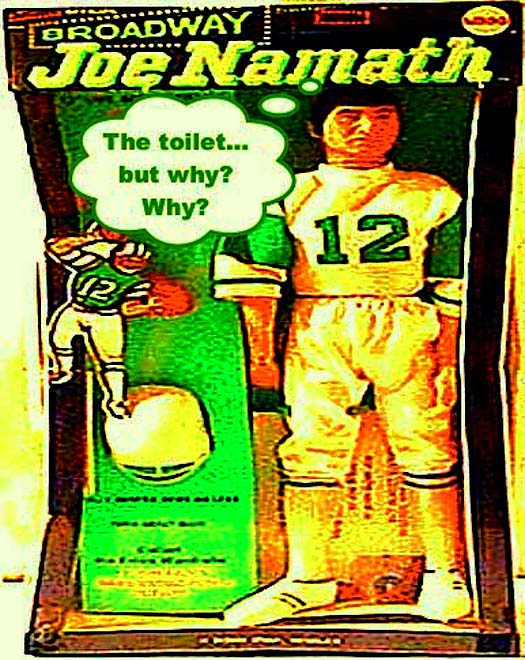
Broadway Joe ponders the great mysteries of memory and intent.

Broadway Joe ponders the great mysteries of memory and intent.

I like to attribute my sense of confusion over the story of Mego Joe Namath to my grandmother’s penchant for revisionist history, as if some of her mojo got on that Joe Namath doll, and made it impossible for me to own up to the specifics of what happened. A refugee, along with my grandfather, to the U.S. of A. just prior to WWII, grandma squished and squashed the family history into something palatable for that era, and then for a later era, the story always holding too many contradictory elements for anybody who knew more than the small slice she was dishing up at any particular time. And, I should also note, I don’t know that grandma was the source of the stories. I just don’t know who else to blame.

In Grandma’s telling, we came from a line of German barons, low-level royalty of sorts, but we were also Jews, dodging Hitler by changing our name from Schildberg to Schildbach.  I’m not sure which part of the story is harder to swallow–that a Jewish family attained noble status in Germany, or that our family’s heavy Lutheran leanings were born of a conversion of convenience–a cover story that resulted in such a complete abandonment of our heritage that the family attended church–well, religiously–and my father became a pastor. We were Nazi fighters, or fighters of Nazis.  Or perhaps we were communist fighters, or fighters of communists. And maybe, just maybe, we were Nazis fighting the communists, or vice versa. However it turns and churns, we were never whatever was bad.

And whatever happened, the family got out of Germany at a pretty good time to get…so hooray for not ending up dead for some political or religious leaning or another.

The shifts in my rememberances and interpretations of the Mego Joe Namath saga could also be attributed to my last memories of my grandmother. She had come to visit my mother’s home around Christmastime during my college years. Before I made it home for the holiday break, my younger brother had already sent notice that grandma was spending most of her time in front of the TV complaining—frequently about communists and gay people—and this was in the days before Fox News. I can only imagine what mainlining such misappropriated anger would have done for her, when a news story about the Soviet Union would send her into a grumble about how we don’t need communists on the TV at Christmas, or seeing Brian Boitano in Olympic trials would launch her into a confused rant about how “they” had accused one of my cousins of being gay—maybe she meant the United States Figure Skating Association, although that seems unlikely.

At some point, I conflated these late memories of my grandmother with why she ever would have sent me a Joe Namath doll in the first place. I figured that maybe, in my early primary school years, she had become concerned because, along with my girly curly hair, penchant for art projects, and general lack of interest in sports, I carted around a dress-wearing teddy bear named Cindy. Grandma may have decided that the antidote to such anti-masculine behavior was a doll that played football. And, speaking of things I really don’t remember, I’m not sure where the teddy bear came from, or why I was convinced it was female and asked my mom to make a dress for it, but I suspect that my sister had a strong hand in all of it.

It was also by my sister’s hand that Joe Namath ended up in the toilet. I’m sure there were numerous warnings leading up to the actual toilet incident. I just don’t remember the triggering event. It could have been that I snuck into her bedroom while she was in the shower, and played 45s on her portable record player. I thought maybe it had something to do with me stealing her Sunshine Family Farm chicken again, so I could make fart noises as I made it squeeze out eggs—but the timeline for that toy’s release placed it far too late to match up with Mego Joe’s trip to the pool. It may have been that I stole Sunshine Family dad’s sweater, so that Mego Joe Namath would have something to wear other than his football outfit—a likely possibility, given that, while Joe’s shirt went into the toilet with him, he was not wearing it.

Chances are, the event that led to Joe taking the plunge was little more than my bragging about how grandma had sent me a present but hadn’t sent one to my sister…or some other antagonistic foolishness…singing an annoying commercial jingle over and over again, calling her names, suggesting she was in love with somebody…I could be pretty damn annoying with very little effort. I can’t remember if the event took place in one fell swoop, with my sister grabbing up the doll and accessories and dropping them all in the toilet, or if it happened in stages, with me refusing to give up whatever it was I was doing that was annoying her, as she dropped items of clothing into the toilet, one by one, finally plopping Joe in as the final measure.

There is also the matter of just who hit the handle on the toilet, flushing as much as would go down—which I think was only Joe’s shirt, football, and helmet—maybe one of his shoes, too. Joe himself was spared the trip to the sewer by dint of his size, or positioning–an inability to navigate the crooks of the toilet piping.

I have a vague recollection, obscured by the lies that took place in its wake, of staring down at Joe in the toilet after my sister stomped triumphantly out of the bathroom, evil grin on her face, or maybe with her standing right there, relishing my disbelief. And as I looked, and imagined having to fish him out of the toilet to clean and dry him off, and admit my sister got the best of me—that she had completed an unspeakable act I was sure she would never dare—I was filled with anger…anger that could only be redeemed with destruction. Joe would go down, a sacrifice to Mars, and I would blame it on my sister, pleading with my mother to punish her for the destruction of such a beloved gift.

Truth is, from the time I got Mego Joe Namath, I was puzzled. What the hell did I want this for? But it was a toy, right? A gift? Something I obviously was supposed to want. And given my unnatural attachment to objects, I had to keep it. It had to mean something more than I could quite fathom. It was as important as all material things, as all toys I longed for…right?

But I believe it was me who hit that handle, not only to get my sister in trouble, but because I was finally presented with a way to get rid of that weird, incomprehensible, whatever of a gift. The guilt of trying to flush him was roughly comparable to the guilt of not wanting him in the first place. Perpetually vexed by the tension between trying to accept and do what adults expected of me, and the desire to just melt down or blow up, I was a bit of a mess as a child…as I suspect all children are, in one way or another.

Feeling that you want what others think you shouldn’t, and that you don’t want what they think you should, is a hell of a thing.

So, Joe didn’t go, but he didn’t stay whole. And that became excuse enough for me to leave him behind…something incomplete I had an excuse to no longer play with. Back to teddy bears in dresses for me, with only a small lump of guilt for the subterfuge visited on Joe. And grandma, living several states away, never needed to know.