Requiem for a Snake

My daughter’s pet ball python, Smeagol, died over the weekend. We had no reason to think anything was wrong with him. The last time I observed him for any length of time—Friday, as I was yawning through the long pauses of eliminating a computer virus—he seemed just fine, climbing the ceramic branch/rock fixture in his cage. Sometime between then and Sunday, he vomited up his last meal—a partially-digested black mouse, eaten several days before—and shuffled off this mortal coil, while coiled on the floor of his cage.  I first took notice because he was lying there with his “nose” up under his body, which would have made it extremely difficult for him to breathe—had he still been breathing.

Smeagol was only about ten years old—not all that old for a ball python. And he wasn’t around long enough for me to resolve my mixed feelings about him. To put it mildly, I am not a big fan of snakes. To put it less mildly, they freak me the f*ck out. Constrictors, like Smeagol, don’t raise a panic in me as bad as smaller, squigglier snakes, or, of course, vipers and the like that can cause all manner of swelling, necrosis and more complete death with a single bite. But, still, he was a snake. And for me, that took a lot of getting used to—or not getting used to.

When my wife questioned my dislike of snakes, and more specifically, my queasiness toward our daughter’s pet, I told her that snakes are essentially tubes that crap out of one end, and bite with the other, and that being shat on and bit are not high on my list of favorite things. I didn’t explain to her how, when I saw a snake just out and about, say, in a field or a forest, I would completely lose my mind. She’s only come close to witnessing a subdued version of that once or twice. She still tried to convince me that Smeagol was cute—and he was as far as snakes go. He was pretty, even, with a funky black and brown pattern, a white underbelly, and a face that looked to be smiling.

Smeagol investigates some ice cream.

Smeagol investigates some ice cream.

We had invited him into our home under the thought of good parents supporting our child’s interests. Back when she was in the fourth grade or so, our daughter got caught up in the idea of having a pet python. I told her if she could save up the money for a snake, I would buy the cage—a large, glass tank, with a screened, slide-out lid—for her birthday. Truth be told, I wasn’t sure she would meet the challenge. Ball pythons are not cheap; and I figured something else would capture her attention before she finished piecing together the money. But cash received as birthday gifts put her over the top of her fundraising goal, and she held me to my promise.

On the night we first brought him home, Smeagol bit my daughter, who admittedly was not exercising any caution whatsoever toward a small, confused animal who had just been stuffed into a box and transported through a cold, November night, to his new and unfamiliar home. I tried to tell her to just put the box in the cage and open it there, to let him come out in his own time. But instead, she set the box on a table, flipped it open, and reached in. Chomp!

Granted, when Smeagol bit anybody, it was more like a nip, designed as a quick warning. But he invariably drew blood with his little, hooked teeth when he did it. It was lightning fast, too, almost impossible to escape once he had a mind to do it. I know of two occasions, aside from his first few minutes in our home, when Smeagol bit my daughter. I also remember him taking a shot at one of our dog’s noses. The dog was just curious and unsure what to make of Smeagol. Smeagol took the dog’s face, with its looming mouth, to be a threat. Both dogs steered clear of him after that—she because she’d been bitten, he because I like to believe he shared my general belief in the benefits of snake avoidance.

Although it’s not good to speak ill of the dead, at times I wondered if Smeagol was perhaps something of a jerk among pythons. But then I figured he had, on average, only committed about one quick bite every two years—not bad considering everything he was put through, including visits to my daughters’ classrooms, and my wife’s classrooms, where he behaved around preschoolers and grade schoolers, even when one or two of them made lunging grabs at his face.

Personally, I never got bit by Smeagol, most likely because I kept my distance, even though, with my daughter spending less and less time at home, it fell to me to take care of most of his feedings and cage cleanings. My wife was the main one to spend time “playing” with Smeagol–letting him roam outside of his cage or drape himself over her shoulders. But, sometime in the last year, he bit my wife as she tried to retrieve him from behind a huge bulletin board that was leaning against a wall. Prior to the wife-biting incident, I had a theory that Smeagol’s likelihood of biting someone was, like with German Shepherds, tied to some sort of fear-sensing mechanism. With that one bite, my theory went out the window, as I knew my wife was the only one who had always approached Smeagol with a complete lack of fear, and a full sense of trust and love. This one bite sharply reduced my wife’s willingness to provide Smeagol with passes outside of his cage.

The need to take him out of his cage, or rather the need to keep him in a cage, or perhaps, the whole situation of pets in cages, had become increasingly troubling for me in the past few years. Part of my growing discomfort had to do with seeing Smeagol, essentially a wild animal who had grown to about four feet long, confined to a glass box, where he seemed to spend a good amount of his time searching for a way to get out. Snakes, as a rule, are pretty darn good at finding ways of getting in or out of wherever they want. So I imagine being trapped in such a way was maddening for him.

Part of my growing discomfort had to do with having dogs who have fairly free rein to go anywhere they want within the house and backyard—something I marvel at from time to time in the sense of, “Wow!  We have some fairly large animals just wandering around our house.”

When I was very young, we had a dog that was on the scene before I was, and who didn’t have much use for me, and vice versa. I never marvelled at her, and rarely even realized she was around.  Seriously, I can barely recall her existence, aside from some vague memories of my siblings’ reactions from around the time she was put down. I also didn’t give much thought to the idea of keeping animals confined to cages. In junior high and high school, well after the dog was gone, I acquired quite a few reptiles and amphibians (no snakes), and occasionally rodents, that were kept in a variety of fish tanks, mostly in my bedroom. Hell, once, with the help of my younger brother and a friend, I even transplanted a (slightly-larger-than-puddle-size) pond’s worth of native Oregon frogs (tiny little creatures) from their home in the suburban wild to a tank in our backyard—never thinking about just how difficult it would be to sustain that little ecosystem as the summer wore on and the heat became unbearable in that glass box. They were tadpoles when we caught them, and monitoring their transformation to frogs was pretty amazing. But we could have just visited the pond repeatedly and gotten the same basic show, all without wiping out the small frog community.

The vast majority of the reptiles and amphibians I collected met with premature deaths, often for reasons unknown, but more often through my own failings. There was a red-eared slider (turtle) who died shortly after I fed him bologna, unaware that turtles cannot physically process fat in their food.

There was the fire-bellied newt who escaped his cage (how a newt climbed out of a fish tank with only a few inches of water in the bottom, and a few flat rocks and a small branch poking out of the water is beyond me). I found the newt several days after his disappearance when I stepped on his dehydrated, crunchy little body, tangled in the shag carpet downstairs by the front window. I can only imagine the adventure he had making his way down the steps.

There was a procession of anoles (small lizards they sell in pet stores as chameleons), one to three at a time, who all caught the same wasting disease, despite thorough cleanings of the cage between inhabitants.

Various other turtles and lizards succumbed to death prematurely, with no real indication that anything was wrong until they woke up dead.

Later, well before my daughter acquired Smeagol, she had a pair of Russian dwarf hamsters—one of which completely consumed the other, except for its pelt. I kid you not.  There were no bones left or anything else aside from a well-preserved fur, in the style of a stripped and cleaned item you would find at an actual furriers. What was left of the devoured hamster would have made an excellent rug for, say, a beetle’s bachelor pad. I’m not sure if the consumed hamster died of natural causes before it was cannibalized, or if the carnivorous hamster just decided he’d had enough of corn and seeds, or maybe had had enough of her roommate’s bad habits.

But enough with the tales of animal woe. At this point, I’m going to make a little pledge in honor of our too-soon-taken Smeagol. I’m done with pets that have to be kept in cages. I don’t want to contribute anymore to the kind of recklessness that involves people boxing up animals in the first place. This is not to say that I think it is inherently wrong to have pets that are kept in cages. I suppose in some cases, it makes life more pleasant and less dodgy for the animals, and hopefully involves children learning some measure of responsibility, and hopefully a great deal of kindness and love. But in my personal weighing of the situation, I’ve made too many dumb mistakes. And I’ve failed to provide adequate levels of life outside the box. I’ve apparently failed to monitor properly for signs of illness, and to make sure I was avoiding harm.

Smeagol deserved a greater measure of freedom than he got. Of course, a ball python could do worse in life than to have a safe, warm home with regular feedings. But a snake native to the East coast of Africa probably could have done much better than to be kept in a glass box in the Northwest corner of the U.S., cared for by someone with a large measure of phobia aimed at him.

So, peace to you, Smeagol. May you pass through the fires of Mordor to the place of white shores and beyond—a far green country, under a swift sunrise.
 

Teddy in a Dress, Broadway Joe in the Toilet

By J.C. Schildbach, MA, LMHC, ASOTP

As with so many largely pointless childhood stories, the exact why and how of Mego Joe Namath ending up in the toilet are lost to time, blurred in a haze of retelling and embellishment, and perhaps a heavy dose of blame-shifting.

I’ve always carried a sense that whatever bad happens to me, I am somehow deserving of it, usually because I can trace a path through the exact actions I took that led to the consequences. When it comes to arguments with siblings, those paths are usually pretty clear.

With Mego Joe Namath, the clarity’s not there, perhaps due to my own desire to forget.

Mego was a company that once largely had the corner on the action-figure market, manufacturing all of the DC and Marvel superhero dolls, most of which were crafted with identical bodies—the hands, feet, and heads the only variable parts—with clingy, fabric, footy-pajama-like costumes to provide the rest of the customization. Anyone familiar with Cartoon Network’s “Robot Chicken” has seen plenty of Mego toys.

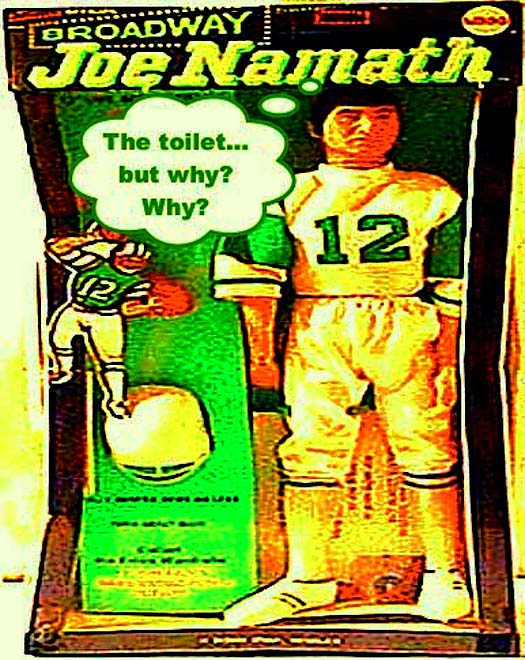
Mego Joe Namath, who had a decidedly different style of dress compared to the superheroes, was a birthday gift from my paternal grandmother. It was totally unexpected, given that she usually only sent cards with checks or cash for birthdays, and a Hickory Farms gift pack as a family gift at Christmas—something that, to this day, makes it mandatory for me to include summer sausage in my Christmas Eve festivities. Mego Joe Namath was also totally unexpected because I had zero interest in football—and may not have even known who Joe Namath was at the time.

Broadway Joe ponders the great mysteries of memory and intent.

Broadway Joe ponders the great mysteries of memory and intent.

I like to attribute my sense of confusion over the story of Mego Joe Namath to my grandmother’s penchant for revisionist history, as if some of her mojo got on that Joe Namath doll, and made it impossible for me to own up to the specifics of what happened. A refugee, along with my grandfather, to the U.S. of A. just prior to WWII, grandma squished and squashed the family history into something palatable for that era, and then for a later era, the story always holding too many contradictory elements for anybody who knew more than the small slice she was dishing up at any particular time. And, I should also note, I don’t know that grandma was the source of the stories. I just don’t know who else to blame.

In Grandma’s telling, we came from a line of German barons, low-level royalty of sorts, but we were also Jews, dodging Hitler by changing our name from Schildberg to Schildbach.  I’m not sure which part of the story is harder to swallow–that a Jewish family attained noble status in Germany, or that our family’s heavy Lutheran leanings were born of a conversion of convenience–a cover story that resulted in such a complete abandonment of our heritage that the family attended church–well, religiously–and my father became a pastor. We were Nazi fighters, or fighters of Nazis.  Or perhaps we were communist fighters, or fighters of communists. And maybe, just maybe, we were Nazis fighting the communists, or vice versa. However it turns and churns, we were never whatever was bad.

And whatever happened, the family got out of Germany at a pretty good time to get…so hooray for not ending up dead for some political or religious leaning or another.

The shifts in my rememberances and interpretations of the Mego Joe Namath saga could also be attributed to my last memories of my grandmother. She had come to visit my mother’s home around Christmastime during my college years. Before I made it home for the holiday break, my younger brother had already sent notice that grandma was spending most of her time in front of the TV complaining—frequently about communists and gay people—and this was in the days before Fox News. I can only imagine what mainlining such misappropriated anger would have done for her, when a news story about the Soviet Union would send her into a grumble about how we don’t need communists on the TV at Christmas, or seeing Brian Boitano in Olympic trials would launch her into a confused rant about how “they” had accused one of my cousins of being gay—maybe she meant the United States Figure Skating Association, although that seems unlikely.

At some point, I conflated these late memories of my grandmother with why she ever would have sent me a Joe Namath doll in the first place. I figured that maybe, in my early primary school years, she had become concerned because, along with my girly curly hair, penchant for art projects, and general lack of interest in sports, I carted around a dress-wearing teddy bear named Cindy. Grandma may have decided that the antidote to such anti-masculine behavior was a doll that played football. And, speaking of things I really don’t remember, I’m not sure where the teddy bear came from, or why I was convinced it was female and asked my mom to make a dress for it, but I suspect that my sister had a strong hand in all of it.

It was also by my sister’s hand that Joe Namath ended up in the toilet. I’m sure there were numerous warnings leading up to the actual toilet incident. I just don’t remember the triggering event. It could have been that I snuck into her bedroom while she was in the shower, and played 45s on her portable record player. I thought maybe it had something to do with me stealing her Sunshine Family Farm chicken again, so I could make fart noises as I made it squeeze out eggs—but the timeline for that toy’s release placed it far too late to match up with Mego Joe’s trip to the pool. It may have been that I stole Sunshine Family dad’s sweater, so that Mego Joe Namath would have something to wear other than his football outfit—a likely possibility, given that, while Joe’s shirt went into the toilet with him, he was not wearing it.

Chances are, the event that led to Joe taking the plunge was little more than my bragging about how grandma had sent me a present but hadn’t sent one to my sister…or some other antagonistic foolishness…singing an annoying commercial jingle over and over again, calling her names, suggesting she was in love with somebody…I could be pretty damn annoying with very little effort. I can’t remember if the event took place in one fell swoop, with my sister grabbing up the doll and accessories and dropping them all in the toilet, or if it happened in stages, with me refusing to give up whatever it was I was doing that was annoying her, as she dropped items of clothing into the toilet, one by one, finally plopping Joe in as the final measure.

There is also the matter of just who hit the handle on the toilet, flushing as much as would go down—which I think was only Joe’s shirt, football, and helmet—maybe one of his shoes, too. Joe himself was spared the trip to the sewer by dint of his size, or positioning–an inability to navigate the crooks of the toilet piping.

I have a vague recollection, obscured by the lies that took place in its wake, of staring down at Joe in the toilet after my sister stomped triumphantly out of the bathroom, evil grin on her face, or maybe with her standing right there, relishing my disbelief. And as I looked, and imagined having to fish him out of the toilet to clean and dry him off, and admit my sister got the best of me—that she had completed an unspeakable act I was sure she would never dare—I was filled with anger…anger that could only be redeemed with destruction. Joe would go down, a sacrifice to Mars, and I would blame it on my sister, pleading with my mother to punish her for the destruction of such a beloved gift.

Truth is, from the time I got Mego Joe Namath, I was puzzled. What the hell did I want this for? But it was a toy, right? A gift? Something I obviously was supposed to want. And given my unnatural attachment to objects, I had to keep it. It had to mean something more than I could quite fathom. It was as important as all material things, as all toys I longed for…right?

But I believe it was me who hit that handle, not only to get my sister in trouble, but because I was finally presented with a way to get rid of that weird, incomprehensible, whatever of a gift. The guilt of trying to flush him was roughly comparable to the guilt of not wanting him in the first place. Perpetually vexed by the tension between trying to accept and do what adults expected of me, and the desire to just melt down or blow up, I was a bit of a mess as a child…as I suspect all children are, in one way or another.

Feeling that you want what others think you shouldn’t, and that you don’t want what they think you should, is a hell of a thing.

So, Joe didn’t go, but he didn’t stay whole. And that became excuse enough for me to leave him behind…something incomplete I had an excuse to no longer play with. Back to teddy bears in dresses for me, with only a small lump of guilt for the subterfuge visited on Joe. And grandma, living several states away, never needed to know.


God Looks Away, Youth Minister Sex Offender Publishes Self-Serving Article (TW)

At the core of “My Easy Trip from Youth Minister to Felon,” an article posted in the online version of Christianity Today’s Leadership Journal, is an odd and self-serving theological point: that God does not look upon sin, and that when sin continues long enough, God gives us over to it so that we might hit rock bottom and then seek redemption. God turning away is, according to the anonymous author, a convicted sex offender still in prison, the reason Jesus felt God had forsaken Him while He was on the cross—God could not look on His Son/Himself as His Son/He took on the sins of the world. It is God’s looking away, the author suggests, that allowed King David to embrace selfishness and send Bathsheba’s husband, Uriah, into battle to die, so that David might have sexual access to Bathsheba. In this same fashion, the author contends, God looked away so that the author might plunge deep enough into sin to be made to answer for those sins.

The author provides no theological discussion of why God also looked away from the victim of the author’s sin, implying (through the author’s shaky theological discourse, and his frequent use of “we” and “our”) that the teenage girl who had been manipulated into a sexual relationship with her youth pastor, shared in the sin, or simply had to be sacrificed so that the author could be redeemed. Without ever naming his actual crime, the author crafts a tale of a sexual predator in need of redemption, and a sexual assault victim as sacrificial lamb, all with God’s blessing/God’s inability to stomach what was happening. But if we are to look at God as incapable of looking on sin, or even the victims of another person’s sinful behavior, then it seems only right to assume God looked away throughout the process that led to the publishing of the article.

The article, taken down from Leadership Journal after much public pressure, can be read from an alternate site here.

I’m a bit torn about whether I think people should read it—not in the sense that I think it deserved to ever be published in the first place—it didn’t—but because it provides an interesting look into the kinds of self-centered justifications, and victim-blaming that sex offenders will endorse in an effort to convince people around them that they’re sorry and won’t ever do anything like that again, because, boy, they’ve learned their lesson, and (in this case) Jesus forgave them, so you should, too.

What was meant by the editors to be taken as a moving story of sin and redemption was, instead, merely a continuation of the abuse, prettied up with self-aggrandizing mock-contrition and Bible verses. And, sadly, the editors saw fit to tag it with the “related topics” of Accountability, Character, Failure, Legal Issues, Self-examination, Sex, and Temptation. Of those tags, “Failure,” and “Legal Issues” seem the only appropriate ones. “Sex” only fits in the broadest definition; whereas “Sexual Assault” or “Sex Offenses” would have been much more fitting. “Temptation” is little more than a label that normalizes the sexualizing of underage girls.

It's not somebody who's seen the light...It's a cold and it's a broken Hallelujah

It’s not somebody who’s seen the light…It’s a cold and it’s a broken Hallelujah

What I keep wondering in all of this is how the article came to be posted in the first place. Did the editors of Leadership Journal coordinate with prison officials to approve the project, or did they just accept it from some inmate, insisting via e-mail that he had a unique tale of a fall from grace and a re-acquaintance with God? Did they know the author prior to his incarceration? Is the author in a treatment program in prison? If so, were his treatment providers at all aware of what he was doing? Were lawyers for the author, lawyers for the victim, or the judge in the case aware of the intent to publish such a piece? And, perhaps most importantly, was the victim, or the victim’s family aware that any of this was happening? And did she/they have any say in the matter?

I ask the above questions because I cannot imagine that, prior to publication, the article was examined by anybody with any clinical knowledge of offender behavior—or, for that matter, by anyone with any sense of the damage done to victims of sexual assaults. If I give the editors the benefit of the doubt, then maybe I can view them as possibly well-meaning, but definitely confused/ignorant people looking to generate an attention-grabbing conversation about statutory rape. And while, it certainly grabbed plenty of attention, that was because it took a story of sexual assault and transformed it into a discussion about how easy it is to be seduced by a teen when one takes one’s eyes off of God, and vice versa. The sexual content is so subdued/obscured that it comes across as if it is intended to describe temptation only—definitely much more so than if it was labeled appropriately as child molestation, pedophilia, hebephilia, exploitation of a minor, statutory rape, or rape.

Any sex offender treatment provider who knows anything at all about what she/he is doing certainly would never have approved of the article as it appeared. Offenders in treatment (in or out of prison) are often given writing assignments wherein they are required to relay details of their behaviors and thought processes and demonstrate an understanding of the damage they caused, as well as the way they convinced themselves it was okay. And while I recognize that it wasn’t specifically crafted as a treatment assignment, the Leadership Today piece reads like an eloquent first draft of such an assignment, crafted with care before a treatment provider and/or members of a treatment group demanded changes due to the author taking a victim stance, failing to acknowledge the actual crime or its impact on anyone other than himself, and refusing to incorporate even the most rudimentary sense of understanding about how he built up to the offense and kept it secret for as long as he did.

Or perhaps it’s more like a second draft, after the offender removed most of the overt blaming of the victim, and switched, instead, to implied mutual blame or implied consent for the crime.

I have heard hundreds of variations on the same basic story told in the article, from the mouths of offenders, emphasizing the frustrations in their lives, the reasons they had contact with the victim to begin with, and the reasons they are not to blame (and, yes, a lot of them invoke religion as part of that). It is rare to come in contact with an offender who, from the beginning (not of the offense, but of contact with the justice system and the need for an evaluation for sexual deviancy) is capable of outlining how he (or occasionally, she) manipulated the victim to engage in sexual acts and to keep it a secret, how he justified the crime to himself, and what specifically happened (in clinically appropriate and criminally accurate terms), without putting a large portion of the blame on the victim for somehow enticing or seducing him.

Despite the author’s claim, added after the controversy erupted, that he takes 100% of the blame for the crime, and recognizes that what he once viewed as a consensual relationship was no such thing, the article itself tells a much different story—of a man who worked hard to build something up for the glory of God (and how he was really amazing at doing that work), and then how he accidentally broke it because he was being selfish. Without ever acknowledging the severe harm he did to the victim, harm that is likely to last a lifetime, he signals that he has returned to a life of service to God because he is involved in leading a ministry group in prison (another thing I have a really hard time with anybody allowing).

And while the author touches on one of his justifications for engaging in his behavior—that his wife was paying too much attention to their children, and not enough to him—he is only able to acknowledge the impact on his wife in the form of the fight they had when she found out about the crimes, and how she left in the middle of the night with the children. The author laments that he has not seen his children since, but doesn’t even mention the extreme embarrassment and devastation he caused his wife and children. Nor does he ever fully indicate that he recognizes how childish his justifications for his behavior were, or how those justifications were merely the starting point for a cycle of lying and manipulation committed for the sole purpose of having repeated sexual contacts with a minor.

In a truly terrible minimization of his behavior, the author compares his repeated sexual abuse of the victim (while implying she shared in an identical struggle with him) to the difficulty of smokers trying to turn away from cigarettes.

From the complete dearth of information in the article, if this really were a treatment assignment, once all the extraneous details, self-promotion, and claims to deserved forgiveness are removed it might sound a little more like this:

“In my 30s, I accepted a position with a church as the coordinator of youth ministry. I built up the group from just a few members until it was one of the largest youth groups in the region. I realized I was experiencing sexual attraction to one of the underage members. I manipulated her into having sex with me, and justified my sex offenses, in part, by blaming my wife for not paying enough attention to me. I had sex with the teen repeatedly. When my wife found out, she took our children and left. I was convicted of sex offenses and sent to prison. I am currently still in prison. I will be a registered sex offender for the rest of my life.”

And, if the author began to actually include the most obvious missing items, the skeleton of a real assignment, or perhaps a combination of real assignments, would start to look like this:

“In my 30s, I accepted a position with a church as the coordinator of youth ministry. I built up the group from just a few members until it was one of the largest youth groups in the region. I realized I was experiencing sexual attraction to one of the underage members, and that she looked up to me in a way that made it possible for me to manipulate her. I set about grooming her. I justified my sex offenses, in part, by blaming my wife for not paying enough attention to me. I managed to work up to the point where I convinced the girl to have sex with me. I then had sex with her repeatedly while convincing myself that she wanted to have sex with me as well, that she was mature enough to handle a sexual relationship with an adult who is an authority figure in her spiritual life, and that I was in no way manipulating her. I managed to keep her from telling anybody about our relationship through various forms of coercion, and went to great lengths to keep anyone from finding out about it. We eventually got caught. My wife, understandably, left me and took the children with her. I was arrested and convicted of sex offenses. I am currently in prison. I will be a registered sex offender for the rest of my life. The teenager I manipulated and raped will need a great deal of therapy and other supports in order to cope with the aftermath of my actions. My wife, my children, and numerous other people impacted by my behavior will also need support to attempt to repair the damage I caused. I recognize that I need to stay away from minors for the rest of my life, and that I can never be placed in any kind of position where I might have authority that can be abused, particularly over any people who could be considered ‘vulnerable.’ I also manipulated editors of Leadership Today into publishing an article I wrote that completely justified my behavior, and suggested that the victim was equally to blame for my sex offenses.”

The assignment would be given back with numerous, specific requests for much more “self reflection,” “accountability,” and actual identification of his specific behaviors and thoughts.

Becoming a sex offender isn’t an “easy” path as the author’s title suggests. It is one that is pieced together with care by the offender, and crafted to secure the cooperation of the victim(s). It is not, as the author portrays it, a little trouble in a marriage, a dash of arrogance, and some innocent flirtations evolving over time into mutual passion—passion that makes God look away, as if God were easily embarrassed. Such a description may be a very simplistic explanation of how an extramarital affair (the words the author uses along with “adultery” to describe his sexually exploitative behavior of a child under his care) evolves.

Unfortunately, by diving into this discussion, without any sense of just how manipulative the author was, and how harmful his words are, the editors of Leadership Journal have put themselves in a place where they must now back away from this discussion entirely. Rather than promoting a meaningful dialog about forgiveness and redemption, they allowed a sex offender to promote himself as a victim of the temptation to have sex with minors.  They allowed him to promote his story of redemption—a story that rings as false as any rapist having the arrogance to compare himself to Christ on the cross, as he suggests that God’s mercy has saved him, all while implying a teenage girl entrusted to him for guidance and education was just as responsible for being raped as he was for raping her.


God Bless Anita Bryant

Friday, May 16, I had my first experience with a mental health/chemical dependency conference hosted by a drag artist. The incomparable Aleksa Manila presided over the “Saying it Out Loud” conference, complete with multiple costume changes and delightfully tasteless jokes between various announcements, awards, introductions, and seminars. This was the thirteenth annual gathering of this conference, which was created with the goal “to continue to co-create learning, growth and understanding of the best practices and relevant clinical services needed to support members of the lesbian, gay, bisexual, transgender and questioning communities.”

Dr. Ronni Sanlo served as the keynote speaker, as well as screening a new documentary, “Letter to Anita,” about her almost-wasn’t involvement in LGBTQ activism. Now I’m going to get into a few spoilers here, but I don’t think the basics of Sanlo’s story are the heart of the documentary, as much as is the personal perspective she brings to them. So, when I say her activism “almost-wasn’t,” I mean that Sanlo, like a number of lesbian women of her generation, went about her life as a heterosexual woman, married (to a man) with whom she had two children, not really aware that there were other options.

Unfortunately, just as Sanlo was realizing that there were other options, that the attraction she felt to women wasn’t something that made her completely alone in the universe, Anita Bryant was ginning up Florida’s legislature to pass laws denying parental rights to gay parents. Sanlo’s divorce went through.  Her children, for all practical purposes, were taken away from her.

Liberty turns her back as Anita Bryant looks to the sky, expecting Jesus to fly down and smite the gays.

Liberty turns her back as Anita Bryant looks to the sky, expecting Jesus to fly down and smite the gays.

Hearing the story now, it seems unfathomable to me. In part, my disbelief comes because at the time Sanlo was being viewed as an unfit parent simply for acknowledging who she was, I was living a few doors away from a blended family—two lesbian mothers with three teenage children among them. Granted, at the time, I was in grade school and not really aware that the two parents in that household were ‘romantically linked.’ I was under the impression, for whatever reason, that the families were living together for other reasons—economic? ecological? I remember that, in the fifth or sixth grade, when our class was given an assignment to write an editorial letter about an issue of concern, I mentioned the family as I explained why we shouldn’t be mowing down forests and fields to build new houses when there were other options, including multi-family homes, that would allow greater preservation of nature. Clearly, I had missed the more important political/social issue facing the family.

At any rate, the nature of my neighbors’ relationship was eventually pointed out to me by gossiping peers, with the implication that I was stupid for not having realized it, along with the weird sexual goings-on that were certainly a part of that relationship. Not to say that I was super-forward-thinking at the time, but I knew the two women as my neighbors who had been pleasant to me whenever I encountered them. So whatever sexual things may have been going on between the two women were of about as much interest to me as those of the parents of anyone I knew. That is to say, I really didn’t devote much time at all to thinking about sexual things between various peoples’ parents, and may, as I tilted toward pubrerty and all manner of prurient thoughts, have actively avoided thinking about them.

As far as I was concerned back then, anyone who was cool and/or innocuous toward me warranted much less concern, anger, or fear than the bevy of teenage male piltdowners who seemed to have little more to do than roam the suburban streets trying to prove their masculinity by tormenting children much younger and smaller than them—a model of “manhood” I unfortunately subscribed to briefly when I hit a similar stage in life.

I can only imagine that the lives of the couple from the blended family had some parallels to Sanlo’s—at least in terms of them apparently having partnered with men to build families in order to live out the deliciously limiting American Dream. It’s not too big of a stretch to believe my neighbors, like Sanlo, had seen few other options for relationships but hetero marriage and procreation. It was my understanding that both of my neighbors were divorced, although, like same-sex partnerships, such things were not discussed a great deal at the time, despite divorce quickly becoming commonplace—something that would reach almost all of my friends who hadn’t, like me, experienced the death of a parent. And if the exes of my neighbors were still coming around to visit their teenage children, I wasn’t aware of it. Then again, I wasn’t aware of much that went on in the lives of those teens, since there was far too great of an age gap between us—that impossibly vast chasm between elementary school and high school—for us to concern ourselves with each other.

Speaking of parallels and gaps, “Letter to Anita” touches on another critical piece of Sanlo’s life that fits in with the development of my own understanding of individual rights, freedoms, and what it actually means to be something “other” than heterosexual: Anita Bryant’s crusade against, well, all people who don’t fit her very narrow definition of appropriate relationships (never you mind Bryant’s own divorce).

As I’ve noted before on my blog, I was raised religiously, in the Lutheran Church, Missouri Synod. My father was a pastor in said church. My father died when I was rather young. I spent a great many years struggling with religious ideals and how they fit into the world. And despite my current agnostic tendencies, I still hold onto an idea of religion as an expanding element in peoples’ lives, a force that should open people up to larger experiences, a force that should create love and acceptance, as opposed to a limitation on peoples’ lives that causes anger, hatred, judgment, and closed-mindedness. I spent a lot of time struggling over moral issues, their relation to legal and spiritual concerns, and how we all get along as a people who are supposed to be dedicated to personal freedom, personal responsibility, community ties, love, and all the rest of that stuff.

But Anita Bryant, with her perfectly coiffed hair and starchily-pressed orange and brown polyester outfits, was telling me, in her own, orange-juice-endorsing way, to fear, hate and distrust people I knew, people who had shown me kindness, people I knew to be funny, smart, and no threat to me at all. She put out albums (which, as a teen, my younger brother delighted in purchasing from the local Goodwill for the purposes of mocking and destroying) filled with patriotic and religious songs, promoting the goodness of the USA and Jesus. Yet, everything she said, every objective she pursued, was in contrast to freedom, goodness, and the anti-judgmental stance that Jesus and America were supposed to represent.

Yes, Anita Bryant, in contrast to all she stood for, or wanted to stand for, had helped turn this white, hetero, suburban boy, and his white, hetero, suburban friends, into supporters of gay America…into people who would forever see the gay menace she was so sure was destroying us all, as nothing more than the paranoid delusion of close-minded, controlling, angry people who were completely incapable of seeing the irony of their anti-freedom, anti-love stance as they waved their flags and thumped their Bibles.  Anita Bryant, as Sanlo notes, managed to galvanize opposition to gay rights opposition–even out into the hetero world and parts of the Christian community she was so sure she could count on to share her views.

So God bless Anita Bryant. God bless Ronni Sanlo. And God bless us everyone.

From Seed to Cocktail–In Memoriam

I had just been talking with a co-worker about growing tomatoes, and how I was late planting the tomato seeds I’d gotten at a friend’s funeral back in October, when I found out that that friend’s wife, Jodi, had died.

As usual, I’m struggling with the appropriate response…both virtually and in the real world. I’ve been on her Facebook wall repeatedly, tapping out letters and words that I then delete, feeling confused about just what is the appropriate response in the time immediately following the death of a friend.

After all, Facebook is where you wish “Happy Birthday” to people you rarely, if ever, see face-to-face, right? I’m not saying there’s anything wrong with that. I’m not saying that there’s anything wrong with posting an RIP message on somebody’s Facebook wall.   But to honor the person in this case, there’s a need for something other than drive-by (surf-by?) condolences. And, no, I’m not considering this piece to be the adequate response.

The message I kept reworking essentially came down to this…

Jodi had been battling that vicious monster since before I met her, over 12 years ago. She fought with such grace and tenacity that I was sure she would outlive us all. And if the kindness one unleashes in the world, and the reverberations of that kindness, count in the tally of one’s years, then I’m sure she will.

In case there’s any question, the above isn’t one of those bullshit eulogies, like when Richard Nixon died, and suddenly everybody remembered what a great guy he was, despite the mountains of evidence to the contrary.  Everybody who met Jodi loved Jodi.  And I’m pretty sure that would have held, even if she had been tied to some ridiculous scandal that led to a widespread loss of faith in American democracy.

Jodi was just one of those people who was funny, warm, and fun to be around. She could slap you with a sarcastic comment that made you instantly feel like a part of her family. She seemed to have a bottomless well of good will and giving. She was the kind of person who lived her life, with cancer, better than most of us live our lives in good health.

A friend of mine from college, Jared, had a semi-serious theory that when a person dies, that person’s soul explodes into a whole bunch of little pieces, which blast out into the world, and attach themselves to the souls of all the people who ever loved that person, becoming a part of all of those people. Jared’s evidence for this was that, when his grandfather died, he was suddenly taken with the urge to go out fishing—something that he had never done, but his grandfather had done religiously. Jared described a beautiful, solitary day out on a lake, where all the love he had felt for his grandfather resolved itself into a sense of peace in regard to his grandfather’s passing, and the meaning of his grandfather’s life, and the lives of us all.

Now, I can’t say that I subscribe to Jared’s theory of exploded souls.   But a weirdly similar sense of “exploded soul attachment” hit me shortly after I received the news of Jodi’s passing. Of course, I was knocked off balance. I wondered if I should leave for the rest of the shift, out of concern that I might be overwhelmed with the demands of assisting people through crisis situations. I gave my co-workers a heads up, essentially enlisting their help in ensuring I didn’t make a mess of things.

But instead of the feared distraction and destruction, I felt imbued with a sense of caring and connection with the clients, which is often difficult to engage. That is, as something of a survival technique for the job, it’s necessary to avoid getting caught up in the drama and emotion of the lives of clients, while also being able to convey a sense of empathy. It’s a difficult balancing act to keep an appropriate sense of distance, without disengaging. But all I felt was calm, a sense of presence with the clients that can be difficult to maintain while also staying on top of the other elements of the job.

Supposing for a minute that the theory of exploding souls is true, my piece of Jodi’s soul manifested itself in the feelings of calmness I experienced—an ability to connect and remain in the moment. Even my exchanges with clients I have spoken to hundreds of times were a bit more ‘in the now.’

I’m going to try to hang onto that little piece of her soul.

And for now, I’m going to get those tomato seeds in their pots, and think on how glad I am to have had the opportunity to craft and share a few lakeside, breakfast Bloody Marys with Jodi.

bloody mary


People Up: Toward ‘Gender Neutral’ Suicide Prevention

Phone-based crisis intervention and suicide prevention frequently involves guiding a caller toward an (often tenuous) agreement that there’s a reason to get through the next day, or maybe just the next hour.

Toward the end of a recent call, the man I’d been talking to for over 40 minutes summed up the call by saying, “Yeah, I get it…man up.”  He went on to mildly berate me, suggesting that he could have had the same stupid conversation with his dad if his dad hadn’t died.  But I’ll take that as a victory.  He agreed he would stay alive to see his kids on the weekend.

He would not agree to turn his gun over to a friend or family member, which would have helped lessen the likelihood of impulsive, violent suicide.  But, for the time being, he had put it away.  And at least he was calling.

Still, the “man up” comment stuck with me.  I suppose on a greatly reductive level, “man up,” was a component of what I had been saying—especially from the perspective of someone who, based on his interpretation of the world around him, had been getting that message for quite some time–that he needed to just take care of his problems and quit complaining.  But it is not the kind of phrase I would ever use with someone, or the kind of message I would try to convey.

My conversation with him had woven in and out of a number of concerns, with the crux of the conversation coming down to the caller’s children, and his responsibility (like that of all parents) to do whatever possible to ensure their well-being.  It is a conversation I’ve had hundreds of times.

The majority of such calls, involving people who have children but are contemplating suicide, involve the caller expressing that his/her children will be better off without them.  There are a small number of variations on the ‘logic’ behind such a thought—usually involving the children not having to suffer through the heartache of the bad parenting they will certainly continue to experience, the hassles the kids will face by bouncing back and forth between divorced parents, and the notion that the children will “get over it” in time.  If the children are young, callers express that it won’t make that big of an impression.  If the children are older, the parents think the children ‘don’t need me anymore’ or are mature enough to process what happened and move on with their lives.

Never mind the mental twists and turns it takes to imagine that children will have coping skills enough to deal with the suicide of a parent, when that parent doesn’t have the coping skills to deal with loss much less permanent than death—loss of a job, loss of a home, loss of a marriage—or any of numerous variations and combinations of things and people that have gotten away.  Statistical studies show that children of people who commit suicide are at greatly increased risk for attempting/committing suicide themselves.  In an overly-simplistic explanation, the increased risk can relate to genetic factors involved in mental health issues, but it also involves behavior modeling.  Our parents are usually the most significant modelers of behavior in our lives.  And we are all doomed to become our parents.

At any rate, I found myself having the same basic conversation with a woman less than two hours later.  “What messages are you sending your kids if you kill yourself?”  I challenged the cognitive distortions in her justifications for suicide, and explained the threat of her children committing suicide and otherwise potentially being saddled with mental health issues from the suicide of a parent.  Ultimately, we got to a similar end result—the caller agreeing she would put up her pills, and live another day.

But in the conversation with the woman, there was no idea of needing to “woman up”–no need to do what was stereotypically feminine in order to go on living, even though the idea of someone ‘sacrificing’ (in this case, the twist being that sacrificing meant staying alive) for one’s children is something that stereotypically falls more heavily on women.

With the ‘man up’ comment replaying itself in my thoughts repeatedly over the next few days, I realized I was (internally) protesting too much.  The notion that I had a nearly identical conversation with a woman that same night seemed like a defensive position more than a straightforward assessment.

I ran through other ideas, examining the way I deal with men versus the way I deal with women.  For example, any form of counseling involves meeting the client where the client is.  Such meeting includes the client’s perceptions of self in relation to gender.

Still, the client’s perceptions are not the same as my way of interacting with the client.  The client’s perceptions dictate a number of things about how I will approach the client, what thoughts might be challenged and how, for example.  But at base, how I deal with people of different genders is on me.  And I need to be aware of whether those dealings are clinically appropriate or not, whether they are tinged with personal biases about what constitutes being appropriately manly or womanly, or fitting into any other gender identity.

I have no problem acknowledging that I speak to people of different genders differently, and that things such as age, economic status, religious beliefs, education, ethnicity, and a whole host of other concerns can color the interactions I have with them.  An awareness of how clients differ in background falls under a heading of “cultural competence.”  Conducting all sessions or interventions in the exact same fashion would be negligent.

Cultural competence includes the need to avoid approaching clients from any viewpoint of prejudice.  In U.S. culture, with its heavy bias toward the idea of women being nurturing and emotional, and men being stoic and strong, it is easy to fall into a trap of diminishing men who seek support, while being much more accepting of women seeking support.  The underlying concepts of weakness and strength, as relates to seeking support, diminish everyone.  Accepting girls and women who seek support while being less accepting of men and boys who do the same indicates an underlying belief in the weakness of women–the need of women to have support, while believing men don’t–or shouldn’t.

In a context where men are expected to “man up” and take care of their problems, rather than to seek help in processing what is going on with them, it makes sense that many men reaching out for help are, if not hostile, at least pensive and anxious—feeling there is something inherently wrong with seeking help, so taking a position challenging those who might help them.

As a culture, we in the U.S. encourage defensiveness and entrenchment in men—refusal to change—with the exception of encouraging men to become ever harder, ever more willing to engage in aggressive fortifying of their position, with that position often being one of isolation.  The processing men do frequently gets externalized to the point where it is not processing at all.  They, for example, focus on fixing the world, usually by berating the weak, or advocating the destruction of people seen as enemies, rather than addressing the personal in their lives and what such isolation and fortification does to them.

I posit that the gender-stereotyped notion that men need to take action is in large part what leads men to commit suicide most often in a rather violent and impulsive fashion.  When the problem is your whole life, and you’ve been taught that the appropriate response to problems is action, frequently violent action, then ending one’s life can seem like an appropriate reaction when that life has gone off the rails.  Mix in alcohol, drugs and weapons, and suicide can seem a reasonable course of action, and be carried out quickly—a decisive form of action, a manly form of action.

This is not to say that I think men in the U.S. are “victims” of the mental health system or of some pro-suicide/anti-male conspiracy.  Men, whether willingly or unwittingly, participate in, and perpetuate, the stereotypes that trap them…the stereotypes that say seeking help is synonymous with weakness.  And so, long as angry men rail against the “wussification” of the nation, they are advocating for a culture of death before mental health, and ensuring that men will not seek help for mental health issues, or if they do, that it will come with a heaping helping of defensiveness and hostility, potentially putting clinicians in a position of enduring abuse, or having to break down numerous walls, before being able to engage productively with male clients.

So, instead of urging anyone to “man up,” perhaps perhaps there could be a kind of unstated encouragement to “people up”–and not in the reductive way that “man up” is used, but in a way that is expansive.  To “people up” could mean to recognize our responsibilities to one another as human beings, whether that be as parents, clinicians, friends, family members, or citizens.  We need to recognize the harm in gender stereotypes, particularly if seeking help and support is connected to stereotypes of weakness.

The Coat: A Haute Couture Horror Story

I wasn’t exactly a fashion-forward fourth grader.  Or perhaps my complete lack of fashion sense just meant I was incapable of comprehending what a style juggernaut I was.

At any rate, one would think that a nearly-knee-length, brown, corduroy coat, with enormous brown buttons and a matted-dog-fur-esque collar/lapel would have perfectly complimented my favorite pair of pants—off-white polyester with a thin woven black and orange-ish-yellow plaid.  But I wasn’t havin’ any of it.

I was used to my wardrobe being largely comprised of hand-me-downs.  And, for the most part, those came from my older brothers, so I’d had a preview of what I’d be wearing in upcoming years.  In most cases, I was looking forward to the day when those items would become mine–that funky navy/robin’s egg/and white macrame´ vest with the tassels, those polyester pants in sea-foam green with a padded micro-waffle texture…

But that coat.  That goddamned coat.  Childhood memories are, of course, often comprised of impressions and sensations, with a few points of actual fact.  As for the jacket, I think it came from a cousin.  I can’t be sure.  But I had been looking forward to taking possession of the multi-panel, blue, red, and white, ‘normal’ ski jacket my older brother had, at the same time I would pass my own multi-panel beige, white, and blue ski jacket onto my younger brother.

But by some cruel twist of fate, that brown, corduroy monstrosity had insinuated itself into the orderly transition of jackets.  It was an interloper.  It did not belong.  I lost my ski jacket to my younger brother, but took possession of that…thing.

Nobody wore a coat like that.  I mean, for fuck’s sake, people had metallic silver NASA jackets, and puffy, stuffed ski jackets in traffic-cone orange.  But a brown, corduroy jacket?  What the hell?  That thing wasn’t even waterproof.  And damned if I wanted to deal with something so stupid and girly as an umbrella to keep me dry (although I did have a really cool, clear, plastic, dome-style umbrella—oh, the sound of rain pounding down on that while pretending to be in a futuristic car or plane with a bubble dome over my own, personal pilot’s compartment.  ‘Fuck you, rain.  I’m from the future’).

Okay, I didn’t actually say “fuck you” to the rain or anybody/anything else when I was in the fourth grade.  But I did have my own arbitrary standards of what I would allow anybody to witness.  I walked to school every morning with my younger brother and older sister.  And, as with the umbrella, I would put the coat away on approaching the school, and, at the end of the school day, would avoid putting it on until a safe distance from the school grounds and any classmates that might see me.

To avoid the suspicion of my sister (or so I thought), as we approached the school, I would mention a few times how hot I was feeling in that bulky coat.  Now, by “put away” I meant I took the coat off and draped it over my arm, or rolled it into a tight bunch, hopefully making it inconspicuous enough that nobody would ask what it was or why I wasn’t wearing it until I could make it to the jacket hooks in my classroom.  There, I would abandon the damned thing, hanging it behind other coats already present, and pray nothing would happen that would lead anyone to look at it too closely.  My mom had, of course, written my name on the collar tag.  All anybody would have to do to see it was mine was flip it open a bit, right where it hung.

To minimize the possibility of anybody accidentally seeing it was my coat, I devised ways of folding the collar down between the hook and the tag, to keep the tag blocked from all but those who would actually go to the trouble of making the effort to move the collar and read the tag…as if that were a thing somebody would do.

I would leave the coat there, hanging.  Walking away from it, I would feel a small tinge of guilt at rejecting something that just wanted a chance to keep me warm—and not just rejecting it, but trying to hide its connection to me.

Mornings, before first bell, I would hang out in the classroom, often hovering by, or leaning against, the heater that ran along the length of the far wall.  I would pretend to study the calendar or the bulletin board that surrounded it, or look at the bulletin boards near the back wall where student classwork was posted, or even pull a book from the bookshelf and lean against the heater, reading, as if this was the kind of thing people did, warming myself from the chill that would set in during the few blocks I walked sans jacket.

If my best friend at the time, Doug, showed up early enough, we would inevitably draw—I don’t think I was in my souped-up van phase yet.  I was probably drawing monsters, while Doug worked at planes and other vehicles with an architect’s precision.  At any rate, I would make sure we moved the drawing activities as close to the heaters as possible.

Recesses were a bit trickier.  I spent them all in the library—first recess—about 15 minutes around 10:15 a.m.; lunch recess—whatever time was left after our noon lunch, which I took to eating rather slowly; and afternoon recess—15 minutes at 2:15 p.m.  There was some sort of ban on spending all of one’s recesses indoors—at least one recess had to be spent outside, to make sure we were getting fresh air and exercise.  Although, if you ask me, fresh air and exercise when it is 40 or fewer degrees outside is just about the last thing anybody needs—especially a skinny fourth-grader who refuses to wear his only coat.

So, in one of my earlier acts of rebellion and coercion, I convinced Doug to blow off the oppressive guidelines that said we had to go outside, and hang out in the library with me where we strategically re-positioned ourselves from recess to recess, playing chess, drawing, listening to old “Jack Benny Show” cassettes on bulky headphones, or, of course, reading.

This went on for several weeks before we were confronted about any of it.

But in the meantime, something else happened.  One morning, on the way to school, I realized I had left a homework assignment at home.  Now, the forgotten homework assignment did not occur to me until after I had gone through my ritual of claiming I was too hot to wear my coat, and had taken it off.  When the thought of the homework struck me, I thrust my coat at my sister, asking her to hold it, while I dug through my bag to confirm what I was already certain of…that I had left my homework papers on my desk at home.

I contemplated taking off with my book bag—after all, if I didn’t have it, what was I going to do with my homework once I retrieved it?  But it could only slow me down.  I checked my brown, Timex watch and calculated whether I could make it home and back in time for first bell, and weighed which was worse—arriving at school without my homework, or maybe arriving late.  I decided I should go for it.  Leaving my bag and coat with my sister, I took off, in a dead sprint all the way home through the suburban streets.

Despite my sense of self that says I was never athletic, I was fast—at least at short-distance running.  Soon, I arrived home, burst in through the front door, charged upstairs and flew across my bedroom to grab my homework.  Of course, this wasn’t the kind of thing that would have escaped my mother.  On my way back down and out, mom stopped me to ask if everything was okay.  I breathlessly told her I forgot my homework, but everything was fine—I could make it to school in time.  Not being one to not notice such things, my mother asked what happened with my coat.

I have no recollection of what I actually said, but in my built-up remembrance of the story, I said that I had made it to my classroom, took off my coat, realized I didn’t have my homework, and so ran home, not thinking about the coat, or anything other than that I needed to get my homework turned in.  I am convinced that I was a big enough nerd/worrier that my mother would have totally accepted this answer.

Perhaps at this point I would do well to lay out exactly what my real problem with the coat was.  Brown corduroy, fuzzy lapels, and giant buttons were only a part of the problem.  Certainly, they were a problem in the face of metallic silver and traffic-cone-orange fabrics.  Brown corduroy could not compete with that.  In fact, a brown corduroy coat was probably just as weird as metallic silver or puffy traffic-cone-orange pants would have been, while brown corduroy pants wouldn’t have drawn any attention at all.  But what was really problematic for me was that the coat reached nearly to my knees.  I thought it looked like an ugly dress.  I was afraid that I would be insulted for being girly.  By this time in my life, between my curly hair, penchant for school work and art, pronounced interest in stuffed animals, and general lack of interest in sports, I had been accused of being girly enough that I realized it was a ‘bad’ thing.  In fact, I had even mostly given up on engaging in one of my sister’s favorite pasttimes for me—putting on her emerald green costume dress and wandering through the living room when we had company.

So, I did my damnedest to try and plough through to the other side of winter without having to wear that damned coat anywhere that any of my classmates might see me, so they wouldn’t add it to the heap of things that suggested I was less-than-masculine.

On that particular occasion, I made it back to the school grounds, which were deserted…at least on the outside.  As I entered the far end of the field, I heard the “final” morning bell ring.  My heart sunk.  I was going to have to go through the humiliation of checking in at the main office.  And, I had left my book bag and coat with my sister.  I had the stupidest coat ever, and was probably going to have to go to my sister’s classroom to pick it up, where I would not only be forced to apologize profusely for interrupting class, but where I would probably be forced to put on the coat so my sister and her classmates could laugh at me before I returned to my own class, where my classmates could laugh at me, and decide right then and there that I was entirely too girly for anybody to ever be friends with me again.

Instead, I had the brilliant idea to go straight to my classroom and play dumb.  What?  I’m late?  Oh, well, here’s the homework assignment.  Gee, it’s cold in here.  Can I go sit on the heater while we copy our spelling words for the week?

My teacher, Ms. W, welcomed me to the classroom, and said nothing about me being late.  Being a teacher’s pet had its advantages.  She brought my book bag over to me, which my sister had thoughtfully dropped off at my classroom.  When I realized the implications of the presence of my book bag, I whipped my head around to check the coat rack.  There, out in front at one of the first spots, was my coat.  I was sure I could read my name on the tag from across the room, and was certain that my classmates had all seen it as well, and had probably already come up with some involved plan for recess wherein I would end up locked in the girls’ bathroom, or wandering the playground in that coat, as people fled from me like I was infected with the plague.

But, due to some sort of weird technicality, I was being set free.  My sister had dropped off my things and explained that I had gone back home to retrieve my homework.  That was good enough for Ms. W.  God, I loved/hated my sister.

Speaking of my sister, there was somewhere in all of this drama where she tried to convince me that the coat was totally acceptable—cool even.  How did she do that?  Peanuts, of course…  She tried to convince me that Snoopy was wearing the same basic coat by showing me a coloring book image with this version of Snoopy in a furry, brown coat.

Check it out...Snoopy's coat is almost as stupid as your's.

Check it out…Snoopy’s coat is almost as stupid as your’s.

I wanted to embrace this.  But it just wasn’t the same coat.  Snoopy was plainly wearing a fur coat that was part of an outfit showcasing his love of football.  And, for once, I didn’t give a fuck what Snoopy was doing.  Even if he had been wearing the exact same coat, it was stupid, and I hated it.  Snoopy should just go back to being naked, and I should get a normal jacket.

The real undoing in the whole coat drama involved my library scheme falling apart.  I can picture alternate versions of this scene…one with one of the librarians confronting me (and Doug), one with the other librarian doing the same, a third with both librarians doing the same, and a fourth with my teacher confronting me—although in that version, my imagination always inserts my sixth grade teacher, which makes no sense.

At any rate, the end result was that I had to go outside for at least one recess a day…which I was supposed to have been doing all along.

If I’m remembering correctly, I chose the lunchtime recess, because I could waste time in the cafeteria until the last person was done eating.  I even tried to sign up for lunch duty in the hopes of getting stuck wiping down tables instead of going outside.  But the cafeteria duty was assigned in a rotating pattern.  I couldn’t take over for anybody, no matter how much they would have been happy to have such a thing happen.  But even without cafeteria duty, after leaving the lunch room, I could waste time in the classroom, pretending to get ready to go out.

But eventually…I would have to go outside.  And I wasn’t going to put that coat on.

Doug and I had invented some sort of (now forgotten) game, based around the monkey bars, which we called “Planet of the Apes.”  So, of course, we called them the ape bars.  I tried to get back into that game, but I was freezing my face off.  I decided I couldn’t survive on the Planet of the Apes, and so ducked into an alcove in an outside wall where a drinking fountain had once been.  It wasn’t exactly comfortable or pleasant, and some of the piping that used to connect to the drinking fountain was still poking out of the back wall.  But it kept me out of the wind.  Doug initially tried to make a game of me being wedged into that alcove, standing in front of me, telling any passers by that there was nothing to see and to move along.  Of course, this attracted attention, at least briefly.  But like most of the things Doug and I did together, most people just ignored us.  It didn’t take Doug long to get bored of hanging out with somebody who was tucked into a hole in the wall.

In my mind, these recesses went on for weeks, in the same way that one’s mind can exaggerate any terrible experience.  Each time I was out on the playground, our playground aide, Ms. Volstack, would ask me about my jacket, doing her due dilligence, but would leave it alone when I said I had a coat but was doing just fine without it.  In reality, the coatless recesses probably lasted about three days…probably a total of 24 minutes outside.  Then Ms. Volstack was out for the day and our Principal, Mr. Scribner, filled in on recess duty.

It was also the day that one of the developmentally delayed kids decided to investigate my presence in the drinking fountain alcove.  My mind keeps inserting one of two particular people into the role of that kid, somebody who I didn’t know until the eighth grade, or a friend of mine from the year before, who had moved away, who was not DD.  Anyway, this kid was flitting about the playground, arms pulled up into his sleeves, flapping them around and making bird noises.

He had passed by the alcove a few times when he decided a bird attack was in order.  He had bird-attacked multiple other people that recess—which consisted of squawking loudly and swatting at the victim with his sleeves).  He augmented his usual bird attack by turning his back to me, and slamming into me.  With the piping coming out of the wall behind me, this became very unpleasant very fast–well, even more unpleasant than somebody slamming me into a concrete wall that didn’t have pipes sticking out of it.  And then Mr. Scribner came into view, checking to see why this kid had become interested in attacking the defunct drinking fountain alcove.

Mr. Scribner shooed the kid away and then began grilling me about just what I was doing wedged into the wall like I was, without a jacket.  I insisted, as I had with Ms. Volstack, that I had a coat, I just didn’t need it.  Mr. Scribner, though, was not as easily persuaded that all was fine.

See, my mom was a widow, or as one might call her these days, a single mother.  And not only a single mother, but one with five sons and one daughter.  Women, it was insisted at the time, could not raise sons adequately.  And given my exceptional oddness, I’m sure I did nothing to help disabuse people of such a notion.

Fortunately, the bird attack had not taken place until the last few minutes of lunch recess.  When the bell rang, despite Mr. Scribner standing there in front of me, I ducked to the side and bolted.  Like I said, I was fast.

I wasn’t party to whatever happened next.  I assume there was a phone call home.  I don’t remember my mother asking me anything about the coat…or I should say, I don’t recall ever being truthful about the coat when speaking to my mother.  I am sure I complained about it to her early on, in the way I most often complain, where there is no resolution except for the target of the complaining to go away forever.

My best guess is that my sister explained to my mother what I hated about that coat.  And I’m guessing my sister casually extracted that information from me while we were playing 45s in her bedroom.  Despite her history of getting me in trouble more than any other person on earth possibly could have, I was open with my sister unlike anybody else.  I can imagine that, while switching records between “Help Me Rhonda” and the “Theme from Rockford Files,” I said that the coat was so long it looked like a dress.  Bam.  Mystery solved.  Problem solved…sort of.

The next morning, when I got up, the coat was laid out at one end of the dining room table…along with a strip of about eight inches of fabric my mother had trimmed off the bottom of the coat.  She had sewn the bottom of the coat up, so it looked just like a shorter version of the same coat.

As with any of the times that I was confronted with the knowledge that somebody had learned of one of my bizarre schemes, I felt some deep-seated terror that I was in real troubl–that my mom had fixed the problem with the coat, and now I was gonna get it (not that I ever really “got it”—my mom is one of the most level-headed people I’ve ever met).  I stiffened up, and took my seat at the table to eat my breakfast…oatmeal and buttered toast.

At some point, my mother entered the dining room and said something along the lines of “I trimmed some of the extra fabric off your coat, so maybe it will fit better.”

I thanked her.  I wore the coat to school.  I took the big leap of wearing it all the way to class…and on recess, anticipating some fallout from wearing a jacket so ridiculously different from everybody else’s.

There was no fallout.

I suppose there’s some lesson to be learned about asking for help, voicing what you want so you can get the help you need…or at least explaining the specifics of what’s bothering you.  But still, even in its altered (and to my mind, less girly) state…I hated that fucking coat.

SHOOTING OUR DAUGHTERS’ BOYFRIENDS: BUICK LACROSSE EDITION

by

J.C. Schildbach, LMHC

And I have yet another follow-up to an earlier post regarding jokes about dads shooting their daughters’ boyfriends. For this entry, I’m looking at a recent commercial for the Buick LaCrosse, notable mostly for actually showing the abject terror of a threatened junior-high boy, and the irritated reaction of the daughter to her father’s insecure, childish behavior.

The ad shows a white Buick Lacrosse driving along as we hear, then see an adult male telling the radio to play multiple songs. The stereo instantly accesses the tunes, along with the information on the artists, which are shown in a big, color display on the car’s console, complete with album cover art. The songs include “U Can’t Touch This” by MC Hammer, “I’ve Got Eyes Everywhere” by T-Booth and the Sensations, and “Keep Your Hands to Yourself” by The Georgia Satellites.

Cut to a shot of a teen(?) pre-teen(?) girl and boy in formal attire, sitting at opposite ends of the back seat, the boy looking terrified. The girl, with a look of contempt on her face, says, “Alright, Dad, we get it.”

Gee, dad, thanks for setting such a low standard for the men in my life by threatening children.

Gee, dad, thanks for setting such a low standard for the men in my life by threatening children.

The car arrives at a school, where a banner outside announces there is a dance happening. A voiceover says, “With Intellilink…” There is then a shot of the kids walking away from the car, the dad looking out the window, his arm resting on the bottom of the window frame, a look of nostalgic longing and dickish smugness on his face. Dad says, “Have fun,” the tone in his voice indicating he is proud to have possibly just caused a 7th grade male years of situational impotence. The voiceover continues, “…all your music is ready to listen to. Even if some people are sick of hearing it.”

Dad fondly remembering the school dance where his girlfriend's dad beat him senseless out by the dumpsters for letting his hands stray.

Dad fondly remembering the school dance where his girlfriend’s dad beat him senseless out by the dumpsters for letting his hands stray.

To anyone who gives it any thought, the commercial raises all manner of questions, like when the voiceover says “sick of hearing it” what exactly does that mean? How many times has dad done this before? And, really, what does that say about him that, one, he is allowing his daughter to go on that many dates when she’s clearly not old enough to be dating, and, two, that he thinks his 13-year-old daughter is constantly having to fight off sexual advances from the boys she takes to school dances?

Now, I’m not saying that kids having sex as young as 12, 13, or 14 is unheard of, but why is it that dad is so obsessed with his 13-year-old daughter’s sexual behavior? That’s more than a little…err…unhealthy. I mean, if dad’s so willing to imply that his daughter and her dates need to be schooled on not having sex while he is driving them to a dance, don’t you think he could’ve had a more productive conversation with his daughter about how to keep herself safe, and how to choose appropriate behaviors? And did he get a look at her date? The kid doesn’t exactly look like the type who’s running around seducing and impregnating his classmates (although I don’t want to stereotype—maybe he really can talk any girl into bed, or into a bathroom stall at a junior high dance, or whatever).

But anyway, let’s give dad the benefit of the doubt on the “sick of hearing it” comment. Let’s say that despite the commercial’s obvious, intended meaning, all it really meant was that your kids don’t like to hear the music you want to play in the car. I can accept that as a true-to-life situation for most adults, particularly those who are too insecure to allow their kids a few minutes of pre-func music while on the way to a dance.

So, how about we look at the music selections that are conveying this threatening message of “I’ll kill you if you try to have sex with my daughter.” As noted before, selection number one is “U Can’t Touch This” by MC Hammer. I’ll let the actual braggadocio of the song go (which has nothing to do with physical touching or sex) in favor of the heavily-sampled song underlying it—“Super Freak” by Rick James. Now was this some kind of sick joke suggesting that 13-year-old girls need to be kept in check, or just unintentional irony? The original Rick James song was about a woman who was rather well-versed in the further reaches of sexual behavior…”She’s a very kinky girl, the kind you don’t take home to mother.” I’ll leave it at that.

Selection number two, “I’ve Got Eyes Everywhere” by T-Booth and the Sensations, is a song (and band) so completely underground that it doesn’t actually exist…not that you’d realize it isn’t a real song from the few seconds of generic music that comes over the stereo. I’m guessing this pretend song had to be included because Rockwell held out for too much cash when Buick asked to use “Somebody’s Watching Me.”

Song selection number three, “Keep Your Hands to Yourself” by The Georgia Satellites functions as another entry in the unintentional irony category, as it is sung from the perspective of a guy trying to get his girlfriend to sleep with him—and it’s his girlfriend telling him ‘no’.

(Buick, call me. I can find tons of songs that might better convey the creepy message you want to get across—and from the knowledge base of a forty-something male who actually likes music).

And speaking of that…keeping in mind that I have no idea how Intellilink actually works…wouldn’t the better commercial involve the daughter and the dad having dueling song choices? (Well, for my comfort, let’s imagine the girl is several years older). Then we could get the girl throwing out some selections endorsing irresponsible teen/drinking/sex songs while dad tries to counter. It would make the boy’s confusion and fear marginally more entertaining…right? Maybe? Like this…

Dad: Play “U Can’t Touch This” (MC Hammer)
Daughter: Play “Hot in Herre.” (Nelly)
Dad: Play “Shot Down in Flames” (AC/DC)
Daughter: Play “Last Friday Night” (Katy Perry)
Dad: Play “Some Heads are Gonna Roll” (Judas Priest)
Daughter: Play “Locked Out of Heaven” (Bruno Mars)
And then the boy could freak out and call out some soft rock hit, like…
Boy: Play “Don’t Cry Out Loud” (Melissa Manchester)

Okay, so my version of the commercial is still playing on the same stupid sexual stereotypes that inform the original commercial, and it would’ve cost Buick a lot more to get the rights to at least some of those songs, but at least in my version the daughter gets to give it back to the dad for being such a dick, and suggests that if dad is going to make assumptions about her behavior, she might as well amp up his insecurities. Try and exert all the control you want, dad. Ultimately you don’t really have any.

Now, if I can get all moralistic on everyone again…what is this commercial saying? I’ve already touched on how creepy it is that dad is obsessed with his teen daughter’s sexuality to the point where he would try to ruin a date for her. Beyond that, dad’s obsession with his daughter’s sexuality leads him to act like a complete ass, and to threaten, or at least infer, violence toward a young boy.

What’s most problematic, though, is that the daughter’s exasperation at her father should speak volumes to him, but it apparently doesn’t even register, except to make him think he’s done his job. He doesn’t care what she’s thinking, and apparently believes it’s his job to act as the gatekeeper to his daughter’s body. But is that really what he wants his daughter to think? That she needs his permission before she can allow another person “access” to her body? Dad gets to lay a physical claim on her person, rather than teaching her about proper boundaries and trusting herself?

But dad’s not really thinking about the messages he’s sending his daughter beyond his desire to embarrass her, because he’s too fixated on scaring a boy who’s probably too young and insecure to even seriously be entertaining the thought that he’ll get beyond a slow dance or two and maybe a peck on the cheek.

As young as they seem, though, both kids in the commercial are certainly old enough to be having sexual thoughts. But is dad foolish enough to think that a junior high dance is the most likely place that any actual sexual activity would play out? Doesn’t dad recognize that maybe threatening violence to try and prevent any sexual activity is a sure-fire way to provoke your kids into shame and negative attitudes about sex? Doesn’t dad think that maybe his asinine behavior is projecting the message to his daughter that she is valued most as a sexual object (the exact opposite of what one would hope he is trying to convey) and that her body belongs to the men who lay a claim to it and can defend that claim through violence?

Also, while we’re looking into ideas about stereotypes and messages we’re sending, would this commercial work if the boy in question were, say, an obviously athletic football-player type? Would it make sense for a “jock” to be quaking in the back seat because of an MC Hammer song? Or if the boyfriend was more stereotypically “masculine” would that cause the message to stray into the territory of an actual pissing contest over the daughter, as opposed to the one that is portrayed, where dad has the obvious upper hand? If the boyfriend was more masculine, might the message run off the tracks, with the boyfriend thinking, “Threaten me to keep my hands off your daughter? Or what? Challenge accepted!”

You see, when you try to coerce somebody out of a particular action under the threat of physical violence, you invite the possibility that if that person can best you in a violent contest, then they are allowed to do what it is you were trying to stop in the first place—in this case, putting their hands all over your daughter. So, where does that leave your daughter’s choice in all this? Why is this not a call she gets to make out of the respect she is due as a human being, and based on her own desires? Certainly, any person as young as the girl in the commercial might not be the best at making thoughtful decisions that carefully consider all avenues of concern, but that’s where parenting comes in, which ideally involves providing guidance about things to consider when making important decisions.

And dads who actually think this is funny…why is it funny? How far would you take this? Would you hit a 13-year-old boy? Threaten to hit him? Why is it okay to threaten a boy with music? Putting it that way just sounds weird, doesn’t it?

So, let’s give Buick a new slogan: The 2014 Buick LaCrosse…for dads who are too immature to have an honest conversation about sex with their own children…but are willing to threaten other peoples’ children through the power of song.

SHOOTING OUR DAUGHTERS’ BOYFRIENDS: TACO BELL EDITION

This is something of a follow-up to last week’s post regarding jokes about dads shooting their daughter’s boyfriends. Such “jokes” are so prevalent that I come across instances of them almost daily, and in a variety of different formats. For this entry, I’m looking at a recent commercial for Taco Bell’s “Grilled Stuft Nachos” (their spelling, not mine)—possibly one of the most incomprehensible versions of this “joke” that I’ve ever seen.

Taco Bell’s ad starts with a shot of a teenage boy running up a street toward the camera, Grilled Stuft Nacho thing in hand, as we hear Portugal. The Man’s (yes the band is “Portugal. The Man”—I don’t claim to understand the punctuation or the high concept name) “Evil Friends,” with the lyrics, “Your mama’s got nothing on me. Your daddy’s got nothing on me.”

A voiceover says “Why would you ever need to eat nachos on the go? Let’s say her parents came home early. That’s one reason.” The boy looks over his shoulder, then turns to face forward again, and takes a bite of the Grilled Stuft Nacho thing, smile/smirk flitting across his face. We then see an adult male (apparently the father of “her”) burst out the front door of the house the boy has just come from, and chase the boy up the street, with a maniacally angry expression on his face, dog in tow. There are some product shots, and a brief product description, then the commercial cuts back to the chase scene, as the voiceover says, “Take the nachos and run.”

Now, just try to construct a narrative where the elements of this scene make sense. Sure, I get the parents coming home early to find the boy engaged in some form of kissing/heavy petting/sex with the daughter. (As he is running up the street, the boy is fully dressed, except for a jacket, which he is carrying. So either he had time to get dressed or he wasn’t undressed—we don’t know about “her” state of dress or undress.) So the boy runs away. And the dad goes chasing after him with—by the look on dad’s face—the intent to beat the living piss out of the boy if he catches him. Ha ha ha!! Hilarious!!

But just how does the Grilled Stuft Nacho get into this scene? Did the boy bring over Taco Bell food, knowing that the girl in question is such a big fan of Taco Bell that it would be her undoing—that she wouldn’t be able to resist him once she got a wiff of that Taco Bell stink? And if so, how long has that Grilled Stuft Nacho thing been sitting in the girl’s house? Aren’t the red, curly chip strips inside it all soggy by now?

Or, in a different scenario maybe dad came home, bag of Taco Bell food in hand, and the boy grabbed out a Grilled Stuft Nacho thing and ran away—and it’s really the Grilled Stuft Nacho that dad’s mad about. Of course, for this re-imagined scenario we need an alternate voiceover: “Why would you ever need to eat nachos on the go? Let’s say you stole them from your girlfriend’s dad. That’s one reason.”

Or if you want to keep it in the realm of sex, why not, “Why would you ever need to eat nachos on the go? Let’s say her husband came home early. That’s one reason”? At least in this version, the man’s anger makes a bit more sense, and we still get an inappropriate message about sexual behavior.

And keeping it in the realm of sex was apparently the real motivation Taco Bell had. I’m guessing it’s because of a number of factors, but most immediately, the appearance of the Grilled Stuft Taco, which we’ll just say bears a strong resemblance to…
Screen Shot 2014-01-04 at 4.47.19 AM
well, the cover of The Black Crowes’ “Amorica”—which was actually lifted from a Hustler magazine cover.
amorica
In this case, Taco Bell, or rather Taco Bell’s ad agency, decided to keep the commercial in the realm of sex because of the appeal to its target audience of young males, who (Taco Bell execs are hoping) won’t recognize that Taco Bell is just trying to sell another version of the same, old crap with an exciting new price point and the suggestion that the product is essentially the same as sex, or a vagina that can conveniently be eaten while running away from the vagina owner’s dad? Okay, the analogy fell apart there. But the real point is that the marketing strategy is as lazy as the whole idea of the “joke” of dads wanting to kill their daughter’s boyfriends.

If you don’t believe the visual evidence, or the other elements of the argument, just think for a few seconds of the kinds of things you can come up with that could have been used as the basis for a commercial about eating on the go (the alleged reason for the existence of the product in the first place)–late for a math test…caught in the running of the bulls…told a group of Republicans that Ronald Reagan really isn’t all that great. Essentially anything on Earth that you might be running to or from could have been the basis of the commercial.

So why use the dads-killing-daughter’s-boyfriends joke? Because it’s a pre-existing narrative that, in this case, doesn’t even have to make any goddamn sense. It is such an accepted part of our culture that teen boys are constantly trying to have sex with teen girls, and that dads are trying to catch and kill them for trying, that people don’t even think about how little sense it makes to attach Grilled Stuft Nachos to that storyline, or to want to advertise anything at all by using that storyline.

–It’s the product for teen boys who want to piss off their girlfriend’s parents (or the parents of some random “her”) by eating on the run after…well, who knows what? I guess the intended teen audience is supposed to think it’s something super-cool, like whatever teen male virgins imagine happens when you take Taco Bell food to a girl’s house when her parents aren’t there.

I can’t help but think that this ‘appeal’ should alienate consumers who actually think about the message being conveyed. I mean, aside from teen boys who think it would be really cool to, as Beavis and Butthead would say, “score” while eating tortilla-wrapped nachos, (nachos! nachos!) I’m not sure who else is supposed to want to buy this product. Hey parents—this is the kind of thing disrespectful teen boys eat. Hey girls—this is the kind of thing horny teen boys think they should bring over to your house in an attempt to get you to have sex with them. Hey teen boys—if you’re the kind of stupid dick who would fall for this, here’s the product for you.

Given that a portion of my work is with sex offenders, and that the scene inside the house is never shown, and that the dad is so angry, you don’t even want to think about the dark places my mind readily goes. I already deleted multiple…ahem…”jokes” about what might have been in the house for fear that I would be sued for causing readers’ hair to turn white, or otherwise traumatizing them. (The above ‘husband comes home early’ line was the tamest thing I could lay out here, and even that involves a sexual crime).

The question, then, is what is it we as a culture want to convey in, uh, Taco Bell ads? That teen boys need to sneak around trying to have sex with girls whose families see violence as a legitimate means to try and control those sexual behaviors? That teens are never to be trusted, and when they stray from our demands, we should physically attack them? That we were all asshole teens who couldn’t be trusted, and were beat up because of that, so we should keep that cycle going? Oh yeah, and nachos!!

So, how about this tagline: Grilled Stuft Nachos—because teen sex is always better with threats of violence, seasoned beef, and chemically-softened cheese product.

AM I REALLY SUPPOSED TO THREATEN TO SHOOT MY DAUGHTER’S BOYFRIEND?

I suppose the title question of this piece is something of a moot point, or rather, the threat to shoot my daughter’s boyfriend would be an empty one, as I don’t have any guns with which to shoot my daughter’s boyfriend—or anybody else. I do have a potato gun.  Home invaders take note.

That said, this is the first holiday season where my (adult but still teen) daughter has had a “boyfriend” important enough to her that we had to consider their plans when making our family plans.  And, happily, she spent time with his family, and he with ours.  And I’ll say I like the guy.  I feel that my daughter has chosen wisely and connected with someone who compliments her, and vice versa.

After the Christmas round of holiday gatherings had come to an end, and I had returned back to work, I got to thinking about the all-too-frequent jokes and ‘memes’ I see in social media that involve threats to shoot boys who are taking peoples’ daughters out on dates (probably because I’ve seen several in the last few days—the most recent involving one of those Dick Dynasty beardos whose family values apparently include threatening to shoot other peoples’ children just for expressing an interest in dating his daughter).

Dads take note: if you want to shoot the boys who have had impure thoughts about your teenage daughters, you should probably shoot all the heterosexual teen boys who have ever seen your daughters.  Or so the predictable jokes go—relying on the idea that all dads used to be teenage boys themselves and so know how vile teenage boys are.  And is that how we as men think back on ourselves as teenagers?  That we really were so vile that we would have raped any time the chance presented itself?

And isn’t there some way that those “vile” and “impure” thoughts can be channeled into more positive outlets—say, like normalizing sexual thoughts and providing some guidance on how to deal with those, rather than tying sexual thoughts to threats of violence?  Or do we really believe that our sons are perpetually on the verge of rape?  Do we believe our daughters are so clueless that we cannot trust them with their own bodies?  Do we have to threaten violence against teen boys to make sure that our teen girls come home with their “virtue” intact?

And what if our daughters are not interested in maintaining that barrier?  Isn’t it better that our daughters are taught to understand what they’re comfortable with, and how to communicate that, and to seek out partners who respect that?  And while we’re at it, how about teaching our sons the same?  If boys know that it is okay for them to be “uncomfortable” with regard to sex, or to value girls for the same kinds of things they value their male friends for—common interests, for instance—they might feel a lot less pressure to be so gung-ho about looking at our daughters through such a narrow lens—they might be able to see our daughters as people rather than as sexual targets.

And beyond all that, what is it with adult males feeling the need to threaten the boys/young men who have expressed an interest in their daughters?  At it’s most base expression, this is a pissing contest over sexual access to the females of the species.  It is treating our daughters as property or livestock.  It is sending the message to girls not that their fathers want what’s best for them, but that their fathers don’t trust their judgment.  It sends clichéd messages that girls are not interested in sex, and that only men can be trusted with (and are never to be trusted with) protecting women’s lady parts.  On top of that, it, perhaps unintentionally, sends the message that all men are rapists that need to be stopped by other, more powerful men.

All of this takes on an even more twisted element when we look at how rape victims are treated in this culture.  Girls and women who come forward with complaints of sexual assault are viewed first in terms of what they must have done to invite the sexual assault.  Where were you?  What were you wearing?  Were you drunk?  Using drugs?  Why are you making these accusations?  Men and teenage boys are too often excused for rape, especially if they have some status in the community and/or if their victims can be shown to be (or it can be implied that they are) less-than-perfectly-pure in every way.

The whole “get my daughter home on time or I’ll shoot you” (read: you are not to have sex with my daughter or I’ll kill you) idea plays on the idea that boys/men are incapable of controlling themselves sexually when they have time alone with a girl/woman.  It plays on the idea that girls/women are not to be trusted with their own sexuality or sexual decisions.  Worst of all, perhaps, it plays into adolescent revenge fantasies where girls/women are perpetually the victims or prizes in contests between men–that girls’/women’s chastity counts, but girls/women don’t.

Men in our culture (myself included) are not generally taught how to engage their emotions in productive ways, but to channel everything into problem solving, feelings-dodging, and violence.  It is in this context that we tell our daughter’s boyfriends that we’ll shoot them if they “come home late.”  It is also in this context where we connect violence and sex on numerous levels.

If we as men think of teenage boys as little more than rape machines with faulty safety mechanisms, or worse yet, think that we were rape machines as teenagers, then we excuse the worst of male behaviors as nothing more than biology—hormones acting out the only way they can express themselves—violently.  And that’s simply not true.  It is not only as teenagers that people have powerful sexual urges, or multiple forms of confusion and angst over various aspects of sexuality and relationships; and it is never acceptable for those urges to be translated into violence.  It is as teenagers that we should really be learning how to navigate relationships in a positive fashion.  It is as adults that we should guide teenagers—and that means mentoring our daughter’s boyfriends, not threatening to kill them.

I would much rather welcome my daughter’s boyfriend into the family and make him feel comfortable than to threaten him.  But then again, I don’t imagine my daughter coming home with somebody who I would feel threatened by—someone I would feel the need to engage in a pissing contest.  This is not to say that I feel my daughter is immune to sexual assault, or even bad decisions in choosing guys to hang out with.  It is to say that I do what I can to convey my trust in her, but more importantly, to let her know to trust herself as a whole person.