Sylvia Frumkin’s Place

by JC Schildbach, LMHC

I’d venture a guess that many who enter the mental health field, as with any potentially dramatic profession all the way from police to executives, do so with visions informed by Hollywood. One of the main Hollywood portrayals of the mental health worker is is that of the therapist/psychiatrist as a well-compensated genius, ensconced in a plush office, treating the worried well or other “eccentric” or “neurotic” types, while constantly being admired by clients for one’s observational skill and ability to call forth ‘breakthrough’ moments. The other end of the spectrum is the heroic social worker who, through sheer tenacity, overcomes all the problems an impoverished neighborhood can throw at her, overcoming multi-generational patterns, and very recent traumas, to really, really make a difference in the lives of an entire community.

Many in the field are drawn to books by Yalom, or Rogers, or perhaps even some acolytes of Oprah, who tell us that just by listening and accepting our clients, or by throwing the right bit of tough-love advice a client’s way, true transformation will take place, and clients will make huge leaps forward, forever changing their lives for the better.

Susan Sheehan’s “Is There No Place on Earth for Me?” is perhaps the perfect antidote to the pie-in-the-sky visions of one’s brilliance and dedication making all the clinical difference in the world. It balances out the ideas about the wondrous gift of therapy with the reality of chronic and severe mental illness, and its resistance to ‘ah-ha moments’ and dramatic progress. It pushes past that “we don’t need no medications” mantra, which can, in fairness, apply to a lot of mental health issues.

“Is There No Place on Earth for Me?” was first published as a four part series in The New Yorker in 1981, then published as a book in 1982. For it, Sheehan won the Pulitzer Prize for General Non-Fiction in 1983. A new edition of the book was released roughly a year ago, including a new afterword by Sheehan. On reading about the re-issue in the online version of the New York Times in January of 2014, and having never read it before, I put it on my ‘to read’ list, and eventually checked out an old edition from the library.

Frumkin cover

The book, written from the perspective of a journalist, and not of a therapist trying to convince the readers of the efficacy of particular approaches to treatment, is involved in ways that few case studies can be. Sheehan spent over two years with Sylvia Frumkin (not her real name), a woman diagnosed with schizophrenia. Sheehan had a great deal of access not only to the information on Frumkin’s treatment and behavior during the period when Sheehan shadowed Frumkin, but also to family members and others, getting a great deal of background on Frumkin’s life prior to her diagnosis, and the progress and setbacks that took place before Sheehan had ever met her.

Having had numerous contacts with clients diagnosed with schizophrenia, or suffering from other forms of psychosis, most often from a distance, it took me a while to get through the book. That is, the kinds of delusions, rants, and flights from treatment that plague Frumkin and those trying to help her, and which Sheehan documents in detail, were familiar to me—of course, with Frumkin’s behaviors being particular to her own case. Still, it was like trying to read about many of the most frustrating aspects of work during one’s down time.

For the uninitiated, I imagine the book is much more compelling, rather than overly familiar, and thus, somewhat draining. In discussing “Is There No Place on Earth for Me?” with colleagues, I’ve most often likened it to Kafka’s “The Trial”—a book that is deliberately tedious in its depiction of a bureaucracy more intent on sustaining itself than serving any clear purpose—although, that comparison probably has much more to do with what I bring to the reading of Sheehan’s book than to what she has documented in such depth of detail. Also, I don’t think the mental health system—either now or at the time—is deliberately set up to be frustrating…it just frequently is, particularly for those most in need of help.

In addition to capturing the daily details of the behavior of a (this) client with schizophrenia, Sheehan also does a masterful job of explaining, simply and concisely, some fairly complicated legal, medical, and treatment-related concepts. For instance, Sheehan outlines the concept of “least restrictive” forms of treatment, both the bane and the beauty of our mental health system, which has been around since well before the current lack of options made it so completely mandatory.  In doing so, she answers that most familiar of questions about why we can’t “just lock up” people suffering from chronic forms of mental illness who can become rather taxing to a variety of public and private resources.

The most fascinating elements of Frumkin’s story to me, though, were the ‘side treatments’—pointless, and sometimes dangerous, programs that Sylvia was subjected to. Without going into a great deal of detail, the treatments ranged from moving in with a relative and his family who believed that all Frumkin needed was a good dose of Jesus and discipline to overcome her laziness and wicked ways, to a doctor who felt that manipulating the insulin levels of patients to extreme degrees could cure them of schizophrenia.

Ultimately, what works for Frumkin (or worked back around 1980) is what still works for clients today: a small number of medications that prove effective in treating schizophrenia, as well as (to greatly simplify things) a structured environment and supportive professionals. Unfortunately, said medications can lose their effectiveness over time, or the side effects can become increasingly detrimental to the clients. It is also quite common for clients to simply quit taking their medications, feeling them unnecessary or viewing them as the root cause of various forms of discomfort or other troubles in their lives. In addition, the structured environments can only be maintained for as long as clients are compliant with treatment, and as long as the treatment remains effective, and as long as funding and various programs allow. On top of that, anything from the restructuring of institutions, to changes in law and other policy, to the career changes of providers, to differences of opinion between providers and family members, can lead to new doctors and other providers making changes, sometimes rather arbitrarily, to a client’s medication regimen or support systems. In Frumkin’s case, alterations to her treatment and medications were made numerous times, in the most haphazard of fashions, often by doctors and other providers who seemed ignorant of her case history, or of how the medications work.

One might also note that this book was written back before the U.S., under President Ronald Reagan, decided that people with chronic mental illness enjoy the freedom that homelessness brings. So, Frumkin’s movements within the system are relatively easy in terms of her various forays into decompensation leading to fairly quick, and relatively long-term inpatient placements, with step-downs to semi-independent housing, and other supports that are much rarer today (and for most of the last three decades).

Ideally, Sheehan’s book would be taught in graduate schools, or maybe at earlier levels, by instructors who are familiar with the clinical aspects of schizophrenia; the current and historical treatments for it; and the current and historical state of affairs with regard to mental health facilities, available inpatient beds for clients with mental health issues, and legal and systemic complications to accessing those beds or other program options.

To be clear, it is necessary, as therapists, or in other capacities in the mental health field, to come equipped with a belief that we can make a difference. Without a bit of the dreamer in us, we would never head down this path to begin with.

But it is also necessary for providers at all levels to understand just what they are up against, particularly given that almost all providers in the mental health field will end up doing at least a round or two in the public mental health system–from practicums/internships to early jobs to entire careers–where the most challenging of clients often end up by default—frequently after being abandoned by families and other support systems, including insurance companies.

Frumkin’s family, as dysfunctional as they are, and as frequently detrimental to her treatment as they can be, at least hang in there to the extent that they can—which I imagine was at least somewhat less difficult when hospital beds and supported living options weren’t at such a premium as they are today. In the end, though, this isn’t a story of a family hanging together and triumphing over a terrible disease. It’s the story of a debilitating mental illness, and the toll it takes on the client, as well as those around her, and the wildly inconsistent efforts by a variety of people and systems to help her cope.

Welcome to Sylvia’s Place.
Honey Boo Boo Needs Some Real TLC, Not Abandonment

by JC Schildbach, LMHC, de-commissioned ASOTP

Not quite a month ago, The Learning Channel (TLC) announced plans to drop production of its ‘reality’ show, Here Comes Honey Boo Boo, as well as shelving an entire season that has been completed, but not aired. The reason? “Mama June” Shannon was photographed out and about with her former beau, convicted sex offender Mark McDaniel. Even worse, a few days after the original story broke, a photo surfaced showing June, Mark, and Alana “Honey Boo Boo” Thompson together.

McDaniel was convicted of “aggravated child molestation” for sexual contact with Anna Marie Cardwell, who is June’s daughter, and Alana’s half-sister. McDaniel served a ten-year sentence for the molestation, having been released from prison in March.

Now, I’m not a big fan of Here Comes Honey Boo Boo.   I’ve seen occasional clips on other shows, and watched most of one episode when I came across it while flipping channels. But in that episode, I saw that the family was accepting of Alana’s uncle, who is gay, without making a big deal about it. And, despite my unease at the general weirdness of the child pageant circuit, the family members seemed to enjoy each other’s company. And then the show concluded with Honey Boo Boo climbing up on a chair and sticking her butt in the air to fart loudly, which, strangely enough, served as the lead-in to a very somber, ‘feed the children’ infomercial.

At any rate, speaking of the weirdness of the child pageant circuit, having seen a few episodes of Toddlers in Tiaras, the TLC show that spawned Honey Boo Boo’s spinoff, I am disturbed by what can only be described as the sexualization of little girls on that show. The contestants are small children who are essentially treated identically to adult beauty pageant contestants—made to wear too much makeup, with piled-up hairdos, wearing a variety of—I guess you’d call them revealing, although that sounds weird when talking about children—dresses and bathing suits, while performing routines involving dance moves that I pray the girls don’t understand the origins/meaning of.

I’ve had offender clients specifically mention Toddlers in Tiaras as a kind of ‘gateway’ form of visual stimulation leading to seeking out even more exploitative material. And, while such ‘gateway’ comments are often spoken with the intent to limit the personal responsibility of those clients—the whole ‘society is sexualizing young girls, what am I to do?’ complaint—it is somewhat difficult to view the show without thinking, ‘Wow—pedophiles must really enjoy this.’

So, while I could start shaming Mama June for putting her daughter in the beauty pageant circuit, or for taking up with a man who molested one of her daughters; instead it seems a better course in all of this would be for TLC to invest some more effort and money in the show, and maybe take it in some completely different directions—maybe even directions that would involve some actual learning.

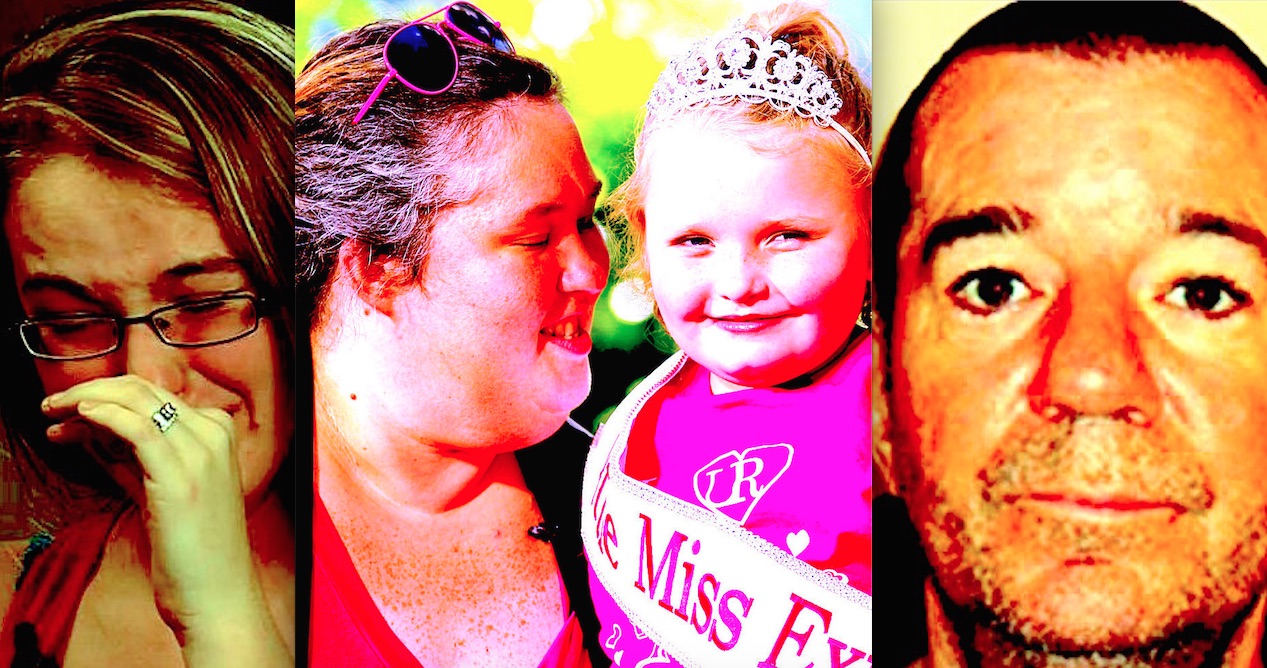
Broken portrait of an exploited family unit--Anna Marie, Mama June, Honey Boo Boo, and Mark McDaniel.

Broken portrait of an exploited family unit–Anna Marie, Mama June, Honey Boo Boo, and Mark McDaniel.

That is to say, it’s very odd to have a show built on the highjinks of a family that is portrayed as a bunch of unsophisticated rubes chasing a weird dream, and then to turn around and cancel the show when the matriarch of the family does something that shows she really doesn’t understand what’s at stake in a particular situation. According to Anna Marie’s own statements to the media, June minimized McDaniel’s behavior, telling Anna Marie that McDaniel wasn’t all that dangerous because Anna Marie was McDaniel’s only victim.

Such a statement is a big red flag that Mama June just might be buying a whole lot of lies from McDaniels—the kind of lies that offenders tell all too frequently. ‘It was just the one time;’ ‘I was drunk;’ ‘It was a mistake;’ ‘The victim did X first;’ ‘I paid the price/did my time;’ ‘I won’t ever do that again;’ etc, etc.

I don’t know what kind of treatment McDaniel may or may not have received in prison. But unless McDaniel has developed some understanding of his own behaviors, and unless Mama June has been educated on exactly what McDaniel did, how he did it, how he justified it to himself, what kinds of things Mama June needs to look out for in McDaniel’s behavior (preferably coming from McDaniel’s own confession); and unless she’s been given instruction in what McDaniel’s behavior means for the safety of her other children, and how to reduce risk (risk can never fully be eliminated), then it’s a little hypocritical of TLC executives to cut her off, claiming that it is in the best interest of the safety of the children involved.

And just for context, here’s the statement issued by the network at the time of the show’s cancellation: “TLC has cancelled the series HERE COMES HONEY BOO BOO and ended all activities around the series, effective immediately. Supporting the health and welfare of these remarkable children is our only priority. TLC is faithfully committed to the children’s ongoing comfort and well-being.”

Great, TLC, but where’s the support? I’ve seen many mothers of victims continue on in relationship with the men who molested those women’s children. And a supportive and appropriate relationship with an adult partner can actually reduce risk for re-offense. However, that risk isn’t (generally speaking) reduced when the offender is allowed back around likely victims, particularly without the partner being fully informed as to the nature of the offender’s behavior, and how to provide adequate support for the offender and for other family members. But maybe TLC executives are just looking at this as another example of the stereotypes they’re comfortable promoting–of poor, Southern folk accepting child molestation as a routine part of life.

It is potentially extremely damaging for victims of molestation, like Anna Marie, to see their mothers return to relationship with the offender, or to, in any way, be given the impression that they are being treated as secondary to the perpetrator of sexual violence. It definitely sends some disturbing messages about who is being given priority, and where the concern of the mother lies. It is possible to mitigate that damage, but only with some very involved, professionally-guided therapy.

I don’t want to over-simplify things here, but a major reason for women to continue on in relationship with offenders is economic. I don’t have any idea if McDaniel has any real way of providing for June’s family, but since TLC just cut off the family’s current main source of income, they are increasing Mama June’s likely reliance on someone who can provide support—and at a time when the person June is in relationship with is an offender who is very much putting Honey Boo Boo—that “remarkable child”—at risk.

So, again, why not take the show in a new direction? A learning direction? I don’t mean to advocate for making an offender a reality TV star, but TLC could at least build in scenes to Honey Boo Boo’s show, or maybe a spinoff, that follow McDaniel through treatment, and through all of the difficulties he now faces as a convicted offender trying to rebuild a life outside of prison, in conjunction with Mama June’s exposure to McDaniel’s treatment process.  The audience could see scenes of June attending sessions with McDaniel—scenes of McDaniel explaining his ‘offense cycle’ to June, of McDaniel explaining his actual offense to June, of June going through a chaperone class where she learns just what limits need to be placed on McDaniel and his contact with June’s children.

And what about making sure Anna Marie’s okay? How about, instead of channeling any income to McDaniel, any money involved in a standard TLC reality-star fee, over and above the cost of his evaluation and treatment—funded by TLC—goes to Anna Marie to make sure she can get some ongoing treatment herself?  Perhaps let Anna Marie gain some economic benefit from the exploitation she’s already suffered? She’s had various media outlets contacting her to ask how she feels about the man who molested her being released from prison. How about making sure Anna Marie’s not being re-traumatized by all of this? After all, how many victims of molestation really want the molestation being made public, and then want to have to address it, with complete strangers, for the purposes of having it blasted out all over the airwaves and the Internet?

Of course, TLC doesn’t have to do anything in this case. Perhaps TLC executives were grateful that a scandal of this sort came around when Here Comes Honey Boo Boo was pulling ratings of less than half of its peak performance, just so they had a good excuse to cut their losses. Then again, TLC could really do some good in this case. TLC could truly support the “health and welfare” of their child stars. TLC could really help advance public discourse on offenders, offender treatment, and victim advocacy.

Or TLC could just leave Mama June, Honey Boo Boo, and the rest of the clan dangling—dangling over a cliff where falling means families torn apart and potential acts of child sexual abuse—and move on to whatever other ‘reality’ show goofballs America wants to laugh at, until ‘reality’ creeps in and undoes them as well—leaving TLC to cut its losses, abandon its ‘stars,’ and run.


Dropping Keys, Dropping Letters

by Jonathan C. Schildbach, LMHC, waning ASOTP, reforming soul-eater

An eighth-season episode of The X-Files was built around a “soul-eater”—a person who could draw the disease out from others into his own body, eventually vomiting it out. The concept of the soul eater is based in various forms of folklore involving a range of ideas about curses and cures, and the ability of some to take away those things that most harm or most sustain a person. Unfortunately for this particular soul eater, the demands of those who knew of his powers began to overwhelm his ability to process and expel the disease. He existed in a perpetual state of deformity and misery.

I like the soul eater as a metaphor for the work done by many people in “the healing professions.” In this field, many of us work at building a skill set that allows us to help extract the mental and spiritual toxins in others. Ideally, those receiving help will find a way to vomit out the toxins themselves. Yet, such toxins are in no short supply, and many who are most in need of help thrive on a constant diet of disease coupled with a willingness to let others take on the burdens of that disease. It becomes far too easy for helpers to end up like the suffocating soul eater, awash in the illness of others.

In the professional parlance, we call all that business of being overwhelmed by the problems of others “secondary trauma.” There’s a tendency to assume that, as trained professionals, we are able to recognize and address our own forms of distress. But, like many people in positions of suffering, particularly those who are considered high-functioning, it is entirely too easy to soldier on without addressing our own needs. We know how to address all this, and yet we often don’t, or we often address it in an unhealthy fashion, assuming it will pass in time. We take on more than we can handle, and think nothing of it. Whatever doesn’t kill me makes me more convinced I’m strong enough to take it.

Hey--eat any good diseases lately?

Hey–eat any good diseases lately?  The X-Files’ soul eater.

I bring this all up by way of saying that I’m in the midst of a career shift—not out of the helping professions, but into some different channels in the same field.

In particular, last night I dropped off the keys to the office where I’ve been serving as an ASOTP for the last year-and-a-half, at least temporarily distancing myself from a particular portion of the field that I have been involved with for over seven-and-a-half years—the treatment of sex offenders.

The change was forced by way of making a shift in my full-time employment in crisis services. As I write this, I am deliberately allowing myself only some small bit of awareness of the insanity of my professional life over the past several years. Yes, I have been working full time in crisis services, while also working anywhere from zero to ten hours per week with sex offenders. Such arrangements are not unusual in the helping professions—where we are pushed to learn our craft in rigorous, unpaid positions, while also attending school and working a paid job just to stay afloat. The habits of overextension established while in graduate school can extend out into professional life, and feel totally normal, even as we are pushed toward deformity and misery.

Currently in a break from a years-long pattern of toxic soul-eating, and ready engagement with secondary trauma, I realize I’ve become numb to plenty of very bizarre things. Running plethysmography assessments, I can sit through audio scenarios of sexually violent behaviors, paying them as little attention as if they were overplayed Top 40 hits from yesteryear piped over a grocery store or dentist office sound system. I’ve become entirely too comfortable asking people about their masturbation habits, and pressing them when I think they’re lying (only in the course of assessments, of course—well, mostly). Fortunately, I haven’t become so numb that I’ve lost all awareness of the twists and turns of my mind, although I frequently find myself stumbling in otherwise polite conversations when frighteningly dark and vulgar jokes spring to mind—an entirely appropriate coping mechanism in certain circumstances and with particular people—but definitely nothing you want to spring on friends of friends who don’t even have the most limited of contexts for understanding where such thoughts could come from.

And all of that was on top of 40-plus hours per week of run-of-the-mill crisis intervention, suicide prevention, utilization management…

So, if I want to mix in some metaphors, I can say I’m now a ronin—a samurai without a master—an ASOTP without a CSOTP—which, really just makes me a guy with an expensive piece of paper that says I’m an ASOTP until next September, but which conveys no real ability to treat any offenders unless and until I take on another master/CSOTP. Weighing the massive number of hours I still have to accrue across assessment, face-to-face treatment, and supervision, in order to get the full credential myself, I think this may be it for my involvement in offender-land.

I’ve dropped off the keys; and, with no further action, the letters, too, will drop—as will the level of…expulsion required of me on a regular basis. Sure, I’ll still do what I can to draw out various forms of mental/spiritual disease when that is required of m—but hopefully now in more manageable, fun-sized portions.


Why John Grisham Wasn’t All Wrong about His Child-Porn-Viewing Friend

by J.C. Schildbach, LMHC, ASOTP

Way back in mid-October, an eon ago in Internet time, an article and partial interview was published in The Telegraph, wherein John Grisham decried the unfair treatment an old law school buddy of his had received at the hands of the overzealous legal system. After all, Grisham argued, his friend had only looked at some child porn that was really just technically child porn, because it involved 16-year-olds who looked 30, or some such rot.

You can read that piece here: Grisham on What Makes a Real Pedophile

Jessica Goldstein put together a piece for Think Progress that explains a whole lot about what was wrong with what John Grisham said, from the perspective of why maybe, just maybe, seeking out pictures of 16-year-old girls, even if they look mature, might be problematic. It is available here: Goldstein Explains Why Grisham’s Friend Shouldn’t View Child Porn

I would add to Goldstein’s piece that, developmentally speaking, if you think 16-year-olds are capable of making rational decisions about being ‘porn stars’ then, well, you’re wrong. Look into brain development, and when people actually become capable of making decisions about the long-term consequences of their current behaviors. Add to that the problem that sixteen-year-olds, legally speaking, can’t enter into ANY contracts (even if they can legally consent to sex) and, well, it’s pretty cut and dry that 16-year-olds (and minors of all ages) in pornography are just plain being exploited, as well as frequently being abused, drugged, threatened, or otherwise coerced.

In the time since the publication of the original piece, Grisham’s friend has come out to say that his treatment in the legal system was not unfair, that he deserved what he got, and that he should have never done the things he did. It also came out that, unlike what Grisham said, his friend did not just accidentally look at some 16-year-olds who looked like adults, but that he was actively participating in the exchange of child pornography, including files involving children as young as 12 (who presumably did not look like they were 30).

Much has been made about why Grisham would have given such a distorted view of what happened with his friend. My guess is that he didn’t know exactly what happened, and that he was going off of an explanation his friend had probably given several times to family and friends when his legal troubles started. That explanation probably went very much like Grisham explained it: ‘I was drunk. I was unhappy. I clicked on a link that I didn’t realize was child pornography.’

Not surprisingly, when friends and family of an offender first hear of allegations of any kind of sexual misconduct, particularly when it falls into the realm of sexual misconduct involving children, whether that is “hands-on” contact or viewing child pornography, the default position is to not want to believe it. Likewise, the default position for the person engaging in the offending behavior is to not want to admit to it.

When offenders are “found out,” there are several stages that they often go through on the way to actually being able to own up to their actions. Very roughly speaking, those usually look like: 1) Nothing happened; 2) Something happened but it’s not nearly as bad as they say it is; 3) It was an accident/the victim did x first; 4) Something happened that is worse than I originally said, but really not as bad as they are saying; 5) Really, I have a pretty extensive history of this kind of behavior.

The offender, and those closest to the offender, simply do not want to believe that what happened actually happened, and often cling to that as long as possible, and often to the detriment of the victims of sexual abuse.

Grisham's factual failure may have led to a bit of a headache for him

Grisham’s factual failure may have led to a bit of a headache for him

So, I’ve highlighted a few of the things that Grisham said that were clearly wrong and stupid when it comes to offenders. So, what did he get right?

Grisham’s words were rather careless. Citing old white guys in prison as a big problem is not really the best way to go about making a case. Old white guys in prison is about as big a problem as young white guys not being able to get into college because of Affirmative Action. In other words, relative to other systemic problems, it’s nothing.

But something that is pretty limited is the threat that old guys (regardless of ethnicity) represent to the community at large. In the case of old guys looking at child porn, the threat can be further reduced by eliminating their Internet access and by eliminating any contact they are allowed with children.

But how do such limitations get put in place or enforced? In several states there are “sentencing alternatives” for sex offenders (and for people who have committed various other types of violations), particularly those who are not considered “violent offenders.” And, I realize the language is odd, but “violent offenders” are those kinds of offenders who, say, go after kids they don’t know or engage in physical violence beyond just the sexual acts they inflict on their victims, as opposed to “grooming” children that they are in regular contact with. Groomers, or non-violent offenders, tend to work slowly and patiently to get what they want from their victims. Violent offenders smash and grab and are a small minority of overall offenders.

At any rate, from what has come out, Grisham’s friend had no hands-on victims. And really, what’s the bigger punishment? Putting him in prison for three or more years, and then letting him out, all done, all paid for; or putting him in jail for less than a year, and then putting him out to go about rebuilding his shattered life, while under strict supervision and treatment guidelines?   Once on the outs, he has to get a job (probably not a high-paying attorney job as I’m guessing that door has probably closed), pay for whatever housing is available to him—which will likely be severely limited, be under the supervision of a Community Corrections Officer (CCO), and have to go to/pay for outpatient sex offender treatment for the next several years, potentially for the rest of his life.

At any rate, the sentencing alternatives cost taxpayers a lot less money, are just as effective from a treatment perspective. And, for the vindictive among you, such sentencing alternatives are plenty demeaning—loss of status and being under a harsh set of rules, with the threat of being bounced back to prison for violating those rules, is not something anybody wants to live with. And for those offenders who manage to maintain any kind of support network, or rebuild a new one, they get to go through the rather unpleasant process of explaining their offenses again and again, just so that they can build a group of chaperones, or at least informed contacts.

So, in a way, Grisham was right that people like his friend don’t need to be clogging up the prison system, just like Grisham is right that non-violent drug offenders don’t need to be clogging up the prison system. Sure, there need to be consequences, but there are more and less effective consequences, and more and less expensive consequences, both to offenders and to the public at large.

But since laws are generally written by politicians, and not for the purpose of doing what is most effective, but for doing what is most politically expedient/most popular, things like sentencing alternatives are created and used less and less frequently. No matter how much sense such policies make, or how cost-effective they are, lawmakers don’t want to be labeled as the ones who let sex offenders, even offenders with no hands-on victims, even offenders who are made to pay severe penalties other than prison time, out into the community.

But such short-sightedness means that more offenders actually get out of prison somewhere down the road, and with little or no supervision, and no organized checks on their behavior.  Grisham is right that there are better places for his friend to be, even if he was completely wrong about what his friend did, and what it meant.


Three Frightening Movies that Aren’t Traditional Horror, or Suspense, or…

Well, Halloween is over, but who cares? You can still keep on scaring yourself, right? Only, rather than the usual gore and mayhem, how about some unsettling horror, the kind that makes you question the reality of the movie, it’s characters, and your own thought processes?

Don’t get me wrong, I’m a big fan of the traditional monsters-and-bogeymen (bogeypeople?) style of horror. But sometimes it’s good to be scared by things that aren’t quite so over-the-top. And speaking of over-the-top, you’re probably already irritated with all the ‘Early Black Friday’ specials and the ‘Holiday’ ads anyway.

The movies listed here also get at some small bit of what it is/might be to cope with various forms of mental illness, or to deal with others who are struggling with it. They spotlight what it is like to be unsure about what is happening, and to have a difficult time understanding what constitutes legitimate forms of support. These are movies that cause a tightness in your chest, and not the kind that is alleviated by the next hissing cat springing out of a cabinet, or garden tool splitting open some body part or other.  They carry with them the kind of dread that has a real impact.

And I’m going to say there’s probably a good chance that these movies should come with some trigger warnings, in case that’s not obvious from the descriptions.

Safe (1995): From Todd Haynes, writer/director of Velvet Goldmine, I’m Not There, and Far From Heaven, Safe sees Julianne Moore as Carol White, a woman who, after much confusion from a wide range of medical, mental health, and ‘other’ providers, is diagnosed with Environmental Illness, a disease that makes her hypersensitive to various chemical agents that are common in everyday life in modern America.

But is she really suffering from anything, or is the disease a physical manifestation of the sheltered nothingness her life has become? The only people who claim to understand her and her disease have clear motivations for convincing her she’s sick, while those who tell her she’s fine seem to lack any concern for her whatsoever.

As much an indictment of the “American Dream” of being completely carefree (there’s no such thing as “safe”), as it is of various forms of mental and physical healthcare, and the lack of clear, irrefutable knowledge to address all maladies (despite ‘professional’ claims to the contrary) Safe will have you clearing your throat, checking your temperature, wondering just what that smell is, and…wait, that’s probably not the best way to encourage anybody to watch a movie.

Safe is a bit difficult to track down. They don’t have it available on Netflix in any format, and Amazon only has it for sale as a DVD or Blu-Ray. Here’s a trailer (that kinda sucks)…

Affliction (1997): Written and directed by Paul Schrader (writer of Taxi Driver, and writer and/or director of numerous other impressive works), based on a novel by Russell Banks, Affliction sees Wade Whitehouse (Nick Nolte) descending into unreality, or perhaps hyper-reality, during what should be the routine investigation of a hunting accident. Having grown up in the shadow of an abusive father, played in frightening fashion by James Coburn, Wade never quite makes it out into the light that might help him establish some reliable sense of self.

An occasionally brutal meditation on familial abuse, PTSD, and other forms of trauma, this one is a slow crawl over gravel, peppered with the occasional hot coal. It’s available right now streaming or by disc on Netflix, as well as on Amazon Prime.

Here’s a trailer (that isn’t all that bad…)

Take Shelter (2011): From Jeff Nichols, also writer/director of Mud, Take Shelter stars Michael Shannon, aka General Zod and numerous other amazing roles, as Curtis, a man convinced that tornado season is bringing something much more sinister than twisters. Curtis jeopardizes his job, his financial security (including money saved for a cochlear implant for his daughter), his friendships, and his marriage to Samantha, played by Jessica Chastain, to build a storm shelter that can keep his family safe from not only storms, but perhaps the end of the world.

Nichols keeps the audience off balance by providing plenty of information that is clearly accurate, or at least witnessed by people other than Curtis, and also including a number of elements we can’t be so sure of. Is Curtis the only one alert to the signs of danger all around? Or is he suffering a breakdown of some kind?

Take Shelter is currently available via disc on Netflix, via Amazon or AmazonPrime in multiple formats, and on Starz—both on-demand and in the regular schedule.

Here’s a trailer (which is pretty darn good)…

https://www.youtube.com/watch?v=I5U4TtYpKIc

So, happy no-longer-Halloween season. And remember, Thanksgiving and Christmas are still a good, long way off…as well as being great times to share disturbing films with family and friends.

The Stigma of Mental Illness and the Noble Savage Myth

Okay, I’m kind of cheating here.  I haven’t posted anything for a while, so I’m popping this up.

This is an article I worked on with Dr. Jeffrey Guterman, based in part on a post I did for this blog (which was a great deal snarkier, and which I will re-post at a later date).

Enjoy… The Stigma of Mental Illness and the Noble Savage Myth

noble savage photo

Sons of Guns & Daughters of Rapists

by Jonathan C. Schildbach, MA, LMHC, ASOTP

The last several weeks have seen charges of molestation, “aggravated crimes against nature,” and rape of a child, among others, brought against Will Hayden of Red Jacket Firearms and the Discovery Channel’s “Sons of Guns” reality show. Hayden has protested that the alleged victim, his own 12-year-old daughter, made the accusations only after his angry ex-girlfriend put the child up to it. The police and many news sources are now walking back their identification of the victim as Hayden’s daughter under laws that protect the identity of minors…but since it’s already splashed all over the Internet, I’m not sure what good that’s supposed to do.

I’ll put forth the disclaimer that anyone accused of a crime in the U.S. is innocent until proven guilty. I’ll also say I’m all for keeping things like this out of the media—but that’s clearly not the world we’re living in, particularly when such charges involve a public figure. After all, Hayden’s show was abruptly cancelled, and his business partners openly distanced themselves from him as a form of damage control to keep their custom gun business afloat. In addition, in the time since the accusations from Hayden’s minor daughter first surfaced, multiple other alleged victims have come forward, including Hayden’s adult daughter Stephanie, who initially defended him against the charges, but is now reportedly slated to appear on the “Dr. Phil” show later this week to explain that she was molested and raped by Hayden when she was a child.

And to add to the various disclaimers and caveats, I must also say I don’t know enough about Hayden’s past, or his current behaviors, to suggest that I, in any way, know that he fits, or doesn’t fit, the general clinical conditions suggesting high-risk behaviors for pedophilia or sexual abuse of a minor.

Let me also put forward that as much as there is an assumption of innocence for the accused, if we really want to make any headway on addressing sexual abuse of children, the assumption needs to be that children who come forward to seek help for sexual abuse are not making things up. When children are lying, their stories do not hold up particularly well, although depending on how skilled or unskilled, careful or careless, someone is when interviewing children, plenty can go wrong with the information that is gathered. But if our first reaction to children who report sexual abuse is to shut them down, or leave them in the homes of the accused, they are potentially being put at further danger, and a likely increase in the level of that danger.

And speaking of making headway in addressing issues of sexual abuse, I’ve noticed, at least as indicated by Internet comments, that when it comes to stories like this, we can count on public opinion to fall into a small number of categories:

1) Kill ’em all: This just involves amped-up vitriol aimed at sex offenders, and those accused of having committed sex offenses. I understand the anger. But, seriously, if you think that killing more people, or addressing problems of abuse with violence is the way to move toward a better society, a more healthy understanding of human sexuality, or better protection for children, you’re taking an overly simplistic view of the way the world works. And if you think this approach has some merit, why weren’t you able to spot Hayden and bring him to justice earlier? Is that anger and all those demands for vengeance really accomplishing anything?

2) “He’s obviously a rapist because he does/likes/thinks X.” Whenever somebody is in trouble for being an (alleged or convicted) sex offender, people like to equate the offender’s other behaviors and beliefs (that don’t jibe with their own) with the offense behavior. In the case of Hayden, some have connected “gun culture” to sexual abuse of children. And while, as anybody who has read my other posts knows, I am no fan of guns, I just can’t see anything productive coming from conflating gun ownership or gun manufacture with child molestation. Of all the people I know, holding varying levels of support for gun ownership or gun control, none of them have ever expressed an endorsement of sexually abusing children. This lack of support for sexually abusing children is pretty universal, regardless of one’s political beliefs, religious beliefs or hobbies.

Furthermore, while I have worked with a few offenders who have had guns figure prominently or incidentally in their abuse behaviors, they have been the exception, not the rule. In terms of grooming behaviors, things like money, jewelry, candy, drugs/alcohol, video games, clothing, toys, and porn have been involved in many more of the offenses I’m aware of than have guns.  And I’m not going to advocate for the banning of any of those items based on the ability of abusers to involve them in abuse patterns. I’m more than happy to advocate for a ban on guns based on their use in—well, shootings—homicide and suicide and attempts at both, not to mention all manner of other crimes and accidental deaths, but as for their involvement in child molestation–not a huge concern, at least from what I’ve personally seen.

3) “How can somebody do this?” This is usually sideways of the “Kill ’em all” concept, and often involves plenty of name-calling. I get that it is very difficult to understand how somebody could rape their own daughter—or sexually abuse any child—but many of the factors involved are not beyond explanation. Most people just don’t want to hear the explanations…or deal with them…except in punitive, harsh ways once somebody has committed such acts.

Generally speaking, though, a person doesn’t sexually abuse a child because he or she is thinking clearly, or because he or she has just suddenly come up with such an idea after a long life of healthy relationships. If Hayden was engaging in sexual abuse of children, he wasn’t, one assumes, doing it out in the open, as such behaviors usually involve a great deal of secrecy and manipulation, like Hayden’s alleged warnings and threats to his daughter not to tell anyone, because, “I’m all you’ve got.”  In short, people who sexually abuse children are ill and engage in a number of behaviors to try and mask that illness, or keep others from learning of it.  I’m not sure how to properly emphasize this enough.  Sexual abusers of children are not just random guys who are bored and horny.  There are a lot of factors involved, including a huge number of elements (rationalizations, justifications, creating situations where one has access to children and is willing to take advantage of that access while plotting to keep anyone from finding out) that involve breaking down the normal barriers that prevent such sexual abuse.  In other words, “How does somebody do this?” is a question that involves a long and extended answer.

…And now for a clip of Hayden that seems weirdly re-contextualized, check this out–especially the last 20 seconds or so…y’know, where he talks about people becoming bad headlines and how he tends to his own conscience.

Anyway, let’s say that way back before Hayden had ever (assuming he did) touched his daughter or any other young girls in a sexually inappropriate manner, he realized he was having thoughts in that direction, and that he needed to do something to steer clear of that behavior. What would he do?

For those of you who know what kinds of resources are out there for dealing with someone who is having thoughts of sexually abusing a child, bravo. Please do what you can to make sure others know. I will say that over my years working on the crisis line, I have fielded a very small number of calls from people (both men and women) who were concerned about the nature of some of their sexual thoughts towards minors—either specific minors in specific situations, or more generalized sexual thoughts—and were seeking help.  In my years of dealing with offenders, I have seen numerous people who just might have sought help if they had any idea how to, and if they hadn’t felt like total garbage for acknowledging that they needed help.

But most people facing thoughts of sexual attraction to children do not have the wherewithal to seek help, much less have any idea where such help could be sought. It is a much more common reaction to deny that there is a problem, to try to push the thoughts away, or even to feed the thoughts (as in masturbating to inappropriate fantasies) while assuming that the actual offense behaviors can still be avoided.

Furthermore, treatment providers in the field of sexual abuse can have a difficult time promoting services. People tend to come to providers by referral from a lawyer or a community corrections officer (CCO) after they are already in trouble or have already served time, even though the same types of treatment could be just as effective before any offenses were committed. After all, just how welcome do you think a provider would be if they hung a sign out on their business that said “Sex Offender Treatment” or “Specializing in the Treatment of Sexual Deviancy,” or something similar? The stigma and shame that prevents people from seeking help for mental health issues as relatively common and accepted (and I mean relatively accepted) as depression, is increased a great deal for issues surrounding sexually inappropriate thoughts and behavior.

So, regardless of all that business about stigma and secrecy and providers protecting the privacy of their clients and confidentiality of their services…here’s a site that has a directory of providers throughout the U.S.  It’s basically set up for people who are already in trouble.  But it doesn’t have to be.  This is through “Stop It Now” which has referrals to the Association for the Treatment of Sexual Abusers (ATSA) and numerous other organizations.  Get help if you need it.  Get help for others if they need it.  That’s right, help, and try to discontinue the hurt.

http://www.stopitnow.org/faqs_treatment

Maybe if everybody calmed the f*ck down and decided they were more interested in actually protecting children than in getting angry at offenders, we might make some progress.  And maybe tend to that part of your conscience that’s problematic before you become a bad headline, or before you celebrate a bad headline.

Peace.

Suicide?!? Shazbot!

By J.C. Schildbach, MA, LMHC, ASOTP

Before we get started, let me just mention that I spend the better part of my workweek involved in crisis intervention and suicide prevention. And let me note that anybody’s reaction to the death of another is going to be personal, and related to the kind of connection between them.

Now, let me tell you something horribly, selfishly, insensitively awful about me.

When I first heard of Robin Williams’ death by suicide, my thoughts were, more-or-less in this order…

1)  Damn!

2)  60-something-year-old man…history of mental health issues…history of substance abuse…makes sense.

3)  I wonder what else was going on with him.

4)  I am NOT going to write a blog post about this.

5)  Uggh! There’s gonna be a shitload of extra calls on the crisis line tonight!

Somewhere down the line was, “Shazbot!!” I totally f*cking wish “Shazbot!!” had been my first thought.

Anyway, before you climb all over me for my previously-mentioned insensitivity and selfishness, or whatever you might want to call it (I think I’ll call it “appropriate clinical detachment”), let me explain, in order of those thoughts.

1)  Yes, “damn!” It was shocking and unexpected to hear such a thing, essentially out of the blue. As for the context…I received a text message from my daughter about Williams’ death while running a plethysmography assessment (look it up). What this means is I was sitting in a small, dark, very stuffy and hot room running what I imagine would seem to most people to be a very disturbing clinical assessment to determine what kinds of really terrible things might lead to…ahem…responses for somebody with some admittedly inappropriate arousal patterns.

In such a situation, I didn’t have a lot of options for furthering a conversation or following whatever breaking news may have been happening. I had to shelve whatever thoughts or emotions I was having, and continue on with the assessment.

(You may ask why I wouldn’t have turned my phone completely off during a forensic assessment, but the reality of it is that the trace of the assessment is being recorded for later review, where it’s much easier to spot problem situations, and that turning my phone off only leads to things like my daughter destroying a sliding glass door because she locked herself out of the house on a cold day in early March—long story—well, not really, I think I just told it).

2) Which leads to…”60-something-year-old man…history of mental health issues…history of substance abuse…makes sense.”

Sitting in that dark, stuffy, hot room, staring at a double-lined forensic “trace” on a computer screen, with few responsible options available for furthering my knowledge/understanding of the situation, the defense mechanism of clinical detachment kicked in. Think about it, yelling “Oh my God!,” or sobbing openly, or exclaiming, “Shazbot!” all would have been pretty inappropriate.

At any rate, the quick run-through of Williams’ risk factors is the kind of clinically detached comment that I suppose is hard for a lot of people to take, especially when it has not been filtered at all. I can’t speak for everybody in the field of counseling/therapy, mental health, or even crisis intervention and suicide prevention, but there’s an odd dichotomy that exists in most people who get involved in such fields: we tend to be highly sensitive people; we learn to be very objective about that sensitivity.

If I wanted to get all sci-fi, I could say people in this field are empaths…empaths who have honed their skills away from making them one big, raw nerve, and toward using that sensitivity to discern a deeper sense of what is happening in others without being overwhelmed by it. Most of us have some pretty pronounced defense mechanisms. So, ideally, our training leads to an ability to pick out risk factors and make judgments about how those risk factors affect a situation, so that an appropriate course of action can be taken. Such risk factors are not predictive, but tend to be more actuarial.

Furthermore, the assessment of risk factors tends to weed out irrelevant elements. I’ve heard so many people go off about Williams’ fame and money as if that should have kept him from suicide, but those factors are irrelevant to a suicide assessment…except perhaps in the context of Williams’ available resources for obtaining help. But, and here’s a big generalization (as well as a big but), for somebody who is at the point of committing suicide, the concept of “help,” regardless of one’s resources, has become rather abstract and unreachable. From such a viewpoint, the available “help” appears to have been exhausted and shown to be inadequate. So, pushing past the money and fame, if one looks at Robin Williams from the standpoint of demographics and his personal history, he fits into a high risk category—or, rather, multiple high risk categories, even before other information about his health was revealed.

3)  “I wonder what else was going on with him” was merely a further part of the assessment of risk and what led Williams to his course of action. In suicide risk assessment, this is a huge factor. (Can I get a ‘duh’?). If the demographic factors alone played the deciding role in whether somebody was going to commit suicide, then we’d have near-universal suicide by people who fit into the same demographic categories as Williams.

Hence, one of the things that is always asked of people expressing suicidal thoughts is some variation on “Is there anything in particular that’s leading you to feel this way?”

The big idea behind such a question is to open up a conversation with someone who has, perhaps, not had such an opportunity to discuss what’s going on with them. A lot of people who attempt suicide, or are headed in that direction (here’s another big generalization) have been very closed off about their thoughts, and what they’re going through. Sometimes, broaching this conversation, being able to “normalize” suicidal thoughts (let people know they’re not as rare as they might think), and giving somebody a chance to talk through their immediate experiences, can lead to a person discovering that they have supports and strengths they weren’t considering when they were staying closed off and keeping it all to themselves.

4) The idea that “I am NOT going to write a blog post about this” came from a number of places. As someone who works in suicide prevention, and who writes a (mostly weekly) blog it seemed almost obligatory for me to at least note Mr. Williams’ passing. I shudder at “obligatory.”

Also, following any highly-publicized suicide, a whole slew of TV pieces, articles and blog posts (among other things) commenting on suicide and depression and the lives of those who complete or attempt suicide go flooding out into the world. It makes sense that people want to find out what happened, or understand how it could’ve happened, or share their personal feelings, or pay tribute, or say obnoxious, ignorant things…and there is often plenty of overlap in all of that.

And all of the posts and articles, and TV pieces close out with the phone number for Lifeline, the National Suicide Prevention Hotline, urging people to get help for themselves, or for anybody they know, who is considering suicide or having suicidal thoughts.

As I’ve noted in other posts, I don’t do death too well. And I don’t really like talking about a particular celebrity because they died, or talking about suicide because that’s how someone famous died. I don’t generally shy away from talking about suicide, but I’m not deep into worrying about what celebrities are doing in their private lives. At any rate, when such conversations happen, I find myself slipping too far into the clinical, or just keeping my mouth shut. As for Robin Williams…I’m pretty sure I saw the entire run of “Mork and Mindy” and the “Happy Days” episode that spawned Mork, although I couldn’t really tell you much of anything about any of those storylines…as apparently memorable as they were, what with the rainbow suspenders and flying eggs and all. I’ve seen several, but definitely not all, of Williams’ movies.

Williams, like almost any accomplished artist who is around long enough, and productive enough, is going to put out work that is great, and some that is less great. The last thing I saw him in was “World’s Greatest Dad”—strangely enough, a story about a man who becomes a sort of celebrity after he ghost-writes a suicide note to cover up the fact that his teenage son died from autoerotic asphyxiation. I really enjoyed this movie, like I’ve enjoyed all of Bobcat Goldthwait’s movies (the ones he writes and directs). They tend to involve a kind of dark humor and exploration of at least mildly taboo subjects that are right up my alley. And, as a special bonus, “World’s Greatest Dad” was partly filmed at a bookstore and “mall” about five minutes from my house.

Williams as the most talkative mime ever in "Shakes the Clown"...shattering expectations for better or worse.

Williams as the most talkative mime ever in “Shakes the Clown”…shattering expectations for better or worse.

But then again, I had also written some spotty notes about how “Good Will Hunting” is one of numerous movies that gets the therapeutic relationship all wrong. I could continue on about liking how “Alladin” made good use of Williams’ rapid-fire joking, as did “Good Morning, Vietnam” and how he did some good stuff around mental health issues, like “Awakenings” and even “Patch Adams.”

I could tell of how I once spent half of a 9th-grade biology class trying to stop laughing uncontrollably after attempting to relay part of a Williams comedy routine to my lab partner (who is still my closest friend, not counting my wife). To completely butcher the joke, it involved Williams doing an impersonation of E.T. saying “ouch” because he was standing on his testicles.

5) Which leaves only “Uggh! There’s gonna be a shitload of extra calls on the crisis line tonight!”

I’ll concede that this is a pretty damn selfish thought. But, to provide some context, the call volume on Lifeline, the National Suicide Prevention Hotline on Monday, the day of Williams’ death, was double the call volume of the day before. On Tuesday, August 12, Lifeline had its highest call volume ever in the history of the service.

It’s true that not all of those calls involved people with suicidal thoughts, or suicidal intentions. The calls were not all from people standing on a bridge, or sitting in their living room with a gun in their lap, or lying in bed with several containers of pills and a bottle of gin beside them. Many of the calls were people asking how to get help for people they know. Many were people upset and sad at Williams’ passing, and just trying to process their own thoughts. But many were from people struggling with suicidal thoughts and intentions, several of them consumed with the idea that if Williams, with all he had achieved, was going to kill himself, then why shouldn’t they?

And, of course, people being the way they are, whenever the Lifeline number gets widely published and shared around on social media, there were more than the usual number of prank calls. (Quick note, kids: DO NOT prank the Lifeline—we have to take suicidal threats seriously, which means you might get a visit from the police as the price of your little joke, and as the price to the people of your hometown, who now have police officers responding to a non-emergency situation because you thought it was funny to be the kind of asshole who mocks people suffering from depression).

On top of the massive increase in Lifeline calls, most of the Lifeline call centers also serve as local crisis lines, and there was a huge uptick in the calls to local crisis lines (I don’t have specific numbers on this one yet, but trust me). Several of the Lifeline call centers, including the one I work in, also serve multiple functions within the local mental health system. To say the least, things got a little overwhelming.

I could go on about a number of other factors involved here, like how, while some call centers may be able to call in additional volunteers to address the short-term spike, generally speaking, the staffing, as with any business, is aimed at addressing an ‘average’ workload.  And there isn’t any way to suddenly increase the number of telephone lines and work stations to deal with what is, ultimately, only going to be a short-term (even if massive) increase in call volume.

By Thursday night/Friday morning, things seemed to be calming down a bit, easing back down to normal…at least in terms of call volume.

But we’re all still left with the sadness and the loss of an entertainer who reached people worldwide, and the struggle to understand and accept whatever this means to us personally, or societally, or clinically.

And, oh yeah…

If you or anyone you know is struggling with suicidal thoughts, PLEASE PLEASE PLEASE call LIFELINE, the National Suicide Prevention Hotline, at 1-800-273-TALK.

Why Would You Work in the Field of Sexual Abuse?

By J.C. Schildbach, MA, LMHC, ASOTP

There are few circumstances where one would relish the opportunity to talk about sexual assault with one’s niece. But given that my niece and I both work in fields related to sexual abuse, and don’t get to see each other very often, chances to “talk shop”—despite “shop” involving some rather heinous things—are pretty great.

You see, my niece, I’ll call her SC for short so I don’t have to keep calling her “my niece” and so I don’t have to use her actual name, spends a portion of her workweek as a Forensic Nurse Examiner (FNE). I spend a portion of my workweek as an (Affiliate) Sex Offender Treatment Provider, and have worked with offenders in one capacity or another for over seven years.

Among the topics we discussed was the rather personal issue of why anyone gets into a field related to so much trauma and other forms of ugliness.

One big similarity we found is that, on learning of our professional lives, most everyone says, “I couldn’t do what you do.” In fact, we said it to each other. I have zero desire to be involved in anything that involves touching patients or perpetrators in order to draw blood or gather other bodily fluids and materials. I cannot imagine dealing with people who have just been traumatized, when the wounds are so fresh and the pain is still so raw. SC has no interest in engaging with those who commit sexual crimes, in order to get them to accept responsibility for what they’ve done, and unravel the knots they’ve tied themselves into on their way to convincing themselves it was okay.

One huge difference SC and I found in relation to the subject of why we do the work we do is that almost everybody asks me how I got into the field, while almost nobody asks her the same. The split in questions about why anyone goes into any career built around sexual crimes may be based largely on gender, and stereotypical beliefs about how one’s gender informs one’s connection to sexual assault. Then again, the particulars of our jobs might connect to different expectations. She’s involved in the early stages of trauma intervention and evidence gathering. Generally speaking, I’m involved with people with impending court proceedings or who have already served time for their crimes.

At any rate, in her estimation, it’s likely that nobody asks SC about her entry into the field because there is an underlying assumption/fear that she chose her path because she was sexually victimized. There is an assumption that asking her will unleash some history of traumatic experiences that will lead to all manner of emotional unpleasantness and the conversation rapidly turning uncomfortable.

Anna Gillespie's "I Don't Want to Know"

Anna Gillespie’s “I Don’t Want to Know”

On the other hand, people ask me because they assume that, since I’m a guy, I’ll have some interesting tale that is much less likely to involve me having been sexually victimized. From a purely statistical standpoint, the gender-based assumptions make a fairly good bit of sense. Although, with SC working mostly with adult victims of violent crimes, and me working mostly with offenders who groomed and manipulated underage victims, and no fully accurate statistics existing for crimes in either realm, statistics only say so much.

On top of the statistical inadequacies, despite such gender-based assumptions, I’m really not sure what people might think would be my reason for getting involved in the field that wouldn’t involve at least some form of indirect (to me) trauma—such as someone I know and love having been victimized. Or perhaps there’s some stereotypical thought that men in this field are engaged in matters of clinical interest due to career-building, problem-solving pursuits, while women are involved with their choices for more personal reasons. Perhaps a bit of research on gender-based perceptions of the career choices made by other people is in in order.

Inevitably, when I attempt to explain my involvement in evaluating and treating sex offenders, and I mention a connection to a pastor at the church I attended growing up, I get a “say no more” response. That is, once a pastor is invoked, the person asking me makes a quick re-evaluation of their question, resulting in the immediate reaction of trying to cut me off before I say anything they’d rather not hear.

But the connection to the pastor has much more to do with struggles of faith, and just what it means to have a significant portion of one’s religious education delivered by a sexual abuser of children, than with having been victimized. It has to do with understanding how anybody, let alone a religious leader, could have developed such behavior. But I rarely have the chance to get all of that out once the question has been raised.

And now that I think of it, while talking with SC, I didn’t get through much of that either—through no fault of hers, but due to my own hesitation/difficulty at explaining myself in this matter—or perhaps because I’m so used to being cut off. I did get to the “I’m not doing this because I was molested by a pastor” part, but didn’t get into the more esoteric components of my attraction to the field.

I don’t fault people for their (perhaps prurient) interest in hearing disturbing tales of twice-removed personal trauma. Anybody in this field has at least a clinical interest in such stories and understanding what is behind them, or how those involved might be healed or rehabilitated to the extent possible. Still, it’s much easier for most people to deal with such tales when they involve an unknown or distant victim, or when a computer or TV screen or a printed page is safely containing that victim’s story, than it is to deal with somebody whose emotional scars may burst open right in front of you.

In my work, I am much less likely to deal with such potential emotional eruptions than SC is. I’m used to dealing with all manner of misdirected, sometimes explosive, anger and shame. Still, the focus of my work involves a significant amount of distance from the victims of sexual crimes, and the pain of those experiences. As much as those of us who are involved in the treatment of offenders may attempt to dig in deep and uproot the sources of objectification and emotional distortion that may lead to further offenses, we providers are spared that intense level of immediate pain that comes from sexual assault. Even when dealing with offenders who have a history of victimization themselves, providers are generally removed from such experiences by years. In other words, I’m afforded a high level of abstraction of the victims and their pain that SC is not allowed in her work.

It may ultimately be that the distance from, and abstraction of, pain and victimization involved in my work makes it easier for people to ask me why I do what I do. In fact, the people I deal with are, to the general public, abstractions themselves. “Sex offenders” and “pedophiles” are little more than skewed ideas to large portions of the population. People want to know what such offenders are like, and if they fit the pervasive stereotypes. In that context, asking me what I do is merely a precursor to getting to “the good stuff,” the hope for a glimpse at the back-stories of true crime tales, as well as the actual true crime tales.

In contrast, the immediacy of the hurt SC deals with as a routine part of her job, and the connection to so much pain, is perhaps too real for most people to want to delve into. It doesn’t involve that level of abstraction, where offenders stay as cartoon characters, and, where the bad guys have already been caught and made to pay.

Or, to put it another way…SC deals with “us.” I deal with “them.” We all know what “us” is about. But what’s up with “them”?

People understand how a person could be in the wrong place at the wrong time, how someone could be so unfortunate as to become a victim, and they want to keep that out of their mind as much as possible, because it suggests their own vulnerability. They really want to know how a person becomes the factor…the thing…that causes that shift in time and place that makes that time and place all wrong. What they don’t realize is they’re still touching on another form of vulnerability, but one that they can’t acknowledge in themselves. They want to remain “us”—potential victims but still ‘normal’—while looking at “them”—the offenders as something alien.

Perhaps it’s just that people want to know more about my work, or why I’m doing it, because it involves the more unfathomable end of the abuse equation, the place where they cannot imagine themselves being, while they don’t want to know about SC’s work, or her connections to it, because that speaks to a form of vulnerability they more immediately understand…how they could be assaulted. Failing to imagine how anything could ever happen to lead them to become a victimizer (although, statistically speaking, a huge number more people victimize than are ever held to account for such behavior—whether with adult or child victims) people are much more comfortable asking me, “Why did you get into this field?”

How About We All Stop Using “Schizophrenic” as an Insult?

by J.C. Schildbach, LMHC, ASOTP

One night about two years ago, I challenged a friend for describing his behavior as “schizophrenic.” In an admittedly snide tone, I asked a quick barrage of questions referencing various types and symptoms of schizophrenia: Are you catatonic? Paranoid? Suffering from delusions? Auditory hallucinations? Visual hallucinations? And so on…

Somewhat unexpectedly, my friend responded with an apology for his use of the term, and didn’t engage in any kind of defensive posturing or attempts to justify his word choice. He clarified that he meant he had changed his mind back and forth several times in relation to a particular situation.

I was a little surprised that I had reacted in such a way to what was supposed to be a self-deprecating comment from a friend. But there were a number of things weighing on me at the time, not the least of which was that my friend was seeking advice on a matter that was best kept between him and his partner, and maybe a good couples counselor. As with most of the times he sought advice, he had already made up his mind about what he intended to do, and was looking to have his intentions validated, or to have them challenged with an argument so compelling that he would have no choice but to turn from that position.

Aside from my irritation with the immediate situation that evening, I had been in contact earlier in the week with a young man diagnosed with schizophrenia. He was in some pretty serious legal trouble, and did not appear to comprehend all that much about it except in the most concrete of terms. That is, he knew what law he had broken and why it was problematic. That information had been drilled into him during his time in court and a stay in jail. But his sense of what the crime meant, and how it was going to impact him, his connection to others, and the choices he was going to have to make, both short- and long-term, was murky at best. It struck me that he was so used to being marginalized that his current situation involved just one more bureaucratic system to interact with—as if this latest set of restrictions was little more than an additional cluster of tasks to occupy his time.

Working in crisis intervention, I also have fairly frequent (phone) contact with people coping with schizophrenia and other mental illnesses that involve psychotic symptoms of varying levels of severity, and which often fluctuate over time. There are few, if any, blanket statements that would accurately cover them all, or make a nice, tidy explanation of what they are dealing with. But, unlike the popular usage of the term “schizophrenic,” the way my friend had engaged it, the behavior, thoughts, and challenges of those dealing with schizophrenia are not simply a matter of being indecisive or changing their approach to an issue.

In the time since I first barked at that friend about his use of the word “schizophrenic,” I have seen it become more and more commonly used (or, perhaps, it was used a great deal before that, and I just hadn’t noticed). Currently, in addition to the way my friend used it, to describe his somewhat erratic decision-making behavior, it is used quite often in relation to politics, and often by writers and other figures I respect or at least tend to agree with. Such uses, though, are potentially offensive, and even insulting in a way that is beneath anyone attempting to make a serious point.

For example, in recent weeks it has been relatively easy to find articles, or to come across people on television news/opinion shows, complaining of politicians behaving in a “schizophrenic” fashion toward immigration policies. Generally, what the use of the term “schizophrenic” means in such a context is that the politicians are saying one thing and doing another, or that they have changed their position on an issue multiple times. It is basically used to mean that a politician or group of politicians have been inconsistent on an issue.

A quick Internet search can find all manner of uses of "schizophrenic" as a derogatory label--frequently in political discourse.

A quick Internet search can find all manner of uses of “schizophrenic” as a derogatory label–frequently in political discourse.

But the problem with using “schizophrenic” to describe contradictory political positions is that it suggests the politicians are suffering from a diagnosable mental illness that is beyond their immediate control, and which can interfere with their perceptions of reality, rather than that said politicians are making rational decisions based on what they think will get the most traction with their “base” or constituents. Politicians shifting their political positions is something that is done with the assistance of political strategists in an attempt to get a message out to voters in a way that might provoke support of a carefully crafted message, even if that message is inconsistent over time.

Schizophrenia, on the other hand, is not volitional. It is not deliberate. People who are living with schizophrenia are not choosing one day to deal with only minimal or well-managed psychotic symptoms, and the next day to pursue the exact opposite. People coping with schizophrenia do not, for example, determine that they will change the content and intensity of their auditory hallucinations based on political polling and messaging strategies. They are not thinking of the gains to be made by crafting an elaborate delusion wherein their friends and family are colluding with various government agencies to monitor and control them.

In short, saying that one’s political opponents are “schizophrenic” is just a different way of labeling one’s political opponents with the big, sloppy label of “crazy”—of indicating that their ideas do not merit any consideration because the people presenting those ideas are not grounded in reality. But, because “schizophrenic” is being used as an insult, as a way of accusing somebody of being worthy of ridicule and dismissal, by extension, it implies that people with schizophrenia are also worthy of ridicule and disrespect. Using “schizophrenic” as an insult encourages ongoing stigma towards those with mental illness. It encourages a lack of understanding of mental illness, and of how to address the needs of those struggling with it. It is dehumanizing in the way that all insults aimed at one’s “enemies” are intended to dehumanize.

And people with schizophrenia are not our enemies. They are people struggling with something that we only barely understand. They are people who, at the very least, do not deserve to be lumped in with politicians who are fine-tuning messages of anger and outrage to try and get votes.

Now, lest anyone think I’m engaging in “word policing,” let me say that I am. As much as language is a dynamic thing, there are still right and wrong ways to use words, or rather, more and less accurate ways of using them. We still make daily decisions about whether we are going to use words to clarify or to obscure, to increase understanding or to confuse. The word “schizophrenia,” unlike a number of other words used in mental health diagnoses (anxiety, narcissistic, etc.) was coined, by Eugen Bleuler around 1908, specifically to refer to the mental illness. It literally means “split mind.”

Arguably, the literal definition of schizophrenia could easily be applied to various other situations such as the one’s already described, and it would not be inaccurate. And, arguably, the mental illness or cluster of illnesses known as schizophrenia involves a broad enough range of symptoms and presentations that the diagnosis requires specifiers for clarification in individual cases. Still, rather than taking a word created to refer to a mental illness, one that will always have ties to that mental illness regardless of how one claims to be using it, and expanding the use of that word to include any behaviors one perceives as inconsistent or otherwise in opposition to one’s own beliefs about appropriate behavior, why not pursue more accurate understanding of the word, and a greater understanding of what the mental illness means, and does not mean?

It seems to me that, rather than calling politicians “schizophrenic,” it would be much more damning to say that one’s political opponents are completely inconsistent in their approach to an issue because they feel that they can achieve greater political gains by changing their position and their message, instead of sticking with real principles or working hard to find real solutions to complicated problems.

And instead of labeling our own actions, or the actions of others as “schizophrenic,” simply because they are inconsistent, appear contradictory, or we disagree with them, why not just acknowledge that most of us are not as steadfast and true as we like to imagine, and that we often don’t make decisions unless and until we have to? Why insult people with schizophrenia by suggesting our poor decision-making skills are the result of a serious mental illness, one that involves much deeper struggles than indecisiveness or occasional mild impulsivity?

How about we all stop using “schizophrenic” as an insult?