Suicide?!? Shazbot!

By J.C. Schildbach, MA, LMHC, ASOTP

Before we get started, let me just mention that I spend the better part of my workweek involved in crisis intervention and suicide prevention. And let me note that anybody’s reaction to the death of another is going to be personal, and related to the kind of connection between them.

Now, let me tell you something horribly, selfishly, insensitively awful about me.

When I first heard of Robin Williams’ death by suicide, my thoughts were, more-or-less in this order…

1)  Damn!

2)  60-something-year-old man…history of mental health issues…history of substance abuse…makes sense.

3)  I wonder what else was going on with him.

4)  I am NOT going to write a blog post about this.

5)  Uggh! There’s gonna be a shitload of extra calls on the crisis line tonight!

Somewhere down the line was, “Shazbot!!” I totally f*cking wish “Shazbot!!” had been my first thought.

Anyway, before you climb all over me for my previously-mentioned insensitivity and selfishness, or whatever you might want to call it (I think I’ll call it “appropriate clinical detachment”), let me explain, in order of those thoughts.

1)  Yes, “damn!” It was shocking and unexpected to hear such a thing, essentially out of the blue. As for the context…I received a text message from my daughter about Williams’ death while running a plethysmography assessment (look it up). What this means is I was sitting in a small, dark, very stuffy and hot room running what I imagine would seem to most people to be a very disturbing clinical assessment to determine what kinds of really terrible things might lead to…ahem…responses for somebody with some admittedly inappropriate arousal patterns.

In such a situation, I didn’t have a lot of options for furthering a conversation or following whatever breaking news may have been happening. I had to shelve whatever thoughts or emotions I was having, and continue on with the assessment.

(You may ask why I wouldn’t have turned my phone completely off during a forensic assessment, but the reality of it is that the trace of the assessment is being recorded for later review, where it’s much easier to spot problem situations, and that turning my phone off only leads to things like my daughter destroying a sliding glass door because she locked herself out of the house on a cold day in early March—long story—well, not really, I think I just told it).

2) Which leads to…”60-something-year-old man…history of mental health issues…history of substance abuse…makes sense.”

Sitting in that dark, stuffy, hot room, staring at a double-lined forensic “trace” on a computer screen, with few responsible options available for furthering my knowledge/understanding of the situation, the defense mechanism of clinical detachment kicked in. Think about it, yelling “Oh my God!,” or sobbing openly, or exclaiming, “Shazbot!” all would have been pretty inappropriate.

At any rate, the quick run-through of Williams’ risk factors is the kind of clinically detached comment that I suppose is hard for a lot of people to take, especially when it has not been filtered at all. I can’t speak for everybody in the field of counseling/therapy, mental health, or even crisis intervention and suicide prevention, but there’s an odd dichotomy that exists in most people who get involved in such fields: we tend to be highly sensitive people; we learn to be very objective about that sensitivity.

If I wanted to get all sci-fi, I could say people in this field are empaths…empaths who have honed their skills away from making them one big, raw nerve, and toward using that sensitivity to discern a deeper sense of what is happening in others without being overwhelmed by it. Most of us have some pretty pronounced defense mechanisms. So, ideally, our training leads to an ability to pick out risk factors and make judgments about how those risk factors affect a situation, so that an appropriate course of action can be taken. Such risk factors are not predictive, but tend to be more actuarial.

Furthermore, the assessment of risk factors tends to weed out irrelevant elements. I’ve heard so many people go off about Williams’ fame and money as if that should have kept him from suicide, but those factors are irrelevant to a suicide assessment…except perhaps in the context of Williams’ available resources for obtaining help. But, and here’s a big generalization (as well as a big but), for somebody who is at the point of committing suicide, the concept of “help,” regardless of one’s resources, has become rather abstract and unreachable. From such a viewpoint, the available “help” appears to have been exhausted and shown to be inadequate. So, pushing past the money and fame, if one looks at Robin Williams from the standpoint of demographics and his personal history, he fits into a high risk category—or, rather, multiple high risk categories, even before other information about his health was revealed.

3)  “I wonder what else was going on with him” was merely a further part of the assessment of risk and what led Williams to his course of action. In suicide risk assessment, this is a huge factor. (Can I get a ‘duh’?). If the demographic factors alone played the deciding role in whether somebody was going to commit suicide, then we’d have near-universal suicide by people who fit into the same demographic categories as Williams.

Hence, one of the things that is always asked of people expressing suicidal thoughts is some variation on “Is there anything in particular that’s leading you to feel this way?”

The big idea behind such a question is to open up a conversation with someone who has, perhaps, not had such an opportunity to discuss what’s going on with them. A lot of people who attempt suicide, or are headed in that direction (here’s another big generalization) have been very closed off about their thoughts, and what they’re going through. Sometimes, broaching this conversation, being able to “normalize” suicidal thoughts (let people know they’re not as rare as they might think), and giving somebody a chance to talk through their immediate experiences, can lead to a person discovering that they have supports and strengths they weren’t considering when they were staying closed off and keeping it all to themselves.

4) The idea that “I am NOT going to write a blog post about this” came from a number of places. As someone who works in suicide prevention, and who writes a (mostly weekly) blog it seemed almost obligatory for me to at least note Mr. Williams’ passing. I shudder at “obligatory.”

Also, following any highly-publicized suicide, a whole slew of TV pieces, articles and blog posts (among other things) commenting on suicide and depression and the lives of those who complete or attempt suicide go flooding out into the world. It makes sense that people want to find out what happened, or understand how it could’ve happened, or share their personal feelings, or pay tribute, or say obnoxious, ignorant things…and there is often plenty of overlap in all of that.

And all of the posts and articles, and TV pieces close out with the phone number for Lifeline, the National Suicide Prevention Hotline, urging people to get help for themselves, or for anybody they know, who is considering suicide or having suicidal thoughts.

As I’ve noted in other posts, I don’t do death too well. And I don’t really like talking about a particular celebrity because they died, or talking about suicide because that’s how someone famous died. I don’t generally shy away from talking about suicide, but I’m not deep into worrying about what celebrities are doing in their private lives. At any rate, when such conversations happen, I find myself slipping too far into the clinical, or just keeping my mouth shut. As for Robin Williams…I’m pretty sure I saw the entire run of “Mork and Mindy” and the “Happy Days” episode that spawned Mork, although I couldn’t really tell you much of anything about any of those storylines…as apparently memorable as they were, what with the rainbow suspenders and flying eggs and all. I’ve seen several, but definitely not all, of Williams’ movies.

Williams, like almost any accomplished artist who is around long enough, and productive enough, is going to put out work that is great, and some that is less great. The last thing I saw him in was “World’s Greatest Dad”—strangely enough, a story about a man who becomes a sort of celebrity after he ghost-writes a suicide note to cover up the fact that his teenage son died from autoerotic asphyxiation. I really enjoyed this movie, like I’ve enjoyed all of Bobcat Goldthwait’s movies (the ones he writes and directs). They tend to involve a kind of dark humor and exploration of at least mildly taboo subjects that are right up my alley. And, as a special bonus, “World’s Greatest Dad” was partly filmed at a bookstore and “mall” about five minutes from my house.

Williams as the most talkative mime ever in "Shakes the Clown"...shattering expectations for better or worse.

Williams as the most talkative mime ever in “Shakes the Clown”…shattering expectations for better or worse.

But then again, I had also written some spotty notes about how “Good Will Hunting” is one of numerous movies that gets the therapeutic relationship all wrong. I could continue on about liking how “Alladin” made good use of Williams’ rapid-fire joking, as did “Good Morning, Vietnam” and how he did some good stuff around mental health issues, like “Awakenings” and even “Patch Adams.”

I could tell of how I once spent half of a 9th-grade biology class trying to stop laughing uncontrollably after attempting to relay part of a Williams comedy routine to my lab partner (who is still my closest friend, not counting my wife). To completely butcher the joke, it involved Williams doing an impersonation of E.T. saying “ouch” because he was standing on his testicles.

5) Which leaves only “Uggh! There’s gonna be a shitload of extra calls on the crisis line tonight!”

I’ll concede that this is a pretty damn selfish thought. But, to provide some context, the call volume on Lifeline, the National Suicide Prevention Hotline on Monday, the day of Williams’ death, was double the call volume of the day before. On Tuesday, August 12, Lifeline had its highest call volume ever in the history of the service.

It’s true that not all of those calls involved people with suicidal thoughts, or suicidal intentions. The calls were not all from people standing on a bridge, or sitting in their living room with a gun in their lap, or lying in bed with several containers of pills and a bottle of gin beside them. Many of the calls were people asking how to get help for people they know. Many were people upset and sad at Williams’ passing, and just trying to process their own thoughts. But many were from people struggling with suicidal thoughts and intentions, several of them consumed with the idea that if Williams, with all he had achieved, was going to kill himself, then why shouldn’t they?

And, of course, people being the way they are, whenever the Lifeline number gets widely published and shared around on social media, there were more than the usual number of prank calls. (Quick note, kids: DO NOT prank the Lifeline—we have to take suicidal threats seriously, which means you might get a visit from the police as the price of your little joke, and as the price to the people of your hometown, who now have police officers responding to a non-emergency situation because you thought it was funny to be the kind of asshole who mocks people suffering from depression).

On top of the massive increase in Lifeline calls, most of the Lifeline call centers also serve as local crisis lines, and there was a huge uptick in the calls to local crisis lines (I don’t have specific numbers on this one yet, but trust me). Several of the Lifeline call centers, including the one I work in, also serve multiple functions within the local mental health system. To say the least, things got a little overwhelming.

I could go on about a number of other factors involved here, like how, while some call centers may be able to call in additional volunteers to address the short-term spike, generally speaking, the staffing, as with any business, is aimed at addressing an ‘average’ workload.  And there isn’t any way to suddenly increase the number of telephone lines and work stations to deal with what is, ultimately, only going to be a short-term (even if massive) increase in call volume.

By Thursday night/Friday morning, things seemed to be calming down a bit, easing back down to normal…at least in terms of call volume.

But we’re all still left with the sadness and the loss of an entertainer who reached people worldwide, and the struggle to understand and accept whatever this means to us personally, or societally, or clinically.

And, oh yeah…

If you or anyone you know is struggling with suicidal thoughts, PLEASE PLEASE PLEASE call LIFELINE, the National Suicide Prevention Hotline, at 1-800-273-TALK.
Requiem for a Snake

My daughter’s pet ball python, Smeagol, died over the weekend. We had no reason to think anything was wrong with him. The last time I observed him for any length of time—Friday, as I was yawning through the long pauses of eliminating a computer virus—he seemed just fine, climbing the ceramic branch/rock fixture in his cage. Sometime between then and Sunday, he vomited up his last meal—a partially-digested black mouse, eaten several days before—and shuffled off this mortal coil, while coiled on the floor of his cage.  I first took notice because he was lying there with his “nose” up under his body, which would have made it extremely difficult for him to breathe—had he still been breathing.

Smeagol was only about ten years old—not all that old for a ball python. And he wasn’t around long enough for me to resolve my mixed feelings about him. To put it mildly, I am not a big fan of snakes. To put it less mildly, they freak me the f*ck out. Constrictors, like Smeagol, don’t raise a panic in me as bad as smaller, squigglier snakes, or, of course, vipers and the like that can cause all manner of swelling, necrosis and more complete death with a single bite. But, still, he was a snake. And for me, that took a lot of getting used to—or not getting used to.

When my wife questioned my dislike of snakes, and more specifically, my queasiness toward our daughter’s pet, I told her that snakes are essentially tubes that crap out of one end, and bite with the other, and that being shat on and bit are not high on my list of favorite things. I didn’t explain to her how, when I saw a snake just out and about, say, in a field or a forest, I would completely lose my mind. She’s only come close to witnessing a subdued version of that once or twice. She still tried to convince me that Smeagol was cute—and he was as far as snakes go. He was pretty, even, with a funky black and brown pattern, a white underbelly, and a face that looked to be smiling.

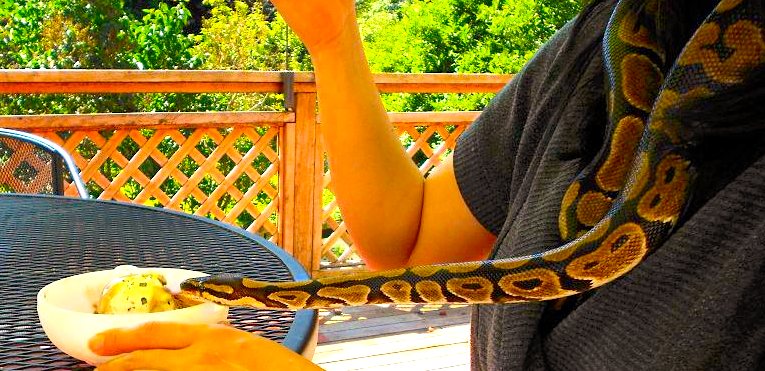
Smeagol investigates some ice cream.

Smeagol investigates some ice cream.

We had invited him into our home under the thought of good parents supporting our child’s interests. Back when she was in the fourth grade or so, our daughter got caught up in the idea of having a pet python. I told her if she could save up the money for a snake, I would buy the cage—a large, glass tank, with a screened, slide-out lid—for her birthday. Truth be told, I wasn’t sure she would meet the challenge. Ball pythons are not cheap; and I figured something else would capture her attention before she finished piecing together the money. But cash received as birthday gifts put her over the top of her fundraising goal, and she held me to my promise.

On the night we first brought him home, Smeagol bit my daughter, who admittedly was not exercising any caution whatsoever toward a small, confused animal who had just been stuffed into a box and transported through a cold, November night, to his new and unfamiliar home. I tried to tell her to just put the box in the cage and open it there, to let him come out in his own time. But instead, she set the box on a table, flipped it open, and reached in. Chomp!

Granted, when Smeagol bit anybody, it was more like a nip, designed as a quick warning. But he invariably drew blood with his little, hooked teeth when he did it. It was lightning fast, too, almost impossible to escape once he had a mind to do it. I know of two occasions, aside from his first few minutes in our home, when Smeagol bit my daughter. I also remember him taking a shot at one of our dog’s noses. The dog was just curious and unsure what to make of Smeagol. Smeagol took the dog’s face, with its looming mouth, to be a threat. Both dogs steered clear of him after that—she because she’d been bitten, he because I like to believe he shared my general belief in the benefits of snake avoidance.

Although it’s not good to speak ill of the dead, at times I wondered if Smeagol was perhaps something of a jerk among pythons. But then I figured he had, on average, only committed about one quick bite every two years—not bad considering everything he was put through, including visits to my daughters’ classrooms, and my wife’s classrooms, where he behaved around preschoolers and grade schoolers, even when one or two of them made lunging grabs at his face.

Personally, I never got bit by Smeagol, most likely because I kept my distance, even though, with my daughter spending less and less time at home, it fell to me to take care of most of his feedings and cage cleanings. My wife was the main one to spend time “playing” with Smeagol–letting him roam outside of his cage or drape himself over her shoulders. But, sometime in the last year, he bit my wife as she tried to retrieve him from behind a huge bulletin board that was leaning against a wall. Prior to the wife-biting incident, I had a theory that Smeagol’s likelihood of biting someone was, like with German Shepherds, tied to some sort of fear-sensing mechanism. With that one bite, my theory went out the window, as I knew my wife was the only one who had always approached Smeagol with a complete lack of fear, and a full sense of trust and love. This one bite sharply reduced my wife’s willingness to provide Smeagol with passes outside of his cage.

The need to take him out of his cage, or rather the need to keep him in a cage, or perhaps, the whole situation of pets in cages, had become increasingly troubling for me in the past few years. Part of my growing discomfort had to do with seeing Smeagol, essentially a wild animal who had grown to about four feet long, confined to a glass box, where he seemed to spend a good amount of his time searching for a way to get out. Snakes, as a rule, are pretty darn good at finding ways of getting in or out of wherever they want. So I imagine being trapped in such a way was maddening for him.

Part of my growing discomfort had to do with having dogs who have fairly free rein to go anywhere they want within the house and backyard—something I marvel at from time to time in the sense of, “Wow!  We have some fairly large animals just wandering around our house.”

When I was very young, we had a dog that was on the scene before I was, and who didn’t have much use for me, and vice versa. I never marvelled at her, and rarely even realized she was around.  Seriously, I can barely recall her existence, aside from some vague memories of my siblings’ reactions from around the time she was put down. I also didn’t give much thought to the idea of keeping animals confined to cages. In junior high and high school, well after the dog was gone, I acquired quite a few reptiles and amphibians (no snakes), and occasionally rodents, that were kept in a variety of fish tanks, mostly in my bedroom. Hell, once, with the help of my younger brother and a friend, I even transplanted a (slightly-larger-than-puddle-size) pond’s worth of native Oregon frogs (tiny little creatures) from their home in the suburban wild to a tank in our backyard—never thinking about just how difficult it would be to sustain that little ecosystem as the summer wore on and the heat became unbearable in that glass box. They were tadpoles when we caught them, and monitoring their transformation to frogs was pretty amazing. But we could have just visited the pond repeatedly and gotten the same basic show, all without wiping out the small frog community.

The vast majority of the reptiles and amphibians I collected met with premature deaths, often for reasons unknown, but more often through my own failings. There was a red-eared slider (turtle) who died shortly after I fed him bologna, unaware that turtles cannot physically process fat in their food.

There was the fire-bellied newt who escaped his cage (how a newt climbed out of a fish tank with only a few inches of water in the bottom, and a few flat rocks and a small branch poking out of the water is beyond me). I found the newt several days after his disappearance when I stepped on his dehydrated, crunchy little body, tangled in the shag carpet downstairs by the front window. I can only imagine the adventure he had making his way down the steps.

There was a procession of anoles (small lizards they sell in pet stores as chameleons), one to three at a time, who all caught the same wasting disease, despite thorough cleanings of the cage between inhabitants.

Various other turtles and lizards succumbed to death prematurely, with no real indication that anything was wrong until they woke up dead.

Later, well before my daughter acquired Smeagol, she had a pair of Russian dwarf hamsters—one of which completely consumed the other, except for its pelt. I kid you not.  There were no bones left or anything else aside from a well-preserved fur, in the style of a stripped and cleaned item you would find at an actual furriers. What was left of the devoured hamster would have made an excellent rug for, say, a beetle’s bachelor pad. I’m not sure if the consumed hamster died of natural causes before it was cannibalized, or if the carnivorous hamster just decided he’d had enough of corn and seeds, or maybe had had enough of her roommate’s bad habits.

But enough with the tales of animal woe. At this point, I’m going to make a little pledge in honor of our too-soon-taken Smeagol. I’m done with pets that have to be kept in cages. I don’t want to contribute anymore to the kind of recklessness that involves people boxing up animals in the first place. This is not to say that I think it is inherently wrong to have pets that are kept in cages. I suppose in some cases, it makes life more pleasant and less dodgy for the animals, and hopefully involves children learning some measure of responsibility, and hopefully a great deal of kindness and love. But in my personal weighing of the situation, I’ve made too many dumb mistakes. And I’ve failed to provide adequate levels of life outside the box. I’ve apparently failed to monitor properly for signs of illness, and to make sure I was avoiding harm.

Smeagol deserved a greater measure of freedom than he got. Of course, a ball python could do worse in life than to have a safe, warm home with regular feedings. But a snake native to the East coast of Africa probably could have done much better than to be kept in a glass box in the Northwest corner of the U.S., cared for by someone with a large measure of phobia aimed at him.

So, peace to you, Smeagol. May you pass through the fires of Mordor to the place of white shores and beyond—a far green country, under a swift sunrise.


God Looks Away, Youth Minister Sex Offender Publishes Self-Serving Article (TW)

At the core of “My Easy Trip from Youth Minister to Felon,” an article posted in the online version of Christianity Today’s Leadership Journal, is an odd and self-serving theological point: that God does not look upon sin, and that when sin continues long enough, God gives us over to it so that we might hit rock bottom and then seek redemption. God turning away is, according to the anonymous author, a convicted sex offender still in prison, the reason Jesus felt God had forsaken Him while He was on the cross—God could not look on His Son/Himself as His Son/He took on the sins of the world. It is God’s looking away, the author suggests, that allowed King David to embrace selfishness and send Bathsheba’s husband, Uriah, into battle to die, so that David might have sexual access to Bathsheba. In this same fashion, the author contends, God looked away so that the author might plunge deep enough into sin to be made to answer for those sins.

The author provides no theological discussion of why God also looked away from the victim of the author’s sin, implying (through the author’s shaky theological discourse, and his frequent use of “we” and “our”) that the teenage girl who had been manipulated into a sexual relationship with her youth pastor, shared in the sin, or simply had to be sacrificed so that the author could be redeemed. Without ever naming his actual crime, the author crafts a tale of a sexual predator in need of redemption, and a sexual assault victim as sacrificial lamb, all with God’s blessing/God’s inability to stomach what was happening. But if we are to look at God as incapable of looking on sin, or even the victims of another person’s sinful behavior, then it seems only right to assume God looked away throughout the process that led to the publishing of the article.

The article, taken down from Leadership Journal after much public pressure, can be read from an alternate site here.

I’m a bit torn about whether I think people should read it—not in the sense that I think it deserved to ever be published in the first place—it didn’t—but because it provides an interesting look into the kinds of self-centered justifications, and victim-blaming that sex offenders will endorse in an effort to convince people around them that they’re sorry and won’t ever do anything like that again, because, boy, they’ve learned their lesson, and (in this case) Jesus forgave them, so you should, too.

What was meant by the editors to be taken as a moving story of sin and redemption was, instead, merely a continuation of the abuse, prettied up with self-aggrandizing mock-contrition and Bible verses. And, sadly, the editors saw fit to tag it with the “related topics” of Accountability, Character, Failure, Legal Issues, Self-examination, Sex, and Temptation. Of those tags, “Failure,” and “Legal Issues” seem the only appropriate ones. “Sex” only fits in the broadest definition; whereas “Sexual Assault” or “Sex Offenses” would have been much more fitting. “Temptation” is little more than a label that normalizes the sexualizing of underage girls.

It's not somebody who's seen the light...It's a cold and it's a broken Hallelujah

It’s not somebody who’s seen the light…It’s a cold and it’s a broken Hallelujah

What I keep wondering in all of this is how the article came to be posted in the first place. Did the editors of Leadership Journal coordinate with prison officials to approve the project, or did they just accept it from some inmate, insisting via e-mail that he had a unique tale of a fall from grace and a re-acquaintance with God? Did they know the author prior to his incarceration? Is the author in a treatment program in prison? If so, were his treatment providers at all aware of what he was doing? Were lawyers for the author, lawyers for the victim, or the judge in the case aware of the intent to publish such a piece? And, perhaps most importantly, was the victim, or the victim’s family aware that any of this was happening? And did she/they have any say in the matter?

I ask the above questions because I cannot imagine that, prior to publication, the article was examined by anybody with any clinical knowledge of offender behavior—or, for that matter, by anyone with any sense of the damage done to victims of sexual assaults. If I give the editors the benefit of the doubt, then maybe I can view them as possibly well-meaning, but definitely confused/ignorant people looking to generate an attention-grabbing conversation about statutory rape. And while, it certainly grabbed plenty of attention, that was because it took a story of sexual assault and transformed it into a discussion about how easy it is to be seduced by a teen when one takes one’s eyes off of God, and vice versa. The sexual content is so subdued/obscured that it comes across as if it is intended to describe temptation only—definitely much more so than if it was labeled appropriately as child molestation, pedophilia, hebephilia, exploitation of a minor, statutory rape, or rape.

Any sex offender treatment provider who knows anything at all about what she/he is doing certainly would never have approved of the article as it appeared. Offenders in treatment (in or out of prison) are often given writing assignments wherein they are required to relay details of their behaviors and thought processes and demonstrate an understanding of the damage they caused, as well as the way they convinced themselves it was okay. And while I recognize that it wasn’t specifically crafted as a treatment assignment, the Leadership Today piece reads like an eloquent first draft of such an assignment, crafted with care before a treatment provider and/or members of a treatment group demanded changes due to the author taking a victim stance, failing to acknowledge the actual crime or its impact on anyone other than himself, and refusing to incorporate even the most rudimentary sense of understanding about how he built up to the offense and kept it secret for as long as he did.

Or perhaps it’s more like a second draft, after the offender removed most of the overt blaming of the victim, and switched, instead, to implied mutual blame or implied consent for the crime.

I have heard hundreds of variations on the same basic story told in the article, from the mouths of offenders, emphasizing the frustrations in their lives, the reasons they had contact with the victim to begin with, and the reasons they are not to blame (and, yes, a lot of them invoke religion as part of that). It is rare to come in contact with an offender who, from the beginning (not of the offense, but of contact with the justice system and the need for an evaluation for sexual deviancy) is capable of outlining how he (or occasionally, she) manipulated the victim to engage in sexual acts and to keep it a secret, how he justified the crime to himself, and what specifically happened (in clinically appropriate and criminally accurate terms), without putting a large portion of the blame on the victim for somehow enticing or seducing him.

Despite the author’s claim, added after the controversy erupted, that he takes 100% of the blame for the crime, and recognizes that what he once viewed as a consensual relationship was no such thing, the article itself tells a much different story—of a man who worked hard to build something up for the glory of God (and how he was really amazing at doing that work), and then how he accidentally broke it because he was being selfish. Without ever acknowledging the severe harm he did to the victim, harm that is likely to last a lifetime, he signals that he has returned to a life of service to God because he is involved in leading a ministry group in prison (another thing I have a really hard time with anybody allowing).

And while the author touches on one of his justifications for engaging in his behavior—that his wife was paying too much attention to their children, and not enough to him—he is only able to acknowledge the impact on his wife in the form of the fight they had when she found out about the crimes, and how she left in the middle of the night with the children. The author laments that he has not seen his children since, but doesn’t even mention the extreme embarrassment and devastation he caused his wife and children. Nor does he ever fully indicate that he recognizes how childish his justifications for his behavior were, or how those justifications were merely the starting point for a cycle of lying and manipulation committed for the sole purpose of having repeated sexual contacts with a minor.

In a truly terrible minimization of his behavior, the author compares his repeated sexual abuse of the victim (while implying she shared in an identical struggle with him) to the difficulty of smokers trying to turn away from cigarettes.

From the complete dearth of information in the article, if this really were a treatment assignment, once all the extraneous details, self-promotion, and claims to deserved forgiveness are removed it might sound a little more like this:

“In my 30s, I accepted a position with a church as the coordinator of youth ministry. I built up the group from just a few members until it was one of the largest youth groups in the region. I realized I was experiencing sexual attraction to one of the underage members. I manipulated her into having sex with me, and justified my sex offenses, in part, by blaming my wife for not paying enough attention to me. I had sex with the teen repeatedly. When my wife found out, she took our children and left. I was convicted of sex offenses and sent to prison. I am currently still in prison. I will be a registered sex offender for the rest of my life.”

And, if the author began to actually include the most obvious missing items, the skeleton of a real assignment, or perhaps a combination of real assignments, would start to look like this:

“In my 30s, I accepted a position with a church as the coordinator of youth ministry. I built up the group from just a few members until it was one of the largest youth groups in the region. I realized I was experiencing sexual attraction to one of the underage members, and that she looked up to me in a way that made it possible for me to manipulate her. I set about grooming her. I justified my sex offenses, in part, by blaming my wife for not paying enough attention to me. I managed to work up to the point where I convinced the girl to have sex with me. I then had sex with her repeatedly while convincing myself that she wanted to have sex with me as well, that she was mature enough to handle a sexual relationship with an adult who is an authority figure in her spiritual life, and that I was in no way manipulating her. I managed to keep her from telling anybody about our relationship through various forms of coercion, and went to great lengths to keep anyone from finding out about it. We eventually got caught. My wife, understandably, left me and took the children with her. I was arrested and convicted of sex offenses. I am currently in prison. I will be a registered sex offender for the rest of my life. The teenager I manipulated and raped will need a great deal of therapy and other supports in order to cope with the aftermath of my actions. My wife, my children, and numerous other people impacted by my behavior will also need support to attempt to repair the damage I caused. I recognize that I need to stay away from minors for the rest of my life, and that I can never be placed in any kind of position where I might have authority that can be abused, particularly over any people who could be considered ‘vulnerable.’ I also manipulated editors of Leadership Today into publishing an article I wrote that completely justified my behavior, and suggested that the victim was equally to blame for my sex offenses.”

The assignment would be given back with numerous, specific requests for much more “self reflection,” “accountability,” and actual identification of his specific behaviors and thoughts.

Becoming a sex offender isn’t an “easy” path as the author’s title suggests. It is one that is pieced together with care by the offender, and crafted to secure the cooperation of the victim(s). It is not, as the author portrays it, a little trouble in a marriage, a dash of arrogance, and some innocent flirtations evolving over time into mutual passion—passion that makes God look away, as if God were easily embarrassed. Such a description may be a very simplistic explanation of how an extramarital affair (the words the author uses along with “adultery” to describe his sexually exploitative behavior of a child under his care) evolves.

Unfortunately, by diving into this discussion, without any sense of just how manipulative the author was, and how harmful his words are, the editors of Leadership Journal have put themselves in a place where they must now back away from this discussion entirely. Rather than promoting a meaningful dialog about forgiveness and redemption, they allowed a sex offender to promote himself as a victim of the temptation to have sex with minors.  They allowed him to promote his story of redemption—a story that rings as false as any rapist having the arrogance to compare himself to Christ on the cross, as he suggests that God’s mercy has saved him, all while implying a teenage girl entrusted to him for guidance and education was just as responsible for being raped as he was for raping her.


God Bless Anita Bryant

Friday, May 16, I had my first experience with a mental health/chemical dependency conference hosted by a drag artist. The incomparable Aleksa Manila presided over the “Saying it Out Loud” conference, complete with multiple costume changes and delightfully tasteless jokes between various announcements, awards, introductions, and seminars. This was the thirteenth annual gathering of this conference, which was created with the goal “to continue to co-create learning, growth and understanding of the best practices and relevant clinical services needed to support members of the lesbian, gay, bisexual, transgender and questioning communities.”

Dr. Ronni Sanlo served as the keynote speaker, as well as screening a new documentary, “Letter to Anita,” about her almost-wasn’t involvement in LGBTQ activism. Now I’m going to get into a few spoilers here, but I don’t think the basics of Sanlo’s story are the heart of the documentary, as much as is the personal perspective she brings to them. So, when I say her activism “almost-wasn’t,” I mean that Sanlo, like a number of lesbian women of her generation, went about her life as a heterosexual woman, married (to a man) with whom she had two children, not really aware that there were other options.

Unfortunately, just as Sanlo was realizing that there were other options, that the attraction she felt to women wasn’t something that made her completely alone in the universe, Anita Bryant was ginning up Florida’s legislature to pass laws denying parental rights to gay parents. Sanlo’s divorce went through.  Her children, for all practical purposes, were taken away from her.

Liberty turns her back as Anita Bryant looks to the sky, expecting Jesus to fly down and smite the gays.

Liberty turns her back as Anita Bryant looks to the sky, expecting Jesus to fly down and smite the gays.

Hearing the story now, it seems unfathomable to me. In part, my disbelief comes because at the time Sanlo was being viewed as an unfit parent simply for acknowledging who she was, I was living a few doors away from a blended family—two lesbian mothers with three teenage children among them. Granted, at the time, I was in grade school and not really aware that the two parents in that household were ‘romantically linked.’ I was under the impression, for whatever reason, that the families were living together for other reasons—economic? ecological? I remember that, in the fifth or sixth grade, when our class was given an assignment to write an editorial letter about an issue of concern, I mentioned the family as I explained why we shouldn’t be mowing down forests and fields to build new houses when there were other options, including multi-family homes, that would allow greater preservation of nature. Clearly, I had missed the more important political/social issue facing the family.

At any rate, the nature of my neighbors’ relationship was eventually pointed out to me by gossiping peers, with the implication that I was stupid for not having realized it, along with the weird sexual goings-on that were certainly a part of that relationship. Not to say that I was super-forward-thinking at the time, but I knew the two women as my neighbors who had been pleasant to me whenever I encountered them. So whatever sexual things may have been going on between the two women were of about as much interest to me as those of the parents of anyone I knew. That is to say, I really didn’t devote much time at all to thinking about sexual things between various peoples’ parents, and may, as I tilted toward pubrerty and all manner of prurient thoughts, have actively avoided thinking about them.

As far as I was concerned back then, anyone who was cool and/or innocuous toward me warranted much less concern, anger, or fear than the bevy of teenage male piltdowners who seemed to have little more to do than roam the suburban streets trying to prove their masculinity by tormenting children much younger and smaller than them—a model of “manhood” I unfortunately subscribed to briefly when I hit a similar stage in life.

I can only imagine that the lives of the couple from the blended family had some parallels to Sanlo’s—at least in terms of them apparently having partnered with men to build families in order to live out the deliciously limiting American Dream. It’s not too big of a stretch to believe my neighbors, like Sanlo, had seen few other options for relationships but hetero marriage and procreation. It was my understanding that both of my neighbors were divorced, although, like same-sex partnerships, such things were not discussed a great deal at the time, despite divorce quickly becoming commonplace—something that would reach almost all of my friends who hadn’t, like me, experienced the death of a parent. And if the exes of my neighbors were still coming around to visit their teenage children, I wasn’t aware of it. Then again, I wasn’t aware of much that went on in the lives of those teens, since there was far too great of an age gap between us—that impossibly vast chasm between elementary school and high school—for us to concern ourselves with each other.

Speaking of parallels and gaps, “Letter to Anita” touches on another critical piece of Sanlo’s life that fits in with the development of my own understanding of individual rights, freedoms, and what it actually means to be something “other” than heterosexual: Anita Bryant’s crusade against, well, all people who don’t fit her very narrow definition of appropriate relationships (never you mind Bryant’s own divorce).

As I’ve noted before on my blog, I was raised religiously, in the Lutheran Church, Missouri Synod. My father was a pastor in said church. My father died when I was rather young. I spent a great many years struggling with religious ideals and how they fit into the world. And despite my current agnostic tendencies, I still hold onto an idea of religion as an expanding element in peoples’ lives, a force that should open people up to larger experiences, a force that should create love and acceptance, as opposed to a limitation on peoples’ lives that causes anger, hatred, judgment, and closed-mindedness. I spent a lot of time struggling over moral issues, their relation to legal and spiritual concerns, and how we all get along as a people who are supposed to be dedicated to personal freedom, personal responsibility, community ties, love, and all the rest of that stuff.

But Anita Bryant, with her perfectly coiffed hair and starchily-pressed orange and brown polyester outfits, was telling me, in her own, orange-juice-endorsing way, to fear, hate and distrust people I knew, people who had shown me kindness, people I knew to be funny, smart, and no threat to me at all. She put out albums (which, as a teen, my younger brother delighted in purchasing from the local Goodwill for the purposes of mocking and destroying) filled with patriotic and religious songs, promoting the goodness of the USA and Jesus. Yet, everything she said, every objective she pursued, was in contrast to freedom, goodness, and the anti-judgmental stance that Jesus and America were supposed to represent.

Yes, Anita Bryant, in contrast to all she stood for, or wanted to stand for, had helped turn this white, hetero, suburban boy, and his white, hetero, suburban friends, into supporters of gay America…into people who would forever see the gay menace she was so sure was destroying us all, as nothing more than the paranoid delusion of close-minded, controlling, angry people who were completely incapable of seeing the irony of their anti-freedom, anti-love stance as they waved their flags and thumped their Bibles.  Anita Bryant, as Sanlo notes, managed to galvanize opposition to gay rights opposition–even out into the hetero world and parts of the Christian community she was so sure she could count on to share her views.

So God bless Anita Bryant. God bless Ronni Sanlo. And God bless us everyone.

Suicide Notes from the Cosmic Web of Coincidence

Back around Christmas, I posted a piece about how, contrary to popular belief, the ‘holiday season’ is not the most suicidal time of the year. I’m gonna let you in on a little secret…spring is.

I wasn’t giving the idea of springtime suicide all that much thought, until the news of a note from Kurt Cobain’s wallet—mock wedding vows that turned out to have been penned by Courtney Love—bounced into the news for a day or two, and I realized I’d been hearing about a lot of recent suicides–well-known and mostly-unknown.

Hearing the specifics of Cobain’s wallet note, on a local radio show as I drove home from work, knocked down a self-imposed wall that had prevented me from engaging with the stories of recently-released information and evidence from Cobain’s death, leading me to think back on my memories from that time.

Back then, my wife and I were making a living designing and printing T-shirts out of our apartment, selling them at the Fremont market, and through ads in a local paper, The Stranger, and in national publications Spin, Vibe, and Rolling Stone, as well as doing custom jobs for businesses, bands, and other organizations. News of Cobain’s death had managed to elude us until I saw it in a Seattle Times headline, there on display by the sales counter at a gas station/convenience store across the road from our apartment, where I had gone on a late-afternoon beer run.

As with most deaths, my reaction was one of stunned silence–an unvoiced, “Wow, that’s weird.”  Back home, I hemmed and hawed and didn’t quite manage to relay the information, instead turning on the TV news and waiting for the story to come on.

We had only recently confirmed my wife’s first and only pregnancy; and it hadn’t been long enough for us to share the news with friends and family. I couldn’t stop thinking of that photo of Kurt, Courtney, and baby Frances from the cover of Spin. Cobain, not even a year-and-a-half older than me, had achieved what we were all supposed to want—right? Money, fame, a family—all while getting to tout his artistic integrity and give a big middle finger to…well, whoever he wanted, I guess. He was just getting started. He could continue on being a vital artist, or get old and boring, or become a recluse, or whatever he wanted. He had the resources now, and…

Kurt and courtney and frances

Well, if I steer clear of the conspiracy theories, he killed himself. How was that even possible?

Looking back through a lens of pop culture references, I think of Tyler Durden confirming that we weren’t all going to become millionaires, and movie stars, and rock gods. But Cobain had become that…or at least two out of three.

Also, prior to Cobain’s death, I’d read interviews with Eddie Vedder where he talked about being depressed and drinking too much wine, and I was worried Vedder was going to kill himself…intentionally, passively, or accidentally. Cobain said plenty of dark things, sure, but he was just kidding…right?  And, yeah, I had all the Nirvana albums, and all the tracks that turned up on compilations, credited and uncredited…No Alternative, Hard to Believe, The Beavis and Butthead Experience

In my earliest thoughts about this post, I had some germ of an idea about making a connection between Cobain’s death and my current work…like Cobain’s death had some impact on the trajectory of my life, and…oh well, whatever, nevermind. I think we all try to fit various life events into narratives that make everything add up into some kind of “everything happens for a reason” bumper sticker idea…as if the suicide of a celebrity I had never even met was meant to guide me to my purpose.

It was a good 12+ years from the time of Cobain’s death until I bounced back into school with the intention of becoming a therapist, and then a few more before I had gotten involved in suicide prevention, almost more by happenstance than by a powerful drive to do so. I found out I was good at it–able to handle the stress of trying to redirect people in crisis—trying to suss out what it was they were after, and find a way to address that (which often just comes down to listening and validating the underlying emotions of their distress).

Cobain may have been one tiny thread among numerous others leading up to where I landed, just like the other people I knew (mostly peripherally) who had taken their own lives—or tried to—the bulk of them in spring. But Cobain was never some overtly motivating factor. In fact, I think if I cited him as a big reason for my work, it would be kind of ridiculous… “Man, Cobain’s suicide really changed me, and I decided I wanted to help people.” But to be clear, I have no harsh judgment for whatever factors direct people to engage in ‘the helping professions.’

A supervisor of mine, who was instrumental in providing me with the fundamentals for dealing with people struggling with suicidal thoughts, theorized that the increase in suicides in spring might have something to do with the dashing of expectations…that slogging through a cold, dark winter is one thing when everybody has to put up with the cold and the darkness. But when spring starts peeling open, turning itself toward the sun, grasping those opportunities to grow…and you’re still stuck in that winter mindset…cold, despondent, unable to see the sun or feel its warmth, or to even care about dragging yourself out into it…well, that’s when you lose hope.

In thinking about springtime suicide, I’ve had this other little germ of a thought…that when we are constantly exposed to the idea that everything happens for a reason, it can have the inadvertent effect of making people seek out connections for why they feel shitty. And when they can’t find particular reasons…or perhaps the reasons they find are viewed as trite or easily resolved by the people around them…or maybe the reasons they find all land in the arena of self-doubt, shame, or a sense that they are apparently deserving of the bad things that have happened to them and the lack of happiness they feel…well, it can hurt that much more.

Instead, why not embrace the idea that plenty of things in life happen for no reason at all, except, perhaps, for the culmination of random factors and arbitrary decisions…the cosmic web of coincidence…which can end up dropping anyone down a deep dark hole? (Arguably, this is a ‘shit happens’ bumper sticker argument, but I like to think of it as much more involved).  And why not embrace the idea that darkness is an essential part of being human? As much as happiness may be the goal, as much as we may all want to be millionaires and rock stars and movie gods, even the millionaires and rock stars and movie gods among us can’t completely avoid disappointments, disasters, trauma, and loss—hell, a lot of them are born of that negativity (although I don’t want to promote any ‘tortured artist’ stereotypes).

None of us get to insulate ourselves against negative feelings. Those negative feelings–even feelings of suicide–are actually much more common than people think. But when we’re so fixated on happy, and so fixated on the idea that we can ARRIVE at happiness once and for all, with just the right combination of attitude and effort, we set people up to wonder just what is wrong with them when happiness seems so elusive.

So, check in with your friends and family this spring and every spring (and every other season for that matter). That celebration-free, often contact-free, stretch from New Years Day until the world starts warming up in spring can be long and dark as hell…and when spring rolls around, and people are left feeling like they are still disconnected and down in a hole, despite all the blossoms and rays, that darkness can become something much more overwhelming.


From Seed to Cocktail–In Memoriam

I had just been talking with a co-worker about growing tomatoes, and how I was late planting the tomato seeds I’d gotten at a friend’s funeral back in October, when I found out that that friend’s wife, Jodi, had died.

As usual, I’m struggling with the appropriate response…both virtually and in the real world. I’ve been on her Facebook wall repeatedly, tapping out letters and words that I then delete, feeling confused about just what is the appropriate response in the time immediately following the death of a friend.

After all, Facebook is where you wish “Happy Birthday” to people you rarely, if ever, see face-to-face, right? I’m not saying there’s anything wrong with that. I’m not saying that there’s anything wrong with posting an RIP message on somebody’s Facebook wall.   But to honor the person in this case, there’s a need for something other than drive-by (surf-by?) condolences. And, no, I’m not considering this piece to be the adequate response.

The message I kept reworking essentially came down to this…

Jodi had been battling that vicious monster since before I met her, over 12 years ago. She fought with such grace and tenacity that I was sure she would outlive us all. And if the kindness one unleashes in the world, and the reverberations of that kindness, count in the tally of one’s years, then I’m sure she will.

In case there’s any question, the above isn’t one of those bullshit eulogies, like when Richard Nixon died, and suddenly everybody remembered what a great guy he was, despite the mountains of evidence to the contrary.  Everybody who met Jodi loved Jodi.  And I’m pretty sure that would have held, even if she had been tied to some ridiculous scandal that led to a widespread loss of faith in American democracy.

Jodi was just one of those people who was funny, warm, and fun to be around. She could slap you with a sarcastic comment that made you instantly feel like a part of her family. She seemed to have a bottomless well of good will and giving. She was the kind of person who lived her life, with cancer, better than most of us live our lives in good health.

A friend of mine from college, Jared, had a semi-serious theory that when a person dies, that person’s soul explodes into a whole bunch of little pieces, which blast out into the world, and attach themselves to the souls of all the people who ever loved that person, becoming a part of all of those people. Jared’s evidence for this was that, when his grandfather died, he was suddenly taken with the urge to go out fishing—something that he had never done, but his grandfather had done religiously. Jared described a beautiful, solitary day out on a lake, where all the love he had felt for his grandfather resolved itself into a sense of peace in regard to his grandfather’s passing, and the meaning of his grandfather’s life, and the lives of us all.

Now, I can’t say that I subscribe to Jared’s theory of exploded souls.   But a weirdly similar sense of “exploded soul attachment” hit me shortly after I received the news of Jodi’s passing. Of course, I was knocked off balance. I wondered if I should leave for the rest of the shift, out of concern that I might be overwhelmed with the demands of assisting people through crisis situations. I gave my co-workers a heads up, essentially enlisting their help in ensuring I didn’t make a mess of things.

But instead of the feared distraction and destruction, I felt imbued with a sense of caring and connection with the clients, which is often difficult to engage. That is, as something of a survival technique for the job, it’s necessary to avoid getting caught up in the drama and emotion of the lives of clients, while also being able to convey a sense of empathy. It’s a difficult balancing act to keep an appropriate sense of distance, without disengaging. But all I felt was calm, a sense of presence with the clients that can be difficult to maintain while also staying on top of the other elements of the job.

Supposing for a minute that the theory of exploding souls is true, my piece of Jodi’s soul manifested itself in the feelings of calmness I experienced—an ability to connect and remain in the moment. Even my exchanges with clients I have spoken to hundreds of times were a bit more ‘in the now.’

I’m going to try to hang onto that little piece of her soul.

And for now, I’m going to get those tomato seeds in their pots, and think on how glad I am to have had the opportunity to craft and share a few lakeside, breakfast Bloody Marys with Jodi.

bloody mary


People Up: Toward ‘Gender Neutral’ Suicide Prevention

Phone-based crisis intervention and suicide prevention frequently involves guiding a caller toward an (often tenuous) agreement that there’s a reason to get through the next day, or maybe just the next hour.

Toward the end of a recent call, the man I’d been talking to for over 40 minutes summed up the call by saying, “Yeah, I get it…man up.”  He went on to mildly berate me, suggesting that he could have had the same stupid conversation with his dad if his dad hadn’t died.  But I’ll take that as a victory.  He agreed he would stay alive to see his kids on the weekend.

He would not agree to turn his gun over to a friend or family member, which would have helped lessen the likelihood of impulsive, violent suicide.  But, for the time being, he had put it away.  And at least he was calling.

Still, the “man up” comment stuck with me.  I suppose on a greatly reductive level, “man up,” was a component of what I had been saying—especially from the perspective of someone who, based on his interpretation of the world around him, had been getting that message for quite some time–that he needed to just take care of his problems and quit complaining.  But it is not the kind of phrase I would ever use with someone, or the kind of message I would try to convey.

My conversation with him had woven in and out of a number of concerns, with the crux of the conversation coming down to the caller’s children, and his responsibility (like that of all parents) to do whatever possible to ensure their well-being.  It is a conversation I’ve had hundreds of times.

The majority of such calls, involving people who have children but are contemplating suicide, involve the caller expressing that his/her children will be better off without them.  There are a small number of variations on the ‘logic’ behind such a thought—usually involving the children not having to suffer through the heartache of the bad parenting they will certainly continue to experience, the hassles the kids will face by bouncing back and forth between divorced parents, and the notion that the children will “get over it” in time.  If the children are young, callers express that it won’t make that big of an impression.  If the children are older, the parents think the children ‘don’t need me anymore’ or are mature enough to process what happened and move on with their lives.

Never mind the mental twists and turns it takes to imagine that children will have coping skills enough to deal with the suicide of a parent, when that parent doesn’t have the coping skills to deal with loss much less permanent than death—loss of a job, loss of a home, loss of a marriage—or any of numerous variations and combinations of things and people that have gotten away.  Statistical studies show that children of people who commit suicide are at greatly increased risk for attempting/committing suicide themselves.  In an overly-simplistic explanation, the increased risk can relate to genetic factors involved in mental health issues, but it also involves behavior modeling.  Our parents are usually the most significant modelers of behavior in our lives.  And we are all doomed to become our parents.

At any rate, I found myself having the same basic conversation with a woman less than two hours later.  “What messages are you sending your kids if you kill yourself?”  I challenged the cognitive distortions in her justifications for suicide, and explained the threat of her children committing suicide and otherwise potentially being saddled with mental health issues from the suicide of a parent.  Ultimately, we got to a similar end result—the caller agreeing she would put up her pills, and live another day.

But in the conversation with the woman, there was no idea of needing to “woman up”–no need to do what was stereotypically feminine in order to go on living, even though the idea of someone ‘sacrificing’ (in this case, the twist being that sacrificing meant staying alive) for one’s children is something that stereotypically falls more heavily on women.

With the ‘man up’ comment replaying itself in my thoughts repeatedly over the next few days, I realized I was (internally) protesting too much.  The notion that I had a nearly identical conversation with a woman that same night seemed like a defensive position more than a straightforward assessment.

I ran through other ideas, examining the way I deal with men versus the way I deal with women.  For example, any form of counseling involves meeting the client where the client is.  Such meeting includes the client’s perceptions of self in relation to gender.

Still, the client’s perceptions are not the same as my way of interacting with the client.  The client’s perceptions dictate a number of things about how I will approach the client, what thoughts might be challenged and how, for example.  But at base, how I deal with people of different genders is on me.  And I need to be aware of whether those dealings are clinically appropriate or not, whether they are tinged with personal biases about what constitutes being appropriately manly or womanly, or fitting into any other gender identity.

I have no problem acknowledging that I speak to people of different genders differently, and that things such as age, economic status, religious beliefs, education, ethnicity, and a whole host of other concerns can color the interactions I have with them.  An awareness of how clients differ in background falls under a heading of “cultural competence.”  Conducting all sessions or interventions in the exact same fashion would be negligent.

Cultural competence includes the need to avoid approaching clients from any viewpoint of prejudice.  In U.S. culture, with its heavy bias toward the idea of women being nurturing and emotional, and men being stoic and strong, it is easy to fall into a trap of diminishing men who seek support, while being much more accepting of women seeking support.  The underlying concepts of weakness and strength, as relates to seeking support, diminish everyone.  Accepting girls and women who seek support while being less accepting of men and boys who do the same indicates an underlying belief in the weakness of women–the need of women to have support, while believing men don’t–or shouldn’t.

In a context where men are expected to “man up” and take care of their problems, rather than to seek help in processing what is going on with them, it makes sense that many men reaching out for help are, if not hostile, at least pensive and anxious—feeling there is something inherently wrong with seeking help, so taking a position challenging those who might help them.

As a culture, we in the U.S. encourage defensiveness and entrenchment in men—refusal to change—with the exception of encouraging men to become ever harder, ever more willing to engage in aggressive fortifying of their position, with that position often being one of isolation.  The processing men do frequently gets externalized to the point where it is not processing at all.  They, for example, focus on fixing the world, usually by berating the weak, or advocating the destruction of people seen as enemies, rather than addressing the personal in their lives and what such isolation and fortification does to them.

I posit that the gender-stereotyped notion that men need to take action is in large part what leads men to commit suicide most often in a rather violent and impulsive fashion.  When the problem is your whole life, and you’ve been taught that the appropriate response to problems is action, frequently violent action, then ending one’s life can seem like an appropriate reaction when that life has gone off the rails.  Mix in alcohol, drugs and weapons, and suicide can seem a reasonable course of action, and be carried out quickly—a decisive form of action, a manly form of action.

This is not to say that I think men in the U.S. are “victims” of the mental health system or of some pro-suicide/anti-male conspiracy.  Men, whether willingly or unwittingly, participate in, and perpetuate, the stereotypes that trap them…the stereotypes that say seeking help is synonymous with weakness.  And so, long as angry men rail against the “wussification” of the nation, they are advocating for a culture of death before mental health, and ensuring that men will not seek help for mental health issues, or if they do, that it will come with a heaping helping of defensiveness and hostility, potentially putting clinicians in a position of enduring abuse, or having to break down numerous walls, before being able to engage productively with male clients.

So, instead of urging anyone to “man up,” perhaps perhaps there could be a kind of unstated encouragement to “people up”–and not in the reductive way that “man up” is used, but in a way that is expansive.  To “people up” could mean to recognize our responsibilities to one another as human beings, whether that be as parents, clinicians, friends, family members, or citizens.  We need to recognize the harm in gender stereotypes, particularly if seeking help and support is connected to stereotypes of weakness.

GRIEF, AMERICAN STYLE, or, I’m gonna sit here and drink until I hear “Raining Blood” so f*ck you!

I’ve lived through a few Facebook funerals now, where somebody I’m connected to via Facebook, but haven’t seen for years…decades even…dies and the news is relayed on their page and often numerous others’ pages.  Or the news intrudes on completely unrelated posts as the awkward grief styles of the American public become all the more public.  I don’t think the American people in general deal with grief well, and my own personal grieving style tends toward an above-average level of avoidance and, uh, blockage.

I’m trying not to go there right now—to the awkward social media grief, or the blockage—even as I’m posting in a social media outlet.  But a friend of mine really did die last week, (and the post I was working on about swearing therapists decided to punch me in the brain, preventing me from working on it).  In some sort of weird and possibly misguided effort to maintain some level of privacy, I’m not going to name my friend here, although not naming him seems sort of like denying any kind of tribute as well as making this post that much more about me me me.

I will say he was a kick-ass guy with a wonderful wife and kids, as well as numerous other beautiful (in the drunk, ‘you’re my best friend!’ style) family members and friends.  I can’t say as I knew him well enough to give even a marginally adequate sketch of his life, but then there are very few people, even some of my siblings, for whom I could provide such a thing.  I have my own small store of personal recollections and connections, which I’m just not going to share here.  But we’ve been down too long in the midnight sea anyway.

I don’t know if keeping his name out of this would be considered a positive or a negative, because I just don’t know how these things work anymore.  Anymore?  Who am I kidding?  Even before “social media” existed, I didn’t know what to do with the various real-world aspects of grief.  Do I call the family?  Do I leave the family alone?  Do I show up on the family’s doorstep, sobbing, Crock-Pot full of chili and bouquet of sunflowers in hand?  What about donations to charities, the family, or…?

As much as we say the grief is about the deceased, ultimately, grief often comes down to “me me me,” especially for those of us who don’t know how to “do grief” or do the funereal etiquette properly.  We can become obsessed with how the death of someone impacts us, and how we are supposed to act in the face of it.   We can become obsessed with whether we are doing the right thing or not, even when nobody is paying all that much attention to us.  I can’t imagine that anybody is sitting around complaining that I have not made it clear that I am aware of his death, or what I intend to do about it.  I’ll show up for the funeral and work that all out there, or in the days after, or…

Me, I don’t do grief well at all.

Yeah, I’m a therapist, and I have completely inadequate training in dealing with death, and more importantly, the living left behind…perhaps all by design.  It’s not my thing.  It’s not anything I’m comfortable with…not that I should be allowed to claim the privilege of comfort at this point in time.  I truly love this man, and his family, and f*ck me if I know what to do with that.

So let’s change gears.  Here’s a little example of how I function in these situations:  Following a memorial service a few years back, I was somewhat mortified when my grief fog began to lift and I realized I’d been wandering around, a forced smile on my face, at seeing people I hadn’t seen in far too long.  The awkwardness of, “Hey, good to see you,” collided with, and perhaps overrode the awkwardness of, “One of our friends/family members died.”  It’s a fine line between grief and panic…grief and meltdown…grief and straight-up weirdness(?).

It seems like grief is one of those things I should have learned or maybe just known, like you’re supposed to know how to change a tire or unclog a toilet (or how you’re supposed to know all those stupid things that are supposed to be part of a wedding).  But I’ve largely managed to avoid engaging my grief skills, in favor of engaging my grief avoidance skills.  My father died when I was still too young to really understand what that meant.  And almost nobody else I know who died since then was really all that close to me when they went, either due to time and distance, or due to design.

I distinctly remember, back in the summer of my 11th year (was it my 11th?  Maybe it’s not so distinct) when my favorite uncle died.  Due to his prolonged illness, I had intellectualized his passing, had closed myself off from having to feel much of anything.  I didn’t want the hurt, so I wasn’t going to have it.  When my mom got the call, I sat on the couch between my younger brother and older sister as the Beatles’ “She’s Leaving Home” played on vinyl, pushing my mind into that song.  My uncle was gone.  I knew he was going well before he left.  “Something inside, that was always denied, for so many years…”

I will also say that in many instances, I kept my distance, which was usually just a matter of carrying the relationships on as usual.  I guess my attachment issues lead me to downplay relationships, to where connections most anyone else would call friendships feel more like acquaintanceships to me.

And perhaps even worse, my instinct to dull the pain often leads to making jokes, usually sarcastic comments, realizing only after I’ve begun unleashing them that I am saying things that are horrifically inappropriate.  I want to imagine myself, like Superman, realizing a missile has been launched, taking off to steer that missile out into space.  Only, like Superman and the missile, I end up blowing up the Phantom Zone instead, unleashing General Zod, Ursa, and Non, ultimately raining much more hell down on everyone, myself included, than I would have if I’d learned to keep my mouth shut, or to make appropriately staid comments.

I’ll say that right now, I’m trying to do this right.  I’m trying to let myself take this in, even as I am engaging in various forms of avoidance.  I can’t promise that I won’t just crawl inside a bottle for a few days, and then drag myself out, emotions appropriately muddled and washed downstream.  But I’m gonna try to feel this one for real, dammit.