Requiem for a Snake

My daughter’s pet ball python, Smeagol, died over the weekend. We had no reason to think anything was wrong with him. The last time I observed him for any length of time—Friday, as I was yawning through the long pauses of eliminating a computer virus—he seemed just fine, climbing the ceramic branch/rock fixture in his cage. Sometime between then and Sunday, he vomited up his last meal—a partially-digested black mouse, eaten several days before—and shuffled off this mortal coil, while coiled on the floor of his cage.  I first took notice because he was lying there with his “nose” up under his body, which would have made it extremely difficult for him to breathe—had he still been breathing.

Smeagol was only about ten years old—not all that old for a ball python. And he wasn’t around long enough for me to resolve my mixed feelings about him. To put it mildly, I am not a big fan of snakes. To put it less mildly, they freak me the f*ck out. Constrictors, like Smeagol, don’t raise a panic in me as bad as smaller, squigglier snakes, or, of course, vipers and the like that can cause all manner of swelling, necrosis and more complete death with a single bite. But, still, he was a snake. And for me, that took a lot of getting used to—or not getting used to.

When my wife questioned my dislike of snakes, and more specifically, my queasiness toward our daughter’s pet, I told her that snakes are essentially tubes that crap out of one end, and bite with the other, and that being shat on and bit are not high on my list of favorite things. I didn’t explain to her how, when I saw a snake just out and about, say, in a field or a forest, I would completely lose my mind. She’s only come close to witnessing a subdued version of that once or twice. She still tried to convince me that Smeagol was cute—and he was as far as snakes go. He was pretty, even, with a funky black and brown pattern, a white underbelly, and a face that looked to be smiling.
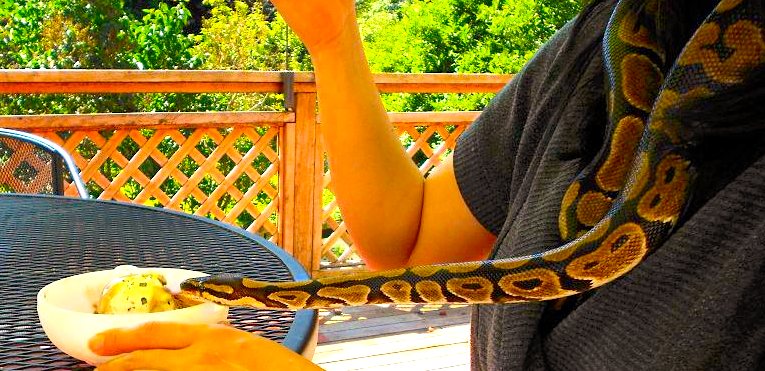
Smeagol investigates some ice cream.

Smeagol investigates some ice cream.

We had invited him into our home under the thought of good parents supporting our child’s interests. Back when she was in the fourth grade or so, our daughter got caught up in the idea of having a pet python. I told her if she could save up the money for a snake, I would buy the cage—a large, glass tank, with a screened, slide-out lid—for her birthday. Truth be told, I wasn’t sure she would meet the challenge. Ball pythons are not cheap; and I figured something else would capture her attention before she finished piecing together the money. But cash received as birthday gifts put her over the top of her fundraising goal, and she held me to my promise.

On the night we first brought him home, Smeagol bit my daughter, who admittedly was not exercising any caution whatsoever toward a small, confused animal who had just been stuffed into a box and transported through a cold, November night, to his new and unfamiliar home. I tried to tell her to just put the box in the cage and open it there, to let him come out in his own time. But instead, she set the box on a table, flipped it open, and reached in. Chomp!

Granted, when Smeagol bit anybody, it was more like a nip, designed as a quick warning. But he invariably drew blood with his little, hooked teeth when he did it. It was lightning fast, too, almost impossible to escape once he had a mind to do it. I know of two occasions, aside from his first few minutes in our home, when Smeagol bit my daughter. I also remember him taking a shot at one of our dog’s noses. The dog was just curious and unsure what to make of Smeagol. Smeagol took the dog’s face, with its looming mouth, to be a threat. Both dogs steered clear of him after that—she because she’d been bitten, he because I like to believe he shared my general belief in the benefits of snake avoidance.

Although it’s not good to speak ill of the dead, at times I wondered if Smeagol was perhaps something of a jerk among pythons. But then I figured he had, on average, only committed about one quick bite every two years—not bad considering everything he was put through, including visits to my daughters’ classrooms, and my wife’s classrooms, where he behaved around preschoolers and grade schoolers, even when one or two of them made lunging grabs at his face.

Personally, I never got bit by Smeagol, most likely because I kept my distance, even though, with my daughter spending less and less time at home, it fell to me to take care of most of his feedings and cage cleanings. My wife was the main one to spend time “playing” with Smeagol–letting him roam outside of his cage or drape himself over her shoulders. But, sometime in the last year, he bit my wife as she tried to retrieve him from behind a huge bulletin board that was leaning against a wall. Prior to the wife-biting incident, I had a theory that Smeagol’s likelihood of biting someone was, like with German Shepherds, tied to some sort of fear-sensing mechanism. With that one bite, my theory went out the window, as I knew my wife was the only one who had always approached Smeagol with a complete lack of fear, and a full sense of trust and love. This one bite sharply reduced my wife’s willingness to provide Smeagol with passes outside of his cage.

The need to take him out of his cage, or rather the need to keep him in a cage, or perhaps, the whole situation of pets in cages, had become increasingly troubling for me in the past few years. Part of my growing discomfort had to do with seeing Smeagol, essentially a wild animal who had grown to about four feet long, confined to a glass box, where he seemed to spend a good amount of his time searching for a way to get out. Snakes, as a rule, are pretty darn good at finding ways of getting in or out of wherever they want. So I imagine being trapped in such a way was maddening for him.

Part of my growing discomfort had to do with having dogs who have fairly free rein to go anywhere they want within the house and backyard—something I marvel at from time to time in the sense of, “Wow!  We have some fairly large animals just wandering around our house.”

When I was very young, we had a dog that was on the scene before I was, and who didn’t have much use for me, and vice versa. I never marvelled at her, and rarely even realized she was around.  Seriously, I can barely recall her existence, aside from some vague memories of my siblings’ reactions from around the time she was put down. I also didn’t give much thought to the idea of keeping animals confined to cages. In junior high and high school, well after the dog was gone, I acquired quite a few reptiles and amphibians (no snakes), and occasionally rodents, that were kept in a variety of fish tanks, mostly in my bedroom. Hell, once, with the help of my younger brother and a friend, I even transplanted a (slightly-larger-than-puddle-size) pond’s worth of native Oregon frogs (tiny little creatures) from their home in the suburban wild to a tank in our backyard—never thinking about just how difficult it would be to sustain that little ecosystem as the summer wore on and the heat became unbearable in that glass box. They were tadpoles when we caught them, and monitoring their transformation to frogs was pretty amazing. But we could have just visited the pond repeatedly and gotten the same basic show, all without wiping out the small frog community.

The vast majority of the reptiles and amphibians I collected met with premature deaths, often for reasons unknown, but more often through my own failings. There was a red-eared slider (turtle) who died shortly after I fed him bologna, unaware that turtles cannot physically process fat in their food.

There was the fire-bellied newt who escaped his cage (how a newt climbed out of a fish tank with only a few inches of water in the bottom, and a few flat rocks and a small branch poking out of the water is beyond me). I found the newt several days after his disappearance when I stepped on his dehydrated, crunchy little body, tangled in the shag carpet downstairs by the front window. I can only imagine the adventure he had making his way down the steps.

There was a procession of anoles (small lizards they sell in pet stores as chameleons), one to three at a time, who all caught the same wasting disease, despite thorough cleanings of the cage between inhabitants.

Various other turtles and lizards succumbed to death prematurely, with no real indication that anything was wrong until they woke up dead.

Later, well before my daughter acquired Smeagol, she had a pair of Russian dwarf hamsters—one of which completely consumed the other, except for its pelt. I kid you not.  There were no bones left or anything else aside from a well-preserved fur, in the style of a stripped and cleaned item you would find at an actual furriers. What was left of the devoured hamster would have made an excellent rug for, say, a beetle’s bachelor pad. I’m not sure if the consumed hamster died of natural causes before it was cannibalized, or if the carnivorous hamster just decided he’d had enough of corn and seeds, or maybe had had enough of her roommate’s bad habits.

But enough with the tales of animal woe. At this point, I’m going to make a little pledge in honor of our too-soon-taken Smeagol. I’m done with pets that have to be kept in cages. I don’t want to contribute anymore to the kind of recklessness that involves people boxing up animals in the first place. This is not to say that I think it is inherently wrong to have pets that are kept in cages. I suppose in some cases, it makes life more pleasant and less dodgy for the animals, and hopefully involves children learning some measure of responsibility, and hopefully a great deal of kindness and love. But in my personal weighing of the situation, I’ve made too many dumb mistakes. And I’ve failed to provide adequate levels of life outside the box. I’ve apparently failed to monitor properly for signs of illness, and to make sure I was avoiding harm.

Smeagol deserved a greater measure of freedom than he got. Of course, a ball python could do worse in life than to have a safe, warm home with regular feedings. But a snake native to the East coast of Africa probably could have done much better than to be kept in a glass box in the Northwest corner of the U.S., cared for by someone with a large measure of phobia aimed at him.

So, peace to you, Smeagol. May you pass through the fires of Mordor to the place of white shores and beyond—a far green country, under a swift sunrise.


Suicide Notes from the Cosmic Web of Coincidence

Back around Christmas, I posted a piece about how, contrary to popular belief, the ‘holiday season’ is not the most suicidal time of the year. I’m gonna let you in on a little secret…spring is.

I wasn’t giving the idea of springtime suicide all that much thought, until the news of a note from Kurt Cobain’s wallet—mock wedding vows that turned out to have been penned by Courtney Love—bounced into the news for a day or two, and I realized I’d been hearing about a lot of recent suicides–well-known and mostly-unknown.

Hearing the specifics of Cobain’s wallet note, on a local radio show as I drove home from work, knocked down a self-imposed wall that had prevented me from engaging with the stories of recently-released information and evidence from Cobain’s death, leading me to think back on my memories from that time.

Back then, my wife and I were making a living designing and printing T-shirts out of our apartment, selling them at the Fremont market, and through ads in a local paper, The Stranger, and in national publications Spin, Vibe, and Rolling Stone, as well as doing custom jobs for businesses, bands, and other organizations. News of Cobain’s death had managed to elude us until I saw it in a Seattle Times headline, there on display by the sales counter at a gas station/convenience store across the road from our apartment, where I had gone on a late-afternoon beer run.

As with most deaths, my reaction was one of stunned silence–an unvoiced, “Wow, that’s weird.”  Back home, I hemmed and hawed and didn’t quite manage to relay the information, instead turning on the TV news and waiting for the story to come on.

We had only recently confirmed my wife’s first and only pregnancy; and it hadn’t been long enough for us to share the news with friends and family. I couldn’t stop thinking of that photo of Kurt, Courtney, and baby Frances from the cover of Spin. Cobain, not even a year-and-a-half older than me, had achieved what we were all supposed to want—right? Money, fame, a family—all while getting to tout his artistic integrity and give a big middle finger to…well, whoever he wanted, I guess. He was just getting started. He could continue on being a vital artist, or get old and boring, or become a recluse, or whatever he wanted. He had the resources now, and…

Kurt and courtney and frances

Well, if I steer clear of the conspiracy theories, he killed himself. How was that even possible?

Looking back through a lens of pop culture references, I think of Tyler Durden confirming that we weren’t all going to become millionaires, and movie stars, and rock gods. But Cobain had become that…or at least two out of three.

Also, prior to Cobain’s death, I’d read interviews with Eddie Vedder where he talked about being depressed and drinking too much wine, and I was worried Vedder was going to kill himself…intentionally, passively, or accidentally. Cobain said plenty of dark things, sure, but he was just kidding…right?  And, yeah, I had all the Nirvana albums, and all the tracks that turned up on compilations, credited and uncredited…No Alternative, Hard to Believe, The Beavis and Butthead Experience

In my earliest thoughts about this post, I had some germ of an idea about making a connection between Cobain’s death and my current work…like Cobain’s death had some impact on the trajectory of my life, and…oh well, whatever, nevermind. I think we all try to fit various life events into narratives that make everything add up into some kind of “everything happens for a reason” bumper sticker idea…as if the suicide of a celebrity I had never even met was meant to guide me to my purpose.

It was a good 12+ years from the time of Cobain’s death until I bounced back into school with the intention of becoming a therapist, and then a few more before I had gotten involved in suicide prevention, almost more by happenstance than by a powerful drive to do so. I found out I was good at it–able to handle the stress of trying to redirect people in crisis—trying to suss out what it was they were after, and find a way to address that (which often just comes down to listening and validating the underlying emotions of their distress).

Cobain may have been one tiny thread among numerous others leading up to where I landed, just like the other people I knew (mostly peripherally) who had taken their own lives—or tried to—the bulk of them in spring. But Cobain was never some overtly motivating factor. In fact, I think if I cited him as a big reason for my work, it would be kind of ridiculous… “Man, Cobain’s suicide really changed me, and I decided I wanted to help people.” But to be clear, I have no harsh judgment for whatever factors direct people to engage in ‘the helping professions.’

A supervisor of mine, who was instrumental in providing me with the fundamentals for dealing with people struggling with suicidal thoughts, theorized that the increase in suicides in spring might have something to do with the dashing of expectations…that slogging through a cold, dark winter is one thing when everybody has to put up with the cold and the darkness. But when spring starts peeling open, turning itself toward the sun, grasping those opportunities to grow…and you’re still stuck in that winter mindset…cold, despondent, unable to see the sun or feel its warmth, or to even care about dragging yourself out into it…well, that’s when you lose hope.

In thinking about springtime suicide, I’ve had this other little germ of a thought…that when we are constantly exposed to the idea that everything happens for a reason, it can have the inadvertent effect of making people seek out connections for why they feel shitty. And when they can’t find particular reasons…or perhaps the reasons they find are viewed as trite or easily resolved by the people around them…or maybe the reasons they find all land in the arena of self-doubt, shame, or a sense that they are apparently deserving of the bad things that have happened to them and the lack of happiness they feel…well, it can hurt that much more.

Instead, why not embrace the idea that plenty of things in life happen for no reason at all, except, perhaps, for the culmination of random factors and arbitrary decisions…the cosmic web of coincidence…which can end up dropping anyone down a deep dark hole? (Arguably, this is a ‘shit happens’ bumper sticker argument, but I like to think of it as much more involved).  And why not embrace the idea that darkness is an essential part of being human? As much as happiness may be the goal, as much as we may all want to be millionaires and rock stars and movie gods, even the millionaires and rock stars and movie gods among us can’t completely avoid disappointments, disasters, trauma, and loss—hell, a lot of them are born of that negativity (although I don’t want to promote any ‘tortured artist’ stereotypes).

None of us get to insulate ourselves against negative feelings. Those negative feelings–even feelings of suicide–are actually much more common than people think. But when we’re so fixated on happy, and so fixated on the idea that we can ARRIVE at happiness once and for all, with just the right combination of attitude and effort, we set people up to wonder just what is wrong with them when happiness seems so elusive.

So, check in with your friends and family this spring and every spring (and every other season for that matter). That celebration-free, often contact-free, stretch from New Years Day until the world starts warming up in spring can be long and dark as hell…and when spring rolls around, and people are left feeling like they are still disconnected and down in a hole, despite all the blossoms and rays, that darkness can become something much more overwhelming.


From Seed to Cocktail–In Memoriam

I had just been talking with a co-worker about growing tomatoes, and how I was late planting the tomato seeds I’d gotten at a friend’s funeral back in October, when I found out that that friend’s wife, Jodi, had died.

As usual, I’m struggling with the appropriate response…both virtually and in the real world. I’ve been on her Facebook wall repeatedly, tapping out letters and words that I then delete, feeling confused about just what is the appropriate response in the time immediately following the death of a friend.

After all, Facebook is where you wish “Happy Birthday” to people you rarely, if ever, see face-to-face, right? I’m not saying there’s anything wrong with that. I’m not saying that there’s anything wrong with posting an RIP message on somebody’s Facebook wall.   But to honor the person in this case, there’s a need for something other than drive-by (surf-by?) condolences. And, no, I’m not considering this piece to be the adequate response.

The message I kept reworking essentially came down to this…

Jodi had been battling that vicious monster since before I met her, over 12 years ago. She fought with such grace and tenacity that I was sure she would outlive us all. And if the kindness one unleashes in the world, and the reverberations of that kindness, count in the tally of one’s years, then I’m sure she will.

In case there’s any question, the above isn’t one of those bullshit eulogies, like when Richard Nixon died, and suddenly everybody remembered what a great guy he was, despite the mountains of evidence to the contrary.  Everybody who met Jodi loved Jodi.  And I’m pretty sure that would have held, even if she had been tied to some ridiculous scandal that led to a widespread loss of faith in American democracy.

Jodi was just one of those people who was funny, warm, and fun to be around. She could slap you with a sarcastic comment that made you instantly feel like a part of her family. She seemed to have a bottomless well of good will and giving. She was the kind of person who lived her life, with cancer, better than most of us live our lives in good health.

A friend of mine from college, Jared, had a semi-serious theory that when a person dies, that person’s soul explodes into a whole bunch of little pieces, which blast out into the world, and attach themselves to the souls of all the people who ever loved that person, becoming a part of all of those people. Jared’s evidence for this was that, when his grandfather died, he was suddenly taken with the urge to go out fishing—something that he had never done, but his grandfather had done religiously. Jared described a beautiful, solitary day out on a lake, where all the love he had felt for his grandfather resolved itself into a sense of peace in regard to his grandfather’s passing, and the meaning of his grandfather’s life, and the lives of us all.

Now, I can’t say that I subscribe to Jared’s theory of exploded souls.   But a weirdly similar sense of “exploded soul attachment” hit me shortly after I received the news of Jodi’s passing. Of course, I was knocked off balance. I wondered if I should leave for the rest of the shift, out of concern that I might be overwhelmed with the demands of assisting people through crisis situations. I gave my co-workers a heads up, essentially enlisting their help in ensuring I didn’t make a mess of things.

But instead of the feared distraction and destruction, I felt imbued with a sense of caring and connection with the clients, which is often difficult to engage. That is, as something of a survival technique for the job, it’s necessary to avoid getting caught up in the drama and emotion of the lives of clients, while also being able to convey a sense of empathy. It’s a difficult balancing act to keep an appropriate sense of distance, without disengaging. But all I felt was calm, a sense of presence with the clients that can be difficult to maintain while also staying on top of the other elements of the job.

Supposing for a minute that the theory of exploding souls is true, my piece of Jodi’s soul manifested itself in the feelings of calmness I experienced—an ability to connect and remain in the moment. Even my exchanges with clients I have spoken to hundreds of times were a bit more ‘in the now.’

I’m going to try to hang onto that little piece of her soul.

And for now, I’m going to get those tomato seeds in their pots, and think on how glad I am to have had the opportunity to craft and share a few lakeside, breakfast Bloody Marys with Jodi.

bloody mary


Forced Healing: A “Girls” Beach House Retreat

(Spoiler Alert)

Season Three, Episode Seven of HBO’s Girls finds Marnie securing a North Fork (the vacation destination for people who feel the Hamptons are “tacky”) beach house from a family friend, in an attempt to engage her friends in some never-defined process of “healing”—healing that is supposed to take place over a duck dinner, leaving time for face masks, a viewing of “Queens of Comedy,” and a ceremony built around throwing slips of paper, inscribed with wishes, into a bonfire.

As she hops around in the turbulent surf, insisting it’s “the best swimming conditions imaginable,” while the rest of her friends wait uncomfortably on shore, Marnie observes, “I just think we have a lot of healing to do and we have a lot of ways that we could do it.”

The best swimming conditions imaginable--why isn't anyone joining in?

The best swimming conditions imaginable–why isn’t anyone joining in?

Healing rituals can be very powerful…I guess.  I can’t say as I’ve ever utilized any as part of a therapy or group therapy session.  And, just to be clear, I’m using the phrase “healing ritual” in the broadest way possible—essentially encompassing any kind of activity designed to provide participants with a positive outcome by engaging in some sort of symbolic action.

I have, at times, advocated that people use healing rituals, for example, when grieving.  But in those cases, I’ve suggested an individualized ritual, focused on something that is specific to the mourner’s connection to the deceased.  And such rituals come with the caveat that one cannot simply get over grief by coming up with a clever routine that serves as a reminder of a loved one.  You have to feel the hurt to get to the heal.

Personally, I’ve only ever taken part in one healing ritual, at a church.  That particular ritual involved dropping stones into water, and had something to do with establishing intentions and letting go of bad habits or negative thoughts that trap one in old patterns…or something like that.  While I enjoyed it, and found it to be engaging while it was taking place, it wasn’t something I was particularly invested in, or something that spoke to my own personal needs or expectations at the time.  So it didn’t really stick with me.

I suppose I associate healing rituals, or rituals in general, with religion or spirituality, rather than with therapy.  This is not to say that religion and spirituality are totally separate from therapy—perhaps different sides of the same street…finding meaning in, and ways to deal with, the difficulties of life.

Ritual, though, is imposed on reality.  Ritual says, ‘we are here now, and these are the steps we are going to take to create shared meaning.’  Therapy depends more on meeting people where they are, and taking steps as those steps become possible.  At any rate, for either rituals or therapy to work, they need the ‘buy-in’ of the participants.  If there’s no meaningful connection to the work being done, no personal sense that it is worthwhile, then little is likely to come of it.

Marnie, unfortunately, never gets the buy-in of her friends.  Hannah, Jessa, and Shoshanna come out to the beach house as much out of a strained sense of obligation to Marnie as they do because they’ve been offered a free, weekend getaway.  Hannah soon sabotages Marnie’s tightly-scheduled friendship renewal when, on a trip into town, she runs into past roommate Elijah and a group of his friends.  Inviting them to join Marnie’s restorative retreat, Hannah implores Elijah to, “save me from this hell.”

Strangely enough, the only actual healing that takes place is between specific members of Marnie’s healing retreat and Elijah.  Prior to inviting Elijah over, Hannah and Elijah excitedly reveal how much they miss each other, thus effortlessly mending a pointless rift that started because Elijah had slept with Marnie.  Later, after some icy exchanges, Marnie opens up to Elijah about her break-up with Charlie and about her connection to “Old Man Ray,” because she cannot, in the context of the healing she wants to pursue, reveal to her other friends that she is sleeping with Shoshanna’s ex.  Nor would she want to admit it, as Ray does not fit into the overly-planned, picture-perfect life Marnie envisions for herself.

In addition to keeping secrets, as much as Marnie tries to impose control and ritual on the gathering, her friends are not particularly in the mood for structure, ritual, healing, or therapy.  What growth these characters experience is a result of taking steps forward on their own, or being confronted with the consequences of their actions.  At the moment of this particular beach retreat, Jessa is recently out of rehab (where she “learned a lot of great communication games”), Hannah is (relatively) satisfied with her career and her significant other, and Shoshanna is re-evaluating her life, potentially involving splitting from her friends (who she characterizes as “fucking whiny nothings”) permanently.

It clearly is not the time for a ritual based in Marnie’s need for connection, and modeled after a pop-culture version of how women bond with each other (with acknowledgment of the irony that I’m using an extended pop culture reference to explore how and why ritual and therapy may or may not work in particular contexts).

In a shallow, drunken conversation about the impact of their parents on their lives, Hannah tells Marnie that she had been dreading the trip to the beach house, and “would have done anything to not be here.”  Then, to assure Marnie that they are having a valuable exchange, and perhaps in hopes of pre-empting the scheduled dinnertime healing session, Hannah assures Marnie that they are taking part in “one of the most meaningful weekends of the summer.”

Hannah’s dismissive comment speaks to the crux of the problem.  Marnie views the weekend as a reset button on their lives, a way to make things “like old times” and to get back to normal, once and for all.  But everyone else sees it as just a weekend…a break from their real concerns…time out from “normal.”  Their lack of ongoing, meaningful connection to one another has become ordinary and acceptable for everyone but Marnie, who is clinging to a Hollywood ideal of female friendship, particularly given that her Hollywood ideals of marriage and career have completely fallen apart.

Perhaps the problem with ritual as a strategy for healing, then, is that it is often a break, outside of commonplace daily activities, potentially gripping in the moment, but ultimately just a break.  There are few, if any, rituals we engage in that become transformative, except perhaps those rituals that are constants in our lives, practices based in our beliefs.  It is a delightful fantasy to think that we can come together with friends in a carefully orchestrated event that will have life-changing potential.  However, close relationships are a process of careful, ongoing cultivation, just as most things in our lives do not bend to sudden, planned transformation, resulting in perfection, or reclaimed perfection.

As for the Girls, whether the rest of the group is really thinking about how they fit together is up for debate.  None of them, aside from Marnie, seem particularly concerned with making sure they move forward together, developing deep bonds.  As it stands, their bonds seem more circumstantial than intentional.  Although they express concern for one another, Hannah, Jessa, and Shoshanna seem content to pursue their own ends, and let the relationships go where they go, even if that involves completely drifting apart.

When Marnie finally decides to throw down, and try to force the group to engage in whatever ritual it is that she has planned, any thought of such healing has jumped the track, and it becomes more like an impromptu, and leaderless, group therapy session—the kind where problems are brought up, but no resolution is sought.  Grievances are aired, and alliances shift rapidly, but the intent of the participants becomes wounding, not healing.

Shoshanna takes center stage in this process.  Having consumed numerous “North Fork Fizzes” throughout the day, or perhaps simply frustrated enough by the behavior of the people around her to finally demand attention and express herself, she unloads on the group for treating her “like I’m a fucking cab driver…like I am invisible.”  Then, delivering the final blow to Marnie’s healing weekend, Shoshanna tells Marnie, “You are tortured by self-doubt and fear and it is not pleasant to be around.”

In short, Shoshanna indicates that Marnie needs to go get some therapy rather than trying to heal things that were never whole to begin with.

The episode ends with the “girls,” waiting for the bus back to their regular lives, slipping back into the one ritual that did come together over the weekend—a dance routine taught to them by Gerald (with a hard ‘G’).  Not exactly a healing moment, but an indication that things are essentially where they’ve been for a long time—with individuals who occasionally connect as much as their circumstances and personalities allow.

GRIEF, AMERICAN STYLE, or, I’m gonna sit here and drink until I hear “Raining Blood” so f*ck you!

I’ve lived through a few Facebook funerals now, where somebody I’m connected to via Facebook, but haven’t seen for years…decades even…dies and the news is relayed on their page and often numerous others’ pages.  Or the news intrudes on completely unrelated posts as the awkward grief styles of the American public become all the more public.  I don’t think the American people in general deal with grief well, and my own personal grieving style tends toward an above-average level of avoidance and, uh, blockage.

I’m trying not to go there right now—to the awkward social media grief, or the blockage—even as I’m posting in a social media outlet.  But a friend of mine really did die last week, (and the post I was working on about swearing therapists decided to punch me in the brain, preventing me from working on it).  In some sort of weird and possibly misguided effort to maintain some level of privacy, I’m not going to name my friend here, although not naming him seems sort of like denying any kind of tribute as well as making this post that much more about me me me.

I will say he was a kick-ass guy with a wonderful wife and kids, as well as numerous other beautiful (in the drunk, ‘you’re my best friend!’ style) family members and friends.  I can’t say as I knew him well enough to give even a marginally adequate sketch of his life, but then there are very few people, even some of my siblings, for whom I could provide such a thing.  I have my own small store of personal recollections and connections, which I’m just not going to share here.  But we’ve been down too long in the midnight sea anyway.

I don’t know if keeping his name out of this would be considered a positive or a negative, because I just don’t know how these things work anymore.  Anymore?  Who am I kidding?  Even before “social media” existed, I didn’t know what to do with the various real-world aspects of grief.  Do I call the family?  Do I leave the family alone?  Do I show up on the family’s doorstep, sobbing, Crock-Pot full of chili and bouquet of sunflowers in hand?  What about donations to charities, the family, or…?

As much as we say the grief is about the deceased, ultimately, grief often comes down to “me me me,” especially for those of us who don’t know how to “do grief” or do the funereal etiquette properly.  We can become obsessed with how the death of someone impacts us, and how we are supposed to act in the face of it.   We can become obsessed with whether we are doing the right thing or not, even when nobody is paying all that much attention to us.  I can’t imagine that anybody is sitting around complaining that I have not made it clear that I am aware of his death, or what I intend to do about it.  I’ll show up for the funeral and work that all out there, or in the days after, or…

Me, I don’t do grief well at all.

Yeah, I’m a therapist, and I have completely inadequate training in dealing with death, and more importantly, the living left behind…perhaps all by design.  It’s not my thing.  It’s not anything I’m comfortable with…not that I should be allowed to claim the privilege of comfort at this point in time.  I truly love this man, and his family, and f*ck me if I know what to do with that.

So let’s change gears.  Here’s a little example of how I function in these situations:  Following a memorial service a few years back, I was somewhat mortified when my grief fog began to lift and I realized I’d been wandering around, a forced smile on my face, at seeing people I hadn’t seen in far too long.  The awkwardness of, “Hey, good to see you,” collided with, and perhaps overrode the awkwardness of, “One of our friends/family members died.”  It’s a fine line between grief and panic…grief and meltdown…grief and straight-up weirdness(?).

It seems like grief is one of those things I should have learned or maybe just known, like you’re supposed to know how to change a tire or unclog a toilet (or how you’re supposed to know all those stupid things that are supposed to be part of a wedding).  But I’ve largely managed to avoid engaging my grief skills, in favor of engaging my grief avoidance skills.  My father died when I was still too young to really understand what that meant.  And almost nobody else I know who died since then was really all that close to me when they went, either due to time and distance, or due to design.

I distinctly remember, back in the summer of my 11th year (was it my 11th?  Maybe it’s not so distinct) when my favorite uncle died.  Due to his prolonged illness, I had intellectualized his passing, had closed myself off from having to feel much of anything.  I didn’t want the hurt, so I wasn’t going to have it.  When my mom got the call, I sat on the couch between my younger brother and older sister as the Beatles’ “She’s Leaving Home” played on vinyl, pushing my mind into that song.  My uncle was gone.  I knew he was going well before he left.  “Something inside, that was always denied, for so many years…”

I will also say that in many instances, I kept my distance, which was usually just a matter of carrying the relationships on as usual.  I guess my attachment issues lead me to downplay relationships, to where connections most anyone else would call friendships feel more like acquaintanceships to me.

And perhaps even worse, my instinct to dull the pain often leads to making jokes, usually sarcastic comments, realizing only after I’ve begun unleashing them that I am saying things that are horrifically inappropriate.  I want to imagine myself, like Superman, realizing a missile has been launched, taking off to steer that missile out into space.  Only, like Superman and the missile, I end up blowing up the Phantom Zone instead, unleashing General Zod, Ursa, and Non, ultimately raining much more hell down on everyone, myself included, than I would have if I’d learned to keep my mouth shut, or to make appropriately staid comments.

I’ll say that right now, I’m trying to do this right.  I’m trying to let myself take this in, even as I am engaging in various forms of avoidance.  I can’t promise that I won’t just crawl inside a bottle for a few days, and then drag myself out, emotions appropriately muddled and washed downstream.  But I’m gonna try to feel this one for real, dammit.