Teddy in a Dress, Broadway Joe in the Toilet

By J.C. Schildbach, MA, LMHC, ASOTP

As with so many largely pointless childhood stories, the exact why and how of Mego Joe Namath ending up in the toilet are lost to time, blurred in a haze of retelling and embellishment, and perhaps a heavy dose of blame-shifting.

I’ve always carried a sense that whatever bad happens to me, I am somehow deserving of it, usually because I can trace a path through the exact actions I took that led to the consequences. When it comes to arguments with siblings, those paths are usually pretty clear.

With Mego Joe Namath, the clarity’s not there, perhaps due to my own desire to forget.

Mego was a company that once largely had the corner on the action-figure market, manufacturing all of the DC and Marvel superhero dolls, most of which were crafted with identical bodies—the hands, feet, and heads the only variable parts—with clingy, fabric, footy-pajama-like costumes to provide the rest of the customization. Anyone familiar with Cartoon Network’s “Robot Chicken” has seen plenty of Mego toys.

Mego Joe Namath, who had a decidedly different style of dress compared to the superheroes, was a birthday gift from my paternal grandmother. It was totally unexpected, given that she usually only sent cards with checks or cash for birthdays, and a Hickory Farms gift pack as a family gift at Christmas—something that, to this day, makes it mandatory for me to include summer sausage in my Christmas Eve festivities. Mego Joe Namath was also totally unexpected because I had zero interest in football—and may not have even known who Joe Namath was at the time.
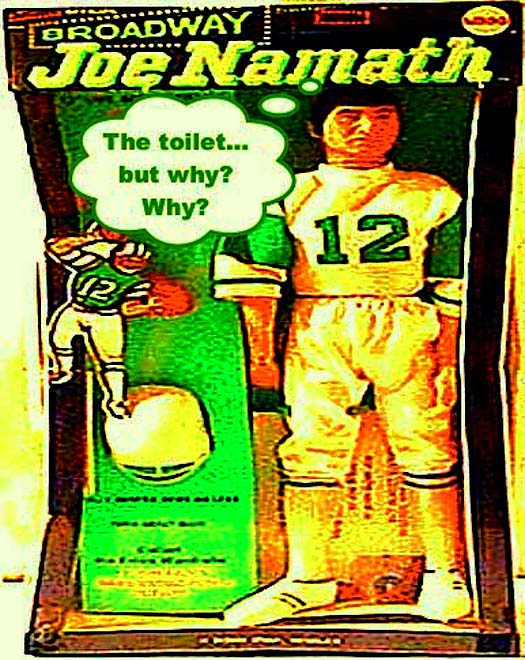
Broadway Joe ponders the great mysteries of memory and intent.

Broadway Joe ponders the great mysteries of memory and intent.

I like to attribute my sense of confusion over the story of Mego Joe Namath to my grandmother’s penchant for revisionist history, as if some of her mojo got on that Joe Namath doll, and made it impossible for me to own up to the specifics of what happened. A refugee, along with my grandfather, to the U.S. of A. just prior to WWII, grandma squished and squashed the family history into something palatable for that era, and then for a later era, the story always holding too many contradictory elements for anybody who knew more than the small slice she was dishing up at any particular time. And, I should also note, I don’t know that grandma was the source of the stories. I just don’t know who else to blame.

In Grandma’s telling, we came from a line of German barons, low-level royalty of sorts, but we were also Jews, dodging Hitler by changing our name from Schildberg to Schildbach.  I’m not sure which part of the story is harder to swallow–that a Jewish family attained noble status in Germany, or that our family’s heavy Lutheran leanings were born of a conversion of convenience–a cover story that resulted in such a complete abandonment of our heritage that the family attended church–well, religiously–and my father became a pastor. We were Nazi fighters, or fighters of Nazis.  Or perhaps we were communist fighters, or fighters of communists. And maybe, just maybe, we were Nazis fighting the communists, or vice versa. However it turns and churns, we were never whatever was bad.

And whatever happened, the family got out of Germany at a pretty good time to get…so hooray for not ending up dead for some political or religious leaning or another.

The shifts in my rememberances and interpretations of the Mego Joe Namath saga could also be attributed to my last memories of my grandmother. She had come to visit my mother’s home around Christmastime during my college years. Before I made it home for the holiday break, my younger brother had already sent notice that grandma was spending most of her time in front of the TV complaining—frequently about communists and gay people—and this was in the days before Fox News. I can only imagine what mainlining such misappropriated anger would have done for her, when a news story about the Soviet Union would send her into a grumble about how we don’t need communists on the TV at Christmas, or seeing Brian Boitano in Olympic trials would launch her into a confused rant about how “they” had accused one of my cousins of being gay—maybe she meant the United States Figure Skating Association, although that seems unlikely.

At some point, I conflated these late memories of my grandmother with why she ever would have sent me a Joe Namath doll in the first place. I figured that maybe, in my early primary school years, she had become concerned because, along with my girly curly hair, penchant for art projects, and general lack of interest in sports, I carted around a dress-wearing teddy bear named Cindy. Grandma may have decided that the antidote to such anti-masculine behavior was a doll that played football. And, speaking of things I really don’t remember, I’m not sure where the teddy bear came from, or why I was convinced it was female and asked my mom to make a dress for it, but I suspect that my sister had a strong hand in all of it.

It was also by my sister’s hand that Joe Namath ended up in the toilet. I’m sure there were numerous warnings leading up to the actual toilet incident. I just don’t remember the triggering event. It could have been that I snuck into her bedroom while she was in the shower, and played 45s on her portable record player. I thought maybe it had something to do with me stealing her Sunshine Family Farm chicken again, so I could make fart noises as I made it squeeze out eggs—but the timeline for that toy’s release placed it far too late to match up with Mego Joe’s trip to the pool. It may have been that I stole Sunshine Family dad’s sweater, so that Mego Joe Namath would have something to wear other than his football outfit—a likely possibility, given that, while Joe’s shirt went into the toilet with him, he was not wearing it.

Chances are, the event that led to Joe taking the plunge was little more than my bragging about how grandma had sent me a present but hadn’t sent one to my sister…or some other antagonistic foolishness…singing an annoying commercial jingle over and over again, calling her names, suggesting she was in love with somebody…I could be pretty damn annoying with very little effort. I can’t remember if the event took place in one fell swoop, with my sister grabbing up the doll and accessories and dropping them all in the toilet, or if it happened in stages, with me refusing to give up whatever it was I was doing that was annoying her, as she dropped items of clothing into the toilet, one by one, finally plopping Joe in as the final measure.

There is also the matter of just who hit the handle on the toilet, flushing as much as would go down—which I think was only Joe’s shirt, football, and helmet—maybe one of his shoes, too. Joe himself was spared the trip to the sewer by dint of his size, or positioning–an inability to navigate the crooks of the toilet piping.

I have a vague recollection, obscured by the lies that took place in its wake, of staring down at Joe in the toilet after my sister stomped triumphantly out of the bathroom, evil grin on her face, or maybe with her standing right there, relishing my disbelief. And as I looked, and imagined having to fish him out of the toilet to clean and dry him off, and admit my sister got the best of me—that she had completed an unspeakable act I was sure she would never dare—I was filled with anger…anger that could only be redeemed with destruction. Joe would go down, a sacrifice to Mars, and I would blame it on my sister, pleading with my mother to punish her for the destruction of such a beloved gift.

Truth is, from the time I got Mego Joe Namath, I was puzzled. What the hell did I want this for? But it was a toy, right? A gift? Something I obviously was supposed to want. And given my unnatural attachment to objects, I had to keep it. It had to mean something more than I could quite fathom. It was as important as all material things, as all toys I longed for…right?

But I believe it was me who hit that handle, not only to get my sister in trouble, but because I was finally presented with a way to get rid of that weird, incomprehensible, whatever of a gift. The guilt of trying to flush him was roughly comparable to the guilt of not wanting him in the first place. Perpetually vexed by the tension between trying to accept and do what adults expected of me, and the desire to just melt down or blow up, I was a bit of a mess as a child…as I suspect all children are, in one way or another.

Feeling that you want what others think you shouldn’t, and that you don’t want what they think you should, is a hell of a thing.

So, Joe didn’t go, but he didn’t stay whole. And that became excuse enough for me to leave him behind…something incomplete I had an excuse to no longer play with. Back to teddy bears in dresses for me, with only a small lump of guilt for the subterfuge visited on Joe. And grandma, living several states away, never needed to know.


God Looks Away, Youth Minister Sex Offender Publishes Self-Serving Article (TW)

At the core of “My Easy Trip from Youth Minister to Felon,” an article posted in the online version of Christianity Today’s Leadership Journal, is an odd and self-serving theological point: that God does not look upon sin, and that when sin continues long enough, God gives us over to it so that we might hit rock bottom and then seek redemption. God turning away is, according to the anonymous author, a convicted sex offender still in prison, the reason Jesus felt God had forsaken Him while He was on the cross—God could not look on His Son/Himself as His Son/He took on the sins of the world. It is God’s looking away, the author suggests, that allowed King David to embrace selfishness and send Bathsheba’s husband, Uriah, into battle to die, so that David might have sexual access to Bathsheba. In this same fashion, the author contends, God looked away so that the author might plunge deep enough into sin to be made to answer for those sins.

The author provides no theological discussion of why God also looked away from the victim of the author’s sin, implying (through the author’s shaky theological discourse, and his frequent use of “we” and “our”) that the teenage girl who had been manipulated into a sexual relationship with her youth pastor, shared in the sin, or simply had to be sacrificed so that the author could be redeemed. Without ever naming his actual crime, the author crafts a tale of a sexual predator in need of redemption, and a sexual assault victim as sacrificial lamb, all with God’s blessing/God’s inability to stomach what was happening. But if we are to look at God as incapable of looking on sin, or even the victims of another person’s sinful behavior, then it seems only right to assume God looked away throughout the process that led to the publishing of the article.

The article, taken down from Leadership Journal after much public pressure, can be read from an alternate site here.

I’m a bit torn about whether I think people should read it—not in the sense that I think it deserved to ever be published in the first place—it didn’t—but because it provides an interesting look into the kinds of self-centered justifications, and victim-blaming that sex offenders will endorse in an effort to convince people around them that they’re sorry and won’t ever do anything like that again, because, boy, they’ve learned their lesson, and (in this case) Jesus forgave them, so you should, too.

What was meant by the editors to be taken as a moving story of sin and redemption was, instead, merely a continuation of the abuse, prettied up with self-aggrandizing mock-contrition and Bible verses. And, sadly, the editors saw fit to tag it with the “related topics” of Accountability, Character, Failure, Legal Issues, Self-examination, Sex, and Temptation. Of those tags, “Failure,” and “Legal Issues” seem the only appropriate ones. “Sex” only fits in the broadest definition; whereas “Sexual Assault” or “Sex Offenses” would have been much more fitting. “Temptation” is little more than a label that normalizes the sexualizing of underage girls.

It's not somebody who's seen the light...It's a cold and it's a broken Hallelujah

It’s not somebody who’s seen the light…It’s a cold and it’s a broken Hallelujah

What I keep wondering in all of this is how the article came to be posted in the first place. Did the editors of Leadership Journal coordinate with prison officials to approve the project, or did they just accept it from some inmate, insisting via e-mail that he had a unique tale of a fall from grace and a re-acquaintance with God? Did they know the author prior to his incarceration? Is the author in a treatment program in prison? If so, were his treatment providers at all aware of what he was doing? Were lawyers for the author, lawyers for the victim, or the judge in the case aware of the intent to publish such a piece? And, perhaps most importantly, was the victim, or the victim’s family aware that any of this was happening? And did she/they have any say in the matter?

I ask the above questions because I cannot imagine that, prior to publication, the article was examined by anybody with any clinical knowledge of offender behavior—or, for that matter, by anyone with any sense of the damage done to victims of sexual assaults. If I give the editors the benefit of the doubt, then maybe I can view them as possibly well-meaning, but definitely confused/ignorant people looking to generate an attention-grabbing conversation about statutory rape. And while, it certainly grabbed plenty of attention, that was because it took a story of sexual assault and transformed it into a discussion about how easy it is to be seduced by a teen when one takes one’s eyes off of God, and vice versa. The sexual content is so subdued/obscured that it comes across as if it is intended to describe temptation only—definitely much more so than if it was labeled appropriately as child molestation, pedophilia, hebephilia, exploitation of a minor, statutory rape, or rape.

Any sex offender treatment provider who knows anything at all about what she/he is doing certainly would never have approved of the article as it appeared. Offenders in treatment (in or out of prison) are often given writing assignments wherein they are required to relay details of their behaviors and thought processes and demonstrate an understanding of the damage they caused, as well as the way they convinced themselves it was okay. And while I recognize that it wasn’t specifically crafted as a treatment assignment, the Leadership Today piece reads like an eloquent first draft of such an assignment, crafted with care before a treatment provider and/or members of a treatment group demanded changes due to the author taking a victim stance, failing to acknowledge the actual crime or its impact on anyone other than himself, and refusing to incorporate even the most rudimentary sense of understanding about how he built up to the offense and kept it secret for as long as he did.

Or perhaps it’s more like a second draft, after the offender removed most of the overt blaming of the victim, and switched, instead, to implied mutual blame or implied consent for the crime.

I have heard hundreds of variations on the same basic story told in the article, from the mouths of offenders, emphasizing the frustrations in their lives, the reasons they had contact with the victim to begin with, and the reasons they are not to blame (and, yes, a lot of them invoke religion as part of that). It is rare to come in contact with an offender who, from the beginning (not of the offense, but of contact with the justice system and the need for an evaluation for sexual deviancy) is capable of outlining how he (or occasionally, she) manipulated the victim to engage in sexual acts and to keep it a secret, how he justified the crime to himself, and what specifically happened (in clinically appropriate and criminally accurate terms), without putting a large portion of the blame on the victim for somehow enticing or seducing him.

Despite the author’s claim, added after the controversy erupted, that he takes 100% of the blame for the crime, and recognizes that what he once viewed as a consensual relationship was no such thing, the article itself tells a much different story—of a man who worked hard to build something up for the glory of God (and how he was really amazing at doing that work), and then how he accidentally broke it because he was being selfish. Without ever acknowledging the severe harm he did to the victim, harm that is likely to last a lifetime, he signals that he has returned to a life of service to God because he is involved in leading a ministry group in prison (another thing I have a really hard time with anybody allowing).

And while the author touches on one of his justifications for engaging in his behavior—that his wife was paying too much attention to their children, and not enough to him—he is only able to acknowledge the impact on his wife in the form of the fight they had when she found out about the crimes, and how she left in the middle of the night with the children. The author laments that he has not seen his children since, but doesn’t even mention the extreme embarrassment and devastation he caused his wife and children. Nor does he ever fully indicate that he recognizes how childish his justifications for his behavior were, or how those justifications were merely the starting point for a cycle of lying and manipulation committed for the sole purpose of having repeated sexual contacts with a minor.

In a truly terrible minimization of his behavior, the author compares his repeated sexual abuse of the victim (while implying she shared in an identical struggle with him) to the difficulty of smokers trying to turn away from cigarettes.

From the complete dearth of information in the article, if this really were a treatment assignment, once all the extraneous details, self-promotion, and claims to deserved forgiveness are removed it might sound a little more like this:

“In my 30s, I accepted a position with a church as the coordinator of youth ministry. I built up the group from just a few members until it was one of the largest youth groups in the region. I realized I was experiencing sexual attraction to one of the underage members. I manipulated her into having sex with me, and justified my sex offenses, in part, by blaming my wife for not paying enough attention to me. I had sex with the teen repeatedly. When my wife found out, she took our children and left. I was convicted of sex offenses and sent to prison. I am currently still in prison. I will be a registered sex offender for the rest of my life.”

And, if the author began to actually include the most obvious missing items, the skeleton of a real assignment, or perhaps a combination of real assignments, would start to look like this:

“In my 30s, I accepted a position with a church as the coordinator of youth ministry. I built up the group from just a few members until it was one of the largest youth groups in the region. I realized I was experiencing sexual attraction to one of the underage members, and that she looked up to me in a way that made it possible for me to manipulate her. I set about grooming her. I justified my sex offenses, in part, by blaming my wife for not paying enough attention to me. I managed to work up to the point where I convinced the girl to have sex with me. I then had sex with her repeatedly while convincing myself that she wanted to have sex with me as well, that she was mature enough to handle a sexual relationship with an adult who is an authority figure in her spiritual life, and that I was in no way manipulating her. I managed to keep her from telling anybody about our relationship through various forms of coercion, and went to great lengths to keep anyone from finding out about it. We eventually got caught. My wife, understandably, left me and took the children with her. I was arrested and convicted of sex offenses. I am currently in prison. I will be a registered sex offender for the rest of my life. The teenager I manipulated and raped will need a great deal of therapy and other supports in order to cope with the aftermath of my actions. My wife, my children, and numerous other people impacted by my behavior will also need support to attempt to repair the damage I caused. I recognize that I need to stay away from minors for the rest of my life, and that I can never be placed in any kind of position where I might have authority that can be abused, particularly over any people who could be considered ‘vulnerable.’ I also manipulated editors of Leadership Today into publishing an article I wrote that completely justified my behavior, and suggested that the victim was equally to blame for my sex offenses.”

The assignment would be given back with numerous, specific requests for much more “self reflection,” “accountability,” and actual identification of his specific behaviors and thoughts.

Becoming a sex offender isn’t an “easy” path as the author’s title suggests. It is one that is pieced together with care by the offender, and crafted to secure the cooperation of the victim(s). It is not, as the author portrays it, a little trouble in a marriage, a dash of arrogance, and some innocent flirtations evolving over time into mutual passion—passion that makes God look away, as if God were easily embarrassed. Such a description may be a very simplistic explanation of how an extramarital affair (the words the author uses along with “adultery” to describe his sexually exploitative behavior of a child under his care) evolves.

Unfortunately, by diving into this discussion, without any sense of just how manipulative the author was, and how harmful his words are, the editors of Leadership Journal have put themselves in a place where they must now back away from this discussion entirely. Rather than promoting a meaningful dialog about forgiveness and redemption, they allowed a sex offender to promote himself as a victim of the temptation to have sex with minors.  They allowed him to promote his story of redemption—a story that rings as false as any rapist having the arrogance to compare himself to Christ on the cross, as he suggests that God’s mercy has saved him, all while implying a teenage girl entrusted to him for guidance and education was just as responsible for being raped as he was for raping her.


God Bless Anita Bryant

Friday, May 16, I had my first experience with a mental health/chemical dependency conference hosted by a drag artist. The incomparable Aleksa Manila presided over the “Saying it Out Loud” conference, complete with multiple costume changes and delightfully tasteless jokes between various announcements, awards, introductions, and seminars. This was the thirteenth annual gathering of this conference, which was created with the goal “to continue to co-create learning, growth and understanding of the best practices and relevant clinical services needed to support members of the lesbian, gay, bisexual, transgender and questioning communities.”

Dr. Ronni Sanlo served as the keynote speaker, as well as screening a new documentary, “Letter to Anita,” about her almost-wasn’t involvement in LGBTQ activism. Now I’m going to get into a few spoilers here, but I don’t think the basics of Sanlo’s story are the heart of the documentary, as much as is the personal perspective she brings to them. So, when I say her activism “almost-wasn’t,” I mean that Sanlo, like a number of lesbian women of her generation, went about her life as a heterosexual woman, married (to a man) with whom she had two children, not really aware that there were other options.

Unfortunately, just as Sanlo was realizing that there were other options, that the attraction she felt to women wasn’t something that made her completely alone in the universe, Anita Bryant was ginning up Florida’s legislature to pass laws denying parental rights to gay parents. Sanlo’s divorce went through.  Her children, for all practical purposes, were taken away from her.

Liberty turns her back as Anita Bryant looks to the sky, expecting Jesus to fly down and smite the gays.

Liberty turns her back as Anita Bryant looks to the sky, expecting Jesus to fly down and smite the gays.

Hearing the story now, it seems unfathomable to me. In part, my disbelief comes because at the time Sanlo was being viewed as an unfit parent simply for acknowledging who she was, I was living a few doors away from a blended family—two lesbian mothers with three teenage children among them. Granted, at the time, I was in grade school and not really aware that the two parents in that household were ‘romantically linked.’ I was under the impression, for whatever reason, that the families were living together for other reasons—economic? ecological? I remember that, in the fifth or sixth grade, when our class was given an assignment to write an editorial letter about an issue of concern, I mentioned the family as I explained why we shouldn’t be mowing down forests and fields to build new houses when there were other options, including multi-family homes, that would allow greater preservation of nature. Clearly, I had missed the more important political/social issue facing the family.

At any rate, the nature of my neighbors’ relationship was eventually pointed out to me by gossiping peers, with the implication that I was stupid for not having realized it, along with the weird sexual goings-on that were certainly a part of that relationship. Not to say that I was super-forward-thinking at the time, but I knew the two women as my neighbors who had been pleasant to me whenever I encountered them. So whatever sexual things may have been going on between the two women were of about as much interest to me as those of the parents of anyone I knew. That is to say, I really didn’t devote much time at all to thinking about sexual things between various peoples’ parents, and may, as I tilted toward pubrerty and all manner of prurient thoughts, have actively avoided thinking about them.

As far as I was concerned back then, anyone who was cool and/or innocuous toward me warranted much less concern, anger, or fear than the bevy of teenage male piltdowners who seemed to have little more to do than roam the suburban streets trying to prove their masculinity by tormenting children much younger and smaller than them—a model of “manhood” I unfortunately subscribed to briefly when I hit a similar stage in life.

I can only imagine that the lives of the couple from the blended family had some parallels to Sanlo’s—at least in terms of them apparently having partnered with men to build families in order to live out the deliciously limiting American Dream. It’s not too big of a stretch to believe my neighbors, like Sanlo, had seen few other options for relationships but hetero marriage and procreation. It was my understanding that both of my neighbors were divorced, although, like same-sex partnerships, such things were not discussed a great deal at the time, despite divorce quickly becoming commonplace—something that would reach almost all of my friends who hadn’t, like me, experienced the death of a parent. And if the exes of my neighbors were still coming around to visit their teenage children, I wasn’t aware of it. Then again, I wasn’t aware of much that went on in the lives of those teens, since there was far too great of an age gap between us—that impossibly vast chasm between elementary school and high school—for us to concern ourselves with each other.

Speaking of parallels and gaps, “Letter to Anita” touches on another critical piece of Sanlo’s life that fits in with the development of my own understanding of individual rights, freedoms, and what it actually means to be something “other” than heterosexual: Anita Bryant’s crusade against, well, all people who don’t fit her very narrow definition of appropriate relationships (never you mind Bryant’s own divorce).

As I’ve noted before on my blog, I was raised religiously, in the Lutheran Church, Missouri Synod. My father was a pastor in said church. My father died when I was rather young. I spent a great many years struggling with religious ideals and how they fit into the world. And despite my current agnostic tendencies, I still hold onto an idea of religion as an expanding element in peoples’ lives, a force that should open people up to larger experiences, a force that should create love and acceptance, as opposed to a limitation on peoples’ lives that causes anger, hatred, judgment, and closed-mindedness. I spent a lot of time struggling over moral issues, their relation to legal and spiritual concerns, and how we all get along as a people who are supposed to be dedicated to personal freedom, personal responsibility, community ties, love, and all the rest of that stuff.

But Anita Bryant, with her perfectly coiffed hair and starchily-pressed orange and brown polyester outfits, was telling me, in her own, orange-juice-endorsing way, to fear, hate and distrust people I knew, people who had shown me kindness, people I knew to be funny, smart, and no threat to me at all. She put out albums (which, as a teen, my younger brother delighted in purchasing from the local Goodwill for the purposes of mocking and destroying) filled with patriotic and religious songs, promoting the goodness of the USA and Jesus. Yet, everything she said, every objective she pursued, was in contrast to freedom, goodness, and the anti-judgmental stance that Jesus and America were supposed to represent.

Yes, Anita Bryant, in contrast to all she stood for, or wanted to stand for, had helped turn this white, hetero, suburban boy, and his white, hetero, suburban friends, into supporters of gay America…into people who would forever see the gay menace she was so sure was destroying us all, as nothing more than the paranoid delusion of close-minded, controlling, angry people who were completely incapable of seeing the irony of their anti-freedom, anti-love stance as they waved their flags and thumped their Bibles.  Anita Bryant, as Sanlo notes, managed to galvanize opposition to gay rights opposition–even out into the hetero world and parts of the Christian community she was so sure she could count on to share her views.

So God bless Anita Bryant. God bless Ronni Sanlo. And God bless us everyone.

Forced Healing: A “Girls” Beach House Retreat

(Spoiler Alert)

Season Three, Episode Seven of HBO’s Girls finds Marnie securing a North Fork (the vacation destination for people who feel the Hamptons are “tacky”) beach house from a family friend, in an attempt to engage her friends in some never-defined process of “healing”—healing that is supposed to take place over a duck dinner, leaving time for face masks, a viewing of “Queens of Comedy,” and a ceremony built around throwing slips of paper, inscribed with wishes, into a bonfire.

As she hops around in the turbulent surf, insisting it’s “the best swimming conditions imaginable,” while the rest of her friends wait uncomfortably on shore, Marnie observes, “I just think we have a lot of healing to do and we have a lot of ways that we could do it.”

The best swimming conditions imaginable--why isn't anyone joining in?

The best swimming conditions imaginable–why isn’t anyone joining in?

Healing rituals can be very powerful…I guess.  I can’t say as I’ve ever utilized any as part of a therapy or group therapy session.  And, just to be clear, I’m using the phrase “healing ritual” in the broadest way possible—essentially encompassing any kind of activity designed to provide participants with a positive outcome by engaging in some sort of symbolic action.

I have, at times, advocated that people use healing rituals, for example, when grieving.  But in those cases, I’ve suggested an individualized ritual, focused on something that is specific to the mourner’s connection to the deceased.  And such rituals come with the caveat that one cannot simply get over grief by coming up with a clever routine that serves as a reminder of a loved one.  You have to feel the hurt to get to the heal.

Personally, I’ve only ever taken part in one healing ritual, at a church.  That particular ritual involved dropping stones into water, and had something to do with establishing intentions and letting go of bad habits or negative thoughts that trap one in old patterns…or something like that.  While I enjoyed it, and found it to be engaging while it was taking place, it wasn’t something I was particularly invested in, or something that spoke to my own personal needs or expectations at the time.  So it didn’t really stick with me.

I suppose I associate healing rituals, or rituals in general, with religion or spirituality, rather than with therapy.  This is not to say that religion and spirituality are totally separate from therapy—perhaps different sides of the same street…finding meaning in, and ways to deal with, the difficulties of life.

Ritual, though, is imposed on reality.  Ritual says, ‘we are here now, and these are the steps we are going to take to create shared meaning.’  Therapy depends more on meeting people where they are, and taking steps as those steps become possible.  At any rate, for either rituals or therapy to work, they need the ‘buy-in’ of the participants.  If there’s no meaningful connection to the work being done, no personal sense that it is worthwhile, then little is likely to come of it.

Marnie, unfortunately, never gets the buy-in of her friends.  Hannah, Jessa, and Shoshanna come out to the beach house as much out of a strained sense of obligation to Marnie as they do because they’ve been offered a free, weekend getaway.  Hannah soon sabotages Marnie’s tightly-scheduled friendship renewal when, on a trip into town, she runs into past roommate Elijah and a group of his friends.  Inviting them to join Marnie’s restorative retreat, Hannah implores Elijah to, “save me from this hell.”

Strangely enough, the only actual healing that takes place is between specific members of Marnie’s healing retreat and Elijah.  Prior to inviting Elijah over, Hannah and Elijah excitedly reveal how much they miss each other, thus effortlessly mending a pointless rift that started because Elijah had slept with Marnie.  Later, after some icy exchanges, Marnie opens up to Elijah about her break-up with Charlie and about her connection to “Old Man Ray,” because she cannot, in the context of the healing she wants to pursue, reveal to her other friends that she is sleeping with Shoshanna’s ex.  Nor would she want to admit it, as Ray does not fit into the overly-planned, picture-perfect life Marnie envisions for herself.

In addition to keeping secrets, as much as Marnie tries to impose control and ritual on the gathering, her friends are not particularly in the mood for structure, ritual, healing, or therapy.  What growth these characters experience is a result of taking steps forward on their own, or being confronted with the consequences of their actions.  At the moment of this particular beach retreat, Jessa is recently out of rehab (where she “learned a lot of great communication games”), Hannah is (relatively) satisfied with her career and her significant other, and Shoshanna is re-evaluating her life, potentially involving splitting from her friends (who she characterizes as “fucking whiny nothings”) permanently.

It clearly is not the time for a ritual based in Marnie’s need for connection, and modeled after a pop-culture version of how women bond with each other (with acknowledgment of the irony that I’m using an extended pop culture reference to explore how and why ritual and therapy may or may not work in particular contexts).

In a shallow, drunken conversation about the impact of their parents on their lives, Hannah tells Marnie that she had been dreading the trip to the beach house, and “would have done anything to not be here.”  Then, to assure Marnie that they are having a valuable exchange, and perhaps in hopes of pre-empting the scheduled dinnertime healing session, Hannah assures Marnie that they are taking part in “one of the most meaningful weekends of the summer.”

Hannah’s dismissive comment speaks to the crux of the problem.  Marnie views the weekend as a reset button on their lives, a way to make things “like old times” and to get back to normal, once and for all.  But everyone else sees it as just a weekend…a break from their real concerns…time out from “normal.”  Their lack of ongoing, meaningful connection to one another has become ordinary and acceptable for everyone but Marnie, who is clinging to a Hollywood ideal of female friendship, particularly given that her Hollywood ideals of marriage and career have completely fallen apart.

Perhaps the problem with ritual as a strategy for healing, then, is that it is often a break, outside of commonplace daily activities, potentially gripping in the moment, but ultimately just a break.  There are few, if any, rituals we engage in that become transformative, except perhaps those rituals that are constants in our lives, practices based in our beliefs.  It is a delightful fantasy to think that we can come together with friends in a carefully orchestrated event that will have life-changing potential.  However, close relationships are a process of careful, ongoing cultivation, just as most things in our lives do not bend to sudden, planned transformation, resulting in perfection, or reclaimed perfection.

As for the Girls, whether the rest of the group is really thinking about how they fit together is up for debate.  None of them, aside from Marnie, seem particularly concerned with making sure they move forward together, developing deep bonds.  As it stands, their bonds seem more circumstantial than intentional.  Although they express concern for one another, Hannah, Jessa, and Shoshanna seem content to pursue their own ends, and let the relationships go where they go, even if that involves completely drifting apart.

When Marnie finally decides to throw down, and try to force the group to engage in whatever ritual it is that she has planned, any thought of such healing has jumped the track, and it becomes more like an impromptu, and leaderless, group therapy session—the kind where problems are brought up, but no resolution is sought.  Grievances are aired, and alliances shift rapidly, but the intent of the participants becomes wounding, not healing.

Shoshanna takes center stage in this process.  Having consumed numerous “North Fork Fizzes” throughout the day, or perhaps simply frustrated enough by the behavior of the people around her to finally demand attention and express herself, she unloads on the group for treating her “like I’m a fucking cab driver…like I am invisible.”  Then, delivering the final blow to Marnie’s healing weekend, Shoshanna tells Marnie, “You are tortured by self-doubt and fear and it is not pleasant to be around.”

In short, Shoshanna indicates that Marnie needs to go get some therapy rather than trying to heal things that were never whole to begin with.

The episode ends with the “girls,” waiting for the bus back to their regular lives, slipping back into the one ritual that did come together over the weekend—a dance routine taught to them by Gerald (with a hard ‘G’).  Not exactly a healing moment, but an indication that things are essentially where they’ve been for a long time—with individuals who occasionally connect as much as their circumstances and personalities allow.

About the New Letters

So, last week I was able to officially add to that string of letters that follows my name when I’m feeling professionally pretentious enough to attach it (like on the main pages of this blog).  The new letters: ASOTP.  I am loath to spell out what exactly it means, as that revelation is usually followed by one of a small number of responses, most of which can be boiled down to either a prurient curiosity or an “Ewww!” reaction—if those are really different things.  Different sides of a two-headed coin, I suppose.

Deep breath, throw it out there, let it sink in.

The letters stand for Affiliate Srrm Orrherrm Treatment Provider.

Ahem.  Let me try that again.

The new letters stand for “Affiliate Sex Offender Treatment Provider.”  In other words, I’m now officially allowed to provide therapy specific to the, uh, needs of convicted sex offenders, generally those who are involved in particular sentencing programs that I won’t detail here, apart from saying that they involve community supervision.  And, more accurately, the “Affiliate” portion of that title means that I am allowed to provide such treatment so long as I have a supervisor who is a Certified SOTP (having a contract with such a supervisor being one of the elements necessary to be granted said letters).

While this particular status is new, my involvement in the treatment of sex offenders is not. I’ve been working in one capacity or another with both juvenile and adult sex offenders for a little over six years now—which sounds like both an insanely long and an unimaginably short period of time to me.

So, why, may you ask, would I want to work with sex offenders?  Everybody asks.  And my answer is usually rather vague and abbreviated, dodging the real heft of the answer.  Let me attempt to present the most straight line formulation of this reason that I can, and please follow closely or you may get a lot of incorrect impressions…

My father was a pastor in the Lutheran Church, Missouri Synod, “stationed” in the Midwest for that part of my life when we were both alive.  My father was killed by a reckless driver exactly one week before my third birthday (which is where a lot of that attachment and blankie business comes in).  My mother, my siblings, and I then moved out to the West Coast, where we soon joined a(n) LCMS church with two pastors.

One of those pastors turned out to be a sex offender, of the hands-on, child molesting type, including incestuous molestation.  For the record, I had always been very wary of this pastor and kept my distance, despite his apparent popularity with other kids/teens in the church.  (Someone call Oprah—or whoever has usurped her throne—to see if we can suss out whether this has to do with repressed memories, supernaturalish intuition, or guardian angels).

The information about the SO pastor became public knowledge during my first year of college, when I was already pretty deep into a crisis of faith.

Bye-bye, faith.

Now if you want something to piss out the flame of your faith, there’s nothing quite like having one of the pastors most responsible for your religious education turn out to be a child molester.  This is particularly dousing when it follows that whole bit about God letting your dad, one of His faithful servants, get killed in a totally senseless accident—all while driving a Pacer, nonetheless (my dad was the one driving the Pacer, not God).

I don’t know how common it is for PKs (preacher’s kids, not Penalty Kicks or Player Kills or Purple Kush{es?} you sporty stoner nerds) to feel some sort of obligation to follow in their father’s (or mother’s in some churches that don’t include the LCMS) footsteps.  But for this kid, who never really even had a conversation with his dad, yet was enthralled by the idea of someone devoting his/her life to faith, there was a perceived pressure to aim, or perhaps a desire to feel at least the smallest inclination to lean, in that direction.  There was a weird, but unfulfilled, sense that there should be a calling—that God should be reaching out a hand, or tugging a leash, or kicking a butt.  I mean, if God could go to the trouble of getting that Jonah guy swallowed up and barfed out at exactly the right times and places, why not at least lay out something more profound than watery eyes during the candlelit singing of “Silent Night” at the Christmas Eve service?

So much for that straight-line formulation.

Anyway, while it took the overcoming of numerous mental blocks and bad habits (okay, the habits are still there) to get to the point where the idea of a ‘life of service’ was even a possibility, the calling wasn’t really perceived until it was time to sign up for final projects in the ‘Abnormal Psych’ course of my Master’s Program.  The list went around.  And while I immediately knew to sign up for a presentation on Pedophilia, I found myself choosing Conversion Disorder (‘hysterical blindness’ and the like) instead.  A sense of guilt immediately began eating away at me, until, a short time later, bothered by what I felt was cowardice at steering clear of the topic I really wanted to study, I tracked down the clipboard with the list, erased my name from the line next to Conversion Disorder, and instead, wrote it next to Pedophilia.

An explosion of anxiety and purpose, roughly on the order of the destruction of the first Death Star, or perhaps equal to the magnitude of the reaction of a normal human digestive system to a Jack-in-the-Box meal, tipped my world forever in the direction I had been looking for…or kind of looking for…or at least in some damn direction for the time being while I decided if this was really what I wanted to involve myself in.

At any rate, it was momentous enough to stick in my brain as some kind of pivotal event that all that previous junk had led up to…or to which all that previous junk had led.

More on that later.