
GUN CONTROL OR PEOPLE CONTROL? Part One: The NRA’s Build-a-Bogeyman Workshop

It doesn’t matter how many shots are fired and how many bodies pile up—particularly in those attention-grabbing mass shootings—the cry goes out, crafted by the NRA, that it is something other than guns and ammunition that needs to be addressed. The most recent and prevalent pro-gun meme is that it’s the mental health system that needs to be fixed, while guns are just great. In fact, guns are so great that everybody should have them all of the time, except for criminals and those people with a severe mental illness. But if any criminals or people with mental illness try to shoot any of us good people, then we can all pull out our guns and shoot them back, and definitely shoot them better, harder, faster, and, just for good measure, deader.

Prior to the pro-gun, blame-the-mental-health-system meme, it was the, “We don’t need new laws, we just need to enforce the existing laws” meme. Of course, since the NRA lobbied to make sure that the existing laws wouldn’t be enforced, and, in fact lobbied to have laws enacted that made it illegal to enforce the earlier existing laws, they had to come up with a different cheer for team shoot-em-up. So, hence: guns good; mental health system bad.

There’s this other, less clearly- and less frequently- articulated position underlying the broken-mental-health-system argument, that people working with the mentally ill are incompetent, first of all, for allowing the system to fall into disarray, and second of all, for not being clairvoyant enough to determine which of the people they encounter who express some form of homicidal ideation are just talking nonsense and which really are stockpiling weapons or have access to weapons their family members stockpiled, so that said mental health professionals can then direct law enforcement to stop the future crimes. Okay, in fairness, there are ways to assess for danger—not that the NRA didn’t lobby to try to prevent anybody in the medical and mental health fields from even asking people anything as simple as whether they have access to guns.

But fortunately, the NRA has finally stepped up and has been instrumental in working to address real-life situations and offer up functional ideas for systemic changes, like, “You guys need to fix the mental health system so that people with mental illness stop shooting people, okay?” Except there’s that whole thing about how people with mental illness who actually commit violent crimes (a very tiny portion of them) are not generally compliant with treatment if they’re even in treatment to begin with. So not only do mental health practitioners have to accurately determine which of their clients might commit violence and make sure those clients are stopped from doing so, but they also have to ferret out all of the potentially violent people with mental illness, even if they have never even met them.

Anyway, what I’m saying is that the argument about fixing the mental health system is a nonsensical argument for a WHOLE lot of reasons…most notably that it’s an argument designed for inaction as far as gun laws go, while setting up a bogeyman that can spring out and yell ‘boo!’ anytime there’s a high-profile shooting. For instance, if somebody commits atrocities, such as shooting up a theater or a school, then we can all say, “Wow, this guy was obviously disturbed. Why wasn’t he getting any help?” Or if said shooter was in treatment, we can say, “How come more wasn’t done to make sure he wouldn’t hurt anybody?” Or if there are no clear indications that a shooter was, for example, psychotic or in treatment, we can always fall back on the idea of undiagnosed mental illness. The broken-mental-health-system argument is also convenient for all those 19,000-ish annual suicides by gun.

The argument to fix the mental health system is also nonsensical because it essentially allows the problem of gun violence to go on forever. That is, no set of laws is ever going to solve the problem of murder 100%, but when the argument is that guns aren’t problematic, but the mental health care system is, then as long as there are shootings, we can keep hemming and hawing, failing to enact simple measures like universal background checks, or tracking of Internet-based weapons and ammunition sales, or making certain classes of weapons flat-out illegal.

In addition, the broken mental health system argument allows gun manufacturers to rack up more gun sales. After all, what are a few dead kids if you can rake in some extra dough by letting 24-hour news networks scare everybody into thinking they need to arm themselves against a bunch of crazy people who are going to shoot their kids? (or invade their homes, or shoot them in a theater, a mall, a church…) Just check out how gun sales spike after high-profile shootings, combined with talking heads appearing on news shows to say stupid things about how the crimes would have been avoided if only everybody on scene had been armed. Check out the secondary spike in sales when the same talking heads suggest that gun laws are going to suddenly become so restrictive that nobody is going to be able to buy a gun anymore.

On top of that, the majority of the people who parrot the broken-mental-health-system meme have no idea how the mental health system actually works, or how it interacts with law enforcement, hospitals, and the court system, or what could actually be done to “fix” it. Nor do most of them care, since it conveniently props up their view of things, without them having to actually learn or understand anything. They’re super-familiar with arguments about why killers are going to kill just as many people whether they have clips with 8, 27, 92, or 412 rounds; why it doesn’t make a difference if a person has access to a pop gun, a hunting rifle, an AK-47, or a BFG-9000; and why any gun control measure at all is useless because criminals are going to get guns anyway, and then only law-abiding citizens will be left unarmed.

Don’t bother trying to point out that all kinds of laws exist that, just as the concept of law implies, are followed by law-abiding citizens, and violated by criminals, and that what makes a person a criminal is that the person violates a law. After all, the no-gun-control stance involves absolutist/absurdist arguments where ANY restrictions on guns and ammunition mean all law-abiding citizens lose ALL access to their guns and ammo, and criminals suddenly have unfettered access to all the weapons they could ever want so that they can create the maximum amount of mayhem. It’s an argument that requires a good dose of the paranoia that persons with mental illness who carry out violent crimes sometimes exhibit.

But the logical extension of the no-gun-control kind of argument is that we could get rid of “gun crimes” and “gun criminals” completely if we could just get rid of all laws related to guns, because then there would be no gun laws to violate. Then we only have to enforce the existing laws against murder. Yup, what’s really broken is the anti-murder system in this country. And if we all had more guns, we could solve that, too.

Now, don’t get me wrong. I would absolutely love it if we, as a nation, were going to get serious about “fixing” the mental health system (makes it sound so simple, doesn’t it—kind of like fixing a leaky faucet or fixing your basset hound). But getting that fix all taken care of isn’t happening anytime soon, since it takes a whole lot of money, a whole lot of changes to the legal system, enough well-trained mental health professionals working in tandem with law enforcement and other community resources, a whole lot more places to keep persons with severe mental illness while they get treatment, and a whole lot of money. Oh, I guess I touched on that money one already.

Of course, a big block to getting the mental health system fixed is that a lot of the same people screaming at everybody about prying beloved guns from cold dead hands and fixing the mental health system are the same ones screaming to slash taxes and remove all government funding from everything everywhere. A lot of them are the same ones who worship former President Ronald Reagan, who loved the idea of shutting down psychiatric facilities in favor of “privatizing” the oversight of people with severe mental illness, who need a lot more than a place to stay and a minimum-wage worker to watch over them.

And even with that “privatization” of things like residential homes and intensive outpatient programs, guess who is paying for mental health care for the people with the most severe mental illnesses. Go on, guess. If you said “the government,” then you’re right. And if it’s a puzzle to you why people with chronic, severe mental illness aren’t getting good jobs with great insurance plans to pay for all the medications, therapy, and hospitalizations they require, well, then I obviously can’t make you understand how we’re ever going to “fix” the mental health system.

So, how do you reconcile de-funding everything in the government, including the mental health system—particularly those long-term inpatient facilities where the people with the most severe mental illnesses stay (or, rather, used to stay)—with the idea that we’re going to fix the mental health system to keep all the most dangerous people with mental illnesses off the street so that we don’t have to have any new gun control laws? Well, the real answer is that you don’t, because it’s a nonsensical argument in the first place.

Now, happily—well maybe not happily, since it took multiple mass shootings and the NRA clamoring to prevent any gun control laws from being enacted while simultaneously screaming about the broken mental health system—mental health funding is kinda-sorta being restored to the very limited levels that existed back when G.W. Bush was president. Unfortunately, those levels are still not anywhere close to the level—comparatively speaking—that such funding was at when dear, old Ronald Reagan became President. So, thanks NRA—you are advocating for restoring all 40,000-ish psychiatric ward long-term “beds” for those with chronic, severe mental illness that went away back when Ronald Reagan was in office, right?

Beyond the complete insincerity behind the NRA’s argument that the mental health system needs to be fixed, the NRA is actively doing a disservice to the people of the United States—a disservice that actually serves the NRA well by scaring up gun sales. By creating a bogeyman out of people with mental illness, the NRA promotes the idea that people who are diagnosed with a mental illness are inherently dangerous, unhinged, and likely to kill us all. Never mind that the mental health system deals with a wide array of concerns, from situational depression to anxiety disorders, PTSD to schizophrenia, and that the majority of those people are never going to commit a violent crime. By squawking that gun violence is a problem of the mental health system, as opposed to a problem with multiple facets, most notably of ensuring easy access to guns, while provoking fear of one’s fellow citizens, the NRA sets the country on yet another course to doing nothing about gun violence, while spreading ignorance about what mental illness is or what it means. The NRA provokes more fear of a big portion of the population, perpetuates a culture where people will avoid seeking help for mental health issues for fear of becoming part of that bogeyman group, and provides an excuse for inaction that will see no end. After all, as long as there are shootings by people who can be labeled as having a mental health issue–bam–the mental health system failed. It’s got nothin’ to do with the guns themselves.

If you want to consider whether the NRA has anybody’s best interest at heart, consider that following the Newtown school shootings, more than 85% of the American people supported instituting ‘universal background checks,’ but the NRA managed to ensure no action would be taken through the power of the almighty dollar. The NRA can threaten to withhold money from political campaigns, or worse, to dump massive amounts of money into campaigns to take out politicians who do anything they don’t like.

The NRA, aka the gun manufacturer’s lobby, knows that an occasional scare is good for business—and having a bogeyman is the best thing possible—especially when that bogeyman is easily stigmatized, poorly understood, and getting the problem of the bogeyman “fixed” could take forever. The whole fix-the-mental-health-system argument put forth by the NRA is nonsensical because it posits that it is easier to “fix” a complex system that attempts to address the needs of people with a broad range of conditions that are not set, uniform, or easily managed than it is to restrict access to the things that people—many who avoid contact with the mental health system prior to committing heinous acts—use to kill people.

AM I REALLY SUPPOSED TO THREATEN TO SHOOT MY DAUGHTER’S BOYFRIEND?

I suppose the title question of this piece is something of a moot point, or rather, the threat to shoot my daughter’s boyfriend would be an empty one, as I don’t have any guns with which to shoot my daughter’s boyfriend—or anybody else. I do have a potato gun.  Home invaders take note.

That said, this is the first holiday season where my (adult but still teen) daughter has had a “boyfriend” important enough to her that we had to consider their plans when making our family plans.  And, happily, she spent time with his family, and he with ours.  And I’ll say I like the guy.  I feel that my daughter has chosen wisely and connected with someone who compliments her, and vice versa.

After the Christmas round of holiday gatherings had come to an end, and I had returned back to work, I got to thinking about the all-too-frequent jokes and ‘memes’ I see in social media that involve threats to shoot boys who are taking peoples’ daughters out on dates (probably because I’ve seen several in the last few days—the most recent involving one of those Dick Dynasty beardos whose family values apparently include threatening to shoot other peoples’ children just for expressing an interest in dating his daughter).

Dads take note: if you want to shoot the boys who have had impure thoughts about your teenage daughters, you should probably shoot all the heterosexual teen boys who have ever seen your daughters.  Or so the predictable jokes go—relying on the idea that all dads used to be teenage boys themselves and so know how vile teenage boys are.  And is that how we as men think back on ourselves as teenagers?  That we really were so vile that we would have raped any time the chance presented itself?

And isn’t there some way that those “vile” and “impure” thoughts can be channeled into more positive outlets—say, like normalizing sexual thoughts and providing some guidance on how to deal with those, rather than tying sexual thoughts to threats of violence?  Or do we really believe that our sons are perpetually on the verge of rape?  Do we believe our daughters are so clueless that we cannot trust them with their own bodies?  Do we have to threaten violence against teen boys to make sure that our teen girls come home with their “virtue” intact?

And what if our daughters are not interested in maintaining that barrier?  Isn’t it better that our daughters are taught to understand what they’re comfortable with, and how to communicate that, and to seek out partners who respect that?  And while we’re at it, how about teaching our sons the same?  If boys know that it is okay for them to be “uncomfortable” with regard to sex, or to value girls for the same kinds of things they value their male friends for—common interests, for instance—they might feel a lot less pressure to be so gung-ho about looking at our daughters through such a narrow lens—they might be able to see our daughters as people rather than as sexual targets.

And beyond all that, what is it with adult males feeling the need to threaten the boys/young men who have expressed an interest in their daughters?  At it’s most base expression, this is a pissing contest over sexual access to the females of the species.  It is treating our daughters as property or livestock.  It is sending the message to girls not that their fathers want what’s best for them, but that their fathers don’t trust their judgment.  It sends clichéd messages that girls are not interested in sex, and that only men can be trusted with (and are never to be trusted with) protecting women’s lady parts.  On top of that, it, perhaps unintentionally, sends the message that all men are rapists that need to be stopped by other, more powerful men.

All of this takes on an even more twisted element when we look at how rape victims are treated in this culture.  Girls and women who come forward with complaints of sexual assault are viewed first in terms of what they must have done to invite the sexual assault.  Where were you?  What were you wearing?  Were you drunk?  Using drugs?  Why are you making these accusations?  Men and teenage boys are too often excused for rape, especially if they have some status in the community and/or if their victims can be shown to be (or it can be implied that they are) less-than-perfectly-pure in every way.

The whole “get my daughter home on time or I’ll shoot you” (read: you are not to have sex with my daughter or I’ll kill you) idea plays on the idea that boys/men are incapable of controlling themselves sexually when they have time alone with a girl/woman.  It plays on the idea that girls/women are not to be trusted with their own sexuality or sexual decisions.  Worst of all, perhaps, it plays into adolescent revenge fantasies where girls/women are perpetually the victims or prizes in contests between men–that girls’/women’s chastity counts, but girls/women don’t.

Men in our culture (myself included) are not generally taught how to engage their emotions in productive ways, but to channel everything into problem solving, feelings-dodging, and violence.  It is in this context that we tell our daughter’s boyfriends that we’ll shoot them if they “come home late.”  It is also in this context where we connect violence and sex on numerous levels.

If we as men think of teenage boys as little more than rape machines with faulty safety mechanisms, or worse yet, think that we were rape machines as teenagers, then we excuse the worst of male behaviors as nothing more than biology—hormones acting out the only way they can express themselves—violently.  And that’s simply not true.  It is not only as teenagers that people have powerful sexual urges, or multiple forms of confusion and angst over various aspects of sexuality and relationships; and it is never acceptable for those urges to be translated into violence.  It is as teenagers that we should really be learning how to navigate relationships in a positive fashion.  It is as adults that we should guide teenagers—and that means mentoring our daughter’s boyfriends, not threatening to kill them.

I would much rather welcome my daughter’s boyfriend into the family and make him feel comfortable than to threaten him.  But then again, I don’t imagine my daughter coming home with somebody who I would feel threatened by—someone I would feel the need to engage in a pissing contest.  This is not to say that I feel my daughter is immune to sexual assault, or even bad decisions in choosing guys to hang out with.  It is to say that I do what I can to convey my trust in her, but more importantly, to let her know to trust herself as a whole person. 

THE WAR ON CHRISTMAS AND THE FIGHT AGAINST COGNITIVE DISTORTIONS

In A Charlie Brown Christmas, Linus points out to Charlie Brown that he has taken “a Wonderful season like Christmas, and turned it into a problem.”  And while I would never compare a beloved figure like Charlie Brown to ridiculous cartoon characters like Bill O’Reilly and Sarah Palin, the people who push the idea of a “War on Christmas” are engaging in that same mindset of turning a wonderful season into a problem—and all allegedly because they love it so much.

When Charlie Brown complained about Christmas, it was because, “I know nobody likes me.  Why do we need a whole holiday season to emphasize it?”  This is what we in the therapy business might call examples of thinking errors, or cognitive distortions.  Look beyond your pantophobia.  Challenge those thoughts, Charlie, and what do you arrive at?

“I know nobody likes me.”  That’s what we might call “All or nothing thinking.”  As a little hint, almost anytime you say that everybody or nobody is doing something, that’s pretty much a distortion—a false statement.  What would a challenge be to that thought, Charlie Brown?  I bet Linus might feel a little offended at being considered a “nobody,” as I doubt he would say he doesn’t like you.  He’s a pretty good friend to you, offering support at every turn.  So, there are people who like you, and you know that.

Now how about the idea that there is “a whole holiday season to emphasize” that nobody likes you?  Well, since we’ve already successfully challenged the idea that nobody likes you, the argument is already flawed, but what else?  Might we call this magnification?  It’s definitely an exaggeration, as if an entire season was there just to make you feel bad.  Is it everybody’s desire to make you feel bad that drives the holiday season, or is there something else going on?  I think your good friend Linus hits on at least one different explanation.  Lights please.

So, now it’s your turn Bill and Sarah.  How about the phrase, “War on Christmas”?  Are there any problems with this phrase?  How about magnification?  Blowing things out of proportion, kind of like Charlie Brown did?

First of all, “War” is a pretty harsh word.  In the most real sense, it means organized, focused acts of aggression and violence.  People get killed.  Property gets destroyed.  So, certainly, in the United States you can’t mean that there is, properly speaking, a war going on with Christmas as its target.

Even in its more hyperbolic meaning, as when it’s applied to a concept, the word “war” is usually attached to actions that have a demonstrable, negative impact on the thing against which the war is being waged.  For example, the “War on poverty” was intended to have specific impacts that “damage” poverty or put an end to poverty.  One might fight poverty by trying to increase employment, reduce hunger, and ensure adequate access to housing.  There is a coordinated plan of “attack” with goals to be achieved and measured.

So, maybe instead of saying that there’s a “War on Christmas” you could say, there’s a “Push for recognition of non-Christmas holidays” or maybe a “Movement to make participation in Christmas celebrations elective.”  Sure, those phrases aren’t that catchy, but they also help steer away from connecting anger and violence with Christmas, which really seems like a great goal, don’t you think?

“But…but,” you may be saying, “the War on Christmas has a demonstrable, negative impact on Christians!”  Careful, now, we don’t want to get into emotional reasoning, believing something is true just because you had a feeling related to the thought.  Let’s look at the impact the war on Christmas has on Christians in the United States.

In order to measure the tangible impacts, we would have to have some specific examples of what this War on Christmas involves.  Let’s see—there’s the matter of some stores having employees say “Happy Holidays” instead of “Merry Christmas,” and utilizing the same language in their ads.  But does that really hurt anybody who is filled with Christmas spirit and good will toward all her/his fellow human beings?  Or does it actually make sense, in the United States, a pluralistic society which was in no small part established by people looking for freedom to worship how they wanted, to expect that people will celebrate whatever holidays they want in whatever way they want?

It is hardly an insult to say “Happy Holidays,” unless you consider referring to Christmas as one of multiple holidays (which literally means “holy days”) insulting. So, what is it about “Happy Holidays” that is so offensive?  Isn’t it more offensive to establish an atmosphere in which people think that “Merry Christmas” might be a challenge—a test to see if they’ll say “Merry Christmas” back in order to avoid a fight?  What is it about Christmas that makes anyone want to start an argument, especially anyone who views Christmas as a positive thing?

So what else have we got?  Public schools deciding not to include specifically religious (Christian) songs in their “holiday” (not Christmas) music programs?  Does it really hurt you if the kids sing “Frosty the Snowman” and “Winter Wonderland” rather than “Greensleeves” and “O Come All Ye Faithful”?  Well, how about this—how many of the “War on Christmas”-endorsing crowd would be happy to find out that all the kids in the local public school had to learn a specifically Muslim song for, say, a concert in honor of Ramadan?  Or if they had to learn a Jewish song that was more religiously-based than the Dreidel Song?  Or maybe the Dreidel Song is offensive enough to anyone who actually believes that there is a war on Christmas.

So, let’s stack up the allegedly negative impacts of the “War on Christmas” against what goes on in the United States every year during the “holiday season.”  Christians, and many people who celebrate Christmas out of tradition rather than out of religious conviction, decorate their homes, and often various community gathering places.  Churches have one of their busiest times of year, including plenty of singing, praying, and programs wherein children perform religious songs and plays while dressed as shepherds, wise men, and the Holy Family.  Stores certainly decorate and make a variety of specifically Christmas-related items available.  I know I can walk into almost any major department store, and even a huge number of specialty stores and find nativity scenes of various sizes, Advent calendars, Christmas tree ornaments, Christmas cards, and on and on.  Where’s the real damage?  The destruction?  The horrible losses?

Acknowledging that other people in your community don’t share your same traditions and religion does not mean you are under attack, and definitely does not mean you are involved in a war.  To believe as much is a massive cognitive distortion, a mental filter siphoning out the good of Christmas in search of a reason to be angry rather than to be filled with joy, love, and the Christmas spirit.  People asserting their right not to be Mannheim Steamrolled by Christmas excesses are not armies or even shoe bombers, just people saying, “Hey, we’re not all like you.”

Now, don’t get me wrong.  Therapists and mental health professionals of various stripes are not automatically opposed to religion.  (And, contrary to popular belief, the holiday season is not the time of year with the most suicides, at least not the most completed suicides).  I have seen firsthand, and participated in, some of the incredible good that people of faith can accomplish.  And I think various expressions of faith and spirituality are wonderful when they are used as part of a person’s support system and coping skills.  Plenty of people derive great strength from their faith, rely on it to provide meaning in their lives, and engage it to look for the good in others.  And I’m pretty sure Jesus said something about being able to tell Christians by their love, and not by the ludicrous complaints they make in an effort to sell books.

But maybe I’m wrong.  Maybe spirituality is not intended as a source for expanding one’s view of the greatness of all creation, and one’s place in, and connection to, it, including one’s ties to one’s fellow people.  Maybe spirituality is the best tool for narrowing down one’s focus to the pettiest things one should really be angry about.  Hunger?  Economic injustice?  War?  Violence?  Why bother with addressing any of that when you can get angry about City Hall having a “holiday tree” but no manger scene, or perhaps a manger scene, but also displays for Chanukah, and Kwanzaa?

What does it do to a person when she/he uses spirituality as a source for anger at those who don’t express their beliefs in the same way she/he does?  What does it do to a person to make Christmas a source of personal anger at other people, not because she/he despises Christmas, but because she/he claims to love it?

Linus, engaging a pure sense of Christmas spirit, shows that love is transformative and life-giving.  It brings people together, and challenges their notions of separateness, selfishness, and persecution.  So, take a cue from Linus this…ahem…holiday season and engage that sense of love and joy.  You may just end up feeling less like “nobody loves me” Charlie brown, and more like “Merry Christmas, Charlie Brown.”

The Sweetest Hangover

The last time I posted anything on Respect the Blankie I was plunging into NaNoWriMo (National Novel Writing Month)—an event/contest of sorts wherein thousands of participants each try to knock out 50,000 words—about 200 pages—of a novel (perhaps an entire novel) inside a month.  I am happy to report that I “won”—meaning I reached the 50,000 word goal.  Those 50,000-plus words now exist in the form of a partial novel that will probably never be completed.  After forcing myself through that much material in that amount of time, all while keeping up with my paid work, but while dropping most of my other ‘recreational’ pursuits, I’m not convinced the story is worth pursuing.  I latched onto a basic premise early in the month and forged ahead.  Careful plotting and ongoing revision were replaced by the drive to get the word count where it needed to be.  Okay, in truth, I never carefully plot things out, which is perhaps of one of many themes of my life.

In large part, having abandoned the writing of this blog for a month was a major factor in forcing myself to best the NaNoWriMo obstacle course.  I didn’t want to take on a challenge, use it as a reason for not tending to other things in my life, and then not complete the challenge.  Then, on December first, I experienced what others refer to as the NaNoWriMo hangover.  I had met my goal, but felt wiped out writing-wise.  And much like those suffering a hangover often promise themselves they will never drink again, I didn’t really want to engage with my story and characters that much again.  It had gotten to the point where we were all fighting each other, anyway, and being entirely too polite about it.

So, around the third of December, when it dawned on me that I was avoiding my writing life, I realized I couldn’t go cold turkey, but needed a little hair of the dog—or hair of a different dog—I still wasn’t going to go back to the novel.  I pledged to get back on track to posting at least one ‘article’ a week on the blog, with the reset button cued to the beginning of December.  I am bringing this post in under pressure of that deadline.  Having completed the NaNoWriMo challenge, though, made me consider a number of other things about what I am doing, and what I am capable of—or perhaps what I want to be doing, and how I can be more capable.  When am I actually challenging myself to do things better, as opposed to more or perhaps just enough?  When am I getting stuck in a rut, as opposed to settling into a comfortable groove?

To be sure, it was an exciting feeling to realize I had met such an ambitious goal.  But it was a goal with a built-in hangover.  It was about doing too much just to prove I could do too much—yet another theme in several parts of my life.

So for now, I reflect on my writing life and its interplay with the other aspects of my existence.  When I started this blog, my intent was to tie it to concerns of mental health, to have a focus on issues relevant to my chosen field.  I have largely kept in line with that goal, but it has been difficult at times to get a solid idea and bend it into an article worth reading.  In part, some of that difficulty is tied to my connection to some rather dark corners of this field, subject matter that is difficult enough to begin with, without the added complication of lacing it with Style.

At other times, I have written things that have been personally satisfying and entertaining, but which I decided did not adequately fit in with the mental health angle, or did fit in with that angle but were potentially…uh…antagonistic, or easily interpreted that way, and so abandoned them.  One such post that I decided to go ahead and put up anyway actually served as the seed for an article, completed with a collaborator, that has since been accepted for publication (more on that when it actually comes out, months from now).  So I’m re-evaluating my standards for subject matter.  That is, I almost second-guessed myself out of a publishing opportunity because I was afraid some ideas might be taken the wrong way—by whom, I don’t know.  Well, actually, I could tell you what I’m thinking on that account, but it’s all an idiotic circle of self-limiting hooey based simultaneously on the fear that nobody and everybody will read a post and everything/nothing will happen to make things go in a direction that can’t possibly be good unless it is.

So, for now, the goal is to write about whatever moves me to write, and in the way I want to express it, without getting too worked up about things being taken the wrong way, rather than trying to maintain a narrow, polite-ish focus.  After all, every aspect of our lives contributes to our mental health, or lack thereof/limitations thereon.  So, here’s to reasonable goals, and fewer hangovers of any sort.

MY DOWN-TIME IS TOO GOAL-ORIENTED, PART I: HALLOWEEN

So, when I started this blog, the idea was that I would post a minimum of once per week, more if possible.  And I would keep the posts to roughly 500 words or less, so they’d all be punchy and fun, and not take up too much of anybody’s time.  Well, none of those goals have been achieved, but I’m okay with that.

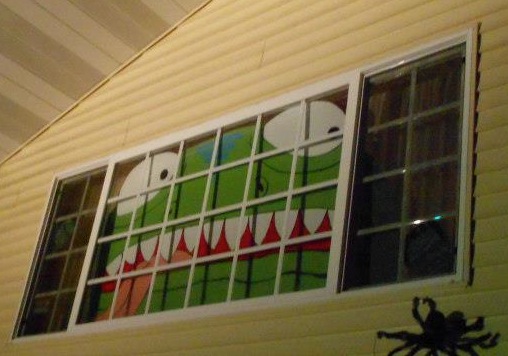
Right now, the big obstacle to me posting anything, aside from my two jobs, the general stuff of life, and having started several posts that I couldn’t work out the way I wanted, is that I am deeply involved in my annual race to make a mess of the house and yard before Halloween.  Yes, I’m one of those people–well, one of those make-a-mess-with-a-Halloween-display people, not one of those, run-a-highly-involved-haunted-house people, although I’ve come close to that in the past.

Immediately prior to our current home, we lived in a house that was perfect for a tour around the yard, and I knew all the neighbors and most of the kids who came around.  But the first year after we moved, I tried to carry on that tradition by setting up part of our display around back in the fenced-in part of the yard.  Let’s just say that when I opened the gate to the backyard for the first two girls who came trick or treating, the fear was palpable—and not in a fun, trick-or-treat kind of way, but in an “I’m-sure-mom-told-us-not-to-follow-any-creeps-into-their-backyards-oh-god-I-hope-we-don’t-get-murdered” kind of way.  It didn’t help that my daughter had disappeared right before the girls rang the doorbell, truly making me look like some lone weirdo.  And I think I was wearing butterfly wings and antennae that year—leftovers from my wife’s costume the year before.  I didn’t, ahem, lead any more kids into the backyard that night, or ever again.

At any rate, I’ve been doing some version of Halloween mess-making since my high school years, a legacy from my older brothers, although my college and early-20s versions were a much different variety of mess.  Now, along with the help of my daughter, and the tolerance of my wife, I have been converting over to entirely homemade decorations.  And not just homemade, but old-school, paint-on-plywood, 2-D creations designed by my daughter and me.

Image

We’ve been angling away from the hyper-realistic latex-and-gore stuff that is everywhere these days, and toward more cartoonishly creepy decorations.  The other day I mentioned to my daughter that I was going to get rid of one of our old, store-bought decorations, “Stillborn Evil”—a weird baby-in-a-jar with horns, hair, and a tail, which we’ve had since 1996 or so.  When she asked why, I emoted, “Tracking down this kind of stuff used to MEAN something, man!  You had to know the cool stores, and the cool companies to order from!  Now any knob can walk into a Spirit Halloween Store, or go on eBay and find this kind of stuff without even trying!!”  I added that I really didn’t have anywhere to display it properly, and it didn’t fit in with the decorations we were making.

In typical fashion, my daughter nodded, continued applying primer to a sheet of plywood and said drily, “We could keep it in the kitchen.”  She also suggested leaving a latex severed head in a random person’s front yard rather than trying to unload it on Craigslist—not a bad idea, although she decided it would be better to leave it in one of her friends’ yards.  I may just give it to one of the teens who come by trick-or-treating.

As for the mental health component of this post…it’s important to have projects and traditions and things to look forward to, and to find some way to be engaged in the community.  Such elements of life can make you feel good, too, so long as you don’t get too frantic with trying to meet obligations that nobody is really putting on you but yourself.  I’d go into more detail, but I’ve got too much work to do.

So, anyway, the whole Halloween thing is just one more eternal project, never finished, always evolving, only with a built-in yearly deadline.  Every year I imagine I’m going to get out ahead of all the projects and have things done weeks in advance, as if I would ever stop tinkering with and trying to expand the display until the last minute.  And every year I mess around with trying to decide on designs until two weeks before Halloween, when I frantically try to plough through more work than I can possibly finish.  But the impending holiday forces decisions, and sets a stopping point.  Occasionally, the unfinished projects of one year yield a design that I can start with the following year…two weeks before Halloween when I finally make myself get down to it.

Image

GRIEF, AMERICAN STYLE, or, I’m gonna sit here and drink until I hear “Raining Blood” so f*ck you!

I’ve lived through a few Facebook funerals now, where somebody I’m connected to via Facebook, but haven’t seen for years…decades even…dies and the news is relayed on their page and often numerous others’ pages.  Or the news intrudes on completely unrelated posts as the awkward grief styles of the American public become all the more public.  I don’t think the American people in general deal with grief well, and my own personal grieving style tends toward an above-average level of avoidance and, uh, blockage.

I’m trying not to go there right now—to the awkward social media grief, or the blockage—even as I’m posting in a social media outlet.  But a friend of mine really did die last week, (and the post I was working on about swearing therapists decided to punch me in the brain, preventing me from working on it).  In some sort of weird and possibly misguided effort to maintain some level of privacy, I’m not going to name my friend here, although not naming him seems sort of like denying any kind of tribute as well as making this post that much more about me me me.

I will say he was a kick-ass guy with a wonderful wife and kids, as well as numerous other beautiful (in the drunk, ‘you’re my best friend!’ style) family members and friends.  I can’t say as I knew him well enough to give even a marginally adequate sketch of his life, but then there are very few people, even some of my siblings, for whom I could provide such a thing.  I have my own small store of personal recollections and connections, which I’m just not going to share here.  But we’ve been down too long in the midnight sea anyway.

I don’t know if keeping his name out of this would be considered a positive or a negative, because I just don’t know how these things work anymore.  Anymore?  Who am I kidding?  Even before “social media” existed, I didn’t know what to do with the various real-world aspects of grief.  Do I call the family?  Do I leave the family alone?  Do I show up on the family’s doorstep, sobbing, Crock-Pot full of chili and bouquet of sunflowers in hand?  What about donations to charities, the family, or…?

As much as we say the grief is about the deceased, ultimately, grief often comes down to “me me me,” especially for those of us who don’t know how to “do grief” or do the funereal etiquette properly.  We can become obsessed with how the death of someone impacts us, and how we are supposed to act in the face of it.   We can become obsessed with whether we are doing the right thing or not, even when nobody is paying all that much attention to us.  I can’t imagine that anybody is sitting around complaining that I have not made it clear that I am aware of his death, or what I intend to do about it.  I’ll show up for the funeral and work that all out there, or in the days after, or…

Me, I don’t do grief well at all.

Yeah, I’m a therapist, and I have completely inadequate training in dealing with death, and more importantly, the living left behind…perhaps all by design.  It’s not my thing.  It’s not anything I’m comfortable with…not that I should be allowed to claim the privilege of comfort at this point in time.  I truly love this man, and his family, and f*ck me if I know what to do with that.

So let’s change gears.  Here’s a little example of how I function in these situations:  Following a memorial service a few years back, I was somewhat mortified when my grief fog began to lift and I realized I’d been wandering around, a forced smile on my face, at seeing people I hadn’t seen in far too long.  The awkwardness of, “Hey, good to see you,” collided with, and perhaps overrode the awkwardness of, “One of our friends/family members died.”  It’s a fine line between grief and panic…grief and meltdown…grief and straight-up weirdness(?).

It seems like grief is one of those things I should have learned or maybe just known, like you’re supposed to know how to change a tire or unclog a toilet (or how you’re supposed to know all those stupid things that are supposed to be part of a wedding).  But I’ve largely managed to avoid engaging my grief skills, in favor of engaging my grief avoidance skills.  My father died when I was still too young to really understand what that meant.  And almost nobody else I know who died since then was really all that close to me when they went, either due to time and distance, or due to design.

I distinctly remember, back in the summer of my 11th year (was it my 11th?  Maybe it’s not so distinct) when my favorite uncle died.  Due to his prolonged illness, I had intellectualized his passing, had closed myself off from having to feel much of anything.  I didn’t want the hurt, so I wasn’t going to have it.  When my mom got the call, I sat on the couch between my younger brother and older sister as the Beatles’ “She’s Leaving Home” played on vinyl, pushing my mind into that song.  My uncle was gone.  I knew he was going well before he left.  “Something inside, that was always denied, for so many years…”

I will also say that in many instances, I kept my distance, which was usually just a matter of carrying the relationships on as usual.  I guess my attachment issues lead me to downplay relationships, to where connections most anyone else would call friendships feel more like acquaintanceships to me.

And perhaps even worse, my instinct to dull the pain often leads to making jokes, usually sarcastic comments, realizing only after I’ve begun unleashing them that I am saying things that are horrifically inappropriate.  I want to imagine myself, like Superman, realizing a missile has been launched, taking off to steer that missile out into space.  Only, like Superman and the missile, I end up blowing up the Phantom Zone instead, unleashing General Zod, Ursa, and Non, ultimately raining much more hell down on everyone, myself included, than I would have if I’d learned to keep my mouth shut, or to make appropriately staid comments.

I’ll say that right now, I’m trying to do this right.  I’m trying to let myself take this in, even as I am engaging in various forms of avoidance.  I can’t promise that I won’t just crawl inside a bottle for a few days, and then drag myself out, emotions appropriately muddled and washed downstream.  But I’m gonna try to feel this one for real, dammit.

Happy Birthday to Me

“Happy Birthday to Me” is a delightful little horror film from 1981, starring Melissa Sue Anderson, aka Mary from “Little House on the Prairie,” as Virginia, a top student at an exclusive private school who may just be blacking out and killing her annoying friends.  Now, I don’t want to get too involved in the parallels between that movie and my own academic prowess, blackouts, annoying friends—but, hey—uh…what was I saying?  And…uh…is this blood on my shirt?  Good God!  It’s everywhere!

Anyway, for my birthday I decided to treat myself to a late-60s/early 70s, cheapo Charlie Brown plastic mask I found on eBay—not so cheap now that it’s “vintage”—and, no, the costume and box are not with it.  It’s a mask I intend to hang on the wall in my office—sort of a comical homage to all that Jungian persona business, and the notion that all therapists and psychologists have at least one or two carved, ‘primitive’ masks among their office décor.  I suppose that, like with the vast majority of my comical homages, it will go largely un-understood and un-laughed-at by anybody who ever sees it.  But that’s okay.  We’ve got to amuse ourselves, right?

Still, there is a larger personal significance to the mask than just a little inside joke about Jung and the décor of therapists’ offices.  It’s tied to my second—make that my third—I think—memory ever.

My father died a week before my third birthday, in a car accident, when another driver ran one of the few stop signs in the rural Nebraska community where we lived at the time.  By October’s end, my mother had landed the family—my five siblings and me—in Oregon.  We didn’t have much to hold us to Nebraska.  We hadn’t been living there that long, and we had no relatives in the area.  We were there because that’s where my father had been placed in his role as a pastor in the LCMS.

Halloween 1971 was spent at the home of my Uncle Jim (my mother’s brother), while we waited to move into the house that had been purchased with some of the payouts from my father’s death.

That year I went trick-or-treating in a Charlie Brown costume.  The only reason I can recall this at all is that my Uncle Jim had slipped a rock or two into my trick-or-treat bag, predictably and hilariously eliciting cries of “I got a rock!” as we inspected our hauls for the evening.

It’s been a bit of a mystery to me why the end of summer and the beginning of autumn has always been my favorite time of year.  Despite what should be an obvious association with loss, I’ve always tied it to new beginnings—most obviously the start of the school year.  It also seems a bit odd that Halloween would be my favorite holiday as well, given that it’s connected somewhere back in my mind with the death of my father, and being unexpectedly uprooted.

I suppose that on some level, because fall is associated with most of my earliest memories, and it marks the time when I arrived in Oregon, which I will always consider home, fall is when I really joined the world as a conscious, if befuddled, human being.  So I suppose that Charlie Brown mask is a symbol of both that consciousness and that befuddlement…and of the idea of home.

Happy Birthday to me, indeed.

Why I Don’t Hate VH-1’s “Couples Therapy”

I first realized I like Dr. Jenn Berman when, in a session with Flavor Flav and his partner of nine years, Liz Trujillo, Dr. Berman hollered, “Look at her f*cking face!”  Now, some might take issue with a therapist raising her/his voice or swearing in session, especially about somebody’s face, but f*ck those people.  In this case, Berman was trying to cut through Flav’s hyper-defensiveness, and get him to actually pay attention to Trujillo.  And for anyone who viewed the recently-concluded third season of “Couples Therapy,” there is an obvious transition (not in this particular session) where Flav drops the clown act and actually engages with Trujillo, and where she goes from balled up and permanently scowling to opened up and smiling.  The cynic in me says these could all easily be TV editing tricks, but the optimist in me says that I know therapy works, and I hope these changes hold.

I’ll confess that I first started watching “Couples Therapy” (in season three, not having any awareness of the first two seasons) because I saw a few promos and thought it would be easy to do a hatchet job on it for the sake of a blog post.  In one of the commercials, Dr. Berman was shouting down Joe Francis of “Girls Gone Wild” fame (I had no idea who the guy was at the time).  My first thought was, ‘Great, make insecure guys think that couples therapy really is about a therapist siding with women and berating men.’  (And I don’t mean to be overly reductive here, but anybody working in the field who has tried to refer people to much-needed couples therapy will probably have a pretty clear idea what I’m talking about).

But like much of what takes place on the show, to take the promo clip out of context is to fail to see the larger picture of what is actually taking place.  That particular clip involves Dr. Berman asserting herself over an emotionally abusive narcissist for the clinically important reason of ensuring that Abbey Wilson (Francis’ partner) doesn’t have her efforts to overcome an eating disorder repeatedly derailed by Francis’ insistence that he can fix the problem by badgering Wilson into eating.  Whoops…so much for not being overly reductive.

Dr. Jenn Berman acknowledges the awesome nature of this post.

Dr. Jenn Berman acknowledges the awesome nature of this post.

To be sure, if I really wanted to rip into the show, it’s within the realm of possibility.  However, to do so would show a fundamental lack of understanding about how ‘reality TV’ works.  Of course there’s going to be an emphasis on confrontational interactions.  And of course the show adds in exciting/gimmicky activities that fall out of the usual scope of plain, old, in-the-office couples therapy, like excursions to rock-climbing walls, a visit from a psychic, and “expressive therapy” where couples smash things in a junkyard.  Without such catches, attracting an audience to a show about couch-bound therapy sessions would be plenty difficult.  To the show’s credit, though, the field trips and seeming diversions are used as a way of highlighting communication between the couples in order to provide the audience with a clearer picture of how the couples behave than might be evident from therapy sessions, and is definitely more entertaining than watching couples talk about how they communicate.

And despite seeing most of the individuals and couples in some unpleasant/ridiculous situations of their own making, there are still plenty of moments that reveal the core goodness in everyone present.  I actually came away thinking well of everybody, or at least not totally hating anybody, having seen their willingness to accept responsibility and engage honestly in some difficult work in a setting more conducive to fist fights, broken bottles, and thrown furniture than it is to therapy.  Add to that the expectations of reality TV viewers who want blood, and the restraint shown by the cast members on the show is pretty remarkable.

On multiple occasions, cast members disengaged from decidedly negative interactions, reserving the right to judge others not on gossip, but on their own interactions with them—Tyler Baltierra walking away from Joe Francis’ cackling excitement at videos of Dustin Zito’s pornographic past being a prime example.  (Weirdly enough, I didn’t see anyone call Joe on the hypocrisy of him mocking a porn performer, given the millions Joe made off of flashed breasts and college-age-lesbian-experimentation love scenes).

At other times, situations cropped up where cast members, drawn into an argument between a couple, would mediate rather than taking sides, working to make the members of the couple see each others’ perspective—as with Baltierra attempting to bridge the gulf between Temple Poteat and Chingy Bailey that opened up each time Bailey powered up his tablet.

Instances occurred where efforts to stir up trouble were met with, dare I say, Socratic challenges to the thinking driving the pot-stirring.  Temple Poteat questioning Joe Francis’ obsession with Dustin Zito’s missing shoes (after Joe tried to draw Temple into complaining about Dustin) comes to mind.

In general, cast members sought out each others’ advice in earnest, and were provided with real support.

This is not to say that there weren’t plenty of instances of cast members making snap judgments or otherwise engaging in self-indulgent tantrums.  Flavor Flav and Liz Trujillo were, as Joe Francis dubbed them, a “side show” for much of the first half of the season, clearly frustrating several in the group.

Joe Francis, in turn, provided the bulk of the traditional reality-show drama for the second half of the season by deeming various people or couples “trash” and whining about people interfering with “the process” and all of Joe’s hard work.  Even when Dr. Berman managed on occasion to break through Francis’ deflection to draw out what is essentially a scared, little, attention-seeking boy, Joe would then appear for his “confessional”—just Joe and the camera—and say something self-important and off-putting, suggesting that his insight is about as substantial and durable as a soap bubble.

And perhaps to the dismay of audiences and the cast, the full story of what was going on with Trujillo and Flav, individually and as a couple, was never fully revealed.   What little bit of privacy the cast members were granted, for legal or other reasons, was perhaps simultaneously one of the most frustrating and most endearing aspects of the show.  Dr. Berman, in deference to good therapy, and in defiance of reality show convention, at least created some small pockets of safe, off-camera and off-the-record space where couples could work out things they weren’t comfortable sharing with the world.

Plenty of other reality show conventions were broken, as well, or at least bent, on “Couples Therapy.”  Even with only a small portion of each episode devoted to showing actual therapy sessions, Dr. Berman gave a pretty good taste of how therapy works.  The audience doesn’t just get to smirk at the cast members’ bad behavior and watch Berman cut them down.  Rather, problem behaviors were identified, explored in terms of the incidents and patterns that contributed to those behaviors.  Then Dr. Berman collaborated with the clients on ways to better address the issues in a productive manner.

For instance, (and to greatly simplify) Temple isn’t portrayed as a stereotypical uptight control freak for the audience to roll their eyes at, but is shown to have ‘control issues’ stemming from a chaotic past, and is challenged to relinquish some of that control and manage the anxiety that comes along with letting go.  Catelynn Lowell and Tyler Baltierra have their eyes opened to how a lack of stability in childhood has led them to cling to each other, and how public pressure has contributed to them making decisions that may not be in their best interest, or the best interest of their relationship.  Heather Marter and Dustin Zito, who were probably expected to have the most salacious content to work through, seem to have put all the tabloid sex scandal crap behind them, in order to struggle with the more mundane, but more relatable, questions of how to make a relationship last.

One could cynically argue that the celebrities and pseudo celebrities on “Couples Therapy” are merely trying to keep themselves in the public eye and make a few bucks.  But even if that was their original intent, most of them ended up violating their “brand”—Chingy by being reflective as Temple says they need to end their sexual relationship if they are not going to have a full relationship, Temple herself by breaking away from Chingy and his greater “star power”, Tyler and Catelynn by breaking off their expected marriage, Flavor Flav by stopping his perpetual performance as court jester and openly weeping at his past failures and current joys.

And certainly if one wants to chastise Dr. Berman for being egotistical, one can find examples to try to build that argument, as when she proudly trumpets the work she’s done to help Abbey Wilson address her eating disorder.  It would be too easy to sneer about Dr. Berman doing nothing more than taking Abbey to a restaurant.  But that would be taking the restaurant scene and Dr. Berman’s comments out of context.  The restaurant visit comes only after a great deal of preparatory work, and is rather a monumental thing, one which Dr. Berman deserves much credit for, along, of course, with Wilson.

Overall, even in the unreal context of reality TV, Dr. Berman’s show is arguably much less damaging to public perceptions of therapy and therapists than is the average movie or TV show with a therapist as a character.  Such fictional portrayals of therapists often show them as oversexed, overpaid egomaniacs who go about uncaringly inflicting damage on those they are supposed to help.

In contrast, what Dr. Berman does on “Couples Therapy” is manage to sneak some actual therapy in between the egos and the outings.  Ideally, viewers will see through the distractions to get a glimpse of real, honest-to-goodness therapy playing out.  And at the absolute worst, Berman may get some less discerning viewers to attend couples therapy in the belief that they’ll get to smash car windows and go bowling, which isn’t all that bad if the therapists they end up with can get them to buy in without all that excitement.

Ultimately, I was so appreciative of Dr. Berman’s ability to get some snippets of real therapy on reality TV that I’m not even going to say anything mean about her distractingly sparkly and otherwise spangled collars—which are kind of weirdly cool.  And everyone respects my fashion sense.

So You Want to be a Therapist…

By the end of the day Monday, it will have been 32 days since I’ve had a full day off.  And I’m not sure if Tuesday should really count, because I have to go to the dentist, which is sort of like taking a day off to be tortured for an hour or so.  (I’m pretty sure hell involves some lesser demon grinding that fluoride goo into your teeth, and deliberately getting it all over your gums while only letting you rinse your mouth out roughly every 45 seconds). Then it’s back to work on Wednesday.  By next week, things should slow down some, although I fear I may have just jinxed that.

Now, in fairness, some of those work days involved only a few sessions, plus attendant phone calls and paperwork.  But some involved 14 or 15-plus hour shifts or a ten hour shift transitioning into a three-hour assessment, or…  At any rate, all of those hours were tallied up between my full-time job and assisting in the start-up of a new practice.

Another thing to consider is that my full time job is in crisis services/crisis intervention, which is sort of an ugly stepchild (with apologies to ugly stepchildren everywhere) of that highfalutin really real therapy.  Metaphorically speaking, we in crisis services slap on the splints, and close wounds with superglue, and let other people set the fractures proper, and heal up the deeper damage.  Unlike most jobs in the mental health field, crisis services involves round-the-clock shift work—Hollywood depictions of therapists who are accessible 24-hours-a-day notwithstanding.

Of course, movies and TV shows are probably where most people get their ideas of what being a therapist is about.  And if one accepts those portrayals, therapists are all a bunch of immaculately-dressed, well paid, eccentric/brilliant and/or unpleasant/neurotic people with amazing office space who can’t keep from having affairs with their most attractive but least stable clients.

And while that is pretty much my life in a nutshell—aside from all of those parts—getting to the stage of your career as a therapist where you make a high-six-/low-seven- figure income by sitting around dispensing wisdom to the worried well is a potentially treacherous path that is not for everybody.   So it’s probably much better to just embrace the idea of filling a role more like Mariah Carey’s Social Worker character in “Precious” than the jet-setting millionaire therapist she played in “Glitter.” (Admittedly, I haven’t seen “Glitter” for a while and may be misremembering some things).

The short version of how the process works is: first, get a bachelor’s degree.  It doesn’t necessarily have to be in psychology, although that might help.  Once you’ve realized your bachelor’s degree doesn’t really count for anything, and everybody you know who skipped college is making more money than you, go back for a master’s degree.  Don’t worry, there are plenty of private schools out there now that will gladly take insane amounts of your money (or the government’s money that you get to pay back) so that you can get a master’s degree.  Be forewarned that in order to get a master’s degree that will be good toward becoming a therapist, you actually get to borrow money to pay a school so that you can go work for an agency for free for a period of roughly nine months.  The length of your unpaid employment will depend on how quickly you can rack up hours meeting with clients and your supervisor.  In most instances, getting the hours shouldn’t be that problematic, because there’s a good chance you will be saddled with a far larger caseload than you can reasonably manage, especially since you won’t really know how to manage a caseload.  Your clients are likely to remind you on a regular basis that they are very aware that you don’t know what you’re doing and that they would prefer to have a real therapist.  Don’t let this bother you—most of them would say the same thing if Alfred Adler himself came back from the dead for the sole purpose of conducting sessions with them.

Once you have your master’s degree, try not to think about how much money you owe in student loans—you can’t possibly afford the therapy that it would take to manage your anxiety and your sense of hopelessness about ever paying it back.  One good thing, though, is that you are now probably able to get a job where you are making as much or slightly more than at least half of the people you know who skipped college altogether.  Of course, given the severe drubbing the public mental health system has taken in budget cuts over the last decade or so, jobs can be a bit tricky to come by.  Assuming you get a job in the field, be happy in this job—you will be stuck here for at least two more years as you attempt to rack up enough supervised hours to qualify for your license as a counselor.  In addition to the supervised hours you need to log, you also get to pay hundreds of dollars to take a test designed to prove that you have learned enough in grad school and your various forms of employment to be let loose on the public without supervision.

Now you can open a private practice and just let the cash roll in—assuming you can find and maintain a big enough client load in a space with a reasonable rent payment.  You might also want to go through the painstaking and tedious process of getting on various insurance panels, or establish your suitability to take on government contracts, or…whatever else you need to do to stay afloat.  There is no shame in moonlighting in the food services industry, although you have to remember not to acknowledge any of your clients should you, say, end up delivering a pizza to their homes—unless they acknowledge you first.  And depending on the specifics of your various licenses and endorsements, you will pay hundreds or thousands a year to keep up those endorsements, as well as paying to attend various seminars and conferences to keep up your ongoing education credits in all of the relevant fields.

Just remember that anywhere along this process, anybody who gets mad at you for whatever reason can file a complaint causing you no end of distress and the possibility that you will lose everything you worked for.  Keep up your liability insurance payments and remember that homicidal ideation can be grounds for a mental health detention.

On the other hand, if you want to be a life coach, all you really have to do is watch a minimum of four episodes of “Scott Baio is 45…and Single,” (which, admittedly, is getting much harder to track down) and find a web site that allows you to print off a life coach certificate—I think Crayola’s site has some good ones.