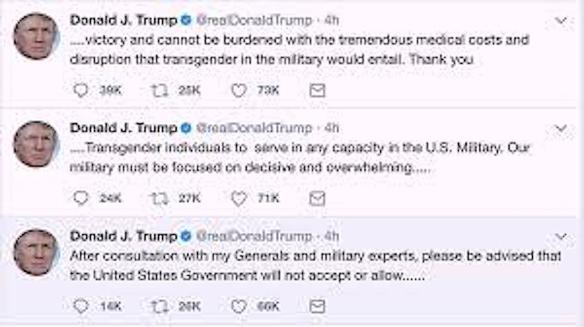
It must have come as a surprise to many in the military community to learn that major DoD policy decisions are now being made under advisement of “generals and military experts” who provide secret counsel to a demented old man tapping away at his tiny phone keyboard with his tiny thumbs, as he sits atop his porcelain throne in a 3 a.m. constipation rage.
(Note to President Trump: Steve Bannon staggering drunkenly around the oval office in a Napoleon hat is not a “general”, and your son-in-law Jared is not a “military expert” in spite of your need to believe he is super-human in both physical and mental capacities as a justification for why your favorite daughter chose him over you as a breeding partner.)
The fuzzy turd of Donald’s logic.
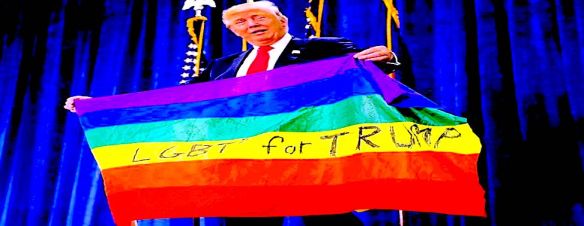
There is actual evidence, Twitter- and otherwise-based, that Trump supported the rights of the entire LGBTQ community, and advocated for everybody just calming the f*ck down about bathroom laws, and all that other genital-fixated nonsense as recently as last year.
Hey–look at my totally-not-staged prop-flag!! I’m so progressive! Psych!!
But that was before he had the neo-Nazis…er, I mean the Brown shirts…er, I mean the alt-Breit folks whispering in his ear about the threat non-masculine men and masculine women pose to the good ol’ US of A in general, and the U.S. Military in particular.
When President Trump wasn’t trying to play shapeshifter to fit the desires of his loyal, yet indiscriminate, yet hyper-discriminatory base, he shouted out his support for “The Gays” and anybody else who fell anywhere near that camp. President Trump was cool with anybody who wouldn’t get too upset about him grabbing their pussies, or anything else they might potentially bleed out of if the grabbing got a bit too intense. Or so he said.
But now that he knows the terrible expense of gender reassignment surgery, and how that money could be much better spent on his weekend trips to his own resorts, he needs to protect the American taxpayers from such wastefulness, so that he might funnel those funds to himself.
So, f*ck transgender people who would put themselves in harm’s way to serve in the U.S. military! We can safely say they are doing nothing more than risking their lives just to finance their elective surgery, and maybe pass on state secrets to people who shouldn’t have them…like maybe their friends in the Soviet Union…wait…that’s not what we call it anymore…is it? Anyway, they’re clearly in it for themselves…right?
Given Trump’s history of valiant service to this country, we can trust that he has the best interests of the military community at heart…and the LGBTQ community as well…just like he has always come out in favor of all Americans at all times, and has never used divisiveness and distraction for his own benefit.
Russia what?!? Russia who?!?
God bless our Commander in Chief…for what it’s worth.
Chester Bennington completed suicide by hanging on Chris Cornell’s birthday, just over a month after Chris Cornell completed suicide by hanging on the 37th anniversary of Ian Curtis’ suicide by hanging.
For those unfamiliar, Bennington was best known as the lead singer of Linkin Park; Chris Cornell was best known as the lead singer of Soundgarden; and Ian Curtis was best known as lead singer of Joy Division.
Now, Linkin Park’s music makes me want to grind my teeth, spit, and curse—and not in a good way. And I never got into Joy Division beyond owning a ‘greatest hits’ collection for a few years as an undergrad. I am, however, a big fan of Soundgarden, as well as another of Cornell’s bands, Audioslave—not such a big fan that I ever made it to a concert. But, living in Seattle, I would see members of the band at other bands’ shows around town in the way back of the early 90s.
How would I know? Cornell from ‘Fell on Black Days.’
I have no idea if Cornell’s suicide was related to Curtis’ beyond coincidence. But Bennington’s was directly connected to Cornell’s. They were friends, and, from what I understand, Bennington took Cornell’s death particularly hard. Both Cornell and Bennington had struggled with addiction and mental health issues during their lives.
But the takeaway shouldn’t only be that a life marbled with addiction and mental health issues leads to suicide. That makes it too easy for people to distance themselves from suicide, its causes, and our potential susceptibility to its draw.
In the wake of a loved one’s death, thoughts of suicide can arise or increase, and suicide attempts climb.
In the wake of a loved one’s death from suicide, those thoughts and those attempts climb significantly higher.
There are those who have criticized Curtis’, Cornell’s, and Bennington’s suicides by pointing out that they had achieved success, or had spouses, friends, children…all of which should have somehow prevented them from completing suicide, much less having thoughts of such.
That’s a natural impulse—to want to point out why we never would have killed ourselves in similar circumstances. But it’s also false comfort.
Just try to imagine finding yourself in a space where money, success, and a loving family can be discounted as not providing enough impetus to go on living. Imagine finding yourself in a space where you actually feel the people who care about you most will be better off without you. Imagine being so deep into that thought process that you can’t find your way out—that killing yourself seems completely logical—that suicide actually seems like the only rational decision.
I could get into explanations of survivor guilt, or what grief can do to people, or the impact of knowing that a friend reached the conclusion that suicide was an appropriate response to the world around them–a world that you were part of.
But I’d rather you think on how declaring yourself immune to something, insisting you are completely separate from some problem, is the first step to blocking your understanding of that problem…or worse, blocking your compassion toward others affected by that problem. You can feel for the families and friends of those who complete suicide without feeling the need to condemn the dead. But that condemnation does nothing to help the grieving, or anybody else, least of all you.
Okay, when I say bumblebees don’t care about your stupid photos, what I really mean is that the bumblebees I know don’t care about my stupid photos. Maybe the bumblebees you know are willing to pose, and your photos aren’t as stupid as mine.
But the bumblebees I know got sh*t to do. No time for them to worry about my composition or framing or the light, or even sitting still for just a second or two.
With a seven-grillion megapixel camera built into every phone these days, I suppose I’ve gotten impatient with the whole photography process. I see something that looks kind of cool, I snap 4,000 pictures in the space of a minute, from a variety of angles, then look through the shots on my computer, and see if anything is good, or at least good enough to be cropped and otherwise manipulated. If it doesn’t work out, oh well. Digital trash bin.
Not like the days of Fotomat, or dropping your film roles, carefully tucked into an envelope marked with sensitive personal information, into a department store box only marginally different than a garbage can, just to have those carefully-crafted, preciously staged moments returned to you, developed into blurry 3 x 5 mementos or grainy 4 x 6 keepsakes–suitable for framing or shoebox storage–all at a cost of about $12 a pic (adjusted for inflation).
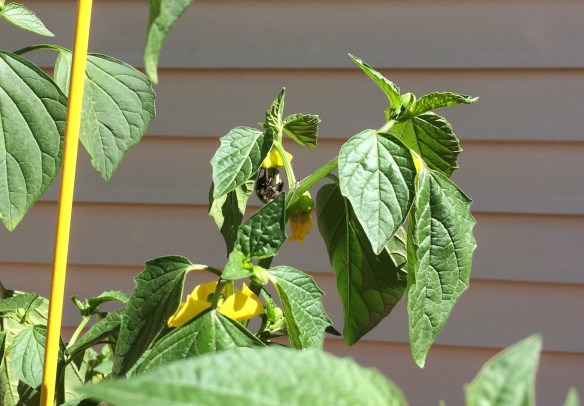
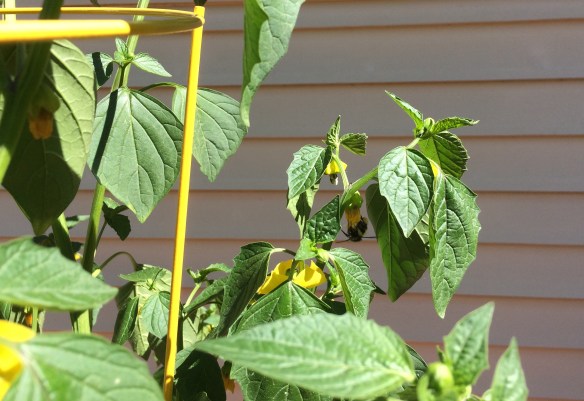
Regardless, I wanted to get some cool pictures of this bumblebee on my tomatillo plants…because I thought of it one morning on an impulse while I was out watering whatever plants needed it. Perhaps predictably, most of my shots turned out like this (yes, cropped and otherwise manipulated) one.
Yeah, that’s a bee in there…a bumblebee.
I’ve been overjoyed that there is apparently a local hive of these guys who have discovered the container garden on my deck–because there are plenty of them visiting every day, and they are getting at it. I don’t know that I’d call them peaceful, because they are working so hard, but they seem content in their busy-ness, focused on the task at hand, and not worried about anything that’s not directly interfering. I really wanted a good shot of one with the full ‘saddlebags’ on its legs.
But, this was the best shot of the bunch, in terms of actually being able to tell it might be some kind of a bee.
Totally a bumblebee. Upside down, with its wings looking like legs or something, but a bumblebee. You see why this is so great…right?
Since the results of my impromptu bumblebee shoot didn’t convey anything of what I was hoping to capture, I’ll leave you with this. On the day I took these photos, my brain started singing “Bumblebees on my Tomatillos make me happy”…to the tune of John Denver’s “Sunshine on My Shoulders”, of course. So, maybe the syllable count is off, but you can try it yourself. I’ll leave this here for anyone so unfortunate as to not know the song being referenced.
And maybe that doesn’t really speak to you anymore than my rushed photos. Maybe I should shoot some video next time.
At any rate, happy gardening–with wishes that you are staying contentedly busy, or able to enjoy watching the world work its magic around you.
I still enjoy Good Will Hunting. Along with a fun romantic comedy, it involves an entertaining dramatic representation of therapy—emphasis on dramatic. I mean, therapist Sean Maguire chokes client Will Hunting in their first ever session, FFS. Despite what the filmmakers would have us believe, this is not a valid technique for establishing rapport or ensuring appropriate transference with clients who have suffered abuse–even when therapist and client are both from south Boston and the client just shit-talked the therapist’s dead wife.
Choking one’s client out is, perhaps, an overly dramatic example of countertransference, Will standing in for anyone who ever questioned Sean’s path in life. But in this instance, it’s used to contrast Sean with the other stereotypically bland, wimpy therapists Will is introduced to—George Plimpton as a self-aggrandizing stuffed shirt of a psychologist/author, who readily succumbs to Will’s mock-flattery, and then is horribly offended when Will calls him out as being gay and closeted; and a hypnotist, who is similarly offended when Will, pretending to be under the throes of hypnosis, begins describing sexual abuse as if suppressed memories are rising to the surface, only to begin reciting the lyrics to, then singing, Afternoon Delight.
Good will choking.
Sean is a different kind of therapist, though. Sean is a manly therapist. Sean lifts weights. Sean is a Vietnam Veteran. Sean is a hard drinker. Sean jabs back at Will’s, snidely well-read comments with a mix of self-deprecation and equally snide rejoinders. That is, until Will crosses the line, and Sean throws Will up against the wall of his office and threatens to “end” him. Getting through to Will is going to take a tough guy therapist. Someone Will can identify with. Someone who has no qualms about using physical violence to break the ice with a client who has suffered a childhood of abuse at the hands of, from what little we hear about it, hard-drinking tough guys.
It’s somewhat odd that nobody thinks to see how Will might respond to a female therapist, given that women greatly outnumber men in the therapy field. Gerry Lambeau, Sean’s college roommate, now math professor intent on harnessing Will’s genius, says he approached five therapists with Will before settling on Sean as a last resort. But if there were women among them, we don’t see them. In fact, we don’t really see any women in this film, aside from Skylar, Will’s love interest. Beyond Skylar, the only other woman in the movie is in the form of Sean’s memories of his sleep-farting wife.
Even more odd is that we don’t learn anything much about Will during the therapy sessions. We hear a great deal about Sean’s wife, how he met her, how that connects to a super-important baseball game, her “imperfections”, and how she died. We learn about Sean watching a friend die in combat. We learn about places Sean has traveled.
Until the second-to-last therapy session, Will doesn’t do much, except tell a joke, crack wise, and listen as Sean accuses will of being a chickensh*t little boy who doesn’t know anything about the world, or love. We hear more about Will’s past in one serious conversation he has with Skylar than in all his therapy sessions.
On top of that, Skylar is the only real thing Will ever talks about—but only in one therapy session—or two, if you count the one where he mentions that he broke up with her. Also, Will admits to having been abused in that second-to-last therapy session, but saves most of those details for his serious talk with Skylar.
I suppose much of the impetus behind Robin Williams’ portrayal of a monologuing therapist is some bland idea about the therapy with Will being therapeutic for the therapist, who has checked out of his previously brilliant professional life to teach psych to barely engaged students at Bunker Hill Community College. But the idea that’s conveyed about therapy is that the therapist can drone on about her/his personal life, then challenge the client to change behaviors and attitudes, and that will inspire the client to heal her/his own (similar) conflicts. This is not how therapy works. In fact, I would guess that most people would get more than a little annoyed at a therapist telling personal stories in order to point out how much more s/he’s experienced in life than the client.
Of course, it would make sense that Will would be content to let a therapist run his mouth while Will sits in silence, since Will doesn’t feel he needs therapy, and is only meeting with Sean to satisfy a legal arrangement Lambeau put in place to get Will out of jail. Having dealt with plenty of people in court-mandated therapy, I can say Will’s resistance to engaging in therapy was probably the most realistic aspect of the film.
Still, despite his almost complete lack of engagement with the therapeutic process, Will achieves a “breakthrough” near the end of therapy, all in the space of one session where Sean speaks of his own history of abuse, tells Will repeatedly, “It’s not your fault”, then initiates a hug with Will. Of course, Will then becomes a sobbing mess. A sobbing mess who is, after all these years, healed.
Good Will Hugging…or, rather, Good Will on the Verge of Hugging.
Sean spells out the idea of such breakthroughs in a lecture he gives to his disinterested community college students in his introductory scene, stating that breakthroughs come from trust built between therapist and client. But because of the way the story plays out, we are presented with the idea that the key to the therapeutic process is therapists sharing their own personal histories, opening up to clients in an astounding absence of professional boundaries. Through such sharing by counselors, along with presenting a few (largely unanswered) challenges to clients, the film suggests that clients will come to a point where everything becomes clear, emotions spill out, the client can go get a high-paying job as a corporate mathematician, and then run off to win back the potential love of said client’s life.
All this because if there’s one thing Hollywood likes to tell us about therapy, it’s that everything falls into place once a person has a moment of emotional catharsis.
Yes, Will’s attachment disorder and fear of abandonment, which Will diagnoses himself (or perhaps, repeats from earlier encounters with therapists in the Foster Care system?) is magically overcome by being a wiseass for several sessions, listening to Sean tell deeply personal stories, and then engaging in a hug with his therapist.
In a sort of defense of the lack of realism in the depiction of the therapy, Will does point out to Sean that, “You f*ckin’ talk more than any other shrink I seen in my life.” To which, Sean replies, “I teach this sh*t, I didn’t say I know how to do it.” Unfortunately, as a defense it is pretty weak. The movie still shows that even poorly-executed therapy gets impressive results, that therapists just have to be a friend to their clients—Will even tells Sean “I thought we were friends” in a scene where Sean kicks him out of his office for resorting to sarcasm in the face of Sean’s questions about what Will wants to do with his life—the only instance of Sean setting any kind of boundaries with Will.
In short, Sean mirrors a lot of the bad behaviors of other adults in Will’s past—aggression, threats, a lack of boundaries, mixed messages, and frequent insults—and it works to heal what those same behaviors, and a heap of violence and abandonment, broke in Will.
Ah, the magic of Hollywood therapy.
And now…one final note about Good Will Hunting–Elliott Smith’s song “Miss Misery” is infinitely better than that terrible, overblown Celine Dion cliché-fest “My Heart Will Go On”—which beat out “Miss Misery” for the Oscar all those years ago, and continues to torture all of us in grocery stores and waiting rooms on a near-daily basis.
Who doesn’t love a good gardening metaphor? Okay, I don’t either. That is, I mean I don’t love them, not that I don’t doesn’t love them. They tend to the obvious. Now I guess I’ve got gardening puns in there, too. Tend. Gardens. Get it? Bit of a stretch? Fine.
Actually, I should say this is more about a container-gardening metaphor, since that’s what’s really involved here. Except for the pumpkins, they’re in a small, cleared patch in the front yard, the only place we could put them where they get enough sun and space. Or where they get enough sun until near the end of the growing season, when the towering, menacing evergreens on my neighbor’s property cast shade even to that one, small, usually sunshiny patch. There’s perhaps another metaphor in there about not letting your neighbor’s shade keep you from growing your biggest pumpkins, except that my neighbor’s shade actually does tend to cause problems with the pumpkins getting enough light just when they need it most. So, maybe just stick with the idea that your neighbor’s shade can keep your pumpkins from growing. No solution offered. Of course, maybe I’m just exaggerating the problems my neighbor’s trees are causing me, and I’m just not that good at raising pumpkins.
But I digress.
At the beginning of the (container) gardening season, my (container) garden looked like this.
Everything all neatly ordered, in nice straight lines.
Except the process of getting to that point was haphazard, more so than usual. Typically, I’ll do a count of the pots, from the previous year, minus any that aren’t going to make it through another season, and make a run to buy soil and enough starts to fill the pots that I’m not going to plant with seeds, along with any replacement pots. I have a general idea of how many of each type of plant I want to grow (mostly tomatoes, peppers, and cucumbers).
There are always a few things that throw off the equation—pepper starts that are only sold in four-packs or six-packs, finding a new (to me) breed of tomato that fits into the Northwest growing season. So I make adjustments.
This year, though, I didn’t take the usual steps. I bought plants from five different stores, across several different trips made primarily for groceries, not matching the collection of starts amassing on the dining room table and in the garden window to the number of pots waiting out on the deck.
By the time I finally stopped myself, I was a good ten pots short of what I needed to handle the starts I bought, plus the snow peas, sugar snap peas, and sunflowers I was planning to plant from seeds.
So, I went out and bought more pots, along with some soil, and then some more soil. I didn’t realize until later that the last batch of soil I bought was marked “not recommended for containers.” Since I’d already made it home, and hauled it up onto the deck, I took the warning in the same way I take those frozen food “not recommended for microwave use” warnings that are followed by instructions for microwaving, when I probably should have taken it more like the warnings on dishes that say “not safe for microwave use.” One can hope the end result will be nothing worse than the kind of disappointment one feels on biting into chewy, soggy, unevenly-heated taquitos, rather than the violent arcing and flames of a metal-rimmed dish. At any rate, if I die later this summer from gastrointestinal distress and renal failure brought on by fertilizer-based toxins ingested in a jalapeno pepper, you’ll know what happened.
A few months down the road, the garden now looks like this.
The straight lines gone, as the containers had to be staggered, shifted, and spaced further apart to accommodate the garden that once fit onto one end of the dining room table. They’ve encroached further into the territory where the table and chairs are. If I’m going to barbecue, it’s going to get tight.
So, now, to get that metaphor going…we’ve got elements of planning and preparation vs. just getting stuff, orderliness vs. disorganization, efforts to contain and control vs. the expansive power of life requiring us to change and adapt.
Or, we could just abandon the need for a metaphor, and I could just leave you with this profound thought:
That’s the funny thing about growth…things get bigger; they need more space; your deck’s gonna get messed up.
So, we’ve hit the halfway point of the year. Actually, that happened at noon on July 2nd, 182.5 days into 2017, 182.5 to go.
Back in January, amongst my other more and less comical resolutions, I resolved to write more frequently. That resolution has been a colossal failure to this point in the year. Not counting my year-end/new year resolution posts, I’ve only done one other post in 2017. And that was about a friend who died last spring. Beyond that, I’ve started a dismally small number of pieces that never quite cut through my brain fog to land on the blog—the point of the work dulling, the edge slipping in the process of writing.
In other forms of writing–which I also resolved to get back into–aside from work-related stuff, I’ve not made it beyond a short note, or even a thought. I’ve reverted back to the lazy habit of thinking that if something is all that great an idea to pursue, I’ll remember it; and that it will take root and grow until inspiration or some other magical motivational force takes over, snowballing into a finished project, fully formed.
Truth be told, it’s not just the writing. So far this year, I’ve struggled to motivate myself to do much more than the things I absolutely have to. I enjoy my paid work despite a number of daily challenges I could do without. On my days off, I imagine all the things I will take care of, and then force myself to get through only a fraction of them. Still, if I scale things down to the immediate and personal, I’ve got plenty of those things people call ‘blessings’, but have to fight to maintain proper focus when looking at them.
I know what I need to do to get beyond this malaise. I also know why I’m not—which involves a number of factors. I’ll leave the self-diagnosis, and those elements that fall into ‘exterior locus of control’ out of the picture for now, as well as the tactical therapeutic moves, aka coping skills, I know to engage. I’ll just work on engaging them.
And along with that, I’ll resolve that, at this point in the year, I will knock out two posts a week for the rest of the year, to catch up to my planned schedule. If the posts suck, or are half-formed, well, that’ll have to do. Right now, the point is to get back in the saddle, even if I’m not sure exactly where my horse went.






 Respect the Blankie