The Sweetest Hangover

The last time I posted anything on Respect the Blankie I was plunging into NaNoWriMo (National Novel Writing Month)—an event/contest of sorts wherein thousands of participants each try to knock out 50,000 words—about 200 pages—of a novel (perhaps an entire novel) inside a month.  I am happy to report that I “won”—meaning I reached the 50,000 word goal.  Those 50,000-plus words now exist in the form of a partial novel that will probably never be completed.  After forcing myself through that much material in that amount of time, all while keeping up with my paid work, but while dropping most of my other ‘recreational’ pursuits, I’m not convinced the story is worth pursuing.  I latched onto a basic premise early in the month and forged ahead.  Careful plotting and ongoing revision were replaced by the drive to get the word count where it needed to be.  Okay, in truth, I never carefully plot things out, which is perhaps of one of many themes of my life.

In large part, having abandoned the writing of this blog for a month was a major factor in forcing myself to best the NaNoWriMo obstacle course.  I didn’t want to take on a challenge, use it as a reason for not tending to other things in my life, and then not complete the challenge.  Then, on December first, I experienced what others refer to as the NaNoWriMo hangover.  I had met my goal, but felt wiped out writing-wise.  And much like those suffering a hangover often promise themselves they will never drink again, I didn’t really want to engage with my story and characters that much again.  It had gotten to the point where we were all fighting each other, anyway, and being entirely too polite about it.

So, around the third of December, when it dawned on me that I was avoiding my writing life, I realized I couldn’t go cold turkey, but needed a little hair of the dog—or hair of a different dog—I still wasn’t going to go back to the novel.  I pledged to get back on track to posting at least one ‘article’ a week on the blog, with the reset button cued to the beginning of December.  I am bringing this post in under pressure of that deadline.  Having completed the NaNoWriMo challenge, though, made me consider a number of other things about what I am doing, and what I am capable of—or perhaps what I want to be doing, and how I can be more capable.  When am I actually challenging myself to do things better, as opposed to more or perhaps just enough?  When am I getting stuck in a rut, as opposed to settling into a comfortable groove?

To be sure, it was an exciting feeling to realize I had met such an ambitious goal.  But it was a goal with a built-in hangover.  It was about doing too much just to prove I could do too much—yet another theme in several parts of my life.

So for now, I reflect on my writing life and its interplay with the other aspects of my existence.  When I started this blog, my intent was to tie it to concerns of mental health, to have a focus on issues relevant to my chosen field.  I have largely kept in line with that goal, but it has been difficult at times to get a solid idea and bend it into an article worth reading.  In part, some of that difficulty is tied to my connection to some rather dark corners of this field, subject matter that is difficult enough to begin with, without the added complication of lacing it with Style.

At other times, I have written things that have been personally satisfying and entertaining, but which I decided did not adequately fit in with the mental health angle, or did fit in with that angle but were potentially…uh…antagonistic, or easily interpreted that way, and so abandoned them.  One such post that I decided to go ahead and put up anyway actually served as the seed for an article, completed with a collaborator, that has since been accepted for publication (more on that when it actually comes out, months from now).  So I’m re-evaluating my standards for subject matter.  That is, I almost second-guessed myself out of a publishing opportunity because I was afraid some ideas might be taken the wrong way—by whom, I don’t know.  Well, actually, I could tell you what I’m thinking on that account, but it’s all an idiotic circle of self-limiting hooey based simultaneously on the fear that nobody and everybody will read a post and everything/nothing will happen to make things go in a direction that can’t possibly be good unless it is.

So, for now, the goal is to write about whatever moves me to write, and in the way I want to express it, without getting too worked up about things being taken the wrong way, rather than trying to maintain a narrow, polite-ish focus.  After all, every aspect of our lives contributes to our mental health, or lack thereof/limitations thereon.  So, here’s to reasonable goals, and fewer hangovers of any sort.

LET’S TRY TO DO WAY TOO MUCH!!

Well, now that I finished up Halloween, I’m doing NaNoWriMo.  I can only write so much, people.  Maybe I’ll dig up some old, embarrassing stuff and post it.  Please don’t leave me!

MY DOWN-TIME IS TOO GOAL-ORIENTED, PART I: HALLOWEEN

So, when I started this blog, the idea was that I would post a minimum of once per week, more if possible.  And I would keep the posts to roughly 500 words or less, so they’d all be punchy and fun, and not take up too much of anybody’s time.  Well, none of those goals have been achieved, but I’m okay with that.

Right now, the big obstacle to me posting anything, aside from my two jobs, the general stuff of life, and having started several posts that I couldn’t work out the way I wanted, is that I am deeply involved in my annual race to make a mess of the house and yard before Halloween.  Yes, I’m one of those people–well, one of those make-a-mess-with-a-Halloween-display people, not one of those, run-a-highly-involved-haunted-house people, although I’ve come close to that in the past.

Immediately prior to our current home, we lived in a house that was perfect for a tour around the yard, and I knew all the neighbors and most of the kids who came around.  But the first year after we moved, I tried to carry on that tradition by setting up part of our display around back in the fenced-in part of the yard.  Let’s just say that when I opened the gate to the backyard for the first two girls who came trick or treating, the fear was palpable—and not in a fun, trick-or-treat kind of way, but in an “I’m-sure-mom-told-us-not-to-follow-any-creeps-into-their-backyards-oh-god-I-hope-we-don’t-get-murdered” kind of way.  It didn’t help that my daughter had disappeared right before the girls rang the doorbell, truly making me look like some lone weirdo.  And I think I was wearing butterfly wings and antennae that year—leftovers from my wife’s costume the year before.  I didn’t, ahem, lead any more kids into the backyard that night, or ever again.

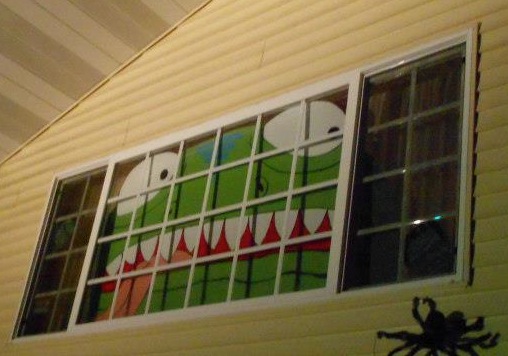
At any rate, I’ve been doing some version of Halloween mess-making since my high school years, a legacy from my older brothers, although my college and early-20s versions were a much different variety of mess.  Now, along with the help of my daughter, and the tolerance of my wife, I have been converting over to entirely homemade decorations.  And not just homemade, but old-school, paint-on-plywood, 2-D creations designed by my daughter and me.

Image

We’ve been angling away from the hyper-realistic latex-and-gore stuff that is everywhere these days, and toward more cartoonishly creepy decorations.  The other day I mentioned to my daughter that I was going to get rid of one of our old, store-bought decorations, “Stillborn Evil”—a weird baby-in-a-jar with horns, hair, and a tail, which we’ve had since 1996 or so.  When she asked why, I emoted, “Tracking down this kind of stuff used to MEAN something, man!  You had to know the cool stores, and the cool companies to order from!  Now any knob can walk into a Spirit Halloween Store, or go on eBay and find this kind of stuff without even trying!!”  I added that I really didn’t have anywhere to display it properly, and it didn’t fit in with the decorations we were making.

In typical fashion, my daughter nodded, continued applying primer to a sheet of plywood and said drily, “We could keep it in the kitchen.”  She also suggested leaving a latex severed head in a random person’s front yard rather than trying to unload it on Craigslist—not a bad idea, although she decided it would be better to leave it in one of her friends’ yards.  I may just give it to one of the teens who come by trick-or-treating.

As for the mental health component of this post…it’s important to have projects and traditions and things to look forward to, and to find some way to be engaged in the community.  Such elements of life can make you feel good, too, so long as you don’t get too frantic with trying to meet obligations that nobody is really putting on you but yourself.  I’d go into more detail, but I’ve got too much work to do.

So, anyway, the whole Halloween thing is just one more eternal project, never finished, always evolving, only with a built-in yearly deadline.  Every year I imagine I’m going to get out ahead of all the projects and have things done weeks in advance, as if I would ever stop tinkering with and trying to expand the display until the last minute.  And every year I mess around with trying to decide on designs until two weeks before Halloween, when I frantically try to plough through more work than I can possibly finish.  But the impending holiday forces decisions, and sets a stopping point.  Occasionally, the unfinished projects of one year yield a design that I can start with the following year…two weeks before Halloween when I finally make myself get down to it.

Image

Of Sex Offenders, Sentencing, and Suicide

Dear Judge G. Todd Baugh,

It’s been about a month since the height of the media attention on the less-than-minimal sentence you gave to teacher Stacey Rambold for violating the terms of a plea deal on charges of rape stemming from a sexual relationship he had at his age of 49 with then-14-year-old Cherice Morales.  In some baffling…uh…I guess you’d call it legal reasoning, you expressed that Rambold had suffered enough as a result of being under the “control” of Cherice, who committed suicide just shy of her 17th birthday in 2010.

I don’t want to devote too much time to going over old ground that plenty of other people have covered, like about your use of ridiculous sexist stereotypes, and your blame-the-victim mentality.  What I really want to do, Judge Baugh, is kick a few ideas your way, from a clinical perspective, in the hopes that you might understand Mr. Rambold’s behavior and how and why it led up to his appearance in your courtroom in late August.  Since Rambold just completed his grueling 30-day sentence yesterday, there’s a possibility that he is going to land back in your courtroom on appeal of that sentence.  So let’s just call this a teachable moment.

In handing out a 30-day (of 15-years) sentence, when prosecutors had pushed for ten years (of 20), you argued that Rambold had already been punished enough.  You lamented Mr. Rambold’s loss of his job, loss of his teaching license, loss of his house, and loss of his wife, as well as Mr. Rambold having to suffer the “Scarlet Letter of the Internet” whatever the hell that’s supposed to mean.  Hester Prynne didn’t get in trouble for having sex with one of her teenage students.  And Mr. Rambold, unlike Prynne, did not try to protect his sexual partner.  If protecting Cherice was his goal, Rambold would have accepted his responsibility and taken a plea deal from the beginning, to keep Cherice from the threat of being grilled in a courtroom.  (I could go into a lot more detail with the literary comparison/contrast here, but let’s just leave it at that).

Now, it’s weird that you consider Mr. Rambold’s loss of his wife and his house as punishments he received for having engaged in the rape of a minor.  What happened between Rambold and his wife as a result of his sexual relationship with a student (and whatever other factors were involved) has nothing to do with any punishment handed out by the courts.  There are plenty of sex offenders who have partners or spouses who stick by them, and plenty whose wives/partners leave them, but that’s a discussion for another day.

Likewise, Mr. Rambold’s loss of his house is not a punishment handed out by the court for having violated laws against having sex with underage girls.  I’m guessing Mr. Rambold lost his house either in the divorce from his wife, or as the result of losing income.  But either way, that has nothing to do with the sanctions of the court for committing a sexual offense.

Some of the specific sanctions that came directly as legal consequences of Rambold’s actions, like losing his teaching license, are clearly spelled out in the law, and for reasons I think most people would agree are necessary.  Perhaps you disagree, Judge Baugh.  Perhaps you do not feel that teachers owe it to their students, the families of those students, and the community at large to steer clear of sexual relationships where there is a vast age, power, and maturity gap.  Perhaps you think that teachers should be able to have sex with 14-year-old students, so long as they pick the “mature” ones.

Perhaps, Judge Baugh, you even think Mr. Rambold should have his teaching credentials restored, and that he should be placed back in a high school.  But from the standpoint of his pathology, he already broke down his internal barriers that might have kept him from engaging in sex with minors/students.  And those barriers don’t really ever get put back together in full.  They can be patched up a bit.  People like Rambold can learn to stay well away from situations where they’ll end up having to rely on those damaged barriers to keep them out of trouble.  But Rambold’s barriers almost certainly won’t hold if he is put back in among teens in a position of authority and trust.

And speaking of being in among teens, Judge Baugh, you didn’t think that it was all that important that Rambold was hanging out, unsupervised, with minors.  From what I can tell, you rationalized this away (or let Mr. Rambold’s lawyer rationalize this away) as being a non-issue because the minors in question were relatives of Mr. Rambold.  Now, from a clinical standpoint, that may or may not make a difference to whether he would re-offend against those particular children.  But it’s not considered a good idea to leave someone who offended against minors in a situation where that offender is alone with minors, relatives or not.

Just a little question, Judge Baugh, would you leave your underage relatives in the care of Mr. Rambold?  Here’s a hint from the treatment perspective: the correct answer is “No.”

And, Judge Baugh, you indicated that you weren’t too concerned that Rambold’s repeated rules violations led his treatment provider to kick him out of the program—you know, the treatment program Rambold agreed to attend as a condition for avoiding prison.  I’m guessing you’re not aware that failing to comply with treatment is considered an acute risk factor for re-offense.  Or maybe you are aware of how risk assessments work, since you were sure that Mr. Rambold was doing just fine because he had been rated as “low-risk to re-offend.”

But you know what?  Almost all non-violent (the ones who groom victims into compliance, rather than forcing them into sex) and non-hands-on offenders are considered “low risk to re-offend.”  Contrary to popular belief, sex offenders (again, of the non-violent sort) have a low rate of recidivism once they’ve been caught.  And that recidivism rate drops even lower with treatment.

A funny thing about those ratings, though, is that the ratings are generally predicated on the assumption that the offender’s behavior is actually going to match up with the information used to obtain the risk-level rating.  In other words, the rating is only as good as the information used to obtain the rating (and the quality of the rating tool, and the ability of the rater to use the tool correctly).  For instance, when the evaluator is doing the risk assessment, if it is assumed that the offender is not going to be left unsupervised with minors (which should be a given for anybody in Rambold’s situation), but then Rambold is left unsupervised around minors, then that rating loses more than a smidge of its reliability.

I also noticed, Judge Baugh, that you didn’t seem to think it was such a big deal that Mr. Rambold failed to show up for multiple sessions with his treatment provider.  So, Judge Baugh, when people are scheduled for court dates in your courtroom, is it important to you that they actually show up?  Also, how do you proceed with cases when involved parties aren’t there?  I’m guessing that things don’t turn out in favor of the people who don’t appear for their court dates.  So, that’s kind of the same thing that goes on when a sex offender doesn’t show up for treatment sessions—it doesn’t work out in his favor.  Or at least it’s not supposed to.

It’s also quite difficult for a treatment provider to get a feel for what’s going on with a client who fails to show up for appointments.  It’s considered kind of important when you, as a treatment provider, are supposed to be holding an offender accountable for his behavior, but that behavior includes skipping treatment—you know, because skipping treatment isn’t really considered being accountable.  Believe me, nobody wants that kind of liability.  This is why most states, including your home state of Montana, have laws that allow for offenders to be thrown into jail and/or prison when they violate the terms of their plea deals.

As a treatment provider, do you know what else makes it difficult to keep tabs on an offender?  Lies and lying.  Maybe you weren’t aware, but offenders lying to their treatment providers is considered another one of those things that moves an offender away from a “low risk to re-offend” rating.  And Rambold lied to his treatment provider, or rather, failed to tell his treatment provider that he was in a sexual relationship with a new girlfriend.

Now, generally speaking, having a committed relationship is considered a good thing in terms of risk assessment of sex offenders.  But, having a sexual relationship with someone without telling your treatment provider is, in technical language, a no-no.  This is for a variety of reasons.  For one thing, the treatment provider needs to know certain key things about the new partner, you know, like if she has children around.  Also, it’s considered important that any new partners are aware of the offender’s background so that they don’t do things like let the offender hang around the partner’s underage relatives unsupervised.  There are a lot of other potentially problematic factors here, like whether the partner is of an appropriate age, or if the partner has a history of trouble with the law, drugs, drinking, domestic violence, abuse as either a victim or perpetrator, and so on.

Now, just so you know, I work with sex offenders, and I’m not a really big “throw ’em in prison type”—at least not when it comes to offenders who take their responsibilities seriously and don’t screw around with their treatment.  But you might guess that I’m a bit sensitive about offenders who treat the whole thing like a joke, as if they don’t have to follow the rules.  I would think that as a judge, people who fail to follow the rules would bother you too, even if you don’t take all of this clinical info into consideration.

But I do hope you take the clinical information into consideration, because Rambold didn’t just violate the rules once or twice.  He violated them on numerous occasions.  And the rules he violated were, in treatment terms, kind of a big deal.  If this were basketball, this wouldn’t be traveling.  It would be Rambold driving a car onto the court, parking it under the basket, climbing up on top of the car to stuff the ball through the hoop, then flipping off the referee while Rambold’s coach explains to the referee that it’s okay for him to act that way, and gets the referee to agree.

So, Judge Baugh, a girl was abused, then shamed, then stressed to the point where she thought killing herself was a viable option, then shamed and blamed some more in your courtroom years after her death.  And even if you view Cherice as fully responsible for taking her own life (and, believe me, I could hammer you with a bunch more clinical info on that count), and even if you (completely ludicrously) view Cherice as equally “in control” of the sexual relationship she had with Rambold, Rambold completely failed to take his responsibilities seriously.  He was given the opportunity to dodge a lengthy stay in prison so long as he engaged in treatment in good faith.  He didn’t do that.

So, Judge Baugh, if Rambold ends up back in your courtroom on appeal, I would urge you to take the aforementioned clinical (and other) concerns into consideration when you decide how to amend your earlier judgment.  And whatever happens, I would urge you not to help Rambold or any other sex offenders minimize and justify their actions—they’re already pretty damn good at that on their own.

Happy Birthday to Me

“Happy Birthday to Me” is a delightful little horror film from 1981, starring Melissa Sue Anderson, aka Mary from “Little House on the Prairie,” as Virginia, a top student at an exclusive private school who may just be blacking out and killing her annoying friends.  Now, I don’t want to get too involved in the parallels between that movie and my own academic prowess, blackouts, annoying friends—but, hey—uh…what was I saying?  And…uh…is this blood on my shirt?  Good God!  It’s everywhere!

Anyway, for my birthday I decided to treat myself to a late-60s/early 70s, cheapo Charlie Brown plastic mask I found on eBay—not so cheap now that it’s “vintage”—and, no, the costume and box are not with it.  It’s a mask I intend to hang on the wall in my office—sort of a comical homage to all that Jungian persona business, and the notion that all therapists and psychologists have at least one or two carved, ‘primitive’ masks among their office décor.  I suppose that, like with the vast majority of my comical homages, it will go largely un-understood and un-laughed-at by anybody who ever sees it.  But that’s okay.  We’ve got to amuse ourselves, right?

Still, there is a larger personal significance to the mask than just a little inside joke about Jung and the décor of therapists’ offices.  It’s tied to my second—make that my third—I think—memory ever.

My father died a week before my third birthday, in a car accident, when another driver ran one of the few stop signs in the rural Nebraska community where we lived at the time.  By October’s end, my mother had landed the family—my five siblings and me—in Oregon.  We didn’t have much to hold us to Nebraska.  We hadn’t been living there that long, and we had no relatives in the area.  We were there because that’s where my father had been placed in his role as a pastor in the LCMS.

Halloween 1971 was spent at the home of my Uncle Jim (my mother’s brother), while we waited to move into the house that had been purchased with some of the payouts from my father’s death.

That year I went trick-or-treating in a Charlie Brown costume.  The only reason I can recall this at all is that my Uncle Jim had slipped a rock or two into my trick-or-treat bag, predictably and hilariously eliciting cries of “I got a rock!” as we inspected our hauls for the evening.

It’s been a bit of a mystery to me why the end of summer and the beginning of autumn has always been my favorite time of year.  Despite what should be an obvious association with loss, I’ve always tied it to new beginnings—most obviously the start of the school year.  It also seems a bit odd that Halloween would be my favorite holiday as well, given that it’s connected somewhere back in my mind with the death of my father, and being unexpectedly uprooted.

I suppose that on some level, because fall is associated with most of my earliest memories, and it marks the time when I arrived in Oregon, which I will always consider home, fall is when I really joined the world as a conscious, if befuddled, human being.  So I suppose that Charlie Brown mask is a symbol of both that consciousness and that befuddlement…and of the idea of home.

Happy Birthday to me, indeed.

Why I Don’t Hate VH-1’s “Couples Therapy”

I first realized I like Dr. Jenn Berman when, in a session with Flavor Flav and his partner of nine years, Liz Trujillo, Dr. Berman hollered, “Look at her f*cking face!”  Now, some might take issue with a therapist raising her/his voice or swearing in session, especially about somebody’s face, but f*ck those people.  In this case, Berman was trying to cut through Flav’s hyper-defensiveness, and get him to actually pay attention to Trujillo.  And for anyone who viewed the recently-concluded third season of “Couples Therapy,” there is an obvious transition (not in this particular session) where Flav drops the clown act and actually engages with Trujillo, and where she goes from balled up and permanently scowling to opened up and smiling.  The cynic in me says these could all easily be TV editing tricks, but the optimist in me says that I know therapy works, and I hope these changes hold.

I’ll confess that I first started watching “Couples Therapy” (in season three, not having any awareness of the first two seasons) because I saw a few promos and thought it would be easy to do a hatchet job on it for the sake of a blog post.  In one of the commercials, Dr. Berman was shouting down Joe Francis of “Girls Gone Wild” fame (I had no idea who the guy was at the time).  My first thought was, ‘Great, make insecure guys think that couples therapy really is about a therapist siding with women and berating men.’  (And I don’t mean to be overly reductive here, but anybody working in the field who has tried to refer people to much-needed couples therapy will probably have a pretty clear idea what I’m talking about).

But like much of what takes place on the show, to take the promo clip out of context is to fail to see the larger picture of what is actually taking place.  That particular clip involves Dr. Berman asserting herself over an emotionally abusive narcissist for the clinically important reason of ensuring that Abbey Wilson (Francis’ partner) doesn’t have her efforts to overcome an eating disorder repeatedly derailed by Francis’ insistence that he can fix the problem by badgering Wilson into eating.  Whoops…so much for not being overly reductive.

Dr. Jenn Berman acknowledges the awesome nature of this post.

Dr. Jenn Berman acknowledges the awesome nature of this post.

To be sure, if I really wanted to rip into the show, it’s within the realm of possibility.  However, to do so would show a fundamental lack of understanding about how ‘reality TV’ works.  Of course there’s going to be an emphasis on confrontational interactions.  And of course the show adds in exciting/gimmicky activities that fall out of the usual scope of plain, old, in-the-office couples therapy, like excursions to rock-climbing walls, a visit from a psychic, and “expressive therapy” where couples smash things in a junkyard.  Without such catches, attracting an audience to a show about couch-bound therapy sessions would be plenty difficult.  To the show’s credit, though, the field trips and seeming diversions are used as a way of highlighting communication between the couples in order to provide the audience with a clearer picture of how the couples behave than might be evident from therapy sessions, and is definitely more entertaining than watching couples talk about how they communicate.

And despite seeing most of the individuals and couples in some unpleasant/ridiculous situations of their own making, there are still plenty of moments that reveal the core goodness in everyone present.  I actually came away thinking well of everybody, or at least not totally hating anybody, having seen their willingness to accept responsibility and engage honestly in some difficult work in a setting more conducive to fist fights, broken bottles, and thrown furniture than it is to therapy.  Add to that the expectations of reality TV viewers who want blood, and the restraint shown by the cast members on the show is pretty remarkable.

On multiple occasions, cast members disengaged from decidedly negative interactions, reserving the right to judge others not on gossip, but on their own interactions with them—Tyler Baltierra walking away from Joe Francis’ cackling excitement at videos of Dustin Zito’s pornographic past being a prime example.  (Weirdly enough, I didn’t see anyone call Joe on the hypocrisy of him mocking a porn performer, given the millions Joe made off of flashed breasts and college-age-lesbian-experimentation love scenes).

At other times, situations cropped up where cast members, drawn into an argument between a couple, would mediate rather than taking sides, working to make the members of the couple see each others’ perspective—as with Baltierra attempting to bridge the gulf between Temple Poteat and Chingy Bailey that opened up each time Bailey powered up his tablet.

Instances occurred where efforts to stir up trouble were met with, dare I say, Socratic challenges to the thinking driving the pot-stirring.  Temple Poteat questioning Joe Francis’ obsession with Dustin Zito’s missing shoes (after Joe tried to draw Temple into complaining about Dustin) comes to mind.

In general, cast members sought out each others’ advice in earnest, and were provided with real support.

This is not to say that there weren’t plenty of instances of cast members making snap judgments or otherwise engaging in self-indulgent tantrums.  Flavor Flav and Liz Trujillo were, as Joe Francis dubbed them, a “side show” for much of the first half of the season, clearly frustrating several in the group.

Joe Francis, in turn, provided the bulk of the traditional reality-show drama for the second half of the season by deeming various people or couples “trash” and whining about people interfering with “the process” and all of Joe’s hard work.  Even when Dr. Berman managed on occasion to break through Francis’ deflection to draw out what is essentially a scared, little, attention-seeking boy, Joe would then appear for his “confessional”—just Joe and the camera—and say something self-important and off-putting, suggesting that his insight is about as substantial and durable as a soap bubble.

And perhaps to the dismay of audiences and the cast, the full story of what was going on with Trujillo and Flav, individually and as a couple, was never fully revealed.   What little bit of privacy the cast members were granted, for legal or other reasons, was perhaps simultaneously one of the most frustrating and most endearing aspects of the show.  Dr. Berman, in deference to good therapy, and in defiance of reality show convention, at least created some small pockets of safe, off-camera and off-the-record space where couples could work out things they weren’t comfortable sharing with the world.

Plenty of other reality show conventions were broken, as well, or at least bent, on “Couples Therapy.”  Even with only a small portion of each episode devoted to showing actual therapy sessions, Dr. Berman gave a pretty good taste of how therapy works.  The audience doesn’t just get to smirk at the cast members’ bad behavior and watch Berman cut them down.  Rather, problem behaviors were identified, explored in terms of the incidents and patterns that contributed to those behaviors.  Then Dr. Berman collaborated with the clients on ways to better address the issues in a productive manner.

For instance, (and to greatly simplify) Temple isn’t portrayed as a stereotypical uptight control freak for the audience to roll their eyes at, but is shown to have ‘control issues’ stemming from a chaotic past, and is challenged to relinquish some of that control and manage the anxiety that comes along with letting go.  Catelynn Lowell and Tyler Baltierra have their eyes opened to how a lack of stability in childhood has led them to cling to each other, and how public pressure has contributed to them making decisions that may not be in their best interest, or the best interest of their relationship.  Heather Marter and Dustin Zito, who were probably expected to have the most salacious content to work through, seem to have put all the tabloid sex scandal crap behind them, in order to struggle with the more mundane, but more relatable, questions of how to make a relationship last.

One could cynically argue that the celebrities and pseudo celebrities on “Couples Therapy” are merely trying to keep themselves in the public eye and make a few bucks.  But even if that was their original intent, most of them ended up violating their “brand”—Chingy by being reflective as Temple says they need to end their sexual relationship if they are not going to have a full relationship, Temple herself by breaking away from Chingy and his greater “star power”, Tyler and Catelynn by breaking off their expected marriage, Flavor Flav by stopping his perpetual performance as court jester and openly weeping at his past failures and current joys.

And certainly if one wants to chastise Dr. Berman for being egotistical, one can find examples to try to build that argument, as when she proudly trumpets the work she’s done to help Abbey Wilson address her eating disorder.  It would be too easy to sneer about Dr. Berman doing nothing more than taking Abbey to a restaurant.  But that would be taking the restaurant scene and Dr. Berman’s comments out of context.  The restaurant visit comes only after a great deal of preparatory work, and is rather a monumental thing, one which Dr. Berman deserves much credit for, along, of course, with Wilson.

Overall, even in the unreal context of reality TV, Dr. Berman’s show is arguably much less damaging to public perceptions of therapy and therapists than is the average movie or TV show with a therapist as a character.  Such fictional portrayals of therapists often show them as oversexed, overpaid egomaniacs who go about uncaringly inflicting damage on those they are supposed to help.

In contrast, what Dr. Berman does on “Couples Therapy” is manage to sneak some actual therapy in between the egos and the outings.  Ideally, viewers will see through the distractions to get a glimpse of real, honest-to-goodness therapy playing out.  And at the absolute worst, Berman may get some less discerning viewers to attend couples therapy in the belief that they’ll get to smash car windows and go bowling, which isn’t all that bad if the therapists they end up with can get them to buy in without all that excitement.

Ultimately, I was so appreciative of Dr. Berman’s ability to get some snippets of real therapy on reality TV that I’m not even going to say anything mean about her distractingly sparkly and otherwise spangled collars—which are kind of weirdly cool.  And everyone respects my fashion sense.

So You Want to be a Therapist…

By the end of the day Monday, it will have been 32 days since I’ve had a full day off.  And I’m not sure if Tuesday should really count, because I have to go to the dentist, which is sort of like taking a day off to be tortured for an hour or so.  (I’m pretty sure hell involves some lesser demon grinding that fluoride goo into your teeth, and deliberately getting it all over your gums while only letting you rinse your mouth out roughly every 45 seconds). Then it’s back to work on Wednesday.  By next week, things should slow down some, although I fear I may have just jinxed that.

Now, in fairness, some of those work days involved only a few sessions, plus attendant phone calls and paperwork.  But some involved 14 or 15-plus hour shifts or a ten hour shift transitioning into a three-hour assessment, or…  At any rate, all of those hours were tallied up between my full-time job and assisting in the start-up of a new practice.

Another thing to consider is that my full time job is in crisis services/crisis intervention, which is sort of an ugly stepchild (with apologies to ugly stepchildren everywhere) of that highfalutin really real therapy.  Metaphorically speaking, we in crisis services slap on the splints, and close wounds with superglue, and let other people set the fractures proper, and heal up the deeper damage.  Unlike most jobs in the mental health field, crisis services involves round-the-clock shift work—Hollywood depictions of therapists who are accessible 24-hours-a-day notwithstanding.

Of course, movies and TV shows are probably where most people get their ideas of what being a therapist is about.  And if one accepts those portrayals, therapists are all a bunch of immaculately-dressed, well paid, eccentric/brilliant and/or unpleasant/neurotic people with amazing office space who can’t keep from having affairs with their most attractive but least stable clients.

And while that is pretty much my life in a nutshell—aside from all of those parts—getting to the stage of your career as a therapist where you make a high-six-/low-seven- figure income by sitting around dispensing wisdom to the worried well is a potentially treacherous path that is not for everybody.   So it’s probably much better to just embrace the idea of filling a role more like Mariah Carey’s Social Worker character in “Precious” than the jet-setting millionaire therapist she played in “Glitter.” (Admittedly, I haven’t seen “Glitter” for a while and may be misremembering some things).

The short version of how the process works is: first, get a bachelor’s degree.  It doesn’t necessarily have to be in psychology, although that might help.  Once you’ve realized your bachelor’s degree doesn’t really count for anything, and everybody you know who skipped college is making more money than you, go back for a master’s degree.  Don’t worry, there are plenty of private schools out there now that will gladly take insane amounts of your money (or the government’s money that you get to pay back) so that you can get a master’s degree.  Be forewarned that in order to get a master’s degree that will be good toward becoming a therapist, you actually get to borrow money to pay a school so that you can go work for an agency for free for a period of roughly nine months.  The length of your unpaid employment will depend on how quickly you can rack up hours meeting with clients and your supervisor.  In most instances, getting the hours shouldn’t be that problematic, because there’s a good chance you will be saddled with a far larger caseload than you can reasonably manage, especially since you won’t really know how to manage a caseload.  Your clients are likely to remind you on a regular basis that they are very aware that you don’t know what you’re doing and that they would prefer to have a real therapist.  Don’t let this bother you—most of them would say the same thing if Alfred Adler himself came back from the dead for the sole purpose of conducting sessions with them.

Once you have your master’s degree, try not to think about how much money you owe in student loans—you can’t possibly afford the therapy that it would take to manage your anxiety and your sense of hopelessness about ever paying it back.  One good thing, though, is that you are now probably able to get a job where you are making as much or slightly more than at least half of the people you know who skipped college altogether.  Of course, given the severe drubbing the public mental health system has taken in budget cuts over the last decade or so, jobs can be a bit tricky to come by.  Assuming you get a job in the field, be happy in this job—you will be stuck here for at least two more years as you attempt to rack up enough supervised hours to qualify for your license as a counselor.  In addition to the supervised hours you need to log, you also get to pay hundreds of dollars to take a test designed to prove that you have learned enough in grad school and your various forms of employment to be let loose on the public without supervision.

Now you can open a private practice and just let the cash roll in—assuming you can find and maintain a big enough client load in a space with a reasonable rent payment.  You might also want to go through the painstaking and tedious process of getting on various insurance panels, or establish your suitability to take on government contracts, or…whatever else you need to do to stay afloat.  There is no shame in moonlighting in the food services industry, although you have to remember not to acknowledge any of your clients should you, say, end up delivering a pizza to their homes—unless they acknowledge you first.  And depending on the specifics of your various licenses and endorsements, you will pay hundreds or thousands a year to keep up those endorsements, as well as paying to attend various seminars and conferences to keep up your ongoing education credits in all of the relevant fields.

Just remember that anywhere along this process, anybody who gets mad at you for whatever reason can file a complaint causing you no end of distress and the possibility that you will lose everything you worked for.  Keep up your liability insurance payments and remember that homicidal ideation can be grounds for a mental health detention.

On the other hand, if you want to be a life coach, all you really have to do is watch a minimum of four episodes of “Scott Baio is 45…and Single,” (which, admittedly, is getting much harder to track down) and find a web site that allows you to print off a life coach certificate—I think Crayola’s site has some good ones.

America’s Hate/Love Relationship with Sex Offenders

If you use social media enough, it’s not that uncommon to come across ‘memes’ about how sex offenders should be maimed or killed in some horrible fashion, memes involving ideas like “Why use animals for laboratory research when there are so many sex offenders available?” or ugly, violent images tagged with bombastic proclamations of homicidal ideation toward anyone who would “hurt my children.”  Now, I understand the desire for a simple solution to a complex problem, but is there really some ‘debate’ about whether any of us want somebody to sexually abuse our children?

Arguably, the source of such black-and-white statements is a lack of knowledge, even a commitment to ignore any real information that might lead to a greater understanding of how to address the problem of sexual abuse, or even what is encompassed in the term “sex offender.”  “Sex offender,” to the oversized segment of the population desiring to eradicate problems through violence, is synonymous with “rapist/murderer of children.” 

But the reality of the term “sex offender” is that it applies to plenty of people who have never had any sexual contact with a child, let alone murdered anybody.  I don’t say this to minimize the seriousness of sex offenses, but to point out that, unlike the term “serial killer, “ “sex offender” does not have a single, well-defined meaning.  What’s legal in one state based on, for instance, the age of the participants, can be illegal in another.  What is normal, adult sexual behavior may be criminalized in a state, while much worse forms of sexual abuse are not defined as crimes, or are given much lighter penalties.

For example, if your 16-year-old son’s 16-year-old girlfriend sends him a nude or semi-nude photo of herself via phone, even if it may be legal for them to be having sex in your home state, your son may now be in possession of a depiction of a minor engaged in sexually explicit conduct, aka child pornography, which can lead to being charged with a crime and labeled a sex offender.  The label “sex offender” is also applied to exposers, who in the not-too-distant past were characterized as oh-so-comical ‘flashers’ and given a slap on the wrist. 

The sex offender label includes those convicted of statutory rape, which can include people who, if they had waited a few months, or lived in a different state, would have been having perfectly legal sex.  A 35-year-old software engineer engaging in a sexually-charged chat with a 38-year-old insurance salesman pretending to be a 13-year-old girl is disturbing and isn’t going to lead anywhere positive.  A 35-year-old software engineer engaging in a sexually-charged chat with a law enforcement official posing as a 13-year-old girl could lead to being labeled a sex offender under charges of communicating with a minor for immoral purposes, or attempted rape of a child–if the police can get the engineer to take the admittedly-twisted fantasy a bit further. 

To be sure, those convicted of sex offenses have almost certainly done things that range from the unsettling to the unthinkable, things that provoke reactions from disgust to outrage, things that require some form of restitution to the victims and to society at large—forms of restitution that are provided for in law.  But to lump ‘sex offenders’ into a uniform group whose members are all deserving of murder is to take the Carl Spackler approach to problem-solving: blowing up the golf course to get at the gopher, ultimately making the problem worse.  And, no, I’m not suggesting that the gopher was a pedophile.  I am saying that outright hostility toward “sex offenders” ensures that we will never get to a point of dealing with the problem in a way that might eventually reduce instances of sex offenses—but that’s an argument for another day.

For now, what most baffles me is how the self-righteous anger of those who would annihilate all sex offenders can so quickly reverse itself from being focused on the offender to being aimed at the victim.  While there are numerous recent and not-so-recent examples of this, Steubenville immediately comes to mind as a town that is now synonymous with rape and rape cover-ups.  It is also synonymous with blaming the victim.   And blaming the victim is just a different way of saying “siding with the sex offender.”   Let’s be clear about that: to whatever degree one blames the victim, one is, to that same degree, siding with the sex offender.

So how does the threat to smoke out and crush every evil, lurking sex offender get transformed into threats of violence against sexual abuse victims?  Well, when the offender is no longer some random, unshaven, greasy-haired creep in an arrest photo shown on the local news, but instead a high-school football star who is well-known in the community; and when the victim is no longer an unquestionably-innocent seven-year-old, but a 16-year-old girl who got drunk at a party; large swaths of the public suddenly decide to love the sex offender and hate the victim. 

In such situations, all of the Internet-clogging-bravado that fuels adolescent fantasies of being the slayer of sex offenders suddenly gets channeled into death threats and, astonishingly enough, rape threats aimed at high school girls.   Justifications are created to excuse the ‘dumb mistakes’ made by the teen sex offenders who apparently no longer deserve any consequences for their behavior.  And the Internet equivalent of pitchforks and torches are taken up in service of ridiculous arguments about how teen girls need to recognize that if they are going to behave like drunken sluts, they have to accept the responsibility for being sexually assaulted.

So, if you’re going to be all black-and-white about how much sex offenders deserve to be burned at the stake, then don’t pull them from the fire so that you can toss their victims in.  If you so enjoy black-and-white thinking, the only absolutes involved are that nobody deserves to be sexually assaulted, and that nobody has the right to sexually assault anyone.

If things are so black and white, then ask yourself why you would ever choose to side with sex offenders against their victims. 

About the New Letters

So, last week I was able to officially add to that string of letters that follows my name when I’m feeling professionally pretentious enough to attach it (like on the main pages of this blog).  The new letters: ASOTP.  I am loath to spell out what exactly it means, as that revelation is usually followed by one of a small number of responses, most of which can be boiled down to either a prurient curiosity or an “Ewww!” reaction—if those are really different things.  Different sides of a two-headed coin, I suppose.

Deep breath, throw it out there, let it sink in.

The letters stand for Affiliate Srrm Orrherrm Treatment Provider.

Ahem.  Let me try that again.

The new letters stand for “Affiliate Sex Offender Treatment Provider.”  In other words, I’m now officially allowed to provide therapy specific to the, uh, needs of convicted sex offenders, generally those who are involved in particular sentencing programs that I won’t detail here, apart from saying that they involve community supervision.  And, more accurately, the “Affiliate” portion of that title means that I am allowed to provide such treatment so long as I have a supervisor who is a Certified SOTP (having a contract with such a supervisor being one of the elements necessary to be granted said letters).

While this particular status is new, my involvement in the treatment of sex offenders is not. I’ve been working in one capacity or another with both juvenile and adult sex offenders for a little over six years now—which sounds like both an insanely long and an unimaginably short period of time to me.

So, why, may you ask, would I want to work with sex offenders?  Everybody asks.  And my answer is usually rather vague and abbreviated, dodging the real heft of the answer.  Let me attempt to present the most straight line formulation of this reason that I can, and please follow closely or you may get a lot of incorrect impressions…

My father was a pastor in the Lutheran Church, Missouri Synod, “stationed” in the Midwest for that part of my life when we were both alive.  My father was killed by a reckless driver exactly one week before my third birthday (which is where a lot of that attachment and blankie business comes in).  My mother, my siblings, and I then moved out to the West Coast, where we soon joined a(n) LCMS church with two pastors.

One of those pastors turned out to be a sex offender, of the hands-on, child molesting type, including incestuous molestation.  For the record, I had always been very wary of this pastor and kept my distance, despite his apparent popularity with other kids/teens in the church.  (Someone call Oprah—or whoever has usurped her throne—to see if we can suss out whether this has to do with repressed memories, supernaturalish intuition, or guardian angels).

The information about the SO pastor became public knowledge during my first year of college, when I was already pretty deep into a crisis of faith.

Bye-bye, faith.

Now if you want something to piss out the flame of your faith, there’s nothing quite like having one of the pastors most responsible for your religious education turn out to be a child molester.  This is particularly dousing when it follows that whole bit about God letting your dad, one of His faithful servants, get killed in a totally senseless accident—all while driving a Pacer, nonetheless (my dad was the one driving the Pacer, not God).

I don’t know how common it is for PKs (preacher’s kids, not Penalty Kicks or Player Kills or Purple Kush{es?} you sporty stoner nerds) to feel some sort of obligation to follow in their father’s (or mother’s in some churches that don’t include the LCMS) footsteps.  But for this kid, who never really even had a conversation with his dad, yet was enthralled by the idea of someone devoting his/her life to faith, there was a perceived pressure to aim, or perhaps a desire to feel at least the smallest inclination to lean, in that direction.  There was a weird, but unfulfilled, sense that there should be a calling—that God should be reaching out a hand, or tugging a leash, or kicking a butt.  I mean, if God could go to the trouble of getting that Jonah guy swallowed up and barfed out at exactly the right times and places, why not at least lay out something more profound than watery eyes during the candlelit singing of “Silent Night” at the Christmas Eve service?

So much for that straight-line formulation.

Anyway, while it took the overcoming of numerous mental blocks and bad habits (okay, the habits are still there) to get to the point where the idea of a ‘life of service’ was even a possibility, the calling wasn’t really perceived until it was time to sign up for final projects in the ‘Abnormal Psych’ course of my Master’s Program.  The list went around.  And while I immediately knew to sign up for a presentation on Pedophilia, I found myself choosing Conversion Disorder (‘hysterical blindness’ and the like) instead.  A sense of guilt immediately began eating away at me, until, a short time later, bothered by what I felt was cowardice at steering clear of the topic I really wanted to study, I tracked down the clipboard with the list, erased my name from the line next to Conversion Disorder, and instead, wrote it next to Pedophilia.

An explosion of anxiety and purpose, roughly on the order of the destruction of the first Death Star, or perhaps equal to the magnitude of the reaction of a normal human digestive system to a Jack-in-the-Box meal, tipped my world forever in the direction I had been looking for…or kind of looking for…or at least in some damn direction for the time being while I decided if this was really what I wanted to involve myself in.

At any rate, it was momentous enough to stick in my brain as some kind of pivotal event that all that previous junk had led up to…or to which all that previous junk had led.

More on that later.

Therapists’ Therapists

It’s a well known fact that a majority of people who go into the field of psychology do so because we—I mean they—are self-absorbed and trying to figure out why they are such human train-wrecks.  They self-diagnose, bolster their negative behaviors with justifications born from that self-diagnosis and then set about diagnosing everyone else and recommending therapy, all while avoiding engaging in therapy for themselves.

To help compound the failure of future mental health professionals to seek much-needed help, grad school programs for such people often fail to require that students engage in even a minimal amount of therapy.  There are roughly 12 billion reasons why this should be a requirement, and essentially only one reason why would-be-therapists reject the idea that they should get therapy: “I don’t need it.”

But therapists and would-be-therapists arguing that they don’t need therapy, is like meth-heads arguing that they don’t need dental care.   It’s the voice of fear, not confidence.  Or if it is confidence, it’s confidence born of meth—at least for most of the meth-heads, and a few of the therapists.  It’s saying ‘I’ve messed around in my stuff enough, and don’t need anybody else poking around in there, because Lord knows it could all come crumbling apart like that bust of Martha Plimpton I made out of things I picked off my scalp, after I forgot to mist it for four days running.’

And, really, if a student is going through a Master’s program to become a therapist, and doesn’t have at least one or two experiences that frighten/disturb that student into recognizing her/his need for therapy, that student is either the most together person ever, or has built up such impenetrable defenses around his/her frail psyche that she/he is probably in danger of eventually dismembering, freezing, and eating his/her clients bit by bit—either metaphorically or for reals.  (Or else the student is just in a really shitty program where he/she never actually gets challenged to explore much of anything about her/himself beyond early childhood experiences that contributed to his/her preference for natural fibers over synthetics or vice versa).

A large number of mental health professionals, and people in what are dubbed the ‘helping professions’ have a sense that they need to exude confidence, avoid negativity and doubt, and just generally have, or appear to have, their crap together across the full range of life activities.  Any admission that such is not the case can be looked on as an admission that one is not fit to help others.  The big twist, of course, is that if one can’t admit when one needs help, and stop trying to fix everything for everyone else, one really does start to lose the ability to be effective at providing help for anyone, oneself included.

As a confession of sorts, I am not currently seeing a therapist—not because I feel I wouldn’t benefit from it, but because I like to pretend I’m together enough to recognize when I need to seek help, and also because I kind of like the idea of seeing what would happen if I let everything just completely go to hell.  On top of that, I am what I would call ‘therapy-resistant.’  I approach therapy like a jealous magician watching another magician’s show—noting the ‘re-directions,’ and countering with an extra helping of defense mechanisms—‘Just try and abracadabra your way out of that underwater straitjacket, before my Buick hits your milk can, buddy.’  Okay, I don’t really own a Buick.

But, what the hell—I was trying to say something about the problem with therapists not actually getting therapy, and then presented myself as an exhibit to bolster that argument.  But don’t worry about me. I’m completely together.   And I like cotton more than rayon.