Honey Boo Boo Needs Some Real TLC, Not Abandonment

by JC Schildbach, LMHC, de-commissioned ASOTP

Not quite a month ago, The Learning Channel (TLC) announced plans to drop production of its ‘reality’ show, Here Comes Honey Boo Boo, as well as shelving an entire season that has been completed, but not aired. The reason? “Mama June” Shannon was photographed out and about with her former beau, convicted sex offender Mark McDaniel. Even worse, a few days after the original story broke, a photo surfaced showing June, Mark, and Alana “Honey Boo Boo” Thompson together.

McDaniel was convicted of “aggravated child molestation” for sexual contact with Anna Marie Cardwell, who is June’s daughter, and Alana’s half-sister. McDaniel served a ten-year sentence for the molestation, having been released from prison in March.

Now, I’m not a big fan of Here Comes Honey Boo Boo.   I’ve seen occasional clips on other shows, and watched most of one episode when I came across it while flipping channels. But in that episode, I saw that the family was accepting of Alana’s uncle, who is gay, without making a big deal about it. And, despite my unease at the general weirdness of the child pageant circuit, the family members seemed to enjoy each other’s company. And then the show concluded with Honey Boo Boo climbing up on a chair and sticking her butt in the air to fart loudly, which, strangely enough, served as the lead-in to a very somber, ‘feed the children’ infomercial.

At any rate, speaking of the weirdness of the child pageant circuit, having seen a few episodes of Toddlers in Tiaras, the TLC show that spawned Honey Boo Boo’s spinoff, I am disturbed by what can only be described as the sexualization of little girls on that show. The contestants are small children who are essentially treated identically to adult beauty pageant contestants—made to wear too much makeup, with piled-up hairdos, wearing a variety of—I guess you’d call them revealing, although that sounds weird when talking about children—dresses and bathing suits, while performing routines involving dance moves that I pray the girls don’t understand the origins/meaning of.

I’ve had offender clients specifically mention Toddlers in Tiaras as a kind of ‘gateway’ form of visual stimulation leading to seeking out even more exploitative material. And, while such ‘gateway’ comments are often spoken with the intent to limit the personal responsibility of those clients—the whole ‘society is sexualizing young girls, what am I to do?’ complaint—it is somewhat difficult to view the show without thinking, ‘Wow—pedophiles must really enjoy this.’

So, while I could start shaming Mama June for putting her daughter in the beauty pageant circuit, or for taking up with a man who molested one of her daughters; instead it seems a better course in all of this would be for TLC to invest some more effort and money in the show, and maybe take it in some completely different directions—maybe even directions that would involve some actual learning.
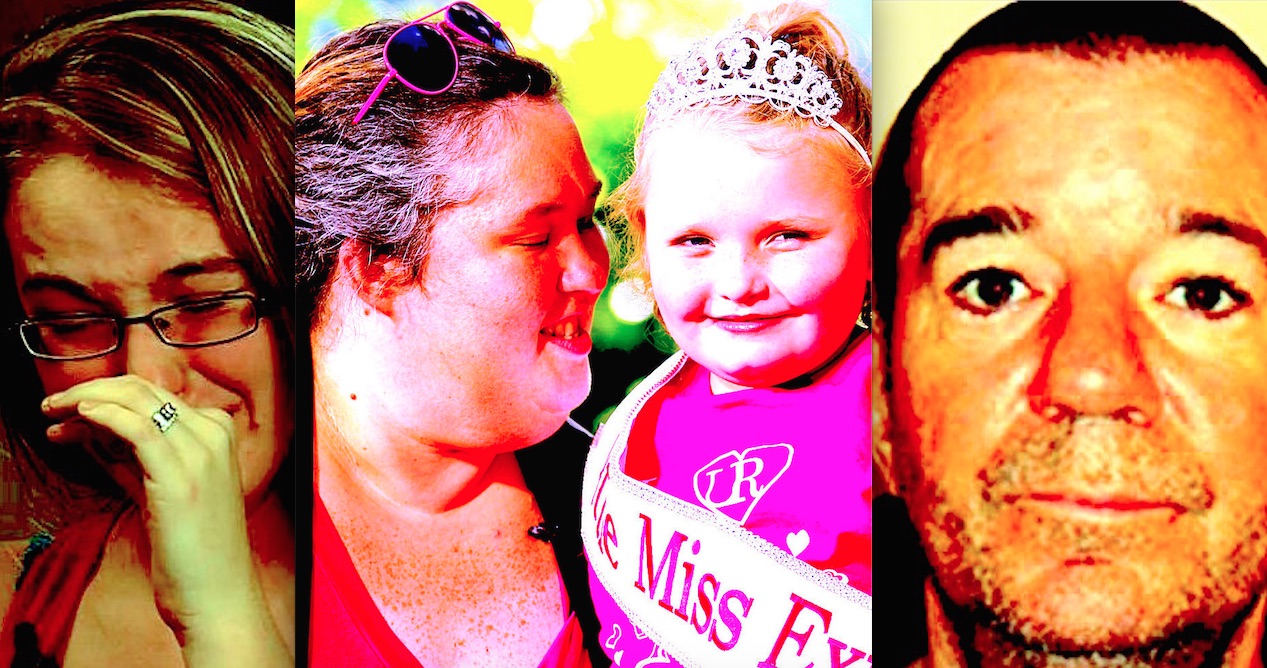
Broken portrait of an exploited family unit--Anna Marie, Mama June, Honey Boo Boo, and Mark McDaniel.

Broken portrait of an exploited family unit–Anna Marie, Mama June, Honey Boo Boo, and Mark McDaniel.

That is to say, it’s very odd to have a show built on the highjinks of a family that is portrayed as a bunch of unsophisticated rubes chasing a weird dream, and then to turn around and cancel the show when the matriarch of the family does something that shows she really doesn’t understand what’s at stake in a particular situation. According to Anna Marie’s own statements to the media, June minimized McDaniel’s behavior, telling Anna Marie that McDaniel wasn’t all that dangerous because Anna Marie was McDaniel’s only victim.

Such a statement is a big red flag that Mama June just might be buying a whole lot of lies from McDaniels—the kind of lies that offenders tell all too frequently. ‘It was just the one time;’ ‘I was drunk;’ ‘It was a mistake;’ ‘The victim did X first;’ ‘I paid the price/did my time;’ ‘I won’t ever do that again;’ etc, etc.

I don’t know what kind of treatment McDaniel may or may not have received in prison. But unless McDaniel has developed some understanding of his own behaviors, and unless Mama June has been educated on exactly what McDaniel did, how he did it, how he justified it to himself, what kinds of things Mama June needs to look out for in McDaniel’s behavior (preferably coming from McDaniel’s own confession); and unless she’s been given instruction in what McDaniel’s behavior means for the safety of her other children, and how to reduce risk (risk can never fully be eliminated), then it’s a little hypocritical of TLC executives to cut her off, claiming that it is in the best interest of the safety of the children involved.

And just for context, here’s the statement issued by the network at the time of the show’s cancellation: “TLC has cancelled the series HERE COMES HONEY BOO BOO and ended all activities around the series, effective immediately. Supporting the health and welfare of these remarkable children is our only priority. TLC is faithfully committed to the children’s ongoing comfort and well-being.”

Great, TLC, but where’s the support? I’ve seen many mothers of victims continue on in relationship with the men who molested those women’s children. And a supportive and appropriate relationship with an adult partner can actually reduce risk for re-offense. However, that risk isn’t (generally speaking) reduced when the offender is allowed back around likely victims, particularly without the partner being fully informed as to the nature of the offender’s behavior, and how to provide adequate support for the offender and for other family members. But maybe TLC executives are just looking at this as another example of the stereotypes they’re comfortable promoting–of poor, Southern folk accepting child molestation as a routine part of life.

It is potentially extremely damaging for victims of molestation, like Anna Marie, to see their mothers return to relationship with the offender, or to, in any way, be given the impression that they are being treated as secondary to the perpetrator of sexual violence. It definitely sends some disturbing messages about who is being given priority, and where the concern of the mother lies. It is possible to mitigate that damage, but only with some very involved, professionally-guided therapy.

I don’t want to over-simplify things here, but a major reason for women to continue on in relationship with offenders is economic. I don’t have any idea if McDaniel has any real way of providing for June’s family, but since TLC just cut off the family’s current main source of income, they are increasing Mama June’s likely reliance on someone who can provide support—and at a time when the person June is in relationship with is an offender who is very much putting Honey Boo Boo—that “remarkable child”—at risk.

So, again, why not take the show in a new direction? A learning direction? I don’t mean to advocate for making an offender a reality TV star, but TLC could at least build in scenes to Honey Boo Boo’s show, or maybe a spinoff, that follow McDaniel through treatment, and through all of the difficulties he now faces as a convicted offender trying to rebuild a life outside of prison, in conjunction with Mama June’s exposure to McDaniel’s treatment process.  The audience could see scenes of June attending sessions with McDaniel—scenes of McDaniel explaining his ‘offense cycle’ to June, of McDaniel explaining his actual offense to June, of June going through a chaperone class where she learns just what limits need to be placed on McDaniel and his contact with June’s children.

And what about making sure Anna Marie’s okay? How about, instead of channeling any income to McDaniel, any money involved in a standard TLC reality-star fee, over and above the cost of his evaluation and treatment—funded by TLC—goes to Anna Marie to make sure she can get some ongoing treatment herself?  Perhaps let Anna Marie gain some economic benefit from the exploitation she’s already suffered? She’s had various media outlets contacting her to ask how she feels about the man who molested her being released from prison. How about making sure Anna Marie’s not being re-traumatized by all of this? After all, how many victims of molestation really want the molestation being made public, and then want to have to address it, with complete strangers, for the purposes of having it blasted out all over the airwaves and the Internet?

Of course, TLC doesn’t have to do anything in this case. Perhaps TLC executives were grateful that a scandal of this sort came around when Here Comes Honey Boo Boo was pulling ratings of less than half of its peak performance, just so they had a good excuse to cut their losses. Then again, TLC could really do some good in this case. TLC could truly support the “health and welfare” of their child stars. TLC could really help advance public discourse on offenders, offender treatment, and victim advocacy.

Or TLC could just leave Mama June, Honey Boo Boo, and the rest of the clan dangling—dangling over a cliff where falling means families torn apart and potential acts of child sexual abuse—and move on to whatever other ‘reality’ show goofballs America wants to laugh at, until ‘reality’ creeps in and undoes them as well—leaving TLC to cut its losses, abandon its ‘stars,’ and run.
 

Why John Grisham Wasn’t All Wrong about His Child-Porn-Viewing Friend

by J.C. Schildbach, LMHC, ASOTP

Way back in mid-October, an eon ago in Internet time, an article and partial interview was published in The Telegraph, wherein John Grisham decried the unfair treatment an old law school buddy of his had received at the hands of the overzealous legal system. After all, Grisham argued, his friend had only looked at some child porn that was really just technically child porn, because it involved 16-year-olds who looked 30, or some such rot.

You can read that piece here: Grisham on What Makes a Real Pedophile

Jessica Goldstein put together a piece for Think Progress that explains a whole lot about what was wrong with what John Grisham said, from the perspective of why maybe, just maybe, seeking out pictures of 16-year-old girls, even if they look mature, might be problematic. It is available here: Goldstein Explains Why Grisham’s Friend Shouldn’t View Child Porn

I would add to Goldstein’s piece that, developmentally speaking, if you think 16-year-olds are capable of making rational decisions about being ‘porn stars’ then, well, you’re wrong. Look into brain development, and when people actually become capable of making decisions about the long-term consequences of their current behaviors. Add to that the problem that sixteen-year-olds, legally speaking, can’t enter into ANY contracts (even if they can legally consent to sex) and, well, it’s pretty cut and dry that 16-year-olds (and minors of all ages) in pornography are just plain being exploited, as well as frequently being abused, drugged, threatened, or otherwise coerced.

In the time since the publication of the original piece, Grisham’s friend has come out to say that his treatment in the legal system was not unfair, that he deserved what he got, and that he should have never done the things he did. It also came out that, unlike what Grisham said, his friend did not just accidentally look at some 16-year-olds who looked like adults, but that he was actively participating in the exchange of child pornography, including files involving children as young as 12 (who presumably did not look like they were 30).

Much has been made about why Grisham would have given such a distorted view of what happened with his friend. My guess is that he didn’t know exactly what happened, and that he was going off of an explanation his friend had probably given several times to family and friends when his legal troubles started. That explanation probably went very much like Grisham explained it: ‘I was drunk. I was unhappy. I clicked on a link that I didn’t realize was child pornography.’

Not surprisingly, when friends and family of an offender first hear of allegations of any kind of sexual misconduct, particularly when it falls into the realm of sexual misconduct involving children, whether that is “hands-on” contact or viewing child pornography, the default position is to not want to believe it. Likewise, the default position for the person engaging in the offending behavior is to not want to admit to it.

When offenders are “found out,” there are several stages that they often go through on the way to actually being able to own up to their actions. Very roughly speaking, those usually look like: 1) Nothing happened; 2) Something happened but it’s not nearly as bad as they say it is; 3) It was an accident/the victim did x first; 4) Something happened that is worse than I originally said, but really not as bad as they are saying; 5) Really, I have a pretty extensive history of this kind of behavior.

The offender, and those closest to the offender, simply do not want to believe that what happened actually happened, and often cling to that as long as possible, and often to the detriment of the victims of sexual abuse.

Grisham's factual failure may have led to a bit of a headache for him

Grisham’s factual failure may have led to a bit of a headache for him

So, I’ve highlighted a few of the things that Grisham said that were clearly wrong and stupid when it comes to offenders. So, what did he get right?

Grisham’s words were rather careless. Citing old white guys in prison as a big problem is not really the best way to go about making a case. Old white guys in prison is about as big a problem as young white guys not being able to get into college because of Affirmative Action. In other words, relative to other systemic problems, it’s nothing.

But something that is pretty limited is the threat that old guys (regardless of ethnicity) represent to the community at large. In the case of old guys looking at child porn, the threat can be further reduced by eliminating their Internet access and by eliminating any contact they are allowed with children.

But how do such limitations get put in place or enforced? In several states there are “sentencing alternatives” for sex offenders (and for people who have committed various other types of violations), particularly those who are not considered “violent offenders.” And, I realize the language is odd, but “violent offenders” are those kinds of offenders who, say, go after kids they don’t know or engage in physical violence beyond just the sexual acts they inflict on their victims, as opposed to “grooming” children that they are in regular contact with. Groomers, or non-violent offenders, tend to work slowly and patiently to get what they want from their victims. Violent offenders smash and grab and are a small minority of overall offenders.

At any rate, from what has come out, Grisham’s friend had no hands-on victims. And really, what’s the bigger punishment? Putting him in prison for three or more years, and then letting him out, all done, all paid for; or putting him in jail for less than a year, and then putting him out to go about rebuilding his shattered life, while under strict supervision and treatment guidelines?   Once on the outs, he has to get a job (probably not a high-paying attorney job as I’m guessing that door has probably closed), pay for whatever housing is available to him—which will likely be severely limited, be under the supervision of a Community Corrections Officer (CCO), and have to go to/pay for outpatient sex offender treatment for the next several years, potentially for the rest of his life.

At any rate, the sentencing alternatives cost taxpayers a lot less money, are just as effective from a treatment perspective. And, for the vindictive among you, such sentencing alternatives are plenty demeaning—loss of status and being under a harsh set of rules, with the threat of being bounced back to prison for violating those rules, is not something anybody wants to live with. And for those offenders who manage to maintain any kind of support network, or rebuild a new one, they get to go through the rather unpleasant process of explaining their offenses again and again, just so that they can build a group of chaperones, or at least informed contacts.

So, in a way, Grisham was right that people like his friend don’t need to be clogging up the prison system, just like Grisham is right that non-violent drug offenders don’t need to be clogging up the prison system. Sure, there need to be consequences, but there are more and less effective consequences, and more and less expensive consequences, both to offenders and to the public at large.

But since laws are generally written by politicians, and not for the purpose of doing what is most effective, but for doing what is most politically expedient/most popular, things like sentencing alternatives are created and used less and less frequently. No matter how much sense such policies make, or how cost-effective they are, lawmakers don’t want to be labeled as the ones who let sex offenders, even offenders with no hands-on victims, even offenders who are made to pay severe penalties other than prison time, out into the community.

But such short-sightedness means that more offenders actually get out of prison somewhere down the road, and with little or no supervision, and no organized checks on their behavior.  Grisham is right that there are better places for his friend to be, even if he was completely wrong about what his friend did, and what it meant.


The Stigma of Mental Illness and the Noble Savage Myth

Okay, I’m kind of cheating here.  I haven’t posted anything for a while, so I’m popping this up.

This is an article I worked on with Dr. Jeffrey Guterman, based in part on a post I did for this blog (which was a great deal snarkier, and which I will re-post at a later date).

Enjoy… The Stigma of Mental Illness and the Noble Savage Myth

noble savage photo

How About We All Stop Using “Schizophrenic” as an Insult?

by J.C. Schildbach, LMHC, ASOTP

One night about two years ago, I challenged a friend for describing his behavior as “schizophrenic.” In an admittedly snide tone, I asked a quick barrage of questions referencing various types and symptoms of schizophrenia: Are you catatonic? Paranoid? Suffering from delusions? Auditory hallucinations? Visual hallucinations? And so on…

Somewhat unexpectedly, my friend responded with an apology for his use of the term, and didn’t engage in any kind of defensive posturing or attempts to justify his word choice. He clarified that he meant he had changed his mind back and forth several times in relation to a particular situation.

I was a little surprised that I had reacted in such a way to what was supposed to be a self-deprecating comment from a friend. But there were a number of things weighing on me at the time, not the least of which was that my friend was seeking advice on a matter that was best kept between him and his partner, and maybe a good couples counselor. As with most of the times he sought advice, he had already made up his mind about what he intended to do, and was looking to have his intentions validated, or to have them challenged with an argument so compelling that he would have no choice but to turn from that position.

Aside from my irritation with the immediate situation that evening, I had been in contact earlier in the week with a young man diagnosed with schizophrenia. He was in some pretty serious legal trouble, and did not appear to comprehend all that much about it except in the most concrete of terms. That is, he knew what law he had broken and why it was problematic. That information had been drilled into him during his time in court and a stay in jail. But his sense of what the crime meant, and how it was going to impact him, his connection to others, and the choices he was going to have to make, both short- and long-term, was murky at best. It struck me that he was so used to being marginalized that his current situation involved just one more bureaucratic system to interact with—as if this latest set of restrictions was little more than an additional cluster of tasks to occupy his time.

Working in crisis intervention, I also have fairly frequent (phone) contact with people coping with schizophrenia and other mental illnesses that involve psychotic symptoms of varying levels of severity, and which often fluctuate over time. There are few, if any, blanket statements that would accurately cover them all, or make a nice, tidy explanation of what they are dealing with. But, unlike the popular usage of the term “schizophrenic,” the way my friend had engaged it, the behavior, thoughts, and challenges of those dealing with schizophrenia are not simply a matter of being indecisive or changing their approach to an issue.

In the time since I first barked at that friend about his use of the word “schizophrenic,” I have seen it become more and more commonly used (or, perhaps, it was used a great deal before that, and I just hadn’t noticed). Currently, in addition to the way my friend used it, to describe his somewhat erratic decision-making behavior, it is used quite often in relation to politics, and often by writers and other figures I respect or at least tend to agree with. Such uses, though, are potentially offensive, and even insulting in a way that is beneath anyone attempting to make a serious point.

For example, in recent weeks it has been relatively easy to find articles, or to come across people on television news/opinion shows, complaining of politicians behaving in a “schizophrenic” fashion toward immigration policies. Generally, what the use of the term “schizophrenic” means in such a context is that the politicians are saying one thing and doing another, or that they have changed their position on an issue multiple times. It is basically used to mean that a politician or group of politicians have been inconsistent on an issue.

A quick Internet search can find all manner of uses of "schizophrenic" as a derogatory label--frequently in political discourse.

A quick Internet search can find all manner of uses of “schizophrenic” as a derogatory label–frequently in political discourse.

But the problem with using “schizophrenic” to describe contradictory political positions is that it suggests the politicians are suffering from a diagnosable mental illness that is beyond their immediate control, and which can interfere with their perceptions of reality, rather than that said politicians are making rational decisions based on what they think will get the most traction with their “base” or constituents. Politicians shifting their political positions is something that is done with the assistance of political strategists in an attempt to get a message out to voters in a way that might provoke support of a carefully crafted message, even if that message is inconsistent over time.

Schizophrenia, on the other hand, is not volitional. It is not deliberate. People who are living with schizophrenia are not choosing one day to deal with only minimal or well-managed psychotic symptoms, and the next day to pursue the exact opposite. People coping with schizophrenia do not, for example, determine that they will change the content and intensity of their auditory hallucinations based on political polling and messaging strategies. They are not thinking of the gains to be made by crafting an elaborate delusion wherein their friends and family are colluding with various government agencies to monitor and control them.

In short, saying that one’s political opponents are “schizophrenic” is just a different way of labeling one’s political opponents with the big, sloppy label of “crazy”—of indicating that their ideas do not merit any consideration because the people presenting those ideas are not grounded in reality. But, because “schizophrenic” is being used as an insult, as a way of accusing somebody of being worthy of ridicule and dismissal, by extension, it implies that people with schizophrenia are also worthy of ridicule and disrespect. Using “schizophrenic” as an insult encourages ongoing stigma towards those with mental illness. It encourages a lack of understanding of mental illness, and of how to address the needs of those struggling with it. It is dehumanizing in the way that all insults aimed at one’s “enemies” are intended to dehumanize.

And people with schizophrenia are not our enemies. They are people struggling with something that we only barely understand. They are people who, at the very least, do not deserve to be lumped in with politicians who are fine-tuning messages of anger and outrage to try and get votes.

Now, lest anyone think I’m engaging in “word policing,” let me say that I am. As much as language is a dynamic thing, there are still right and wrong ways to use words, or rather, more and less accurate ways of using them. We still make daily decisions about whether we are going to use words to clarify or to obscure, to increase understanding or to confuse. The word “schizophrenia,” unlike a number of other words used in mental health diagnoses (anxiety, narcissistic, etc.) was coined, by Eugen Bleuler around 1908, specifically to refer to the mental illness. It literally means “split mind.”

Arguably, the literal definition of schizophrenia could easily be applied to various other situations such as the one’s already described, and it would not be inaccurate. And, arguably, the mental illness or cluster of illnesses known as schizophrenia involves a broad enough range of symptoms and presentations that the diagnosis requires specifiers for clarification in individual cases. Still, rather than taking a word created to refer to a mental illness, one that will always have ties to that mental illness regardless of how one claims to be using it, and expanding the use of that word to include any behaviors one perceives as inconsistent or otherwise in opposition to one’s own beliefs about appropriate behavior, why not pursue more accurate understanding of the word, and a greater understanding of what the mental illness means, and does not mean?

It seems to me that, rather than calling politicians “schizophrenic,” it would be much more damning to say that one’s political opponents are completely inconsistent in their approach to an issue because they feel that they can achieve greater political gains by changing their position and their message, instead of sticking with real principles or working hard to find real solutions to complicated problems.

And instead of labeling our own actions, or the actions of others as “schizophrenic,” simply because they are inconsistent, appear contradictory, or we disagree with them, why not just acknowledge that most of us are not as steadfast and true as we like to imagine, and that we often don’t make decisions unless and until we have to? Why insult people with schizophrenia by suggesting our poor decision-making skills are the result of a serious mental illness, one that involves much deeper struggles than indecisiveness or occasional mild impulsivity?

How about we all stop using “schizophrenic” as an insult?