
Shooting Our Daughters’ Boyfriends: Toyota Camry Edition

by

J.C. Schildbach, LMHC

In the race to sell cars by appealing to (the stereotype of) overprotective fathers (aka fathers who are obsessed their daughters’ sexual behavior/fathers who threaten other peoples’ sons) Toyota manages to get in maximum gross-out in minimal time with a disturbing 15-second ad for the Toyota Camry.

Dad enters the Toyota dealership, phone-gazing tween daughter in tow. He approaches Toyota spokeswoman/pretend car salesperson “Jan,” telling her “I need a safe car.” Apparently dad just up-and-decided to head out and buy a car without doing any research beforehand, and thought it was a good idea to start off his negotiation for a new car by immediately notifying the sales staff of just how ill-informed he is.

Jan’s response, “The Camry’s really safe. It has ten airbags. It even has a backup camera,” is almost as bizarre as dad’s clueless request. Is Jan implying that other cars in the Toyota line are not safe? Have fewer airbags? Don’t come with a back-up camera? Is there some reason Jan didn’t ask normal salesperson-type questions, like, “How big is your family?” Or, “What do you need the car for?”

But the strangeness of the initial exchange pales in comparison to what happens next.

Dad says, “That could come in handy.” The commercial then cuts to a scene in dad’s imagination. Dad is sitting in the Camry in a driveway, watching the image from his backup camera. It’s his daughter and a boy, standing awkwardly, leaning in to kiss each other. Dad gives two quick blasts of the horn, breaking up the kiss. Tween daughter emotes, “Da-ad!” Tween boy freezes for a second, then bolts.

Toyota what dad saw

What dad saw.

Toyota’s ad agency apparently expects everybody to take this in without question, to chuckle at dad’s stealthy intervention, and to come away with the impression that the Camry has a lot of great safety features.

The ad begs so many questions, though, not the least of which is, doesn’t dad know how to work a rearview mirror? If dad had pulled the car in facing forward, instead of backing in, wouldn’t he have been able to completely avoid this situation altogether? After all, he would have been facing the kids as they said goodnight.

But the really big question is just what the hell is going on in dad’s mind that when somebody mentions a backup camera, his first thought is that he can use it to watch his daughter as she and her date try to have a goodnight kiss? Does dad imagine a number of other situations where he can use that backup camera to watch his daughter engage in physical contact with boys?

Probably shouldn’t answer that.

Toyota dad hands

Where are your hands, dad?  Show us your hands!

We cut back to the showroom, where dad throws his arm around his daughter, and says, “Gotta keep my little girl safe.” I’m not sure what form of virulent sexually transmitted disease dad thinks is lurking on the lip of his daughter’s 12-year-old date that he concludes he is keeping his daughter safe by using his car’s backup camera and horn to break up a quick peck.  If anything, dad’s actions just convinced those two kids to be much more careful about where they engage in any physical contact in the future—and to do all they can to hide it from dad.

Still, maybe that’s all dad wants—to make a little show of what he’s done to keep his daughter safe, so that he can feel better about himself for having such disturbing fantasies. Unfortunately, dad, your daughter doesn’t need you intervening in such a way—forever causing her to associate your leering…er…watchful eye with any romantic thoughts she might have toward another person. She might benefit from you being able to speak openly with her, and to move beyond your own shame about basic biological functions, so that she knows you are a safe person to turn to, rather than a controlling jerk who is likely to blow up at her if she admits to—I don’t know—let’s just call it ‘making a mistake’—of whatever kind—in her relationships.

You can just hear dad storming around the kitchen as his daughter sobs at the results of a pregnancy test. “How did this happen?!! I bought a car for Christ’s sake! It had a backup camera and everything!!” I’ll spare you whatever other thoughts dad might be having about backup cameras and his daughter getting pregnant.

But the commercial closes out instead with Jan ‘sympathizing’ with the tween daughter, saying, “He’ll only be like this for another 10 or 15 years.”

Pervy toyota dad

I’m so sorry, dear. I had no idea your dad would go there at the mention of a backup camera.

Wait. Does Jan have any idea what dad was just thinking about?   She has to, right? Otherwise, why would she specify 10 or 15 years? She is suggesting that in 10 or 15 years, the daughter might have gotten married, or moved away from dad, or whatever it is that supposedly is going to get dad to quit pointing backup cameras at her and her boyfriends, right?

Oh, Jan. You could’ve done so much better by this girl—by all girls. Don’t just encourage her to suck it up and put up with dad’s troubling attitudes and insecurities. Don’t just let dad get away with his pervy thoughts and car-based voyeurism.

Who am I kidding, though? Jan’s just trying to sell cars, not change the world. She’s just reading the words other people scripted for her—the stupid, stupid words, in a tired, awful, and nonsensical scenario.

You can see the whole commerical here (it has a “private” setting on Toyota’s own Youtube site for whatever reason).

Toyota. Let’s go places. Like the hell away from your dad. I think he’s trying to check us out on his backup camera.


Shooting Our Daughters’ Boyfriends—Chevy Malibu Edition

by

J.C. Schildbach, LMHC

One of the ad industry’s favorite stereotypes is that of the overprotective father…perhaps more appropriately described as the father obsessed with his daughter’s sexual behavior. Currently, there are a number of commercials airing that—to varying degrees—make use of dear old dad’s insecurities about controlling access to his daughter’s erogenous zones as a strategy for selling cars. In today’s blog post, we look at the 2016 Chevy Malibu.

In past “Shooting” posts, the ads I’ve highlighted have typically coupled dad’s weird fixation on his daughter with the father’s tendency to threaten the daughter’s peer-age male friends. By the threat-making standard, Chevrolet’s “Car You Never Expected” commercial for the 2016 Malibu is pretty tame. It is actually absent any explicit threats, and any visible teens, as a focus group looks over an un-branded new car and wonders just what company might have made it, and how much it costs.

You can see the whole commercial here.

As the commercial’s host explains, the car comes equipped with “Teen Driver Technology,” which “lets parents view how their teens are driving.” There is no explanation offered as to what ‘viewing how teens are driving’ actually means. Is there a dashboard camera facing inward? A tracking device that spits out real-time location and traveling speed? A ‘black box’ that compiles stats?

The host goes on to promote other features of the teen-control technology, including how the car “even mutes the radio until the seatbelt is fastened,” at which point one of the focus-group women quips, “My husband could use that.” The woman’s joke is followed by an awkward edit of other group participants laughing in reaction to…well…something.

But the annoyed wife inadvertently brings up a good point. Why wouldn’t spouses (or partners, and family members of various stripes) use the Teen Driver Technology to track each other, or build a case to support their suspicions about just what is going on in that car? And what’s happening with all that information that’s being gathered under the stated goal of letting parents view how their teens are driving? But I digress…

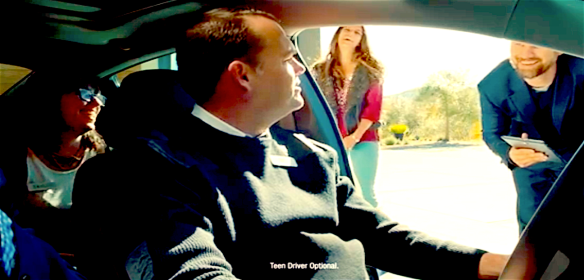
Back on the topic of dads obsessed with their teen daughters’ sexual behavior, when the host first explains that the car allows parents to view how their teens are driving, the one identified dad says, as he settles in behind the wheel, “Will it keep track of how many boys get in the car?” We actually see the host and two women burst out laughing at dad’s witty rejoinder.

I cringed.

Teen Driver Dad

Oh, dad, it’s so hilarious that you want to spy on your daughter’s interactions with boys.  *Teen Driver Optional

Presumably the people who put the commercial together have hours of footage from these focus groups, but decided to go with the ‘creeping on my daughter’ comment—not somebody asking how the system actually works, or somebody commenting on how safe that would make them feel—but dad, cracking wise about how he can use spy-car technology to preserve his daughter’s purity.

And the phrasing of the joke—“Will it keep track of how many boys get in the car?” What do you imagine your daughter is doing when you’re not around?!? And just how many boys would it be acceptable to have in the car at one time, or in the course of a single day…or whatever you’re thinking about the numbers involved? What if no boys ever got in the car? What if there are always boys in the car with your daughter, but she’s not interested in boys in that way? What if the boys in the car aren’t interested in her (or any girls) that way? What if she’s just one of the guys? Or is capable of having male friends without there automatically being a sexual component? Or…well, the possibilities move far beyond the stupid limitations of your prurient assumptions, dad.

At base, though, it feels like an obnoxiously routine joke for a dad to make. All the people in the same frame with dad visibly laugh, like he’s said something witty and original.  Oh, how great it would have been if somebody reacted with distaste–ruining the shot.  But no, it was that laugh of familiarity–a safe laugh. It’s an old joke, with a slightly different twist—my car can support me in my societally-sanctioned, but still bizarre obsession with my teen daughter’s sexual behavior? Sign me up!!

But it’s the routine nature of the joke that makes it so disturbing. Making cracks about keeping boys away from our daughters is almost as common as complaining about the weather, or commenting on last night’s game.  It’s a topic that slides right into surface conversations we have with people we barely know.  It’s practically expected, and rarely questioned. We respond with a polite chuckle and move on, not bothering to think what’s beneath those little jokes.

What’s beneath those jokes, though, is an assertion that men need to control women at all stages of their lives, watching their every move, with the accompanying assertion that men must expend a great deal of energy to prevent one another from deflowering and despoiling the girls and women we each rightfully lay claim to.

You can take my daughter when you can pry her from my cold, dead hands.

Look, I get it that parents (not just creepy dads) want to keep their kids safe, that they want to help them avoid the pitfalls of heartbreak, and the potential for much greater relationship dangers.  And that people often make jokes to alleviate their fears. But if you just keep making the same tired jokes, and laughing about them—or even including them in commercials—without giving any thought to the jokes, then you’re really just getting bogged down in your fear—reacting to it, stuffing it down, rather than actually dealing with it. You’ll keep looking for answers that don’t actually move you forward, or better prepare your teens for anything.

So, with that in mind, I offer this new, if rather convoluted, slogan:

Chevy Malibu with Teen Driver Technology: because you’re incapable of having an honest and rational discussion with your teen about anything of a sexual nature and are praying that a car’s computer system can make up for that fact.

Or perhaps:

Chevy Malibu with Teen Driver Technology: a chastity belt for the 21st century.

Stay Tuned.

Chris Brown, Mental Health Professional

by

J.C. Schildbach, LMHC

The Chris Brown Suicide Assessment Scale is a simple tool, consisting of only two questions:

  1. Have you ever attempted suicide?
  2. Are you dead?

If you can answer “no” to one or more of the above–well, congratulations! You’re not suicidal. And you never have been.

If your answer to both questions is “yes”—well, sorry you didn’t get the help you needed. But, really, how were we supposed to know there was a problem if you weren’t going to actually kill yourself?

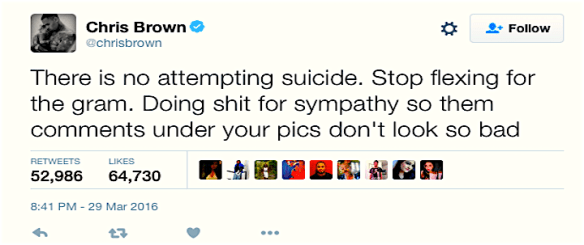
Brown revealed his mastery of the clinical subtleties of all things suicide in this insightful tweet from last week:

brown tweet screen shot

For a bit of context, this expression of Brown’s mental health expertise was aimed at singer Kehlani, who apparently posted a photo to Instagram from a hospital room where she was staying after a suicide attempt.

For a bit more context, Kehlani’s suicide attempt apparently had something to do with Internet trolls attacking and disparaging her for her personal choice in partners—after Kehlani left Cleveland Cavalier’s player Kyrie Irving to return to previous boyfriend Party Next Door.


For even more context, until I saw a news item on Brown’s tweet, I had no idea who any of these people were—aside from Brown, who I know primarily as the guy who physically assaulted then-girlfriend Rihanna back in 2009.

Apparently, Brown is friends with Irving, and thought it was somehow supportive of his friend to mock Kehlani’s suicide attempt. Irving, for his part, has indicated his support of Kehlani, while not saying anything about what an ass Brown is.

Say what you will about Kehlani posting a photo from her hospital bed, but the story was already coming out, and she had every right to relay whatever information she wanted in whatever format she chose. After all, it was arguably Kehlani’s choice not to publicly explain her love life that led to the previously-mentioned trolls deciding it was ok to tear down a 20-year-old woman for her choices in men. And, for all we know, whether she had floated an explanation before she was seen in public with Party Next Door, she would’ve been maligned anyway.

Now, when I first saw Brown’s tweet, it initially seemed that this was just Brown declaring his willingness to stigmatize those with mental health issues, while providing just one more example of how proud we the people are to declare our support for such ignorance (just check out all those “likes” and “retweets.”) And to be sure, the tweet is definitely built on a demonstrable falsehood that people who attempt suicide are just a bunch of pity-seeking fakers.

But when you take it in context of Brown’s other tweets on the same subject, where Brown, for example, accuses Kehlani of direct messaging a lot of men, and states that Kehlani and Party Next Door “look like they have stank sex” (really, Chris?!?—do you spend a lot of time picturing the kind of sex your acquaintances have?), as well as his own assertion that he was just showing support for his good friend Irving, then it becomes apparent that this is Brown just engaging in more of his own, garden-variety misogyny…the same kind of misogyny that led an army of Internet trolls to attack a 20-year-old female for having the audacity to choose one boyfriend over another…the same kind of misogyny that led to Brown’s felony conviction for assaulting Rihanna.

Strangely enough, in the aftermath of Brown’s assault case, despite stating that he is not a violent person, he was repeatedly kicked out of various anger management programs for violent behavior—behavior that Brown’s lawyers have attributed to Brown’s struggle with Bipolar Disorder.

It may very well be that Brown has Bipolar Disorder, and that it could play into his various legal troubles. But it is rather odd that he thinks a young woman who attempted suicide was in complete control—in the sense that she faked a suicide attempt, harming herself in a bid for sympathy—while he has attempted to get his own behavior excused based on mental health concerns that have allegedly left him with a lack of control over the things he’s done to threaten and harm others.

But apparently there are plenty among us who are much more willing to forgive a young man for viciously beating on his girlfriend, and then refusing to live up to the terms of his punishment—whatever the reason—than we are to forgive a young woman for ending a relationship, and then trying to end her own life.